
Pet Obesity: Body Condition Score and Safe Weight Loss
I want to start with something I got wrong for about three years.
I would look down at my dog from above, see something that vaguely resembled a waist, and file the matter as settled. She was “a little solid.” She was “big-boned.” She was, in my head, fine.
Then a veterinarian ran both hands along her ribs for maybe four seconds and said a number I did not expect.
That is the strange thing about pet obesity. It is the most common nutritional problem in American dogs and cats, and it is also the one owners are least likely to see in their own animal. Not because we are careless. Because looking is not the same as checking.
So this is a piece about how to actually check — and about why the standard internet advice for fixing it (“cut the food, cut the treats, add fiber”) is, in several places, wrong enough to be worth correcting carefully.
Photo: Maksim Goncharenok / Pexels
How common is pet obesity in the US, really?
The clearest American figures come from the Association for Pet Obesity Prevention (APOP), whose 2022 numbers were veterinary-assessed rather than owner-reported.
| Category | Dogs | Cats |
|---|---|---|
| Overweight (BCS 6–7) | 37% | 28% |
| Obesity (BCS 8–9) | 22% | 33% |
| Above ideal weight | 59% | 61% |
More than half of the pets in the exam room. And here is the part that matters more than the headline:
32% of owners whose pet scored a 6 to 9 described that pet as “normal, ideal, or thin.”
Split by species, that was 36% of dog owners and 28% of cat owners. It is not an American quirk, either — a study of French owners (304 dogs, 270 cats, data collected 2020–2022) found 27% of dog owners and 24% of cat owners underestimating their pet’s condition, and the single strongest predictor of underestimating was the pet genuinely being overweight.
We are worst at seeing it exactly when it is there.
One number you will see quoted, and should not misread
APOP’s 2025 survey reports 37% of dogs and 43% of cats above ideal weight, and it is tempting to read that as good news.
It is not a decline. That survey was a self-reported opinion survey of 265 screened respondents across 45 states — not clinician body condition scoring. Different method, different question, not comparable to the 2022 clinic-assessed figures. If anything, the gap between 43% and 61% is the perception gap, measured a second way.
Two other findings from 2025 stayed with me. Only 16% of dog owners and 3% of cat owners weigh their pet’s food portions. And 87% of veterinarians say owners show an emotional response when weight comes up — which tells you something about why this conversation is so often avoided.
What excess weight is actually proven to do
I have seen obesity described online as “the root of all chronic illness in pets.” I understand the impulse. But that phrasing is not supported, and it is not needed, because the honest evidence is already strong.
Lifespan. The Purina Life Span Study followed 48 Labrador Retrievers from seven litters, from 1987 to 2001. Littermates were pair-matched, and one of each pair was fed 25% less of the same food for life.
| Outcome | Fed freely | Diet-restricted (lean) |
|---|---|---|
| Median lifespan | 11.2 years | 13.0 years |
| Median age at first long-term treatment for chronic disease | 9.9 years | 12.0 years |
| Mean body condition score, ages 6–12 | 6.7/9 | 4.6/9 |
| Radiographic hip osteoarthritis at age 5 | 52% | 13% |
The lifespan gap gets quoted most, but the second row is the one I think about. The lean dogs went roughly two extra years before chronic disease treatment started. Not just longer — longer well.
One caveat, honestly stated: that study compared lifelong lean feeding against free feeding in a single breed. It is not a study of dieting an already-heavy adult pet.
Client-owned dogs, at scale. Salt et al. 2019 looked at 50,787 middle-aged neutered dogs across roughly 900 Banfield hospitals, covering 12 popular US breeds. Overweight body condition was associated with a shorter lifespan in all 12 breeds — from about five months (male German Shepherds) to about two and a half years (male Yorkshire Terriers). It is observational, and the body condition scale used was coarser than the 9-point one. It is still 50,000 dogs pointing the same direction.
Joints, and the payoff of a small change. Marshall et al. 2010 followed 14 obese dogs with osteoarthritis through a 16-week calorie-restricted diet, measuring lameness with gait analysis as well as scoring. Lameness improved significantly from about 6.1% body weight loss onward. An earlier study (Impellizeri 2000) put the threshold higher, around 11–18%, so the exact number is genuinely disputed. But the direction is encouraging: you may not need a dramatic transformation to see a dog move better.
Diabetes, mostly in cats. Obesity is an established risk factor for feline diabetes through insulin resistance and altered fat-derived hormone signaling. You will often see “two to four times the risk” quoted, tracing back to a 1998 paper — I could not verify that exact multiplier at the source, so I will say what is safe to say: several times higher risk, commonly cited as roughly 2–4×, and worth treating as a real reason to act. The canine diabetes story is different and should not be borrowed from the cat one.
Anesthesia. This one is concrete and under-discussed. In an obese patient, drug doses have to be calculated to estimated lean body weight to avoid overdose, and a layer of fat impairs air exchange during a procedure that already depresses breathing. A routine dental gets less routine.
The two things obesity does not cause
Here is where I have to push back on some very widely repeated advice.
Patellar luxation. The American College of Veterinary Surgeons states that the precise cause “remains unclear in the majority of dogs but is likely multifactorial,” and describes it as arising from skeletal abnormalities — femoral and tibial malformation, a shallow trochlear groove, quadriceps misalignment — with strong breed predisposition and a genetic component significant enough that ACVS advises affected dogs not be bred. Obesity is not listed as a cause. Keeping a dog lean helps manage the joint and reduce load on it. It does not create, or undo, the misalignment.
Intervertebral disc disease. Type I IVDD is driven by chondrodystrophy — an FGF4 retrogene insertion on canine chromosome 12, identified by Brown et al. in 2017. Cornell describes the result as premature hardening of the soft center of the disc from birth to one year of age. The disc has already changed long before an adult dog gains a pound. Excess weight is reasonably described as adding spinal load and complicating recovery, but the specific body-condition-to-IVDD risk numbers I went looking for could not be verified, so I am not going to quantify it for you.
So: obesity is a major, modifiable risk multiplier. That is a strong enough claim. It does not need to be inflated into a theory of everything.
Related reading: [Internal link: Luxating patella in dogs — symptoms, grades, and what home care can and can’t fix]
How to score body condition — look, then feel
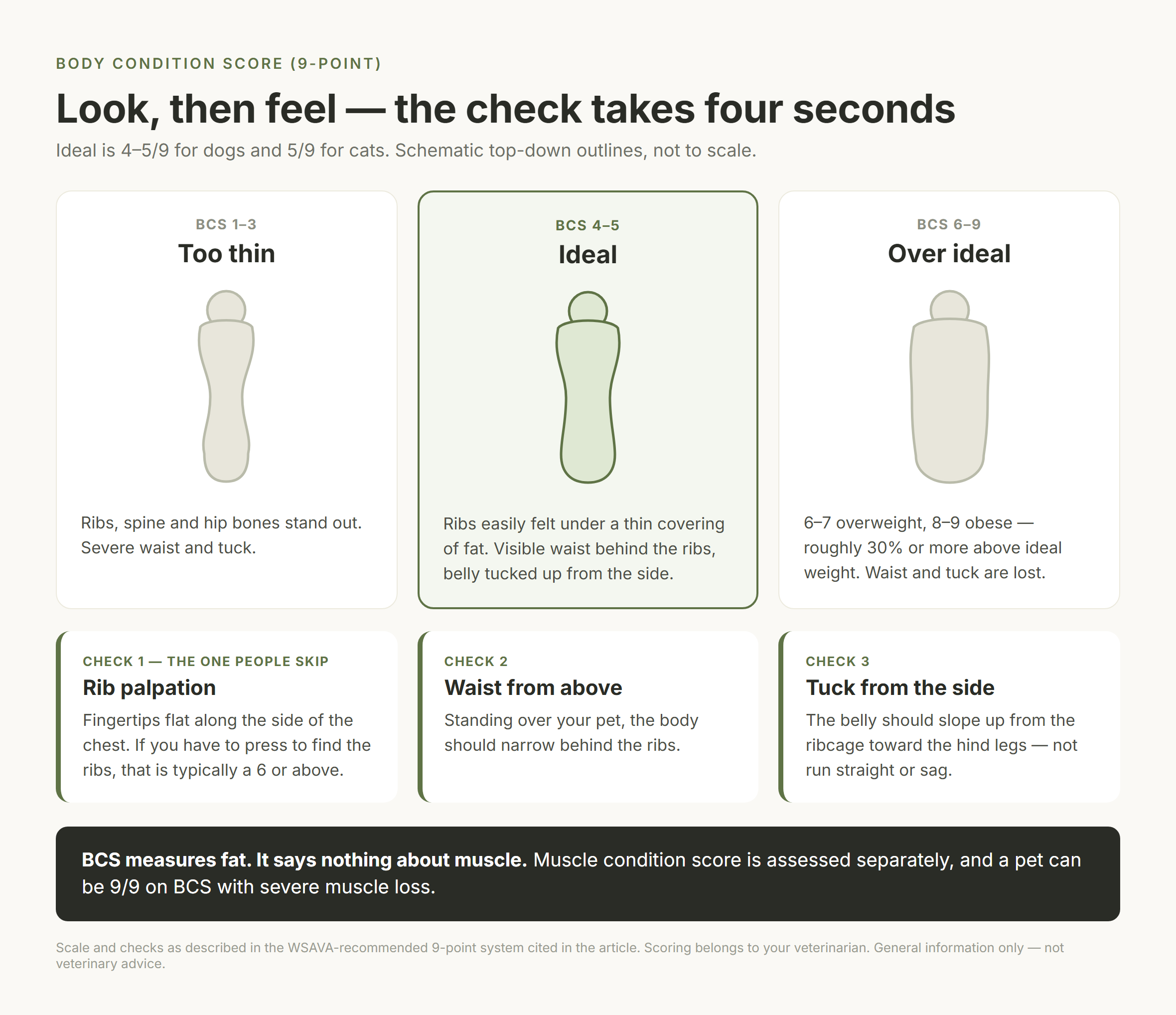
The 9-point body condition score (BCS) is the most validated scale and the one the WSAVA Global Nutrition Committee recommends. 1 is emaciated, 9 is grossly obese. Ideal is 4–5/9 for dogs and 5/9 for cats — with 4/9 being right for lean breeds like Greyhounds. BCS 6–7 is the overweight phenotype; 8–9 is obese, roughly 30% or more above ideal weight.
It is scored from three things, and the first one is the one people skip.
- Rib palpation. Run your fingertips flat along the side of the chest. At ideal condition ribs are easily felt with a thin covering of fat. If you have to press to find them, that is typically a 6 or above.
- Waist from above. Standing over your pet, you should see the body narrow behind the ribs.
- Abdominal tuck from the side. From the side, the belly should slope up from the ribcage toward the hind legs, not run straight or sag.
So is “no waistline from above” a real sign? Yes — losing the waist along with losing the tuck is exactly what the published charts describe at 6 and above. But it is not sufficient on its own. A visual-only read falls apart on a heavily coated dog, on a barrel-chested versus deep-chested build, and on sighthound-type breeds where lean is normal.
You have to put your hands on the animal.
Muscle condition score: the part almost everyone skips
BCS measures fat. It says nothing about muscle.
That distinction matters more than it sounds, because a pet can be 9/9 on BCS and still have severe muscle loss. Muscle condition score (MCS) is assessed separately, in four categories — normal, mild loss, moderate loss, severe loss — by palpating five sites: the temporal region, the shoulder blades, along the spine, the pelvis, and the thigh.
In a weight-loss program, MCS is re-scored at every recheck. That is how a veterinarian tells whether your pet is losing fat or quietly losing muscle. If MCS declines during a diet, the plan is supposed to change — that is a signal, not a detail.
Why “just cut the bag guide by 10%” doesn’t work
The premise behind that advice is actually correct, which is what makes it so persuasive.
Feeding directions on pet food labels do frequently overestimate needs, particularly for neutered adult pets, and one set of guidelines cannot absorb the enormous variation in metabolic rate between individuals (Tufts’ Petfoodology has written on exactly this). A 2025 JAVMA study of cat food labels sold in Ontario found label feeding guidelines diverging from predictive maintenance-energy equations and generally not adjusting for life stage. So yes — plenty of pets gain weight while their owner faithfully “follows the bag.”
The fix is where it goes wrong.
Trimming an already-inflated population average by an arbitrary 10% can be far too little to move an obese pet at all, or, on a very small animal, more restriction than you intended. And restricting a maintenance food cuts vitamins, minerals, and protein in exactly the same proportion as the calories.
What actually happens in a clinic is an energy calculation. As background only — this is how veterinarians work, not a plan for you to run at home: resting energy requirement is estimated as RER = 70 × (body weight in kg)^0.75, with a linear approximation of (30 × kg) + 70 used for patients roughly 2–45 kg. Daily requirement is RER multiplied by a factor — published sets include 1.2 for a neutered adult, 1.4 for an intact adult, and 0.8 for weight loss — and whether that is anchored to current or estimated ideal weight is a clinical judgment.
Two more reasons this belongs with your vet. Portions should be measured by weight on a gram scale, not by cups. And underlying disease has to be excluded first — hypothyroidism in dogs, for example, or hyperadrenocorticism, both of which mean a slower expected rate of loss until the primary problem is treated.

Photo: Ksenia Chernaya / Pexels
The safe rate of loss — and the cat warning that matters most
Roughly speaking:
| Dogs | Cats | |
|---|---|---|
| AAHA guidelines | 1–2% of body weight per week | 0.5–2% per week |
| VCA | 1–2%/wk; morbidly obese closer to 0.5%/wk | 1–2%/wk; morbidly obese closer to 0.5%/wk |
| Feline reviews / general veterinary guidance | 1–2%/wk | 0.5–1% per week |
The sources genuinely disagree on the cat upper bound. AAHA is more permissive at 2%; several feline reviews sit at 1%. Given what is at stake, the conservative framing is the right one: roughly 0.5–2% per week, with cats at the slow end, and the actual target set by your veterinarian. Faster is not better — AAHA’s stated rationale for a moderate rate is that it prevents malnutrition and muscle loss and reduces rebound.
Now the part I would ask you to read twice if you have a cat.

Hepatic lipidosis: why cats cannot crash-diet
Feline hepatic lipidosis is the most common acquired and potentially lethal liver disease in cats. The mechanism is brutally simple: when an overconditioned cat stops eating, fat mobilizes faster than the liver can process it, triglyceride floods the liver cells, and the liver begins to fail.
Obesity is the setup. Not eating is the trigger. The Merck Veterinary Manual explicitly lists “forced weight loss with unacceptable food substitutions” among the triggers, alongside household changes and boarding.
The timeline is short. VCA describes lipidosis developing when a cat stops eating for 3 to 4 consecutive days, and cats typically present after losing more than 25% of body weight. Survival is roughly 75–80% with aggressive treatment versus about 50% with basic supportive care — and recovery usually requires assisted or tube feeding for weeks. Merck also notes that monitoring ALP in an obese cat during weight reduction can catch an emerging case early enough to suspend the diet.
So, plainly:
- Never withhold food from a cat. Not for a day, not “to get her started.”
- Transition foods gradually. An abrupt switch the cat refuses is the classic route into trouble.
- If a cat on a diet stops eating for more than about 24–48 hours, call the veterinarian. Do not wait it out.
- Weigh regularly, and let the vet — not the scale at home — decide when to slow down.
Dogs are not at appreciable risk of this. I mention that deliberately, because the internet tends to flatten cat rules and dog rules into one set, and the cost of getting it backwards runs entirely one direction.

Photo: Maria Luiza Melo / Pexels
Treats: a budget, not a ban
“Cut out all treats” is the advice I hear most, and it is not the veterinary standard.
WSAVA and AAHA, along with the Pet Nutrition Alliance and the UC Davis veterinary teaching hospital’s nutrition service, all land in the same place: treats and extras should stay at or under 10% of daily calories, with at least 90% coming from a complete and balanced food. The reason is nutritional, not moral — a complete diet is only balanced if it supplies the bulk of intake.
The other half of the rule is the half people drop. Treat calories are subtracted from meals, not added on top. The arithmetic is straightforward: a cat on a 200 kcal daily target could take 20 kcal as treats and 180 as meals; a dog on 600 kcal, 60 as treats. (Those are illustrations of the math, not targets for your pet.)

There is also a practical case for the budget over the ban. APOP’s 2025 data show that among owners who attempted weight loss, only 28% of dogs and 19% of cats reached a healthy target weight. A rule owners abandon in week three is not a better rule. I could not find a study quantifying “banning treats hurts compliance,” so I will put it as what it is — a behavioral argument, not a cited statistic.
Things that work inside the budget: set aside part of the measured daily ration to use as training rewards, lean on non-food reinforcement (play, a walk, attention), and use food puzzles to slow intake down. Human foods should be cleared with your vet — many are calorie-dense out of all proportion to their size.
Photo: MART PRODUCTION / Pexels
“Low-fat, high-fiber” is only half remembered
This one surprised me.
The nutrient that matters most in a weight-loss diet is protein, because higher protein spares lean body mass during calorie restriction — the pet loses more of the weight as fat and less as muscle.
A 2025 meta-analysis of hypocaloric diets in obese dogs (20 studies, 397 dogs, protocols of 30–194 days) found that diets with crude protein above 25% dry matter produced greater total and weekly weight loss, greater fat loss, and better lean-mass preservation. And then a finding that runs against the folk wisdom: diets with total dietary fiber below 12% produced greater weight and fat loss than diets above 12%, though the authors also warn that stripping fiber too far risks gastrointestinal problems. So “more fiber is always better” does not hold.
Those are formulation targets for choosing a veterinary diet. They are not a shopping checklist, and I would not use them as one.
The other reason diet selection belongs with your vet: over-the-counter “light” and “weight management” foods are maintenance diets. They are not reformulated for restricted feeding — their nutrient concentrations are not raised to compensate for fewer calories, which can leave gaps in nutrients such as choline and arginine when intake drops. Therapeutic weight-loss diets are fortified precisely so that does not happen, and are lower in caloric density so the bowl still looks like a meal.
What about weight-loss drugs?
Briefly, because the honest answer is short.
Dirlotapide was approved by the FDA on January 5, 2007 as the first drug for canine obesity in the US, and was later withdrawn from the market, with gastrointestinal adverse effects among the cited reasons. Mitratapide, a related compound, was authorized in the EU for dogs. As of now there is no widely marketed FDA-approved weight-loss drug for dogs or cats in the US, and whether dirlotapide should return is an open discussion in the veterinary literature, not an available option.
Interest is clearly there — APOP found 44% of dog owners and 48% of cat owners willing to use one. But no doses, no product recommendations, and no borrowing from human medications belong in an article like this. That conversation is your veterinarian’s.

Photo: Paolo Motti / Pexels
What a real plan looks like
Pulling it together, roughly in order:
- A veterinary exam first — to rule out endocrine and other disease, and to establish baseline weight, BCS and MCS, and an estimated ideal weight.
- A calorie target calculated by the vet, usually from RER with a weight-loss factor, often after a food diary that captures what every member of the household is actually feeding.
- A diet chosen by the veterinarian — typically reduced caloric density, elevated protein, fortified micronutrients.
- Portions measured by weight on a gram scale. Given that only 16% of dog owners and 3% of cat owners currently do this, it may be the highest-yield change on the whole list.
- Treats budgeted at 10% or less, subtracted from meals.
- Activity increased gradually, cleared by the vet. VCA suggests working toward a brisk 30-minute daily walk for dogs, with severely obese dogs needing some weight off before they can tolerate more. And an honest note: exercise alone, short of long distances, is unlikely to produce weight loss without calorie restriction. It protects muscle and quality of life; calorie control does the losing.
- Rechecks — within about a week of starting, again after the food transition, then weighing every one to two weeks until goal, with BCS and MCS re-scored each time.
- Expect the plan to be revised. The first calorie figure is an estimate. Too fast, too slow, or a falling MCS all mean it changes.
- A maintenance phase after goal weight, because regain is a well-documented failure mode.
Photo: Tima Miroshnichenko / Pexels
When to stop reading and call the vet
Some things do not wait for the next scheduled recheck:
- Rapid or unplanned weight loss in a pet you were not dieting
- A cat that has not eaten for more than a day or two — this is the hepatic lipidosis window, and it is the single most urgent item on this page
- Labored or difficult breathing
- Lameness that is getting worse, rather than improving, during a weight-loss program
Related reading: [Internal link: Subtle warning signs of illness in dogs and cats that owners miss]. For clinical background, the AAHA nutrition and weight management guidelines and the Merck Veterinary Manual page on feline hepatic lipidosis are solid external starting points.
If I could hand you one habit out of all of this, it would not be a diet or a schedule.
It would be four seconds with your hands on your pet’s ribs, once a month.
That is the whole trick, really. Not looking down from above and deciding she seems fine — but feeling for the ribs, checking the tuck from the side, and noticing the change while it is still small enough to be easy. The rest of it, the calories and the diet and the pace, is a conversation to have with someone who can weigh her and score her properly.
My dog is a 5 now. It took the better part of a year, and most of that year was just measuring food I used to guess at.
I only wish I had put my hands on her ribs three years earlier.
Veterinary disclaimer: This article is general educational information based on veterinary references and is not a substitute for examination by a licensed veterinarian. Body condition scoring, calorie targets, diet selection, rate of weight loss, and any medication are veterinary decisions specific to your individual pet. Do not start a weight-loss program — especially for a cat — without veterinary guidance, and never withhold food from a cat. No dose, product, or feeding amount in this article should be applied to your own pet without professional advice.
Sources: American Animal Hospital Association (AAHA), WSAVA Global Nutrition Committee, Association for Pet Obesity Prevention (APOP), American College of Veterinary Surgeons (ACVS), Merck Veterinary Manual, Cornell Riney Canine Health Center, VCA Animal Hospitals, Tufts Petfoodology, UC Davis Veterinary Medical Teaching Hospital, Purina Institute, and peer-reviewed veterinary literature including Kealy et al., Salt et al. 2019, Marshall et al. 2010, Brown et al. 2017, and a 2025 meta-analysis of hypocaloric diets in obese dogs.