Beer and Gout: What Alcohol Really Does to Uric Acid
I want to start with a sentence I repeated for years without ever checking it.
“Beer is packed with purines. That’s why it causes gout.”
Most of that sentence is wrong, and the wrong part turns out to matter more than the right part.
So let me give you the honest version of the headline question first. If you already have gout, the beer you drank at nine o’clock genuinely raises the odds that your big toe wakes you at three in the morning. That is measured, not folklore. But if you do not have gout, one night of beer and fried chicken does not create the disease. Gout takes years of high uric acid and crystal buildup before a joint ever hurts.
The beer is a trigger. It is not a manufacturer.
One more thing before we go further. I am not a doctor, and this is general health information rather than medical advice. There is a section near the end about the one situation where a hot, swollen joint is an emergency instead of an inconvenience, and I would rather you read that part than this one.

Photo: Ron Lach / Pexels
The short answer on alcohol, gout, and uric acid
If you read nothing else, here is the compressed version.
- Beer’s problem is mostly the ethanol, not the purines. Alcohol makes your body produce more urate and clears less of it. The purines in beer are the smallest of the three levers.
- Not all alcohol is equal for developing gout — beer is worst, spirits next, wine least. But for triggering a flare when you already have gout, beer, liquor and wine all count.
- “Drink on an empty stomach” is backwards. Fasting raises uric acid on its own, and alcohol taken while fasting raises it more than the same alcohol with food.
- Water is not an antidote. It is reasonable, but the evidence is thin and it is not safe advice for everyone.
- Diet explains far less of your uric acid level than your genes do. This is the part that changes how you should think about the whole subject.
This is not a niche problem, either. In NHANES data from 2015–2016, gout affected 5.2% of US men — about 5.9 million people — and 20.2% of men had hyperuricemia, meaning high uric acid without a diagnosis yet. Mean serum urate in men was 6.0 mg/dL. After decades of increase, the prevalence has been flat across 2007–2016.
Read that second number again. The group with high uric acid and no gout yet is roughly four times the size of the group with gout. That group is who this article is really for.
Why beer raises uric acid, weighted correctly
Uric acid is the end product of purine metabolism. Humans lack the enzyme that would break it down further, so it has to leave through the kidneys and gut. That much of the popular explanation is right.
But three separate things happen when you drink, and the one everybody talks about is the weakest of the three.
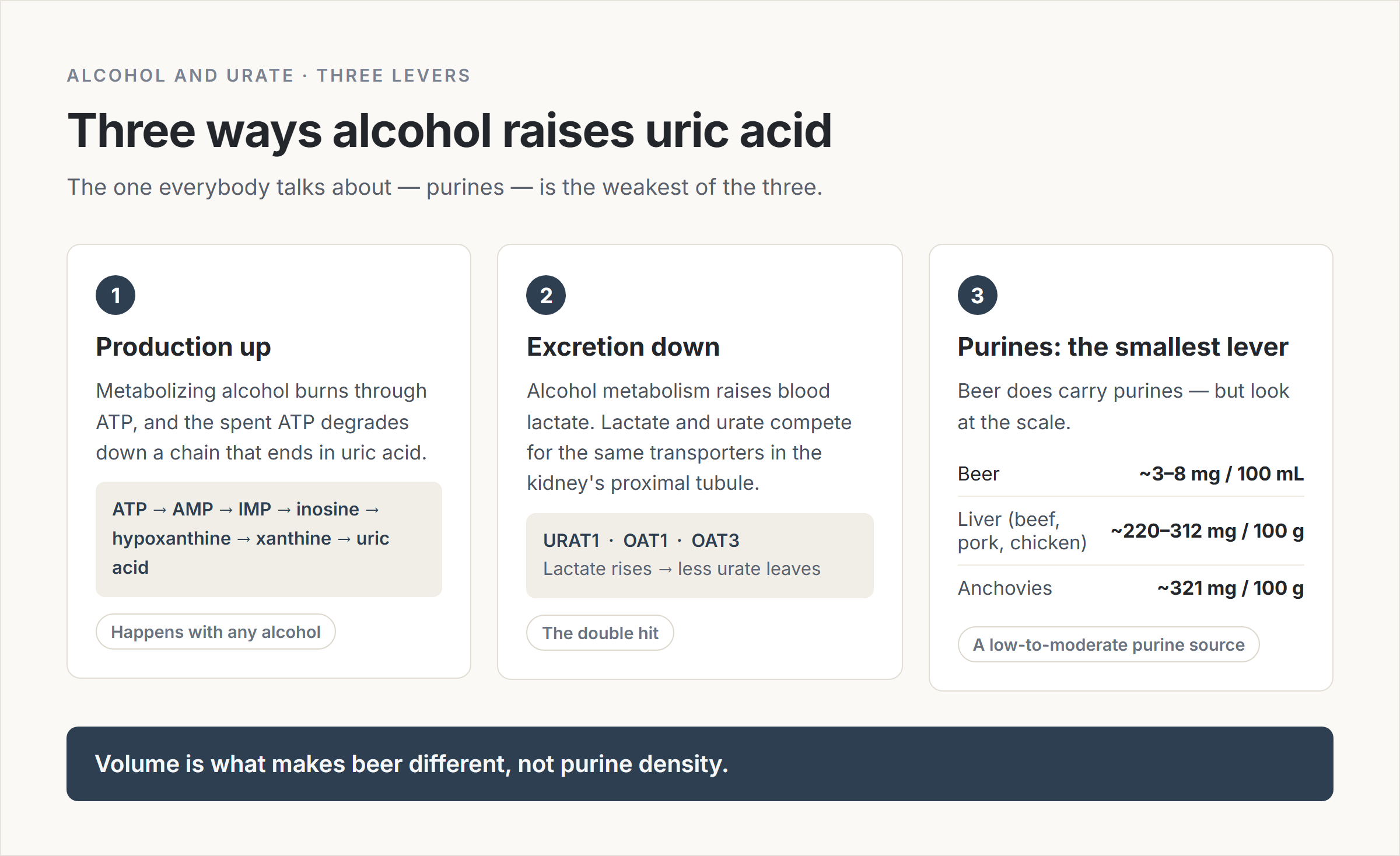
1. Ethanol burns through ATP
Metabolizing alcohol consumes ATP at an accelerated rate. The spent ATP runs down a chain — ATP to AMP to IMP to inosine to hypoxanthine to xanthine — and the last stop on that chain is uric acid.
This raises urate production, it requires no dietary purines at all, and it happens with every kind of alcohol. Vodka does it. Wine does it.
2. Lactate blocks the exit
Alcohol metabolism also raises blood lactate. Lactate and urate compete for the same transporters in the kidney’s proximal tubule — URAT1, OAT1 and OAT3. When lactate rises, less urate gets secreted into the urine.
So excretion falls at the same moment production climbs. That is the double hit, and it is the real reason a heavy night moves your uric acid.
3. The purines, which are the smallest lever
Beer does carry purines. The dominant one is guanosine, which is among the more readily absorbed dietary purines, and darker traditional beers test higher than light lagers.
But look at the scale.
| Item | Approximate purine content |
|---|---|
| Beer | ~3–8 mg per 100 mL |
| Liver (beef, pork, chicken) | ~220–312 mg per 100 g |
| Anchovies | ~321 mg per 100 g |
Beer is somewhere between one hundredth and one tenth as purine-dense as liver or anchovies. Per unit, it is a low-to-moderate purine source, not a high one.
What makes beer different from a shot of vodka is volume. You do not drink 12 ounces of whiskey. Beer delivers ethanol, lactate, purines and calories together, in quantity, over an evening.
So if you want a corrected one-liner: lead with the ethanol, not the purines.
Is all liquor equally bad? Two questions, two answers
This is the point consumer articles get wrong most often, usually by answering one question and printing it as the answer to both.
If you do not have gout yet
Here the beverages are clearly unequal.
The landmark data comes from Choi and colleagues, published in the Lancet in 2004 — 47,150 men with no gout at baseline, followed for 12 years. The multivariate relative risk of developing gout, per daily serving:
| Beverage | Relative risk per serving per day |
|---|---|
| Beer (12 oz) | 1.49 |
| Spirits (one drink) | 1.15 |
| Wine (4 oz) | 1.04 — not significantly associated |
Total intake mattered too: 10.0–14.9 g of alcohol a day carried an RR of 1.32, and 50 g or more a day carried an RR of 2.53.
A 2025 systematic review and meta-analysis in Frontiers in Nutrition pooled 24 studies and 1,173,410 participants and found the same ordering, with the gap narrowed: beer 1.27 (1.07–1.51), spirits 1.19 (1.03–1.39), wine 1.11 (1.00–1.23). Note the wine confidence interval — its lower bound touches 1.00. Any drinking versus none came out at 1.69 (1.47–1.94). The dose-response was linear, with no threshold below which alcohol looked neutral.
If you already have gout
Now the answer flips.
Neogi and colleagues ran an internet-based case-crossover study published in the American Journal of Medicine in 2014, with 724 people who had gout, each acting as their own control. What mattered was alcohol in the previous 24 hours:
| Alcohol in the prior 24 hours | Odds of a recurrent attack |
|---|---|
| 1 drink or less | 1.13 — not significant |
| More than 1 to 2 drinks | 1.36 |
| More than 2 to 4 drinks | 1.51 |
The trend was significant at p < 0.001. And here is the line that matters: wine, beer and liquor were each associated with increased odds of an attack.
Once crystals are already deposited in a joint, the beverage type stops carrying much weight. Total dose over the last 24 hours is what predicts the flare.

Photo: Anna Tarazevich / Pexels
So where does that leave wine?
Less bad. Never safe. It was the weakest of the three for developing gout and not significantly associated at moderate intake in Choi 2004. But it still sits above 1.00 in the 2025 meta-analysis, it appears on the list of items associated with raised serum urate in the diet research below, and it triggers flares in people who already have gout.
If you have gout and someone tells you wine is fine, they are answering the wrong question.
The most harmful advice in the usual list: “drink on an empty stomach”
I have seen this one passed around as a clever workaround. It is exactly backwards, and it is the reason I wanted to write this article.
Maclachlan and Rodnan published the relevant work in the American Journal of Medicine back in 1967, and the findings have held up:
- Fasting by itself raises serum uric acid. Ketone bodies rise during a fast, and they compete with urate for renal excretion.
- Alcohol consumed while fasting produced greater elevations in serum urate than the same alcohol consumed with food, with larger rises in lactate and ketones.
- The authors described fasting and alcohol as additive, even mutually potentiating, on uric acid metabolism.
Food is also what slows alcohol absorption. An empty stomach empties faster, so peak blood alcohol goes higher.
To be fair about the limits: eating does not neutralize alcohol. Larger doses with food still raised lactate, still reduced urinary uric acid output, still produced hyperuricemia. Food does not fix the problem. It just does not make it worse.
The corrected advice is simply the opposite. Do not drink on an empty stomach. Eat, choose the food sensibly, and cut the amount of alcohol — because the amount is the lever, not the presence of food.

What a glass of water can and cannot do
“Sip water constantly to dilute the uric acid” is the other line I want to soften rather than repeat.
What is actually behind it: a cross-sectional conference abstract presented at the ACR annual meeting in 2017, using NHANES 2009–2014 data on 539 adults with gout, which found 58% lower odds of hyperuricemia with high water intake (OR 0.421, p = 0.0007). High intake there meant roughly 3,000 mL a day for men.
Cross-sectional means it cannot establish cause. And there is a second, quieter story: a 2009 case-crossover abstract on water and flares circulated widely, but the investigators declined to publish it in full, because they could not tell whether the benefit came from drinking more water or from drinking less soda and sweetened juice.
Meanwhile, the 2020 American College of Rheumatology guideline contains no hydration recommendation for gout at all. Its lifestyle recommendations are alcohol, purines, high-fructose corn syrup, weight loss, and a recommendation against vitamin C supplementation. Water is not on the list.
What is fair to say: staying adequately hydrated is sensible, dehydration concentrates urate, and urate kidney stones are a real gout complication. What is not fair to say is that water rapidly dilutes uric acid or offsets a night of drinking. Serum urate is a steady-state balance between production and excretion, not a concentration you can flush.
And one safety line that gets left out of every article I have read on this: if you have heart failure, advanced chronic kidney disease, or you take a diuretic, “just drink more water” is not automatically safe advice. Ask your clinician before you increase your fluids.
Photo: cottonbro studio / Pexels
The bar snacks: red meat, organ meat, and the fried chicken question
Red meat — beef, pork, lamb — is genuinely on the list of items associated with raised serum urate, and so is poultry. High-purine seafood such as mussels, scallops, shrimp and anchovies belongs there too. Organ meats are the real outlier, at roughly 220 to 312 mg of purines per 100 g against beer’s 3 to 8 mg per 100 mL.
Now the fried chicken, because I want to be straight about this.
I could not find any direct evidence that frying itself raises uric acid. The cooking method is not the mechanism. What is defensible is this: fried chicken is poultry, which is on the urate-raising list, carrying a heavy calorie load on top. Obesity is a verified gout risk factor, and weight loss is the one lifestyle measure the ACR guideline actually ties to fewer flares.
Right advice. Wrong reason. Worth knowing which is which, because reasons are what let you make your own decisions later.
The sugar nobody mentions
The classic gout advice list never mentions the soda on the same table. It should.
Choi and Curhan followed 46,393 men for 12 years and published the results in the BMJ in 2008, with 755 confirmed new cases of gout. Across increasing fifths of fructose intake, the multivariate relative risk ran 1.00, 1.29, 1.41, 1.84, and 2.02 for the highest fifth (95% CI 1.49–2.75, p for trend < 0.001).
And the detail that proves it is the fructose rather than the sweetness: diet soft drinks were not associated with gout risk.
The mechanism is neat and slightly alarming. Fructose is phosphorylated in the liver by fructokinase, which — unlike the equivalent enzyme for glucose — has no negative feedback. It phosphorylates fructose as fast as it arrives, depleting cellular phosphate and ATP, which activates AMP deaminase and pushes AMP down the same chain that ends in uric acid.
Notice the symmetry. Fructose and ethanol raise urate through the same final pathway. A beer with a sweet chaser stacks that pathway twice. The 2020 ACR guideline conditionally recommends limiting high-fructose corn syrup for exactly this reason.
So how much does diet actually matter? Less than you have been told
This is the section I would keep if I had to delete everything else.
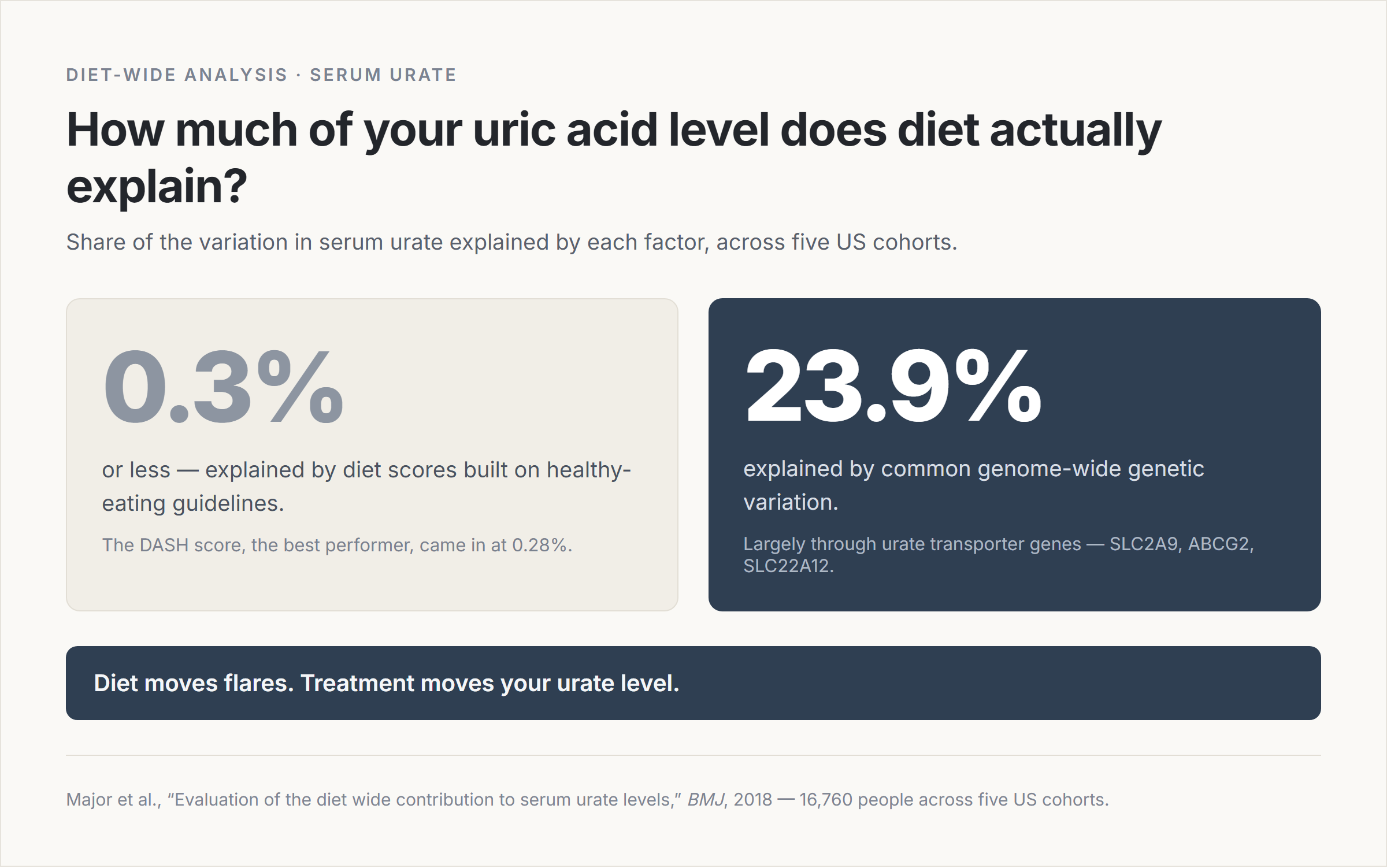
Major and colleagues published a diet-wide analysis in the BMJ in 2018, pooling 16,760 people across five US cohorts. They tested how much of the variation in serum urate diet actually explains.
Diet scores built on healthy-eating guidelines explained 0.3% or less of the variance in serum urate. The DASH score, the best performer, came in at 0.28%.
Common genome-wide genetic variation explained 23.9%.
The authors’ conclusion was blunt: genetic variants contribute far more to hyperuricemia in the general population than dietary exposure does. The genetic contribution runs largely through urate transporter genes — SLC2A9, ABCG2, SLC22A12 — the machinery that decides how much urate your kidneys and gut let go.
The 2020 ACR guideline rates every dietary recommendation it makes — limit alcohol, limit purines, limit high-fructose corn syrup — as conditional, based on low or very low quality evidence. The summary of that guideline in American Family Physician went further, noting that the benefit from dietary changes is limited and “may be outweighed by the risk that patients may feel blamed.”
I want to name the harm plainly, because it is not abstract.
A man reads that gout is a beer-and-meat disease. He concludes he can fix it by drinking less. He declines or postpones urate-lowering therapy — and keeps depositing crystals for years, accumulating tophi, erosive joint damage, and an unmanaged cardiometabolic risk profile alongside it.
Realistic dietary change moves serum urate by a fraction of a mg/dL. The ACR strongly recommends starting urate-lowering therapy for people with one or more tophi, radiographic joint damage, or two or more flares a year, with allopurinol first-line and a treat-to-target strategy aiming below 6 mg/dL, checked with serial blood tests.
So hold both ideas at once. Diet is a real trigger for flares. It is a marginal determinant of your baseline uric acid. Those are different jobs, and only one of them is a substitute for treatment — neither.
If a flare has already started
Generic drug names only here, no doses, and nothing that replaces the plan your clinician wrote for you.
Do:
- Contact your clinician promptly. Flares respond best when treated early.
- Rest and elevate the joint, and keep the bedsheet off it. Cold is a comfort measure only.
- If you already have a written flare plan and a medication for flares, follow that plan — it was written around your kidneys, your heart, and your other prescriptions.
- Keep taking the urate-lowering therapy you are already on. The ACR position is that it should not be interrupted for a flare, and the guideline conditionally recommends even starting it during a flare rather than waiting, provided anti-inflammatory treatment is given alongside.
Do not:
- Do not start allopurinol, or any urate-lowering therapy, on your own during a flare. Starting it properly involves anti-inflammatory prophylaxis for 3 to 6 months, and HLA-B*58:01 testing beforehand for people of Southeast Asian or African American descent. Doing it unsupervised skips both safeguards.
- Do not stop the therapy you are on because a flare began. Stopping and restarting swings your urate level, and swings in either direction are themselves flare triggers. This is the most common self-inflicted mistake in gout.
- Do not treat the pain with whatever is in the cabinet. The options a clinician chooses among — colchicine, NSAIDs, and glucocorticoids — are all rated first-line, and the choice depends on your kidney function, cardiovascular status, diabetes and drug interactions. That is precisely why it is not a self-service decision.
One more conversation worth having. Several common medications raise uric acid: diuretics, low-dose aspirin, high-dose niacin, and cyclosporine. In a population-based case-control study published in Arthritis & Rheumatology in 2014, combined use of a loop plus a thiazide diuretic carried the highest risk of new gout, at an adjusted odds ratio of 4.65. Alternatives exist — losartan is associated with lower gout risk and appears to have uricosuric properties other drugs in its class lack.
That is a question for your next appointment. It is never a reason to stop or switch a prescription on your own. Blood pressure control outranks a uric acid number.
And while you are there: hypertension is present in 69.1% of people with gout versus 30.3% of people without it. A gout diagnosis is a prompt to check blood pressure, kidney function, weight, lipids and glucose — not just to reconsider the beer order.

Photo: cottonbro studio / Pexels
Red flags: when a hot joint is an emergency
This section is not optional, and it is the reason I would rather you skim the rest.
A hot, red, swollen, exquisitely painful joint looks identical in gout and in septic arthritis — a joint infection that can destroy cartilage within days and turn systemic.
- Septic arthritis can occur without fever, and the signs can be subtle in older and immunocompromised people. No fever does not rule it out.
- Blood tests do not settle it. White cell count, ESR and CRP have low likelihood ratios for septic arthritis, and neutrophil-heavy joint fluid shows up in both crystal arthritis and infection.
- Gout and infection can coexist in the same joint. Finding urate crystals does not rule out an infection.
- Having gout is itself a risk factor for septic arthritis, alongside breaks in the skin and immunocompromise.
Seek urgent, same-day medical care if a joint is hot and swollen and you also have fever or chills, feel systemically unwell, cannot bear weight, or the joint was recently injected or has a wound nearby. Do not assume it is “just gout,” even if you have gout.
Two related points worth carrying with you. A gout diagnosis rests on identifying urate crystals in joint fluid, not on a blood number — serum urate can be normal or even low during an acute flare, so a normal result does not exclude gout and a high one does not diagnose it. And untreated recurrent gout progresses to visible tophi and permanent joint damage.
The short version
If I had to compress all of it into a paragraph, it would be this.
The beer at nine and the toe at three are genuinely connected, but the mechanism is the ethanol, not the purines — more urate made, less urate cleared. Beer is worse than spirits, and spirits worse than wine, for developing gout. For triggering a flare when you already have it, all three count and only the amount matters. Eat before you drink, because fasting and alcohol make each other worse. Skip the sweet mixer. Drink water because it is sensible, not because it is an antidote — and ask first if you have heart or kidney disease.
And then the part that outweighs the rest of the list combined: your diet explains a fraction of a percent of your uric acid level, and your genes explain roughly a quarter of it. Which means the beer is worth thinking about, and it is not where the real decision lives.
The real decision is whether you are treating the uric acid or just negotiating with it.
Because the crystals do not care how sincerely you gave up beer. They only respond to the number going down, and staying down.
This article is general health information, not medical advice. It does not replace diagnosis or treatment by a licensed clinician. Do not start, stop, or change any prescription medication based on anything you read here. If you have a hot, swollen joint together with fever or chills, if you feel systemically unwell, or if joint pain keeps getting worse instead of settling, seek urgent medical care the same day.
References
- FitzGerald JF et al. — 2020 American College of Rheumatology Guideline for the Management of Gout, Arthritis Care & Research 2020
- American Family Physician — “Management of Gout: Update from the American College of Rheumatology,” 2021
- Choi HK et al. — “Alcohol intake and risk of incident gout in men: a prospective study,” Lancet 2004
- Neogi T et al. — “Alcohol quantity and type on risk of recurrent gout attacks,” American Journal of Medicine 2014
- Major TJ et al. — “Evaluation of the diet wide contribution to serum urate levels,” BMJ 2018
- Choi HK, Curhan G — “Soft drinks, fructose consumption, and the risk of gout in men,” BMJ 2008
- Chen-Xu M et al. — “Contemporary Prevalence of Gout and Hyperuricemia in the United States: NHANES 2007–2016,” Arthritis & Rheumatology 2019
- “Impact of alcohol consumption on hyperuricemia and gout: a systematic review and meta-analysis,” Frontiers in Nutrition 2025
- Maclachlan MJ, Rodnan GP — “Effects of food, fast and alcohol on serum uric acid and acute attacks of gout,” American Journal of Medicine 1967
- Bruderer S et al. — “Use of Diuretics and Risk of Incident Gout,” Arthritis & Rheumatology 2014
- “Molecular Physiology of Urate Transport,” Physiology 2005
- NIAMS (NIH) — Gout: symptoms, causes and risk factors
- “Septic Arthritis Complicating a Gout Flare: Report of Two Cases and Review of the Literature,” 2022