
Acetaminophen After Drinking: What the Evidence Says
I want to start by admitting which version of this article I decided not to write.
The easy version was right there. Something like: the painkiller you reach for on a hungover morning is quietly wrecking your liver. Taking acetaminophen after drinking is one of those warnings that feels true the second you hear it, and it would have traveled well.
Then I went and read the trials.
The honest version turned out to be more useful than the frightening one — mostly because the frightening one quietly pushes you toward the other painkiller. And that one has its own problem after a night of drinking.
So this is a piece about a fork in the road, not a villain.

Photo: M&W Studios / Pexels
The short answer, before the details
If you only read this far, here is the whole thing.
The concern about acetaminophen and alcohol is real in mechanism, and the FDA requires a liver warning on the label because of it. But controlled human trials — including in the group with the highest theoretical risk — have not found liver injury at label amounts. The documented catastrophes cluster somewhere else entirely: exceeding the label, unknowingly taking two products that both contain acetaminophen, drinking heavily every day, and an empty stomach.
Meanwhile, the obvious substitute is not a free pass. Alcohol plus an NSAID multiplies the risk of upper-gastrointestinal bleeding, which is a well-documented finding rather than a theoretical one.
There is no safe hangover painkiller for me to hand you. There is a label, a pharmacist, and a much less exciting truth about the whole category of hangover cures.
Why acetaminophen and alcohol share a pathway
The mechanism is worth understanding, because it explains both the worry and the limits of the worry.
Most acetaminophen leaves the body through two ordinary routes — sulfation and glucuronidation. A small share goes down a third road, through an enzyme called CYP2E1, and that road produces a reactive metabolite called NAPQI. NAPQI is toxic to liver cells, and the liver normally neutralizes it by binding it to glutathione. Trouble begins only when NAPQI production outruns the glutathione supply.
Alcohol touches both halves of that equation. And here is the nuance most articles get backwards.
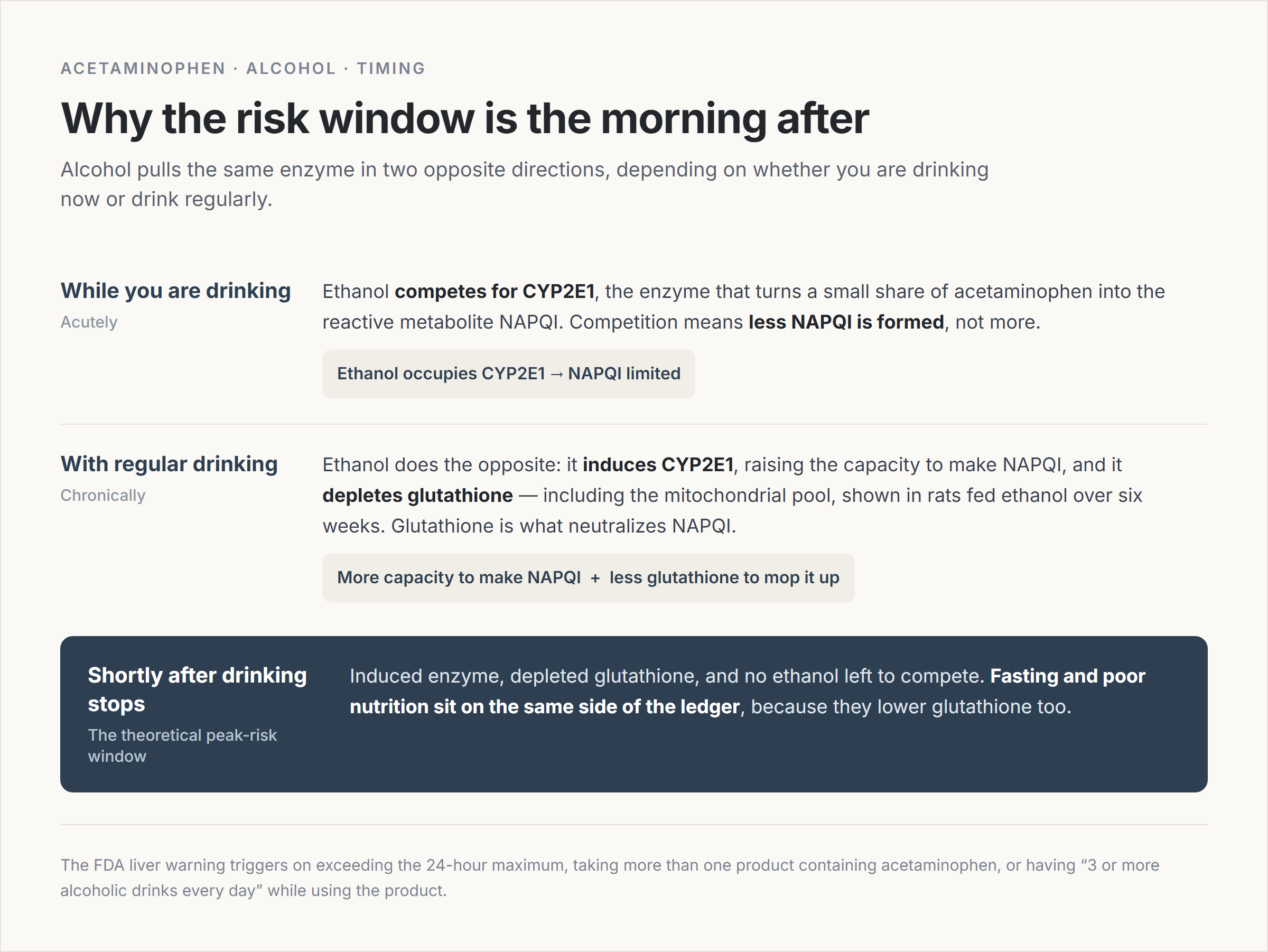
Acutely — while alcohol is still in your system — ethanol competes for the same enzyme and actually limits NAPQI formation. Chronically, ethanol does the opposite: it induces CYP2E1, raising the capacity to make NAPQI, and it depletes glutathione, including the mitochondrial pool specifically, which was shown in rats fed ethanol over six weeks.
Put those together and you get an uncomfortable implication. The theoretically riskiest window is not while you are drunk.
It is shortly after the drinking stops.
Which is, inconveniently, the hungover morning. Fasting and poor nutrition sit on the same side of the ledger, because they also lower glutathione. So the “woke up rough, hasn’t eaten, reaches for a painkiller” scenario is genuinely the plausible-worry scenario. That much I will grant the scary version of this article.
The label warning is narrower than most people quote it
Since 1998 the FDA has required an alcohol caution on over-the-counter acetaminophen labeling, and since the 2009 organ-specific-warnings rule that caution lives inside the Liver warning rather than standing alone.
Read what it actually triggers on. The codified language warns about taking more than the maximum amount in 24 hours, taking it alongside other drugs containing acetaminophen, or having “3 or more alcoholic drinks every day” while using the product.
Every day. That is a description of habitual drinking, not of one rough Saturday.
I think this is where most of the internet’s version goes wrong. The warning gets quoted as “don’t take it if you drank last night,” which is not what it says, and the distortion matters — because it makes people swap to a drug whose alcohol interaction is arguably better documented.
What the human trials actually found
This is the part that changed how I wrote the article.
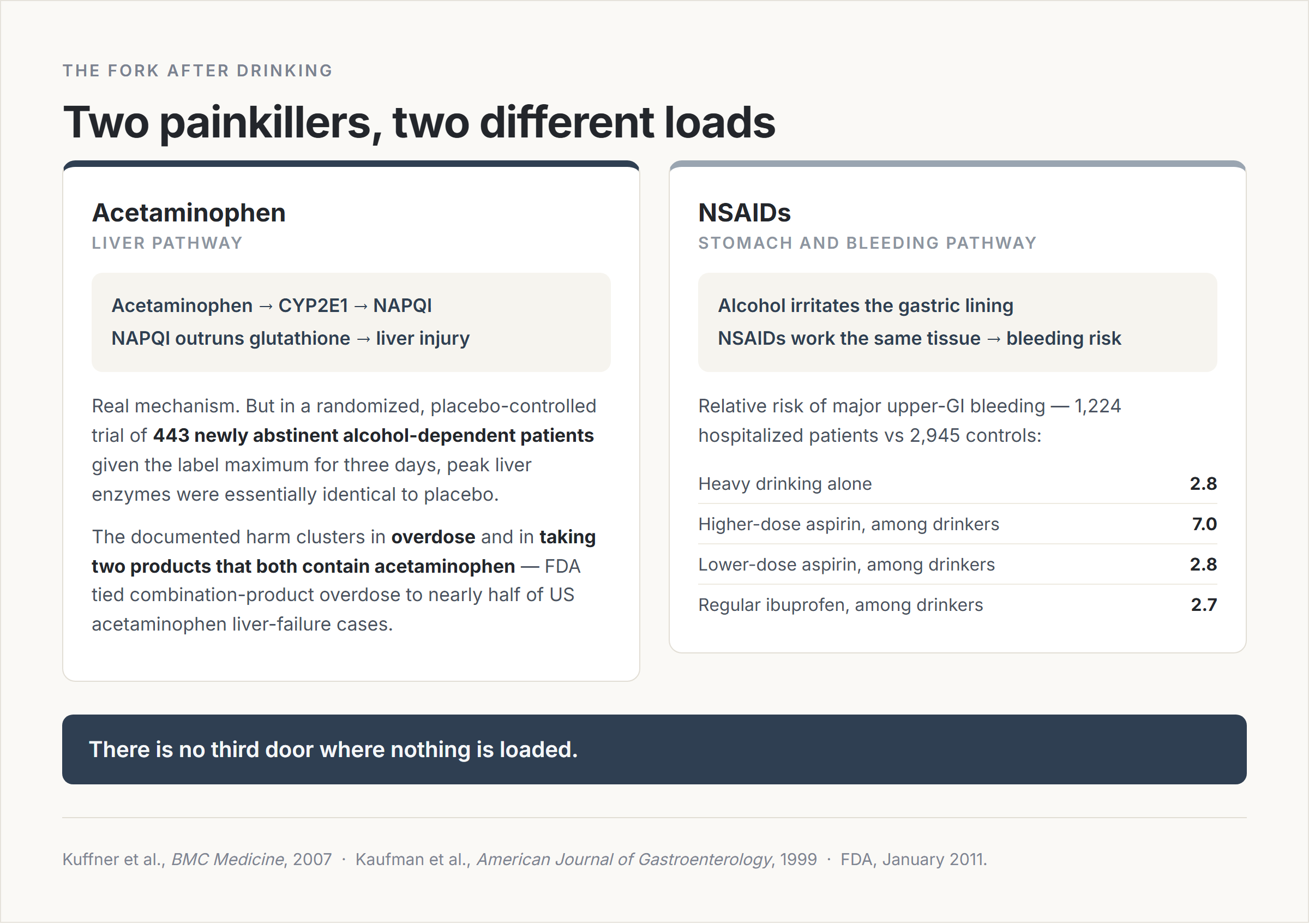
Kuffner and colleagues, BMC Medicine, 2007. A double-blind, randomized, placebo-controlled trial at two alcohol detoxification centers, 443 patients enrolled. The subjects were newly abstinent alcohol-dependent patients — deliberately the worst-case window described above, where CYP2E1 induction is high and glutathione is low. They received the label-maximum daily amount for three consecutive days.
Peak liver enzymes were essentially identical to placebo. No significant differences in AST, bilirubin, or INR either. The authors’ conclusion was that these patients “did not develop increases in serum transaminase or other measures of liver injury.”
NIH’s LiverTox database describes the same tension without resolving it in favor of alarm: chronic alcohol use and glutathione depletion predispose to toxicity, and yet randomized trials have found minimal risk at therapeutic amounts even in people with alcohol dependence.
So the mechanism is real, the label warning is real, and the demonstrated harm at label amounts is — so far — not there.
Where the real harm does cluster
None of that makes acetaminophen harmless. It relocates the danger.
LiverTox anchors serious hepatotoxicity in overdose, most commonly intentional overdose, at amounts far above anything on a label. And the FDA’s own January 2011 action pointed at a different failure entirely: when the agency capped acetaminophen in prescription combination products and required a boxed warning, its stated rationale was that overdose from those combination products accounted for nearly half of all acetaminophen-related liver failure cases in the US. Drinking alcohol while taking acetaminophen products, and taking more than one acetaminophen-containing product, were both cited as contributing factors.
That second one is the practical safety rule, and it is duller than a headline.
Read the active ingredients panel on everything you take. The cold-and-flu combination, the nighttime formula, the leftover prescription painkiller from a dental procedure — several of them contain acetaminophen without the word appearing anywhere on the front of the box. Nobody sets out to double-dose. They just take two different products for two different symptoms.
Photo: Mikhail Nilov / Pexels
“So take an NSAID instead” — the trap in that sentence
Here is where the alarmist version of this article does actual harm.
If you scare someone off acetaminophen, they reach for aspirin or ibuprofen. Alcohol already irritates the gastric lining and increases acid secretion, which is part of why nausea and stomach pain are hangover symptoms in the first place. NSAIDs work on the same tissue from the other direction.
The numbers come from Kaufman and colleagues in the American Journal of Gastroenterology in 1999 — a case-control study of 1,224 patients hospitalized with acute major upper-GI bleeding, compared against 2,945 neighbor controls in the US and Sweden.
| Exposure | Relative risk of major upper-GI bleeding |
|---|---|
| Heavy drinking alone (≥21 drinks/week vs <1) | 2.8 |
| Regular higher-dose aspirin, among drinkers | 7.0 |
| Regular lower-dose aspirin, among drinkers | 2.8 |
| Regular ibuprofen (all doses), among drinkers | 2.7 |
| Occasional ibuprofen, among drinkers | 1.2 (not significant) |
Risk was elevated at all levels of alcohol consumption, including among people taking low-dose aspirin for their heart. The family-medicine summary of the study drew the sensible clinical conclusion: ask about alcohol use in every patient for whom you recommend aspirin or ibuprofen.
So the fork looks like this. Acetaminophen loads the liver pathway. NSAIDs load the stomach and bleeding pathway.
There is no third door where nothing is loaded.
What I can offer instead of a recommendation: read the label and do not exceed it, do not stack products that share an active ingredient, and talk to a pharmacist — genuinely, they will do this in two minutes at the counter — if you drink daily, take other medications, are pregnant, or have any history of liver, kidney, or ulcer problems. I am not going to tell you how long to wait after drinking before taking anything, because I could not find a source that honestly supports a number.
Then what actually helps? Almost nothing, and I mean that
I looked for the good news. It is thin.
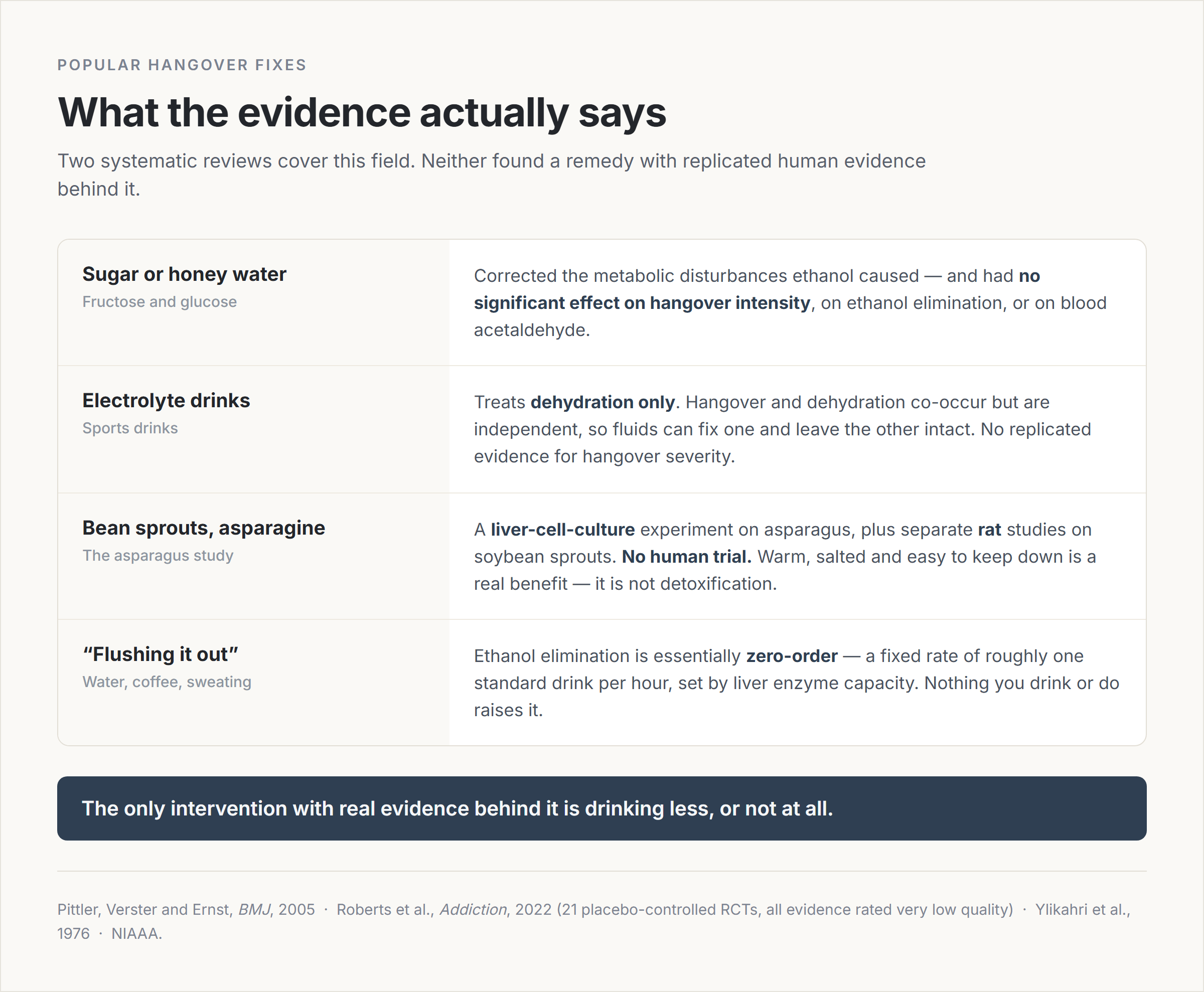
Two systematic reviews frame the entire field. BMJ, 2005 (Pittler, Verster and Ernst) pooled eight randomized controlled trials of everything from propranolol to artichoke to fructose, and concluded in plain language: “No compelling evidence exists to suggest that any conventional or complementary intervention is effective for preventing or treating alcohol hangover.”
Seventeen years later, Addiction, 2022 (Roberts and colleagues) reviewed 21 placebo-controlled RCTs covering more than twenty remedies — clove extract, red ginseng, Korean pear juice, curcumin, probiotics, NAC and others. All of the evidence was rated very low quality. No two studies examined the same remedy, and no result was independently replicated, which made meta-analysis impossible. Worth noting for anyone reading this who is not a man: eight of the 21 studies enrolled men only.
The lead author’s summary was blunt — the surest way to prevent hangover symptoms is to abstain or drink in moderation.
Honey water, and why the biochemistry misleads
The sugar theory has a real basis, which is exactly why it survives.
Metabolizing ethanol floods the liver with NADH, which pushes pyruvate toward lactate and blocks gluconeogenesis. On an empty stomach with depleted glycogen, that can drop blood sugar. Fructose bypasses part of that jam, which is why infused fructose restored hepatic glucose output in classic experiments. The biochemistry is not made up.
But somebody actually tested whether it helps the person.
Ylikahri and colleagues, 1976. Fructose and glucose did correct the metabolic disturbances ethanol had caused. They had no significant effect on the intensity of the hangover, and no effect on the rate of ethanol elimination or on blood acetaldehyde. Fructose and glucose were later among the eight interventions in the BMJ review that found no compelling evidence.
The biochemistry moves. The headache does not.
Which leaves honey water where it belongs: a warm, sweet drink that is easy to keep down when you have not eaten. Eating something is reasonable supportive care. It is not repair, and it is definitely not a liver treatment.
Bean sprouts, asparagine, and a species mix-up
This one deserves tracing, because the trail is short and it does not end where people think.
The claim usually cites a 2009 study in the Journal of Food Science by Kim and colleagues. That study was on Asparagus officinalis — asparagus — and it was a liver-cell-culture experiment. Extracts upregulated alcohol-metabolizing enzymes more than two-fold in cells in a dish. No person in that study had a hangover, because no person in that study drank anything.
The bean-sprout studies are a separate literature, and they are rat studies: soybean-sprout preparations measured for asparagine content and hepatic enzyme activity in chronically alcohol-treated rats.
So the popular claim performs a quiet species swap — asparagus becomes bean sprouts, and cells and rats become you. Neither systematic review found replicated human evidence for any botanical or amino-acid intervention.
Bean-sprout soup is warm, salted, hydrating, and easy to eat when nothing else appeals. That is a real thing worth having. It is not detoxification.
Photo: Calvin / Pexels
Sports drinks, and “flushing it out”
The idea that you can flush alcohol out through urine is the one claim here I would reject outright, because it contradicts the kinetics.
Ethanol elimination is essentially zero-order. The enzyme that clears it is saturated after the first couple of drinks, so the blood alcohol curve falls at a roughly fixed rate rather than in proportion to how much is there. Jones described this in 1984, and NIAAA puts the practical figure at about one standard drink per hour, with blood alcohol concentration declining around 0.015% per hour. That rate is set by your liver’s enzyme capacity.
Water does not raise it. Neither does coffee, a cold shower, exercise, sweating, or urinating more. Only a small fraction of alcohol leaves the body unchanged in urine and breath at all — the overwhelming majority is oxidized by the liver, on the liver’s schedule.
Alcohol does have a diuretic effect, so you will lose fluid. Replacing it treats dehydration, which is a real and separate problem — the Verster group’s 2024 work describes hangover and dehydration as co-occurring but independent, meaning water can fix the dehydration and still leave the hangover intact. Neither systematic review found replicated evidence that electrolyte drinks reduce hangover severity.
Drink fluids because you are dehydrated. Not because anything is being flushed.
And acetaldehyde is not the villain either
One more piece of received wisdom, since it underpins most of the cures above.
The standard story says acetaldehyde — the toxic intermediate of alcohol metabolism — causes the headache and the nausea, so anything that clears it faster ends the hangover. The 2020 review in the Journal of Clinical Medicine by Mackus, Verster and colleagues undercuts that. In Ylikahri’s studies of healthy men, no significant correlations were found between peak blood ethanol, acetaldehyde concentrations, and hangover severity. Acetaldehyde is converted to acetate quickly and frequently falls below the detection limit — it is largely gone by the time a hangover peaks.
There is also a structural reason to doubt it.
Ethanol crosses the blood-brain barrier freely. Acetaldehyde essentially does not — it gets converted to acetate before it can. If your symptoms are substantially neurological, the molecule that reaches your brain is the more plausible suspect.
Current reviews describe hangover as multifactorial: ethanol itself, an inflammatory response, sleep disruption, gastric irritation, and metabolic and blood-sugar disturbance. Even the inflammation piece is unsettled — one 2020 study found hangover severity correlated with IL-6, TNF-α and CRP, while a 2021 study found no cytokine differences between hangover-sensitive and hangover-resistant drinkers at all.
I would rather tell you it is genuinely unresolved than hand you a tidy mechanism that the data does not support.
The liver risk that actually matters
Here is the thing that reframed the whole article for me.
We spend the hungover morning worrying about a pill, and the pill is not the main character. Alcohol-associated liver disease accounts for roughly 50% of cirrhosis in the United States, and deaths from alcohol-associated cirrhosis have been rising among younger people. Nearly everyone who drinks heavily — 90% to 95% — develops fatty liver. From alcohol-associated steatohepatitis, 8% to 20% progress to cirrhosis; from cirrhosis, 3% to 10% progress to liver cancer.
And the early stages are silent. No pain, no symptom, liver enzymes normal or only slightly raised.
That is the part worth sitting with. A hangover is a loud, miserable, completely uninformative signal. The damage that actually matters does not produce one.
The genuinely hopeful counterpart: most people with mild-to-moderate alcohol-associated liver disease recover after stopping, and the single most important determinant of survival in advanced disease is whether the person stops drinking.
What US guidance says now, and why liver specialists objected
This part changed recently, and I am going to report it without picking a side.
The Dietary Guidelines for Americans 2025–2030, released January 7, 2026, no longer specify numeric daily alcohol limits. The previous advice — up to two drinks a day for men, one for women — was removed, for the first time since 1980. The new language advises consuming less alcohol for better overall health and limiting alcoholic beverages, without defining a number. Explicit cancer-risk warnings were removed as well.
Two days later, on January 9, 2026, the American Association for the Study of Liver Diseases published a statement of “deep concern.” AASLD argued the new guidelines do not account for biological differences in alcohol metabolism between men and women, fail to address alcohol’s cancer link, and urged the administration to restore clear, evidence-based recommendations.
For context on the other side of the argument, the Surgeon General’s advisory of January 3, 2025 described alcohol as a leading preventable cause of cancer in the US, attributing nearly 100,000 cancer cases and about 20,000 cancer deaths a year to alcohol, across seven cancers — breast in women, colorectal, esophageal, liver, mouth, throat and larynx. The advisory noted that fewer than half of Americans are aware of the link, and that the risk is not confined to heavy drinking.
I am not going to resolve that disagreement for you, and I do not think I am qualified to. What I can say is that federal guidance currently gives you no number, that hepatologists publicly objected to that, and that the defensible personal framing is simply less is better. For reference, a standard US drink contains 14 grams of pure alcohol.
When it stops being a hangover: emergency signs
This section is not filler, and I want it above the disclaimer rather than buried under it.
Signs of alcohol overdose (alcohol poisoning), per NIAAA:
- Mental confusion, stupor, difficulty staying conscious, or inability to wake the person
- Vomiting
- Seizures
- Slow or irregular breathing — fewer than 8 breaths a minute, or 10 or more seconds between breaths
- Slow heart rate
- Clammy skin, or skin that looks bluish or pale
- Extremely low body temperature
- Dulled responses, such as no gag reflex
Call 911 immediately if you suspect an overdose. Do not wait for all of the symptoms to appear.
And the one I most want people to take away:
Never leave someone to “sleep it off.”
There are two concrete reasons. First, blood alcohol can keep rising after a person stops drinking or loses consciousness, because alcohol still in the stomach and intestine continues entering the bloodstream — a sleeping person can stop breathing later. Second, a suppressed gag reflex means someone who passes out can choke on their own vomit and asphyxiate. If a person is vomiting, help them lean forward, and stay with them. Cold showers, hot coffee, and walking do not reverse an overdose and can make things worse.
Seek urgent care for these too:
- Vomiting blood, or material that looks like coffee grounds
- Black, tarry stools — with the one above, these suggest upper-GI bleeding, exactly the risk that NSAIDs plus alcohol raise
- Yellowing of the skin or eyes (jaundice)
- Severe or persistent abdominal pain, especially in the upper right side
- Abdominal swelling, or new confusion and personality change
If you think someone has taken too much acetaminophen, do not wait to see how they feel. Early signs are delayed and nonspecific — nausea, vomiting, general malaise — while injury develops underneath. Call the Poison Control Center at 1-800-222-1222, or 911.

Photo: RDNE Stock project / Pexels
The honest bottom line
If I compress everything I read into a paragraph, it comes out like this.
The acetaminophen-and-alcohol concern is a real mechanism, printed on a real FDA-mandated warning that triggers on daily drinking — and the human trials, even in the highest-risk group, have not found injury at label amounts. The failures happen when people exceed the label, stack two products that both contain acetaminophen, drink heavily every day, or take it fasting. Switching to an NSAID is not an escape, because alcohol plus NSAIDs multiplies bleeding risk. Nothing you drink or eat speeds up alcohol clearance, no hangover remedy has replicated evidence behind it, and acetaldehyde is not the thing making you feel that way.
The only intervention with real evidence behind it is drinking less, or not at all. Both systematic reviews landed there, which is the least satisfying conclusion in health writing and also the most consistent one.
If one thing survives from this article, let it be the smallest one: turn the box over and read the active ingredients before you take a second product. That is the failure mode with the actual body count attached to it.
And I would keep the larger point somewhere in the back of your mind on the mornings that hurt. The headache is the part you can feel, and it will be gone by evening. The liver never sends a headache.
This article is general information, not medical advice. It does not tell you which pain reliever to take or how much, and it deliberately contains no doses or product names — those belong on the label in front of you and in a conversation with a pharmacist or clinician. Individual risk varies considerably with liver health, kidney health, ulcer history, pregnancy, other medications, and drinking pattern. If you drink daily, take multiple medications, or have any liver, kidney or stomach condition, ask a clinician before taking any over-the-counter pain reliever. If you are worried about your drinking, that is a conversation worth having with a doctor rather than with a search engine.
References
- FDA — 21 CFR 201.326, Organ-Specific Warnings for OTC Internal Analgesic/Antipyretic Drug Products (alcohol warning 1998; folded into “Liver warning” 2009)
- FDA — “FDA Limits Acetaminophen in Prescription Combination Products; Requires Liver Toxicity Warnings,” January 13, 2011
- NIH LiverTox — Acetaminophen monograph
- Kuffner EK, Green JL, Bogdan GM, et al. BMC Medicine. 2007;5:13 — acetaminophen at label maximum for 3 days in newly abstinent alcoholic patients
- Zhao P, Kalhorn TF, Slattery JT. Hepatology. 2002 — selective mitochondrial glutathione depletion by ethanol (rat)
- Kaufman DW, et al. Am J Gastroenterol. 1999;94:3189–96 — upper-GI bleeding with aspirin, ibuprofen and alcohol; AAFP summary, 2000
- Pittler MH, Verster JC, Ernst E. BMJ. 2005;331(7531):1515–8 — systematic review of hangover interventions
- Roberts E, et al. Addiction. 2022 — systematic review of 21 placebo-controlled RCTs
- Ylikahri RH, et al. Eur J Clin Invest. 1976 — fructose and glucose on intoxication and hangover
- Mackus M, Verster JC, et al. J Clin Med. 2020;9(11):3421 — alcohol metabolism and hangover pathology
- van de Loo AJAE, et al. J Clin Med. 2020;9(7):2081; and Healthcare (Basel). 2021;9(4):395 — conflicting inflammation findings
- Merlo A, Verster JC, et al. Alcohol. 2024 — hangover versus dehydration
- Kim B-Y, Cui Z-G, Lee S-R, et al. J Food Sci. 2009 — Asparagus officinalis extracts, liver cell culture
- Korean J Food Preserv. 2024 — soybean sprout mixture in chronically alcohol-treated rats
- Jones AW. Forensic Sci Int. 1984 — rate and kinetic order of ethanol elimination; NIAAA elimination rate
- Mackowiak B, Fu Y, Maccioni L, Gao B. J Clin Invest. 2024;134(3):e176345 — alcohol-associated liver disease
- Dietary Guidelines for Americans 2025–2030 (released January 7, 2026); AASLD statement, January 9, 2026
- US Surgeon General’s Advisory on Alcohol and Cancer Risk, January 3, 2025
- NIAAA — Understanding the Dangers of Alcohol Overdose


