
Chronic Throat Clearing: Why ‘It’s Just Reflux’ Fails
I set out to write a straightforward explainer about laryngopharyngeal reflux, and I ended up writing something closer to a correction.
The version I expected to write goes like this. You clear your throat forty times a day. Your voice is rough in the morning and loosens up by lunch. Stomach acid is creeping up past the top of your esophagus and irritating your larynx, so you take something that turns the acid down, skip the late dinner, and it settles.
That story is coherent, it is widely repeated, and large parts of it do not survive contact with the trial evidence.
Then there is the other thing. The people most likely to search for this — middle-aged men who smoke, whose voices have gone gravelly — are the exact people for whom “it’s just reflux” is the most expensive sentence they can say to themselves.
So I wrote the honest version instead.

Photo: SHVETS production / Pexels
The short answer, before the details
If you read nothing else, read this.
Reflux irritating the larynx is a leading hypothesis, not a confirmed finding in any individual person. There is no diagnostic gold standard for it, and the two scoring tools used to make the call flag a large share of perfectly healthy people.
The largest and best-powered placebo-controlled trial of acid-suppressing medication for persistent throat symptoms found no benefit over placebo. An earlier US multicenter trial found the same. US guidelines have already moved accordingly.
And the part that matters most: hoarseness that lasts more than three to four weeks needs a look at the larynx — sooner if you smoke. Early laryngeal cancer frequently announces itself with a rough voice and nothing else at all.
None of that is a reason to panic. It is a reason to stop self-explaining and get looked at.
What laryngopharyngeal reflux is, and what nobody can confirm
The mechanism story is easy to tell. Gastric contents travel up the esophagus, past the upper esophageal sphincter, into the larynx and pharynx. The tissue there lacks the esophagus’s defenses, so it gets injured — producing throat clearing, hoarseness, cough, and the feeling of a lump.
That is the description carried across the review literature, and it is a reasonable hypothesis. The problem is the leap from “this happens in some people” to “this is what is happening in your throat.”
Reviews state it plainly: there is no diagnostic gold standard for laryngopharyngeal reflux, which leads to both over- and under-diagnosis. The dual pH probe, once treated as the definitive test for pharyngeal acid events, failed to predict who would respond to treatment. And reviews warn directly that overvaluing nonspecific signs is responsible for overdiagnosis, exposing patients to “unnecessary and prolonged” acid-suppressing treatment.
You can see the instability in the prevalence numbers. Published estimates run from 18.8% in one general population up to “20–40% of adults,” with the condition credited for 10–30% of general ENT outpatient visits. That spread reflects differing diagnostic criteria, not differing biology.
The two tests behind the diagnosis, and how weak they are
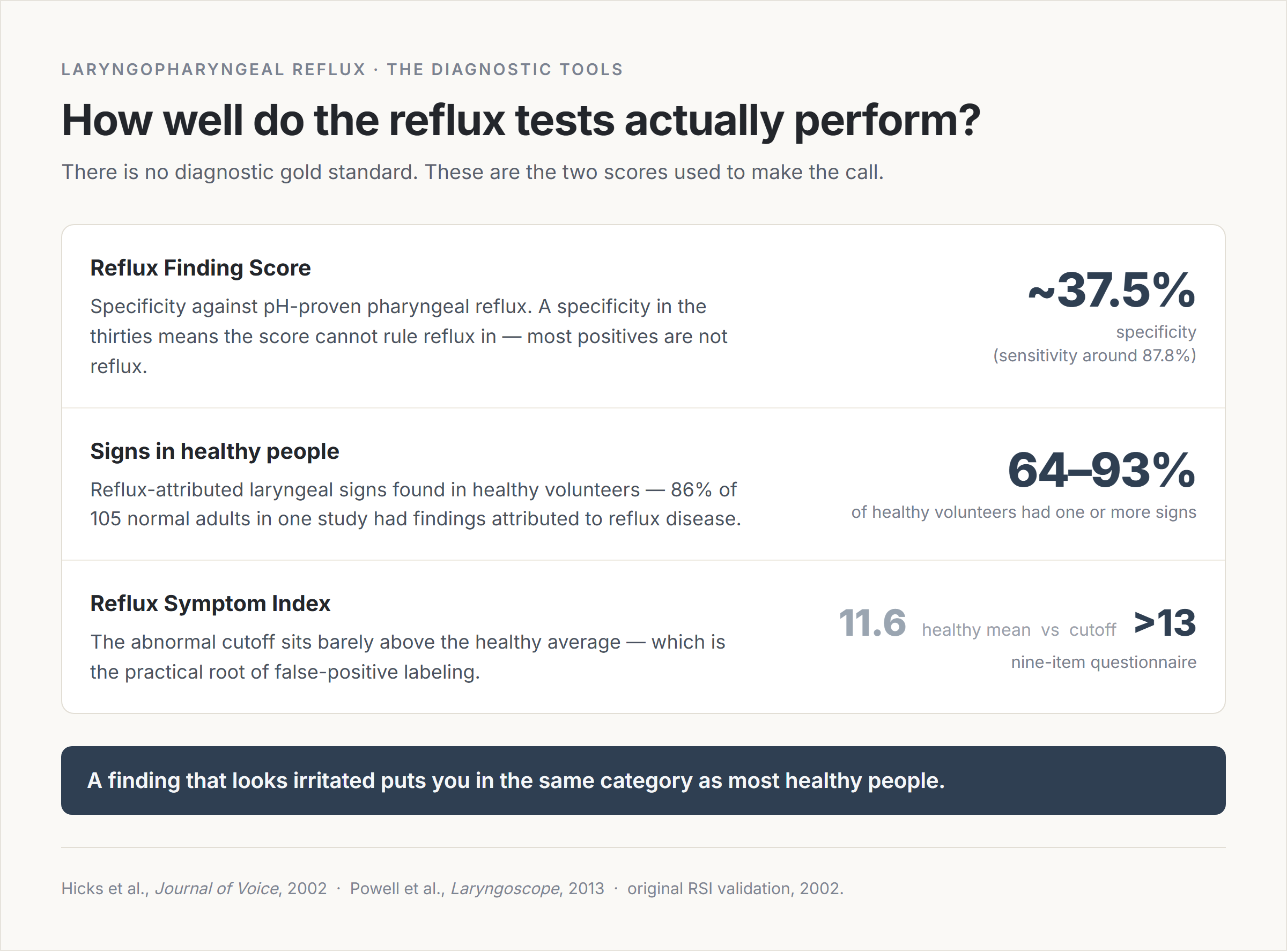
The Reflux Symptom Index (RSI) is a nine-item questionnaire. A score above 13 is treated as abnormal. In the original 2002 validation, patients averaged 21.2 before treatment — against 11.6 in asymptomatic controls.
Sit with those two numbers. The healthy average is 11.6, and the abnormal line is drawn at 13. There is almost no daylight between them, which is the practical root of false-positive labeling.
The Reflux Finding Score (RFS) grades eight visible laryngeal signs. Against pH-proven pharyngeal reflux, its reported sensitivity is around 87.8% — and its specificity around 37.5%.
A specificity in the thirties means the score cannot rule reflux in. Most positives are not reflux.
The finding that convinced me
Here is the study I keep coming back to.
Hicks and colleagues (J Voice, 2002) examined 105 normal, healthy adult volunteers with video fiberoptic endoscopy. Eighty-six percent had findings attributed to reflux disease. Some individual signs showed up in roughly 70% of them.
Powell and colleagues (Laryngoscope, 2013) found one or more reflux-associated mucosal signs in 64–93% of healthy volunteers — though only 3% had more than five signs at once. Other work found that the scope itself, rigid versus flexible, changes how often “reflux signs” appear.
So if you were scoped tomorrow and something looked irritated, that finding on its own would put you in the same category as most healthy people. Smoking, voice use, allergy, and infection all produce the identical picture. For a smoker, the cigarettes alone are a sufficient explanation for the appearance.
Why acid suppression has a ceiling: pepsin
Before the trials, it helps to know why they came out the way they did. The reason has a name.
Pepsin — the stomach’s protein-digesting enzyme — is regarded by many researchers as the most damaging component of what refluxes into the larynx. And it does not need acid to do harm.
Pepsin damages hypopharyngeal epithelial cells in non-acidic refluxate. At weakly acidic pH it cleaves E-cadherin, breaking down the junctions that hold the epithelial barrier together. More awkwardly for the standard treatment: pepsin is taken into laryngeal cells by receptor-mediated endocytosis and can be reactivated inside lower-pH compartments within the cell.
Reviews report that the majority of the reflux episodes associated with these throat symptoms are weakly acidic or non-acidic to begin with.
Put it together. A drug that suppresses gastric acid secretion does not remove pepsin from the refluxate, and it cannot reach pepsin that is already inside a cell.
That is a ceiling built into the mechanism. The trials found exactly that ceiling.

Photo: Ksenia Chernaya / Pexels
The trial that reversed the story
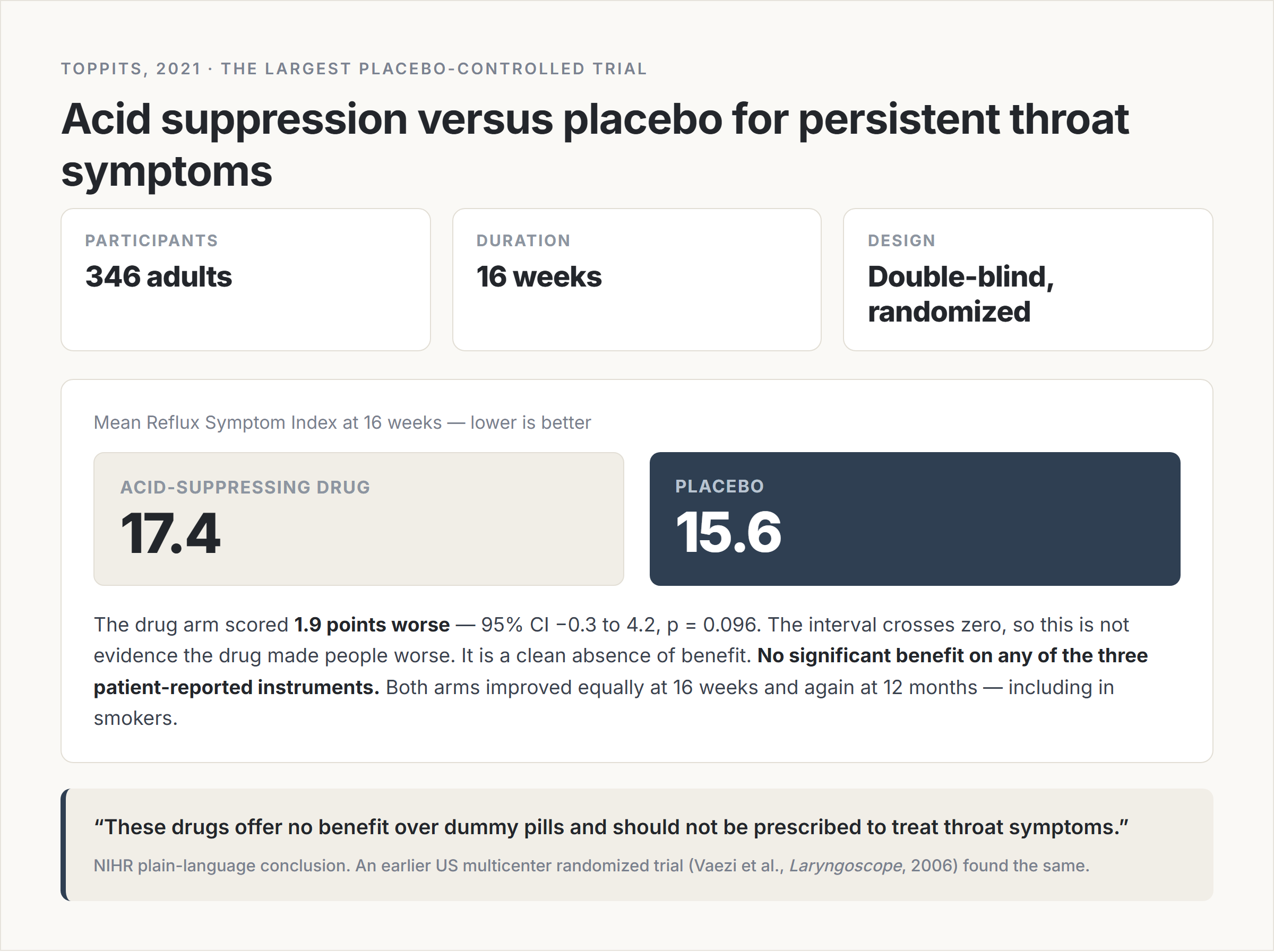
TOPPITS — Trial Of Proton Pump Inhibitors In Throat Symptoms — is the largest and most decisive study in this area. Multicenter, double-blind, randomized, placebo-controlled, run across eight UK NHS sites and published in the BMJ and in full as an NIHR Health Technology Assessment in 2021.
346 adults with persistent throat symptoms were randomized to a proton pump inhibitor or matched placebo for 16 weeks.
The result was not a small benefit. It was not a benefit at all.
Mean RSI at 16 weeks came in at 17.4 on the drug versus 15.6 on placebo — the medication arm scored 1.9 points worse, with a 95% confidence interval of −0.3 to 4.2 and an adjusted p of 0.096. That interval crosses zero, so this is not evidence that the drug made people worse. It is a clean absence of benefit with the point estimate sitting on the wrong side of the line.
There was no significant benefit on any of the three patient-reported instruments used. Symptoms improved in both arms at 16 weeks and again at 12 months, which is what a large natural-history and placebo effect looks like.
And the subgroup detail that matters for this article: improvement was equivalent regardless of baseline severity, age, sex, alcohol use, weight — and smoking status. Smokers did not respond differently.
NIHR’s plain-language conclusion was that these drugs “offer no benefit over dummy pills” and “should not be prescribed to treat throat symptoms.”
This was not a first attempt. Vaezi and colleagues (Laryngoscope, 2006) ran a prospective multicenter randomized trial of a proton pump inhibitor twice daily versus placebo for 16 weeks in patients with chronic posterior laryngitis — symptoms plus laryngoscopic signs. They found no evidence the drug beat placebo.
The meta-analyses genuinely disagree
I want to be careful here, because this is a real conflict in the literature and I am not going to flatten it.
A 2022 pooled analysis of 14 randomized trials and 815 patients found symptom scores favoring the drug (mean difference 3.35, 95% CI 1.34–5.37) — but overall efficacy came out at odds ratio 1.62, 95% CI 0.89–2.95, which is not significant. There was no significant effect on objective laryngeal findings, and no significant relief for cough or hoarseness specifically. The authors explicitly flagged a “strong placebo effect.”
An earlier pooling of 14 trials and 771 participants found a response-rate advantage that barely cleared zero — risk difference 0.15, 95% CI 0.01–0.30 — and again no advantage on laryngeal findings.
A 2022 editorial by two researchers in the field summarized the situation bluntly: multiple systematic reviews reach “completely opposite conclusions.”
So the honest statement is layered. The largest and most rigorous randomized trials found nothing. The pooled analyses argue with each other, and where they find an effect it is small, absent on objective findings, absent for cough and hoarseness specifically, and sitting next to a large placebo response.
That is not a settled “reflux medicine works” story. It is a field that has not converged.
What US guidelines actually say now
This is where I was most surprised, because the guidance moved years ago and the public conversation did not follow.
The AAO-HNS 2018 dysphonia guideline recommends against prescribing antireflux medication for isolated hoarseness based on symptoms alone, without visualization of the larynx. The stated basis was randomized trials with limitations plus observational data showing a preponderance of harm over benefit. The guideline’s own quality-improvement goal was to limit widespread empiric antireflux use in people without reflux symptoms or laryngeal findings.
The AGA’s 2023 update on extraesophageal reflux says an empiric trial of acid suppression can be considered when typical reflux symptoms coexist. With throat symptoms alone, testing should be considered first. Their line is worth quoting: a medication trial “has clinical value but is insufficient on its own to diagnose or manage extraesophageal reflux.”
I am not telling you to stop anything. If you are taking an acid-suppressing medication, that is a conversation with the clinician who prescribed it, not a decision to make after reading a blog post. The accurate frame is simply that the benefit for throat symptoms alone is unproven, no medicine is free, and taking one indefinitely for an unproven indication is a poor trade worth revisiting with a doctor.
The section I would not skip
Everything above is a debate about a nuisance symptom. This part is not a debate.
Hoarseness that persists needs the larynx looked at. The AAO-HNS threshold is four weeks — shortened in the 2018 update from a previous window of up to 90 days. Many patient-facing bodies use three weeks. Both numbers are in circulation, so the safe reading is more than three to four weeks, and do not wait out the full four if you smoke.
The guideline lists factors that should expedite that evaluation: tobacco use history, a neck mass, respiratory distress or stridor, recent head, neck or chest surgery, recent intubation, and professional voice use.
The numbers, for men specifically
Laryngeal cancer is not common. It is also not evenly distributed.
| Measure | Figure |
|---|---|
| Estimated new US cases, 2026 | 12,290 (about 9,730 men, 2,560 women) |
| Estimated US deaths, 2026 | 3,960 (about 3,180 men, 780 women) |
| Incidence in men vs women | 4.3 vs 0.9 per 100,000 (SEER, 2019–2023) |
| Median age at diagnosis | 67 years |
| 5-year relative survival | 62.5% (2016–2022) |
| Trend | New-case rates falling about 2.5% a year (2014–2023) |
One footnote on that survival figure: a 61.5% number also circulates in summaries of the same database. The current published figure is 62.5% for 2016–2022, and I am flagging the discrepancy rather than quietly picking the nicer one.
Then there is the exposure math, which is the part most people underestimate. According to the American Cancer Society, people who both smoke and drink heavily have roughly 30 times the risk of those who do neither — and the two multiply rather than add. Case-control work put current smokers at an odds ratio of 19.8 against never-smokers, with heavy combined alcohol and tobacco exposure reaching an odds ratio of about 177. A 2024 meta-analysis put the interaction of heavy drinking and heavy smoking at a relative risk of 38.75.
These cancers are about five times more common in men, tracking historical smoking and drinking patterns.
On reflux itself as a cause: the ACS notes it is thought to raise the risk of hypopharyngeal cancer, but that more study is needed. That is genuinely uncertain, and I am not going to present it as established.
The trap, named plainly
Here is the specific failure this article exists to prevent.
Early glottic cancer very often presents with hoarseness as the only symptom. No pain. No lump. No bleeding. Just a voice that has changed and stayed changed.
Now picture a man who smokes, whose voice is rough every morning, who has read that this is reflux. He has an explanation that sounds medical, feels reassuring, and predicts exactly the symptom he has. So he adjusts his dinner time, buys something at the pharmacy, and waits.
The reassuring explanation and the dangerous one look identical from the outside. That is the whole problem. Only looking at the larynx tells them apart.
The context that makes this worse: lifetime prevalence of voice problems in US adults runs near 30%, about one in thirteen adults has one in a given year — and only around 10% seek treatment. Not going is already the default behavior. A plausible self-diagnosis just makes the default feel justified.
What else causes chronic throat clearing
Reflux is one item on a long list, and several entries on that list are more common.
- Upper airway cough syndrome (formerly postnasal drip) — with asthma and reflux, it accounts for over 90% of chronic cough in immunocompetent nonsmokers who are not on ACE inhibitors.
- Allergic rhinitis and chronic sinusitis, the usual drivers behind it.
- Asthma, including cough-variant asthma and nonasthmatic eosinophilic bronchitis.
- ACE-inhibitor cough — a class effect of a very common blood-pressure medication, with reported incidence of 5–35%. Onset ranges from hours after the first dose to months later, and it usually resolves 1–4 weeks after stopping, occasionally taking up to three months. ⚠ Never stop a blood-pressure medication on your own. Ask the prescriber.
- Voice overuse, muscle tension dysphonia, phonotrauma — nodules, cysts, polyps.
- Laryngitis — acute laryngitis accounts for about 42% of dysphonia cases in one breakdown, chronic laryngitis about 10%. Most acute laryngitis is viral, which is why antibiotics are not the answer.
- Globus — the lump-in-the-throat sensation, experienced by up to 45% of people at some point, and about 4% of ENT referrals.
- Obstructive sleep apnea — a 2023 meta-analysis supports an association with laryngopharyngeal reflux, with severe apnea showing more nocturnal reflux. Relevant if you are middle-aged, snoring, and waking up with a throat.
- Thyroid disease, other medications, neurologic and rheumatologic conditions.
- Malignancy — squamous cell carcinoma accounts for 85–95% of vocal fold cancers.
No symptom pattern separates these from one another. That is not a rhetorical flourish; it is why the workup exists.
Smoking does two things to your throat, not one
The reflux mechanism is real here. Smoking lowers lower-esophageal-sphincter pressure — later work quantifies the drop at 19–42%, following the original 1971 demonstration in the NEJM. It also impairs acid clearance by reducing salivary bicarbonate, which is a second and independent mechanism most summaries leave out. Alcohol is reported to contribute as well, though the sphincter mechanism for alcohol is less firmly quantified in the sources I could verify.
But the more honest explanation for a smoker’s voice bypasses reflux entirely.
Reinke’s edema — polypoid degeneration, sometimes called smoker’s polyps — comes from chronic irritation increasing capillary permeability, swelling the superficial layer of the vocal fold. About 97% of patients diagnosed with it are habitual smokers. The added mass makes the folds vibrate at a lower frequency, which produces exactly the deep, rough, gravelly voice and the loss of pitch control.
It is benign. It is also not fully reversible — one J Voice study found vocal changes were not entirely undone even after microsurgery and quitting.
And it is still a reason to be scoped, because it occurs in precisely the population at risk for laryngeal cancer, and voice alone cannot distinguish the two.
Does quitting help the reflux side? The evidence says yes, with a limit. A population study linked cessation to improved reflux, and one 2016 analysis reported that 43.9% of former smokers described relief of reflux symptoms, versus 18.2% of current smokers. But that evidence is about reflux symptoms, not throat clearing specifically — and TOPPITS found throat-symptom improvement was similar regardless of smoking status. Quit for the larynx, the lungs, and the cancer math. I am not going to promise it will stop the throat clearing.
One more thing worth flagging: “worse in the morning” is a common description of these symptoms, not proof of reflux. Some data actually describes the reflux pattern here as upright and daytime-predominant. And in a smoker, overnight mucus and airway irritation explain a rough morning voice without invoking reflux at all.

Photo: Gabriela Pons / Pexels
The lifestyle advice, re-sorted by evidence
Some of the standard list holds up well. Some of it has quietly been abandoned by the guidelines while continuing to circulate online.
What the ACG’s 2022 guideline supports:
- Weight loss if you are overweight or obese. This is the strongest lifestyle recommendation and the one most often left off the popular list.
- No meals within 2–3 hours of lying down. This is among the most consistently supported measures. Frame it as a two-to-three hour gap rather than an absolute ban on eating at night.
- Head-of-bed elevation — recommended for people specifically troubled when recumbent, not as a universal instruction.
- Tobacco cessation.
- Individualized trigger avoidance — identify and restrict only the items that reliably set off your symptoms.
What has moved: the blanket elimination list. Guidelines have shifted away from telling everyone to cut carbonated drinks, coffee, chocolate, citrus, tomato, spice and mint. “Cut out all fizzy drinks” is defensible if fizzy drinks reliably provoke your symptoms. There is no guideline basis for banning them from everybody.
The water advice, split into two claims
I looked hard at this one, because the usual phrasing bundles two very different things.
Hydration for the voice: some support, honestly limited. A 2017 systematic review in J Voice found water ingestion produced significant improvements in acoustic measures — shimmer, jitter, frequency, maximum phonation time — and that fasting without fluids made several of them worse. But two literature reviews and a meta-analysis concluded that hydration and vocal function are likely associated while the evidence remains limited, inconsistent and transient. Keep the habit. Do not oversell it.
Water “rinsing” reflux off your larynx: no support at all. I could not verify a single source for it, and the pepsin research points the other way — pepsin is taken inside epithelial cells, where surface rinsing is irrelevant. The “lukewarm” detail has no evidence behind it either. Temperature is not doing anything here.
What water is actually for
The supported version is better than the myth anyway.
Throat clearing is classified as phonotrauma — trauma to the vocal folds from vocal behavior, in the same family as yelling. And it feeds itself. Tissue trauma interferes with normal vocal fold closure and vibration, which prompts compensatory effort to keep phonating, which produces more trauma. In everyday terms: clearing irritates, irritation swells, swelling feels like something stuck, and the stuck feeling makes you clear again.
Voice therapy breaks that loop by teaching a substitute behavior — a silent cough, or a sip of water — in place of the clear.
That is what the glass of water is genuinely for. Not rinsing. Replacing.
And it is the one intervention here that works regardless of whether the reflux diagnosis was ever correct, which is exactly why I would start there.

Photo: Nathan J Hilton / Pexels
See a doctor — and when to go now
This belongs in the article body, not buried in a footer.
Book an evaluation if hoarseness or a voice change lasts more than 3–4 weeks. If you smoke or drink heavily, go sooner — do not wait out the four weeks.
Seek care promptly, at any duration, for any of these:
- Difficulty swallowing (dysphagia)
- Painful swallowing, or a persistent sore throat — especially one-sided
- A lump or mass in the neck
- One-sided ear pain with no ear infection
- Coughing up blood
- Unintentional weight loss
- Noisy or difficult breathing (stridor)
- A sudden change in your voice
The definitive step is visualization of the larynx by an ENT specialist. Nothing you read here substitutes for it, and there is no home test that stands in for it.

Photo: Pavel Danilyuk / Pexels
What I would take away from this
If I compress all of it into one paragraph, it comes out like this.
Reflux may well be irritating your larynx, but no one can confirm that in you, the tools used to claim it flag most healthy people, and the largest placebo-controlled trial found the standard medication no better than a dummy pill — with the pooled analyses openly contradicting each other and pointing at a strong placebo effect. The advice that survives is unglamorous: lose weight if you need to, leave two to three hours between eating and lying down, raise the head of the bed if nights are the problem, cut only the triggers that are actually yours, stop smoking, and replace the throat clear with a sip of water instead of another clear.
And keep the deadline somewhere you can see it.
A rough voice is the cheapest symptom in medicine to explain away, because there is always a reason available — the cigarettes, the late dinner, the dry air, the meeting you talked through. Every one of those explanations is more comfortable than the appointment.
The trouble is that the reassuring explanation and the one that needs finding early produce the same rough voice on the same ordinary morning. Three or four weeks is not a long time to give it. And nobody has ever regretted the scope that came back clean, because that is the appointment you get to forget about afterward.
This article is general information, not medical advice. It cannot diagnose you, and it deliberately contains no medication names, no brands, and no doses. The same throat symptoms are produced by at least a dozen different conditions, including cancer, and no symptom pattern reliably separates them — which is why self-diagnosis is the specific thing this article argues against. Do not start, stop, or change any medication on your own, including over-the-counter acid reducers and any prescribed blood-pressure medicine you suspect is causing a cough; those decisions belong with the prescriber. If hoarseness has lasted more than three to four weeks — sooner if you smoke or drink heavily — or if you have trouble swallowing, painful swallowing, a neck lump, one-sided ear pain, coughing up blood, unexplained weight loss, noisy breathing, or a sudden voice change, see a clinician now. The definitive assessment is visualization of the larynx by an ENT specialist.
References
- Stachler RJ, et al. Clinical Practice Guideline: Hoarseness (Dysphonia) (Update). Otolaryngol Head Neck Surg, 2018 (AAO-HNS) — four-week laryngoscopy rule; recommendation against antireflux medication for isolated dysphonia without laryngeal visualization
- Chen JW, Vela MF, Peterson KA, Carlson DA. AGA Clinical Practice Update on the Diagnosis and Management of Extraesophageal GERD. Clin Gastroenterol Hepatol, 2023
- Katz PO, et al. ACG Clinical Guideline for the Diagnosis and Management of Gastroesophageal Reflux Disease. Am J Gastroenterol, 2022 — lifestyle measures, individualized trigger avoidance
- Wilson JA, et al. Trial Of Proton Pump Inhibitors In Throat Symptoms (TOPPITS): a randomised controlled trial. Health Technol Assess 2021;25(3); also BMJ 2021. NIHR Evidence plain-language alert
- Vaezi MF, et al. Treatment of chronic posterior laryngitis with a proton pump inhibitor: a randomized placebo-controlled trial. Laryngoscope, 2006
- Meta-analysis of Proton Pump Inhibitors in the Treatment of Pharyngeal Reflux Disease (14 RCTs, 815 patients), 2022
- Liu C, et al. Proton Pump Inhibitor Therapy for Laryngopharyngeal Reflux: A Meta-Analysis of RCTs (14 RCTs, 771 participants)
- Karkos PD, Lechien JR. Laryngopharyngeal Reflux: The Last Decade (editorial). J Clin Med, 2022
- Diagnosis of Laryngopharyngeal Reflux: Past, Present, and Future — A Mini-Review. Diagnostics, 2023
- Belafsky PC, et al. Validity and Reliability of the Reflux Symptom Index. J Voice, 2002
- Hicks DM, et al. The prevalence of hypopharynx findings associated with gastroesophageal reflux in normal volunteers. J Voice, 2002
- Powell J, et al. Mucosal changes in laryngopharyngeal reflux — prevalence, sensitivity, specificity and assessment. Laryngoscope, 2013
- Pepsin, Mucosal Injury, and Pathophysiology of Non-acid Reflux. Otolaryngol Clin North Am, 2025; Pepsin in nonacidic refluxate can damage hypopharyngeal epithelial cells, 2009
- NCI SEER — Cancer Stat Facts: Laryngeal Cancer (2026 estimates; incidence 2019–2023; survival 2016–2022)
- American Cancer Society — Key Statistics and Risk Factors for Laryngeal and Hypopharyngeal Cancers
- Combined effect of tobacco and alcohol on laryngeal cancer risk. Cancer Causes Control, 2003; The Combined Effects of Alcohol Consumption and Smoking on Cancer Risk. J Korean Med Sci, 2024
- StatPearls — Dysphonia; Reinke Edema. Cleveland Clinic — Reinke’s edema
- Dennish GW, Castell DO. Inhibitory Effect of Smoking on the Lower Esophageal Sphincter. NEJM, 1971; Long-Term Benefits of Smoking Cessation on GERD, PLOS ONE, 2016
- The Effect of Hydration on Voice Quality in Adults: A Systematic Review. J Voice, 2017
- ASHA — phonotrauma and throat clearing; vocal hyperfunction cycle literature
- Irwin RS, et al. — CHEST/ACCP guidelines on chronic cough and on ACE-inhibitor-induced cough; Int J Cardiol, 2014 (ACE-inhibitor cough incidence, 27,492 patients)
- Bhattacharyya N. The prevalence of voice problems among adults in the United States. Laryngoscope, 2014
- Laryngopharyngeal Reflux in Obstructive Sleep Apnea-Hypopnea Syndrome: An Updated Meta-Analysis. Nat Sci Sleep, 2023