Fatty Liver Without Drinking? Fatigue, Enzymes, and the Fix
Let me guess how you got here.
A routine checkup came back with one line highlighted — your liver enzymes were a little high. And the first thing you thought was, “But I barely drink.” Maybe a couple of beers on the weekend. Nowhere near enough to earn a liver problem. And yet there it is, sitting next to a general, grinding tiredness you had chalked up to work.
Here is the part nobody warned you about.
The most common liver problem in the country right now has almost nothing to do with alcohol. It is a desk-job disease — built from carbs, sugar, sitting, and a slowly expanding waistline. And it is very fixable, if you catch it before it settles in.
First, the honest disclaimer.
I am not a doctor, and this is general information, not medical advice. Fatty liver is usually silent, and it is diagnosed with blood tests and imaging — not by how you feel. If your enzymes are up or you have risk factors, the right move is a real conversation with a doctor, not a supplement you found online.

Photo: Vitaly Gariev / Pexels
What “fatty liver without drinking” actually is
The condition used to be called non-alcoholic fatty liver disease, or NAFLD. In 2023, the major liver societies renamed it MASLD — metabolic dysfunction-associated steatotic liver disease. The clunky new name is actually the whole explanation: this is a metabolic problem, not a drinking one.
In plain terms, it means fat has built up in your liver, and it is tied to at least one metabolic red flag — extra weight around the middle, high blood sugar, high triglycerides, or high blood pressure. That is why the old “non-alcoholic” framing was retired: the fat is coming from your metabolism, not a bottle.
And it is astonishingly common. Estimates for US adults land somewhere around a quarter to well over a third of the population, and models expect that share to keep climbing with obesity and sedentary work. This is arguably the most common chronic liver condition in the country now — and it shows up in people who drink little or nothing.
The desk-life engine
Here is how an ordinary office life builds a fatty liver.
You sit for nine or ten hours. Lunch is fast and carb-heavy. There is a sugary coffee, an afternoon snack, a soda. None of it feels dramatic, but the combination — excess calories, refined carbs, and especially added sugar and fructose — is exactly what the liver converts into stored fat. Add years of sitting, which independently worsens liver fat, and a widening waistline, and you have the recipe.

The cruel twist is that it is quiet. There is no pain, no obvious signal — which is exactly why it gets a decade to develop before a blood test finally flags it.
Enzymes, fatigue, and the honest caveat
So where do the tired days come from?
When liver cells are stressed or inflamed, they leak enzymes — ALT and AST — into the blood. That is what a mildly elevated ALT on your labs usually means, and fatty liver is the single most common reason for it. Fatigue is one of the commonly listed symptoms, and it makes intuitive sense: the liver is central to how your body manages energy.
But I have to be honest about the limits here.
MASLD is usually silent. Plenty of people with elevated enzymes feel completely fine, and fatigue is a maddeningly non-specific symptom — it could be sleep, stress, diet, or a dozen other things. So the correct takeaway is not “I am tired, therefore my liver.” It is this: you cannot rule fatty liver in or out by how you feel. You get your liver enzymes checked. And normal enzymes do not fully clear you either, which is another reason the doctor’s interpretation matters more than any single number.
The “worse hangovers” question
You have probably heard the claim: a fatty liver means worse hangovers. Let me give you the careful version, because the internet oversells it.
It is plausible. A stressed liver metabolizes alcohol less efficiently, so it is reasonable that tolerance drops and hangovers hit harder. But the strong evidence for that lives in heavy drinkers and alcohol-related liver disease — not in near-teetotalers with a metabolic fatty liver. So treat “worse hangovers” as a believable, commonly reported experience, not a proven diagnostic sign.
The useful part of the claim is the instinct behind it: if your liver is already carrying fat, piling alcohol on top is a genuine double hit. That is a good reason to ease off — just not a reliable way to diagnose yourself.

Photo: cottonbro studio / Pexels
What actually reverses it
Now the good news, and it is genuinely good: MASLD responds to lifestyle, and the core fix is well established. No supplement comes close to it.
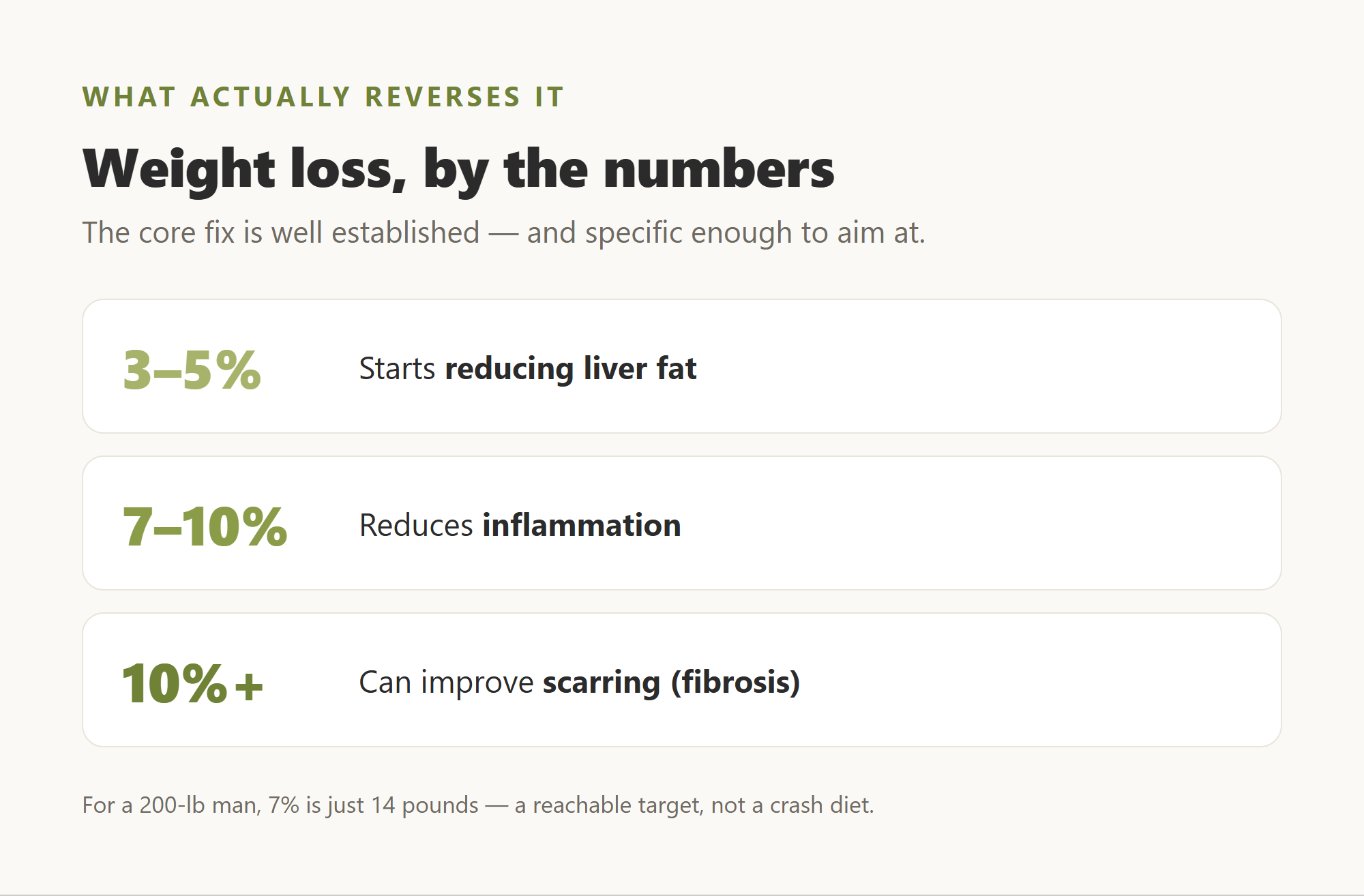
It comes down to weight loss, diet, and movement, and the numbers are specific enough to aim at. According to the NIDDK:
- Losing 3-5% of your body weight starts reducing liver fat.
- Losing 7-10% reduces the inflammation.
- Losing 10% or more can actually improve scarring (fibrosis).
For a 200-pound man, 7% is just 14 pounds. That is a real, reachable target — not a crash diet.
Here is what the evidence points to:
- Eat Mediterranean-style. Vegetables, fruit, whole grains, legumes, olive oil, and fish — with a deliberate cut to red and processed meat, added sugar, and sugary drinks. This is the most evidence-based eating pattern for the liver.
- Kill the liquid sugar first. Sodas, sweet coffees, juices — fructose is a direct driver of liver fat, and drinks are the easiest place to remove a lot of it fast.
- Move, even before the scale moves. Both aerobic and resistance exercise reduce liver fat, and physical activity helps even without weight loss. Aim for the standard ballpark of about 150 minutes a week.
- Go gradual. Crash dieting can actually make liver disease worse. Slow and steady wins this one.
About milk thistle and “liver detox” pills
I know the supplement aisle is tempting when the fix sounds like work. Let me save you some money.
Milk thistle (silymarin) is the classic liver supplement, and the honest verdict is that the evidence is weak. Reviews find at most tiny changes in enzyme numbers that are not clinically meaningful, and major guidelines do not recommend it for fatty liver. UDCA (ursodeoxycholic acid) is not a casual supplement at all — it is a prescription drug, and guidelines specifically do not recommend it for MASLD.
There is real prescription medicine now for advanced cases (a drug called resmetirom was FDA-approved in 2024), but it is for a specific, more serious patient group under a doctor’s care — not a general anti-fatigue pill. For the ordinary office worker with early fatty liver, the treatment is not in a bottle. It is on your plate and in your schedule.
When to see a doctor
Get your liver enzymes (ALT/AST) checked if you have not lately — especially if you carry extra weight, have high blood sugar, high triglycerides, or high blood pressure, or if a routine test already flagged them. If your enzymes are up, let a doctor interpret them and decide whether imaging or further testing makes sense. Do not start supplements or prescription drugs on your own to “help” your liver — some products can harm it.
The short version
If I had to compress all of this into a few lines, it would be this.
Fatty liver without drinking is now the most common liver condition around, and it is built from carbs, sugar, sitting, and belly fat — not alcohol. It is usually silent, so fatigue is a hint, not a diagnosis: get your enzymes checked. The fix that actually works is losing 7-10% of your body weight through a Mediterranean-style diet, cutting liquid sugar, and moving regularly — not milk thistle, not a detox pill.
The liver is quietly forgiving if you catch it early. It just needs you to notice before it stops being quiet.
Because this is the one number you would not want to keep ignoring on the page.
References
- AASLD — “New MASLD Nomenclature” (2023 rename)
- NIDDK / NIH — “Treatment for NAFLD & NASH” (weight-loss targets, diet, exercise)
- Mayo Clinic — “Fatty liver disease (MASLD) diet”
- American Gastroenterological Association; American Diabetes Association (Diabetes Spectrum) — lifestyle management
- 2024 silymarin systematic review (PubMed); ACG / NICE on UDCA
- FDA / Madrigal & NEJM — resmetirom (Rezdiffra) approval, March 2024