Male Pattern Hair Loss: Early Signs and What Actually Works
Let me start with the moment most men actually notice.
It is not a dramatic clump in the shower. It is a photograph. You catch yourself in a picture taken from slightly above, or under harsh light, and your hairline looks different than the one in your head. A little higher at the temples. A little thinner where the crown catches the light.
Then you start checking. The pillow. The drain. The comb.
If that is where you are right now, I want to give you something better than either panic or denial — the two most common reactions, and both of them cost hair. Let me walk through what the early signs really are, why timing matters more than most men realize, and what actually works versus what is just marketing.
First, the honest disclaimer.
I am not a dermatologist, and this is general information, not medical advice. Hair loss has several causes, and not all of them are the pattern kind. The single most useful thing in this article is the recommendation to see a board-certified dermatologist for an accurate diagnosis — everything else is context to make that visit less intimidating.

Photo: Towfiqu barbhuiya / Pexels
The self-check: what early male pattern loss looks like
Male pattern hair loss — doctors call it androgenetic alopecia — follows a recognizable map. It rarely thins evenly all over. Instead, it targets specific zones.
Watch three things:
- The temples. The hairline recedes above both temples first, carving out that classic “M” shape.
- The crown. Thinning at the vertex, usually in a roughly circular pattern, that you often cannot see without a second mirror.
- The shedding. Everyday shedding is normal. More hair than usual on the pillow, in the comb, or circling the drain is the early prompt that sends most men looking.
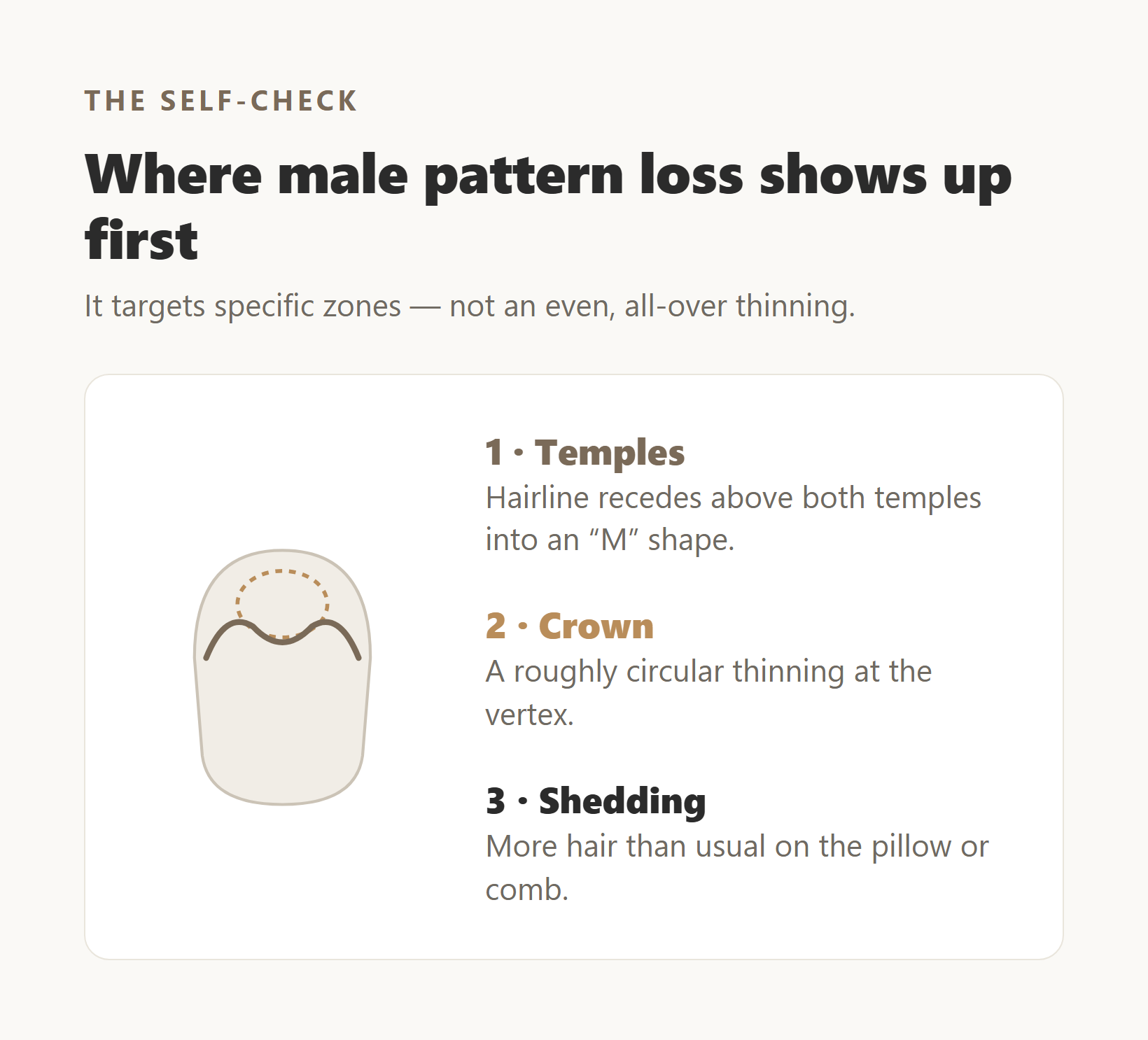
Dermatologists grade this on a seven-stage Norwood scale, from barely-there recession at Stage 1 to loss across the top at Stage 7. You do not need to self-diagnose your stage. You just need to notice the direction of travel — and one detail matters here: male pattern loss is painless and gradual. If your shedding is sudden, patchy, or comes with an itchy or sore scalp, that points toward a different condition entirely, and it is worth getting checked rather than assuming.
Why it happens: the DHT clock
Here is the mechanism, without the mysticism.
Male pattern hair loss is genetic, and it runs on a hormone called DHT (dihydrotestosterone). In men who inherited sensitive follicles, DHT binds to receptors in the scalp and slowly shrinks those follicles with each growth cycle — a process called miniaturization. The hairs come back finer, shorter, and lighter, until eventually they barely come back at all.
That word “eventually” is the whole game.
Because miniaturization is progressive, there is a real cost to waiting. Treatments today are good at slowing loss and partially regrowing hair — but they cannot resurrect a follicle that has already miniaturized into nothing. The American Academy of Dermatology puts it plainly: men tend to get better results when they start treatment soon after noticing the loss.

Photo: Nathan Cowley / Pexels
I want to be careful here, because “golden window” talk gets exaggerated into scare tactics. There is no single deadline stamped on your scalp. But the direction is honest and clinically supported: the follicles you still have are the easiest to keep. Delaying treatment for years because you are afraid of side effects can quietly trade away the hair that was most saveable. That is the trade worth understanding — not fearing.
What actually works (and how long it takes)
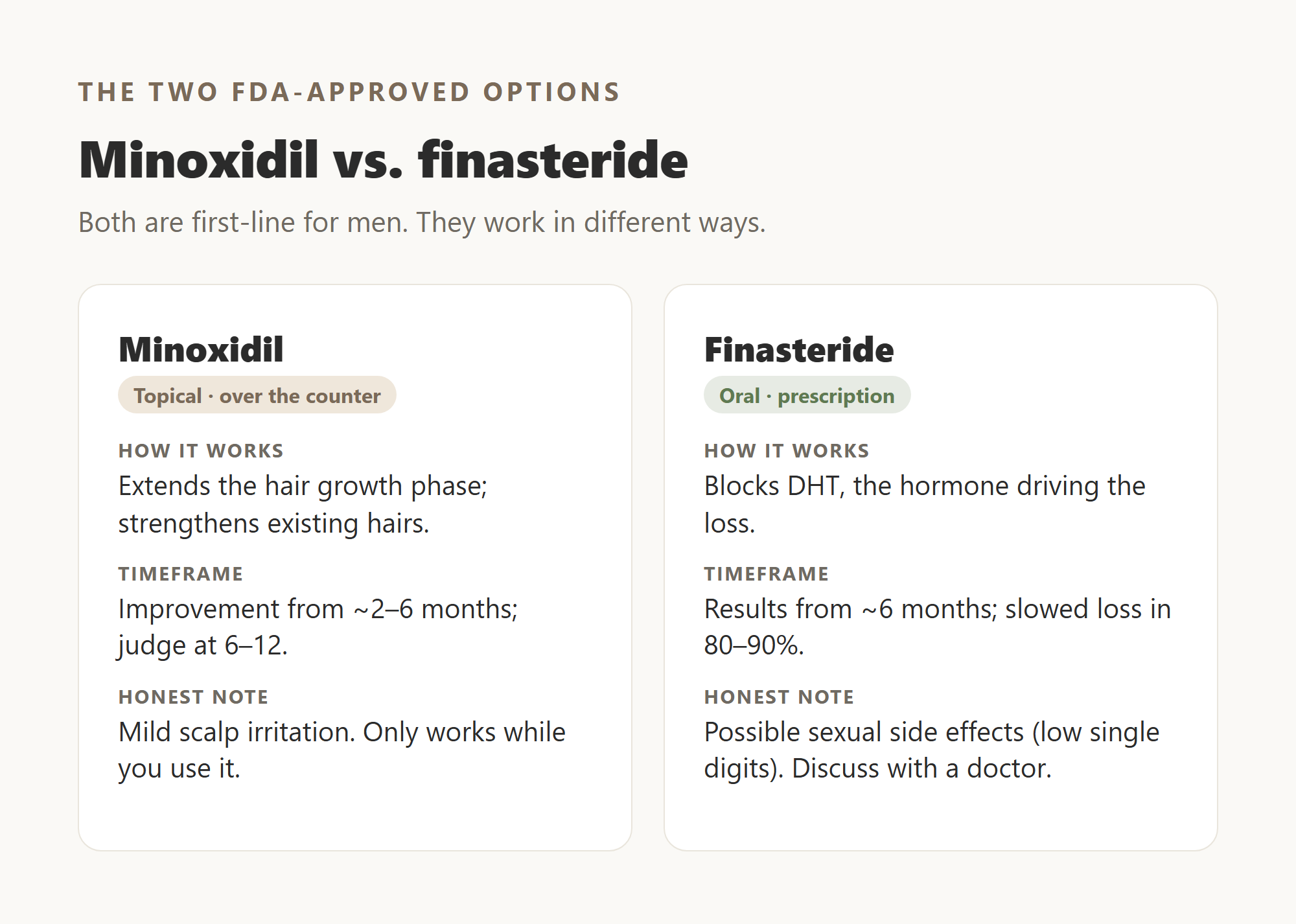
Two treatments are FDA-approved for men, and they are the foundation everything else builds on.
Minoxidil (topical, over the counter)
The one you can buy without a prescription. Minoxidil is a vasodilator that extends the growth phase and helps strengthen existing hairs. It reduces loss, stimulates some regrowth, and — this is the catch — only works while you use it. Stop, and the gains reverse over a few months.
Timeframe: give it real time. Cleveland Clinic notes improvement can start around two to four months; the AAD frames the full picture as six to twelve months. Side effects are usually mild — scalp irritation, and sometimes unwanted hair where it drips.
Finasteride (oral, prescription)
This one goes after the root cause. Finasteride blocks the enzyme that converts testosterone into DHT, lowering the hormone that drives the whole process. The AAD reports it slowed further loss in about 80% to 90% of men who took it, with results emerging around the six-month mark.
Now the honest part, because this is where men get stuck.
Finasteride has a real, if uncommon, side-effect conversation attached to it — reduced libido, erectile issues, and, in a small number of reports, effects that some men describe as persisting after stopping (often discussed as “post-finasteride syndrome”). Here is what is true: in the clinical trials the sexual side-effect rates were low, in the low single digits. Here is what is also true: the persistent-symptom reports exist, the FDA updated the label to acknowledge them in 2012, and a cause-and-effect relationship has not been established. Both of those are real. The reasonable move is not to dismiss the risk or to be paralyzed by it — it is to discuss it honestly with a dermatologist who can weigh it against your own situation.
The “side-effect-free” options
If drug side effects are what is keeping you on the sidelines, there are gentler adjuncts with some real evidence — just weaker than the two above:
- Low-level laser therapy is the only non-drug option FDA-cleared for this, and it can add density, especially alongside minoxidil.
- Ketoconazole shampoo shows some benefit as an adjunct, not a standalone cure.
The honest framing: these work best combined with proven treatment, not as an excuse to avoid it. Doing “everything gentle” while skipping the two things that actually move the needle is a common and costly mistake.
The one thing not to do
Nothing.
That is the trap. Male pattern hair loss is one of the few conditions where the cost of waiting is measured in something you cannot fully get back. You do not have to start medication tomorrow. But you do owe yourself an accurate diagnosis while the follicles are still there to save.
The short version
If I had to compress this into a few lines, it would be this.
Male pattern hair loss shows up first at the temples (the M shape) and the crown, and it is driven by DHT slowly shrinking follicles. The treatments that actually work are topical minoxidil and oral finasteride, and both take three to six months before you can judge them. The gentle adjuncts help, but only alongside the real thing — not instead of it.
And the most valuable move is the least dramatic one: see a dermatologist early, get a real diagnosis, and make a calm decision with the facts in front of you. The hair you keep is almost always the hair you acted on soonest.
Because this is the one thing you would not want to look back on and wish you had checked.
References
- American Academy of Dermatology (AAD) — “What is male pattern hair loss, and can it be treated?”
- Cleveland Clinic — “Male Pattern Baldness (Androgenic Alopecia)”
- NIH / MedlinePlus Genetics — “Androgenetic alopecia”
- Mayo Clinic — “Hair loss: Symptoms and causes”
- Journal of the American Academy of Dermatology (2025) — topical and oral minoxidil recommendations
- FDA labeling history (2012) and Post-Finasteride Syndrome literature (side-effect debate)