
Losing Muscle After 30? A Man’s Guide to Beating Sarcopenia
Let me tell you when this snuck up on me.
It was not a dramatic moment. It was a jar lid that would not budge, a flight of stairs that left me slightly more winded than it should have, a sense that my legs felt a little less there than they used to. Nothing you would mention to a doctor. Just a quiet suspicion that the body I had in my twenties was slowly handing in its notice.
Turns out that suspicion has a name. And the timing is earlier than most men expect.
First, the honest disclaimer: I am not a doctor, and this is general information, not medical advice. But this is one of those slow, silent processes where understanding it early genuinely changes how it plays out.

The decline starts in your 30s — not your 70s
Here is the fact that surprises people. Muscle mass and strength start declining gradually in your 30s or 40s — not in old age. Cleveland Clinic notes you can lose as much as 8% of your muscle mass each decade, with the losses speeding up later in life.
This is not a disease. It happens to healthy men, every year, quietly. The medical term for the age-related loss of muscle mass and strength is sarcopenia — and the road to it starts decades before anyone would call you old.
Why does it happen? Two reasons mostly. Your body starts making less of the protein needed to build and repair muscle. And your hormones shift — specifically, declining testosterone and IGF-1 (a growth factor). For men, that hormonal slide is part of the same picture as the broader drop in testosterone with age. Add a desk job and a few skipped workouts, and the decline accelerates.
Why losing muscle is more than a vanity problem
It would be easy to file this under “looking softer with age.” That undersells it.
Muscle is not just for lifting things. It is metabolically active tissue, which means it burns energy around the clock. When you lose muscle, your basal metabolism drops — your body simply needs fewer calories to idle. And if your eating does not change to match, that is exactly how weight starts creeping on in your 40s despite “doing nothing different.”

It goes deeper than the waistline, though. Muscle is a major site where your body handles blood sugar, so less of it is linked to higher type 2 diabetes risk. And over time, sarcopenia leads to falls, fractures, and loss of independence — the outcomes that quietly define how the back half of life actually goes. This is why muscle is increasingly talked about as a longevity issue, not a gym issue.
Why smart men train from the legs up
If you are going to fight back efficiently, start where the most muscle is.
Now, you may have heard that “70% of your muscle is in your lower body.” I looked into that, and the honest version is: that exact number is not well supported. What is true is still compelling — your legs hold roughly half of your total muscle mass, and the largest muscle groups in your body — the glutes, quadriceps, and hamstrings — are all in your lower body. The gluteus maximus is the single biggest muscle you have.

Photo: Instituto Alpha Fitness / Pexels
The practical point: training your thighs and glutes gives you the most return on your effort — the biggest boost to metabolism, function, and everyday strength. Skip leg day and you are leaving the largest muscles in your body untrained. That is a bad trade.
The two levers: protein and resistance training
The prevention playbook is not complicated, and it works even after decades of neglect. Sarcopenia is often preventable and partly reversible with early action.
Lever one — protein. Older and at-risk adults generally need more protein than the old baseline. Cleveland Clinic suggests roughly 20 to 35 grams of protein per meal, and sarcopenia guidance often targets about 1.0 to 1.2 grams of protein per kilogram of body weight per day — meaningfully more than the standard RDA. Spread it across your meals rather than loading it all at dinner.

Photo: Nadin Sh / Pexels
Lever two — resistance training, with a lower-body emphasis. Strength training is the cornerstone. It consistently improves grip strength, walking speed, balance, muscle mass, and quality of life. You do not need a fancy gym — bands, weights, or bodyweight all work. Aim for at least twice a week, and prioritize the big lower-body movements:
- Squats and sit-to-stand (rising from a chair without hands)
- Lunges and step-ups
- Hip hinges for the glutes and hamstrings
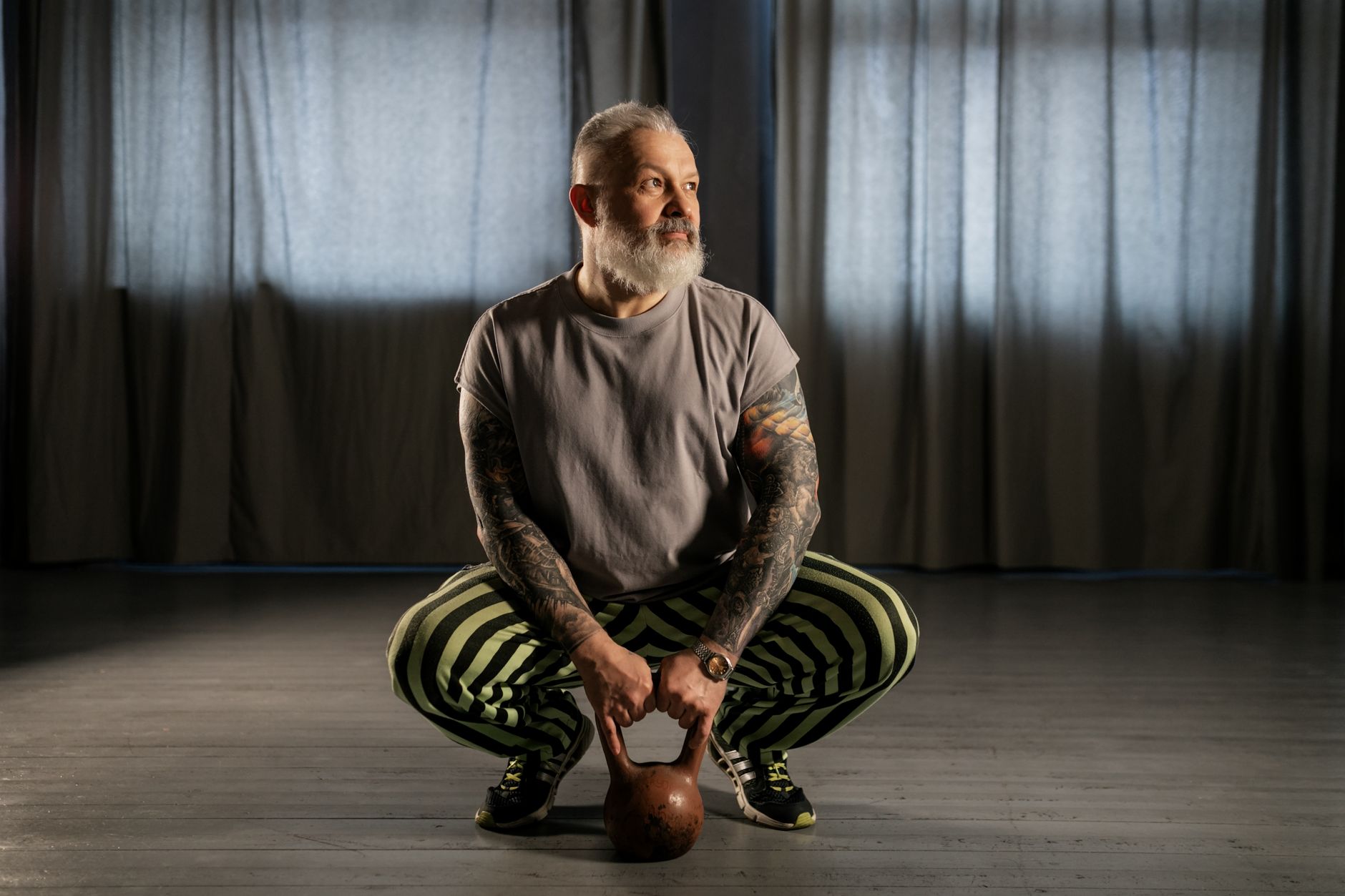
Photo: Alena Darmel / Pexels
A couple of supporting habits round it out: stay generally active through the day, and get your vitamin D checked, since it plays a role in muscle function.
Suspect it? Then get it assessed
I want to be careful here, because self-diagnosis is a trap. The right frame is “suspect, then get assessed” — not deciding on your own that you have sarcopenia.
The early signs worth noticing are the ones I opened with: a weaker grip, slower walking, and trouble rising from a chair. If those feel familiar, that is a reason to get a proper check, not to panic.
Clinicians use objective, simple tests:
- Grip strength with a handgrip dynamometer (for men, a reading below roughly 26–27 kg / ~57 lb raises the flag).
- Gait speed — often a short timed walk, with slow speed (around 1.0 m/s or below) as a marker.
- Chair-stand test, Timed Up and Go, and body-composition scans like DEXA for muscle mass.
If you are noticing unexplained weakness, more falls, or a faster-than-normal loss of strength, see a doctor for an actual assessment. One caution on the protein advice, too: if you have kidney disease, higher protein is not automatically right for you — that is a conversation to have with a clinician, not a blanket rule.
The short version
Compressed to a few lines, here is the whole thing.
Muscle loss starts in your 30s, not old age, and you can lose up to 8% a decade — driven by less protein synthesis and falling testosterone. It matters because less muscle means a slower metabolism, easier weight gain, and higher diabetes and fall risk. Train from the legs up, since your largest muscles live there, and lean on the two levers that actually work: enough protein (around 1.0–1.2 g/kg) and regular resistance training. If you suspect you are slipping, get grip strength and gait speed checked rather than guessing.
The body does not send a loud warning for this one. It just quietly gets weaker while you are busy. The good news is that it answers, remarkably well, to a man who decides to push back.
Because the strength you keep in your 40s is the independence you keep in your 70s.
References
- Cleveland Clinic — “Sarcopenia (Muscle Loss): Symptoms & Causes”
- Sarcopenia consensus definition, prevalence, etiology, consequences — PMC/NCBI
- Role of exercise in age-related sarcopenia — PMC
- Muscle-composition references — lower-body share of total muscle mass
- Sarcopenia screening criteria (grip strength, gait speed) — EWGSOP-type consensus