High-Dose Vitamin C and Kidney Stones: Does Water Help?
I bought the big bottle. The 1,000 mg one, two tablets a day through one bad winter, because a friend told me it was the cheapest insurance there is.
So let me put my own conclusion at the top, since I spent a week reading the sources instead of the label.
High-dose vitamin C does not prevent colds in the general population, there is no evidence I could find that it helps chronic fatigue, and it does measurably raise the oxalate in your urine — in people who have never had a kidney stone as well as in people who have. The part I had most wrong was the fix. Drinking extra water is not a way to make megadosing safe. No study testing that idea turned up at all, and the “2.5 liters” number that gets quoted for it is not even a drinking target.
I am not a doctor and this is general health information, not medical advice. The fuller note, and the list of situations that need a clinician rather than an article, is at the bottom.
Does high-dose vitamin C prevent colds? Not in the general population
The largest review on this is the Cochrane review by Hemilä and Chalker — still the 2013 edition, which is worth dating because people cite it as if it were new. Among general-community participants (n = 10,708; the whole meta-analysis covered 29 trial comparisons and 11,306 participants), the risk ratio for catching a cold was 0.97, 95% CI 0.94–1.00. The authors’ own verdict was that routine vitamin C supplementation is not justified in the general population.
The NIH Office of Dietary Supplements says the same thing in its own words: “in the general population, taking vitamin C prophylactically does not appear to reduce the risk of the common cold.”
That is a federal agency and the biggest meta-analysis agreeing. “Many studies” is true. What those studies concluded is not “it works.”
There is a real exception, and it is probably not you
In 5 trials covering 598 marathon runners, skiers, and soldiers on subarctic exercises, the risk ratio was 0.48 (95% CI 0.35–0.64) — roughly half the risk. That number is real, and it belongs to that population. Brief, extreme physical stress. Not a desk job in February.

Photo: Alexandru MnM / Pexels
Duration and severity: small, and only if you were already taking it
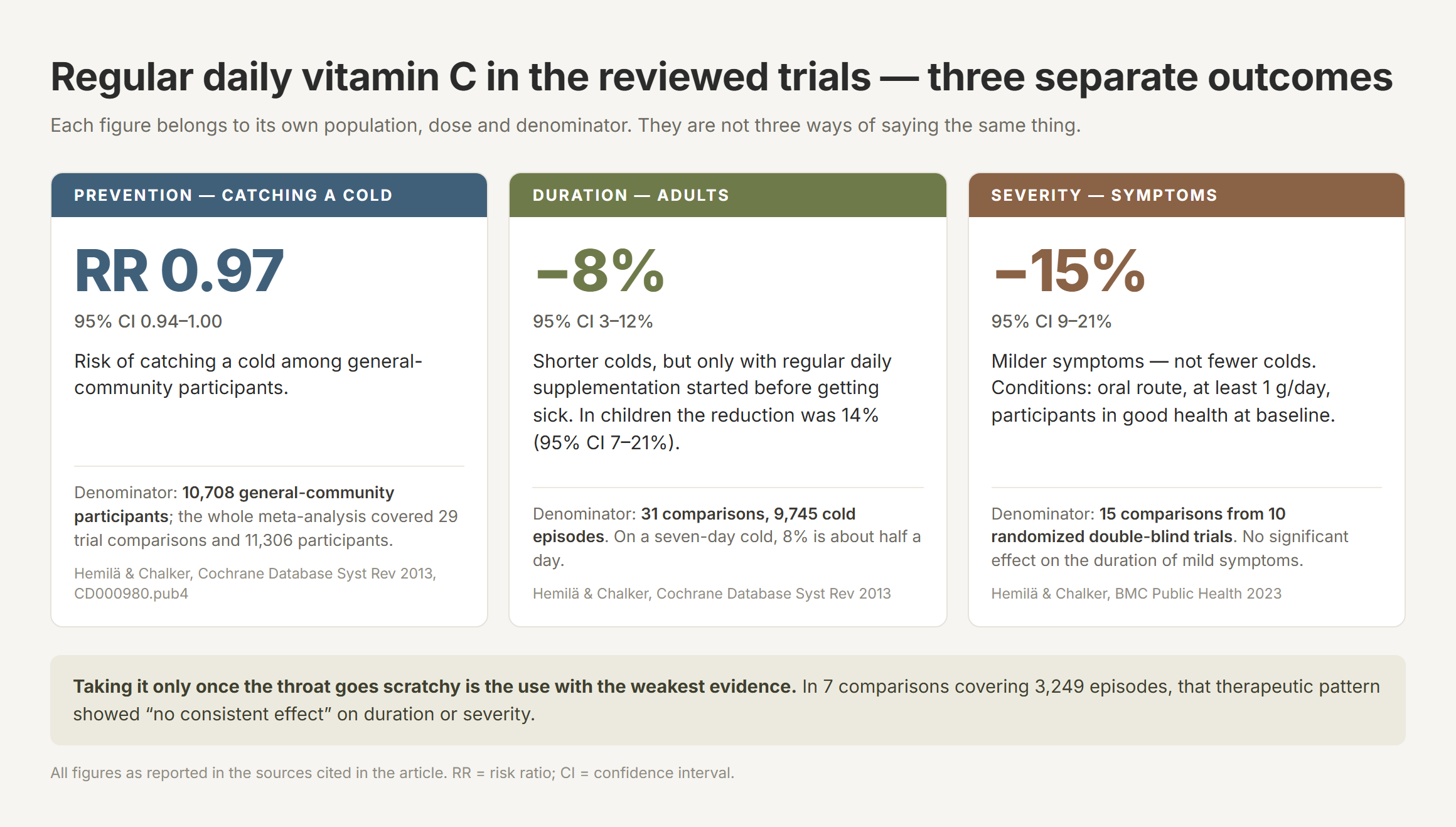
With regular daily supplementation started before you got sick, cold duration was shorter by 8% in adults (95% CI 3–12%) and 14% in children (95% CI 7–21%), with children on 1–2 g/day at −18%; the denominator was 31 comparisons and 9,745 cold episodes. On a seven-day cold, 8% is about half a day.
Severity is the newer finding. A 2023 meta-analysis in BMC Public Health found a 15% reduction in severity (95% CI 9–21%) — under narrow conditions: oral route, at least 1 g/day, participants in good health at baseline, 15 comparisons from 10 randomized double-blind trials. It means symptoms were milder, not that anyone caught 15% fewer colds. The same analysis found no significant effect on the duration of mild symptoms.
And the way most of us actually use it — reaching for the bottle the moment the throat goes scratchy — is the use with the weakest evidence. 7 comparisons and 3,249 episodes of that therapeutic pattern showed “no consistent effect” on duration or severity.
What about fatigue?
I could not find a single randomized trial of oral vitamin C improving chronic fatigue. The NIH ODS health-professional fact sheet does not review fatigue at all — its health sections are cancer prevention, cancer treatment, cardiovascular disease, macular degeneration and cataracts, and the common cold. Fatigue appears once, as an early symptom of deficiency: “Initial symptoms can include fatigue… malaise, and inflammation of the gums.”
The study usually forwarded as proof used a single 10 g intravenous dose in 141 healthy office workers aged 20–49 — not fatigue patients — with an effect lasting one day, significant only in the subgroup with low baseline plasma vitamin C. Intravenous is not oral, and correcting a deficiency is not the same as topping up someone who has plenty.
So the honest line is narrow: no oral trial evidence for fatigue was found, and the one study people quote does not test what they think it tests.
How much does the US actually recommend, and what counts as a megadose?
The RDA is 90 mg/day for adult men and 75 mg/day for adult women, and people who smoke need 35 mg/day more (NIH ODS). The Tolerable Upper Intake Level is 2,000 mg/day, covering food and supplements together.
One correction I had to make to my own head: that 2,000 mg ceiling is about your gut, not your kidneys. The Linus Pauling Institute states the basis plainly — “An upper intake level of 2 g/day was set to avoid diarrhea and gastrointestinal disturbances with high supplemental intakes.”
There is no official definition of a “megadose”
No FDA, NIH, or American Urological Association document sets a milligram threshold for the word. The workable line is above 1,000 mg/day, because that is where ODS says absorption falls below 50%, and it is where the National Kidney Foundation, the Linus Pauling Institute, and the largest US cohort study all locate the risk signal. Whenever you see a number here, hold it loosely — including that one.
The American origin of the idea is local, by the way. Linus Pauling suggested “the optimum daily intake may be about 2,000 milligrams of vitamin C.” The institute that carries his name at Oregon State University now recommends 400 mg/day for generally healthy adults.
Nobody checked the dose on the bottle before it went on sale
This is the part that changed how I read a supplement aisle. FDA, verbatim: “Under DSHEA, FDA does not have the authority to approve dietary supplements before they are marketed.” There is no US legal maximum for vitamin C per serving. A 5,000 mg product being legal on a shelf is not an assessment that 5,000 mg is a good idea.
Photo: RDNE Stock project / Pexels
The upset stomach is physics, not a sensitive constitution
NIH ODS: “at doses above 1 gram (g)/day, absorption falls to less than 50%, and absorbed, unmetabolized ascorbic acid is excreted in the urine.” The classic pharmacokinetic study (Levine 1996, PNAS: 7 healthy volunteers hospitalized for 4–6 months on a diet with under 5 mg/day, tested at 7 dose levels from 30 to 2,500 mg) found bioavailability complete at a single 200 mg dose, declining at single doses of 500 mg and above, and plasma saturation at 1,000 mg/day.
Whatever your gut cannot absorb stays in the gut and pulls water in osmotically. ODS names the result: “diarrhea, nausea, abdominal cramps, and other gastrointestinal disturbances due to the osmotic effect of unabsorbed vitamin C.”
It is a dose effect. If a big tablet sends you to the bathroom, that is chemistry doing exactly what it does, not your body being unusual. When to Take Supplements: Timing for Better Absorption
What high-dose vitamin C does to your urine
Here is the mechanism, and here is the part of it that is genuinely unsettled.
Ascorbic acid breaks down non-enzymatically — ascorbic acid to dehydroascorbic acid to diketogulonic acid to oxalate — and that oxalate leaves in urine, where it can bind calcium as calcium oxalate. About 80% of US kidney stones are calcium stones (Urology Care Foundation).
Two things people get wrong about this. First, it is not “leftover” vitamin C being diverted; the breakdown runs continuously, and a high dose increases the amount, it does not switch on a new process. Second, and this matters: how much of an ingested dose ends up as oxalate has not been established. The reference review on the question (Knight 2016, Urolithiasis) says so directly — “What is not clear is how much AA and DHA is metabolized in cells and tissues, and how much is converted to DKA and ultimately oxalate.” Any tidy conversion percentage you see quoted is not coming from the literature.
The 2026 meta-analysis: the number worth knowing
The newest evidence is a 2026 systematic review and meta-analysis in the Journal of Endourology (9 interventional studies, literature searched from 1965 to February 2023). Pooled, vitamin C supplementation raised 24-hour urinary oxalate by +9.72 mg/24 h versus baseline (p < 0.001) and +6.45 mg/24 h versus placebo (p < 0.001), significantly in both stone formers and non-stone-formers (p < 0.05 for all), with no significant effect on urinary citrate or calcium.
Two honest caveats travel with it. The outcome measured is urinary oxalate — a surrogate marker, not stones that actually formed. And the individual trials behind it disagree on magnitude: reported increases run roughly from 20% to 75% depending on the study, dose and population, which is exactly why the pooled figure in milligrams is the safer one to quote. In Baxmann 2003 (Kidney Int: 47 calcium-stone-forming patients on 1 g or 2 g for 3 days, plus 20 healthy subjects who received 1 g), mean 24-hour oxalate and the calcium-oxalate crystallization index both rose significantly in every group, while urinary pH did not change. Traxer 2003 (2 g/day on a controlled diet) reported +21.8% in normal subjects and +34.4% in stone formers, with values staying inside the normal range.
The oldest and tightest study puts the turning point at a familiar place. Levine 1996, verbatim: “Oxalate and urate excretion were elevated at 1000 mg of vitamin C daily compared to lower doses.”
The stone signal is specific: men, supplements, 1,000 mg and up
The largest cohort work is Ferraro 2016 in the American Journal of Kidney Diseases — 156,735 women in the Nurses’ Health Studies I and II plus 40,536 men in the Health Professionals Follow-up Study, median follow-up 11.3–11.7 years, 6,245 incident kidney stones, adjusted for age, BMI, thiazide use and dietary factors.
- Men, total intake in the highest category (≥1,000 mg/day): HR 1.43 (95% CI 1.15–1.79), P for trend = 0.005. Exposure categories were <90 mg/day as reference, then 90–249, 250–499, 500–999 and ≥1,000.
- Men, supplemental intake ≥1,000 mg/day: HR 1.19 (95% CI 1.01–1.40), P for trend = 0.001.
- Women: no significant association was observed, for total or supplemental intake.
- Dietary vitamin C from food: no association in either sex.
That third line needs care, and I will say it the way the evidence says it: no significant association was observed in women. That is not the same finding as “safe for women,” and nobody knows why the sexes differ here.
A second cohort — 23,355 Swedish men aged 45–79, about 11 years of follow-up, 436 incident stones — found roughly double the risk among men taking ascorbic-acid-only supplements, with tablets of about 1,000 mg. Multivitamin users showed no association. But there were only 31 stone cases in the supplement group, which is a small number to rest a doubling on.
The rebuttal, and why this debate stays open
A published critique from the University of Otago (Pullar, Carr and Vissers, NZMJ 2013) makes points I think are fair: the exposure questionnaire had a positive predictive value of 74%, meaning at least one in four users may have been misclassified at baseline; exposure was never updated across the follow-up; dehydration and diuretic use were not adjusted for; and there were those 31 cases. Their conclusion, verbatim: “the association between ascorbate supplementation and increased risk of kidney stone formation remains controversial, and at this stage should only be of concern to those individuals with a history of kidney stones.”
Their counter-claim — that randomized trials show no increased risk — rests on a 1997 book chapter, not on modern trial data. And that is the shape of the whole argument: no randomized trial has ever used kidney stones as an outcome. A consistent observational signal in men on supplements, a consistent surrogate signal in everyone, and no causal trial in either direction. “It causes stones” overstates it. So does “it is proven harmless.”
What is not in dispute is who should stay away from high doses. On that, every US body lands in the same place, and at 1,000 mg rather than 2 g:
| Body | What it says | Threshold |
|---|---|---|
| National Kidney Foundation | “Avoid high doses of vitamin C supplements”; “Excess amounts of 1000mg/day or more may produce more oxalate in the body.” | ≥1,000 mg/day |
| AUA kidney stone guideline (discussion text) | “Other factors that may contribute to higher urinary oxalate include vitamin C and other over-the-counter nutrition supplements.” | names vitamin C, sets no milligram limit |
| Linus Pauling Institute | “Those predisposed to kidney stone formation may consider avoiding high-dose (≥1 g/day) vitamin C supplementation.” | ≥1 g/day, if predisposed |
| Canadian Urological Association (Canada, not the US) | “Vitamin C supplementation of more than 1000 mg daily is not recommended due to the associated risk of hyperoxaluria and nephrolithiasis” (LE 2–3, Grade C) | >1,000 mg/day |
| NIH ODS | high intakes “could contribute to the formation of kidney stones, especially in individuals with renal disorders” | no figure given |
One more myth to retire while we are here, because it is the reason I felt safe with two tablets a day. “It is water-soluble, so the extra just washes out.” The National Kidney Foundation answers that directly: with chronic kidney disease “your kidneys may not be able to remove the extra amount. This can make them build up and cause problems. For example, too much vitamin C can raise your risk of kidney stones, specifically calcium oxalate stones.” Washing out through the kidney is precisely the route that raises urinary oxalate.
Does drinking more water make megadosing safe?
I want to answer this one carefully, because it was the claim I personally believed, and because a false reassurance here is the kind that sends someone to an emergency room.
No study testing whether extra fluid offsets the stone risk of high-dose vitamin C turned up in this research. Not a positive one, not a negative one. The idea is untested.
The mechanism also argues against it. Water dilutes urine; it does not reduce the quantity of oxalate your body produces. The 2026 meta-analysis measured a rise in total 24-hour oxalate excretion in mg/24 h — a total amount, which dilution does not change.
Where “2.5 liters” actually comes from
It comes from the AUA’s medical management of kidney stones guideline, Statement 8, verbatim:
“Clinicians should recommend to all stone formers a fluid intake that will achieve a urine volume of at least 2.5 liters daily. (Standard; Evidence Strength: Grade B)”
Read that slowly, because two things in it get lost every time it is repeated. It is a urine-volume target, not an amount to drink. And its population is stone formers — adults who have already produced a kidney stone; the guideline’s evidence base was a review of recurrent stone disease in adults. The guideline is modest about the number itself, calling 2.5 L “an accepted goal” and noting that “there is no definitive threshold for urine volume and increased risk (the relationship is continuous and may not be linear).” Cystine stone formers are an explicit exception, often needing “at least four liters per day” of oral intake.
So it is a clinical target for patients, at Grade B, in a unit most people misread. It was never a permission slip for megadosing — and the same guidance that sets it also names vitamin C as something that pushes urinary oxalate up.
Three US numbers, three different meanings
If you have ever felt that the hydration advice contradicts itself, it does. These three figures are not interchangeable, and each only means something with its unit and its population attached.
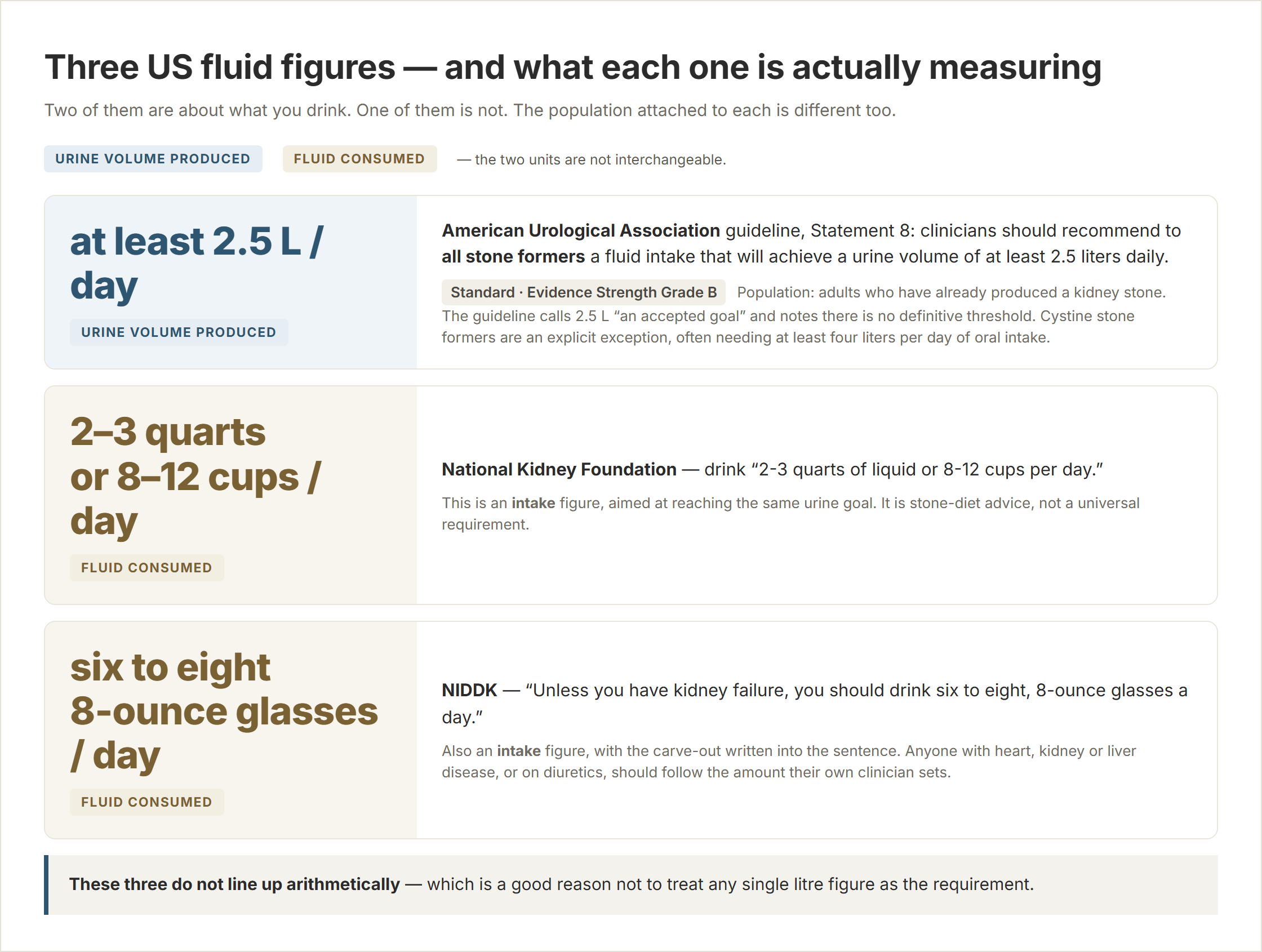
The National Kidney Foundation advises drinking “2-3 quarts of liquid or 8-12 cups per day” — that is intake — aimed at the same urine goal. NIDDK says “Unless you have kidney failure, you should drink six to eight, 8-ounce glasses a day” — also intake, with the carve-out written into the sentence. Even these do not line up arithmetically, which is a good reason not to treat any single litre figure as the requirement.
And deliberately overdrinking has its own risk
Exercise-associated hyponatremia is defined as blood sodium below 135 mmol/L, and its primary cause is “the overconsumption of hypotonic fluids.” The Third International EAH Consensus (Carlsbad, California, 2015) advises “Drink according to thirst… recommending fixed ranges of fluid intake is not appropriate.”
MedlinePlus lists the symptoms — “Confusion, irritability, restlessness; Convulsions; Fatigue; Headache; Loss of appetite; Muscle weakness, spasms, or cramps; Nausea, vomiting” — and warns that it “can be a life-threatening emergency.” Confirmed deaths include high school football players, a soldier, and a college student.
And for people with heart failure, kidney disease, cirrhosis, or on diuretics, the correct instruction may be fluid restriction, not more. “Drink as much as you can” is not neutral advice for them.
Who should be most careful
- Reduced kidney function or CKD. ODS flags renal disorders specifically, and Knight 2016 is blunt: “compromised renal function coupled with excessive AA ingestion can result in oxalate nephropathy in susceptible individuals.”
- Dialysis. In 18 hemodialysis patients given intravenous ascorbate at 250 mg/week escalating to 500 mg/week over 18 months (against 12 untreated controls), plasma oxalate rose significantly (P < 0.001) and 7 of 18 — about 40% — crossed the calcium oxalate saturation threshold during six months at 500 mg weekly. Withdrawal reversed it. Note the route and the unit: intravenous, per week.
- A previous kidney stone. Both sides of the scientific argument agree on this group.
- Hereditary hemochromatosis or iron overload. ODS: “chronic consumption of high doses of vitamin C could exacerbate iron overload and result in tissue damage.”
- G6PD deficiency. Hemolytic anemia was documented in two people given 80 g intravenously, which is why IV vitamin C patients are now pre-screened. Oral risk has not been established — I am not going to imply it has.
- Anyone using a fingerstick glucose meter. FDA, verbatim: “Vitamin C, acetaminophen, acetaminophen containing drugs like Tylenol, and Xylose absorption therapies may interfere with the test and may affect your glucose result.” FDA gives no dose threshold, and the documented clinical cases involve intravenous ascorbate. Check your meter’s instructions and ask your pharmacist.
- Anyone heading for surgery. I looked for a US rule about stopping vitamin C before an operation and found none. The actionable step is disclosure: tell your surgeon and anesthesiologist about every supplement and the dose.

Photo: Vitaly Gariev / Pexels
Related: How to Choose a Multivitamin and Avoid Side Effects
When to seek care
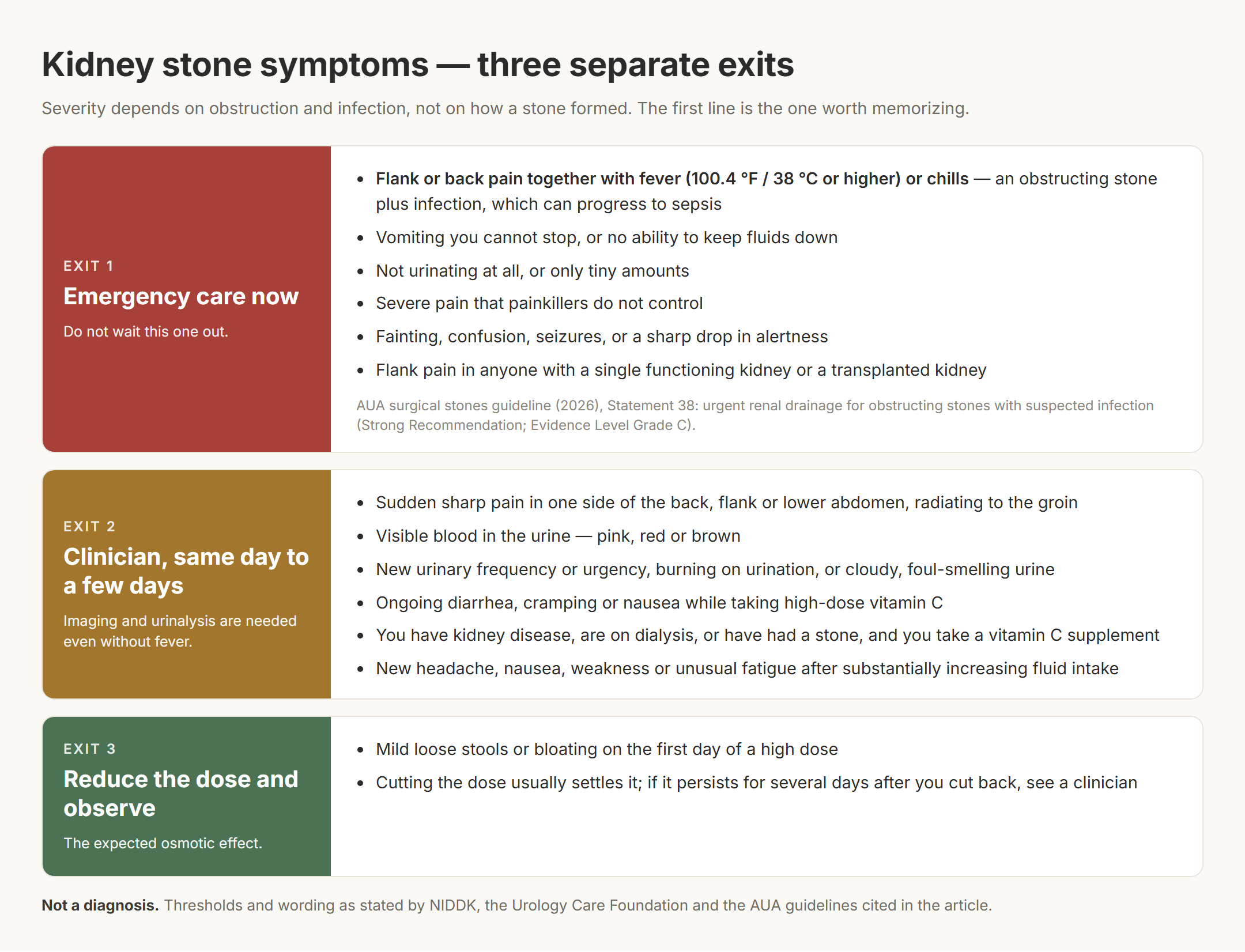
Kidney stones are common in the US — NIDDK reports that “About 11 percent of men and 6 percent of women in the United States have kidney stones at least once during their lifetime” — and most stones that form never become the dramatic pain story. Severity depends on obstruction, not on how the stone formed. The one distinction below that I would ask you to memorize is the first one.
Go to the ER now
- Flank or back pain together with fever (100.4 °F / 38 °C or higher) or chills. This suggests an obstructing stone plus infection, which can progress to sepsis. The AUA surgical stones guideline (2026), Statement 38, is verbatim: “For adult patients with obstructing kidney and/or ureteral stones and suspected infection, clinicians should initiate urgent renal drainage. (Strong Recommendation; Evidence Level: Grade C)” — and it warns that antibiotics without addressing the obstruction are unlikely to resolve the infection. In that guideline’s analysis of 311,100 US adults in the National Inpatient Sample, mortality was 0.2% among non-septic patients who underwent decompression versus 13.6% in patients with septic shock who did not undergo renal drainage. Do not wait this one out.
- Vomiting you cannot stop, or no ability to keep fluids down. NIDDK: “If you are vomiting and dehydrated, you may need to go to the hospital and get fluids through an IV.”
- Not urinating at all, or only tiny amounts.
- Severe pain that painkillers do not control.
- Fainting, confusion, seizures, or a sharp drop in alertness — possible sepsis, or severe hyponatremia if you have been drinking large volumes.
- Flank pain in anyone with a single functioning kidney or a transplanted kidney. Get evaluated immediately.
Same day to a few days
- Sudden sharp pain in one side of the back, flank, or lower abdomen radiating to the groin — imaging and urinalysis are needed even without fever.
- Visible blood in the urine — pink, red, or brown. Other causes need ruling out.
- New urinary frequency or urgency, burning on urination, or cloudy, foul-smelling urine.
- Ongoing diarrhea, cramping, or nausea while taking high-dose vitamin C — reduce or stop the dose and check in.
- You have kidney disease, are on dialysis, or have had a stone, and you take a vitamin C supplement — get the dose reviewed.
- New headache, nausea, weakness, or unusual fatigue after substantially increasing your fluid intake — blood sodium should be checked.
- You have heart failure, kidney failure, or cirrhosis, or take diuretics, and you are thinking about drinking more — ask before you increase, not after.
Watch and wait
- Mild loose stools or bloating on the first day of a high dose — the expected osmotic effect. Cutting the dose usually settles it; if it persists for several days after you cut back, see a clinician.
- A stone already diagnosed and small enough that your clinician chose to let it pass — follow their instructions, and switch to the ER criteria the moment fever, uncontrollable vomiting, or absent urination appears.
- A healthy adult with no stone history taking vitamin C around the RDA (90 mg for men, 75 mg for women, +35 mg if you smoke) — no special action needed.
What is actually legal to say, and what that does not mean
The marketing around this topic is where most of the misinformation lives, so it helps to know the rules it operates under. Supplements may carry structure/function claims — statements about the role of a nutrient in the body — provided they carry the mandatory disclaimer and avoid disease claims. FDA: “A product sold as a dietary supplement and represented explicitly or implicitly for treatment, prevention, or cure of a specific disease meets the definition of a drug.”
FDA has enforced that on this exact subject. In an April 17, 2017 warning letter to Intelligent Vitamin C, Inc. and The Vitamin C Foundation, the agency cited website statements including a claim that high doses cure the common cold, and concluded: “The claims on your websites establish that the products are drugs under section 201(g)(1)(B) of the Federal Food, Drug, and Cosmetic Act…because they are intended for use in the cure, mitigation, treatment, or prevention of disease.” Seasonal framing such as “dietary support during the cold and flu season” is treated the same way — as an implied disease claim.
One nuance worth getting right, because it is widely mangled: “supports the immune system” is a permissible structure/function claim in the US. It is not illegal. It is simply not substantiated for megadosing — and the FTC’s December 2022 health products guidance sets the bar for advertising at randomized controlled trials: “Randomized, controlled human clinical trials (RCTs) are the most reliable form of evidence and are generally the type of substantiation that experts would require for health benefit claims.” By that standard there is no RCT showing cold prevention, no RCT showing a fatigue benefit, and no RCT measuring stones at all.
Which is also why nothing in this article names a brand or links to a product. Health information and an efficacy claim next to a buy button are two different things.
Photo: kaboompics.com / Pexels
One piece of context I keep thinking about. 57.6% of US adults aged 20 and over used a dietary supplement in the past 30 days (NHANES 2017–2018). Online interest in vitamin C quadrupled at the onset of COVID-19 in March 2020 and stayed elevated, 30% of the most popular search results inaccurately suggested vitamin C had benefits in treating COVID-19, and the study that measured this noted, verbatim: “None of these search results discussed the potential increased risk of kidney stones.”
Half the country takes supplements, and the risk half of the story was simply missing from the pages people read.
Here is where I landed, and it is quieter than either side of this argument wants.
Vitamin C is an essential nutrient, and food-source vitamin C was not associated with kidney stones in either sex in the large US cohorts. Nothing here argues against oranges, or against meeting the RDA. What I no longer believe is the bottle’s implied promise. The cold prevention is not there in the general population. The fatigue benefit is not there in any oral trial I could find. The urinary oxalate rise is there in everyone, measured at +9.72 mg/24 h against baseline and +6.45 mg/24 h against placebo across 9 studies.
And the water? Water is good for you, and for people who have already had a stone it is the single most established piece of prevention there is, at a Grade B urine-volume target their clinician sets. It is just not a countermeasure for a dose. Nobody has ever shown that it is, and the oxalate is measured as a total amount, which no amount of dilution reduces.
Levine and his colleagues wrote the plainest sentence in all of this back in 1996: “vitamin C daily doses above 400 mg have no evident value.” I still have most of that big bottle in a cupboard. I stopped taking two a day, and I did not catch more colds — which proves nothing about anyone, and is exactly why the studies exist instead of my winter.
A note on what this article is and is not
This article is general health information. It is not medical diagnosis, treatment, or advice, and it does not replace a licensed clinician. Talk to a doctor or pharmacist before starting or stopping high-dose vitamin C — especially if you have kidney disease or are on dialysis, have had a kidney stone, have hereditary hemochromatosis or another iron-overload condition, have G6PD deficiency, have diabetes, have heart failure or cirrhosis, or take diuretics or other prescription medication.
Dietary supplements are not reviewed or approved by FDA before they go on sale (DSHEA 1994), and a product being legally available at any dose is not a safety assessment. By federal rule (21 CFR 101.93), structure/function statements on supplement labels must carry this disclaimer: “This statement has not been evaluated by the Food and Drug Administration. This product is not intended to diagnose, treat, cure, or prevent any disease.”
Every figure in this article is valid only inside the study conditions it came from — population, sex, dose, route, duration. None of it transfers automatically to you. Fluid needs in particular are individual: the 2.5 L urine-volume goal is a clinical target for people who have already formed a stone, and NIDDK’s own general advice carries the caveat “Unless you have kidney failure.” Anyone with heart, kidney, or liver disease should follow the fluid amount their own clinician sets, and should not increase intake on their own.
References
- NIH Office of Dietary Supplements — Vitamin C, Fact Sheet for Health Professionals (RDA 90/75 mg, smokers +35 mg, UL 2,000 mg, GI effects, absorption above 1 g/day, hemochromatosis, common cold)
- Hemilä H, Chalker E — “Vitamin C for preventing and treating the common cold,” Cochrane Database Syst Rev 2013;(1):CD000980.pub4
- Hemilä H, Chalker E — “Vitamin C reduces the severity of common colds: a meta-analysis,” BMC Public Health 2023
- Levine M et al. — “Vitamin C pharmacokinetics in healthy volunteers,” PNAS 1996;93(8):3704–3709
- Farkouh A, Seibly E, Buell MI, Jhang D, Amasyali AS, Okhunov Z, Baldwin DD — “The Effect of Vitamin C Supplements on Urinary Stone Risk: A Systematic Review and Meta-Analysis,” Journal of Endourology 2026
- Ferraro PM, Curhan GC, Gambaro G, Taylor EN — “Total, Dietary, and Supplemental Vitamin C Intake and Risk of Incident Kidney Stones,” Am J Kidney Dis 2016;67(3):400–407
- Thomas LDK et al. — “Ascorbic acid supplements and kidney stone incidence among men: a prospective study,” JAMA Intern Med 2013;173(5):386–388 (research letter)
- Pullar JM, Carr AC, Vissers MCM — “Vitamin C supplementation and kidney stone risk,” NZMJ 2013;126(1384):133–134
- Knight J et al. — “Ascorbic acid intake and oxalate synthesis,” Urolithiasis 2016;44(4):289–297
- Baxmann AC, Mendonça CDG, Heilberg IP — Kidney International 2003;63:1066–1071; Traxer O et al. — J Urol 2003;170:397–401
- Canavese C et al. — “Long-term, low-dose, intravenous vitamin C leads to plasma calcium oxalate supersaturation in hemodialysis patients,” Am J Kidney Dis 2005;45(3):540–549
- American Urological Association — Medical Management of Kidney Stones: AUA Guideline (Statement 8 urine volume, Standard / Evidence Strength Grade B; Statement 10 discussion on oxalate). An updated edition was released July 30, 2026; its full text is behind member login and is not quoted here.
- American Urological Association — Surgical Management of Kidney and Ureteral Stones: AUA Guideline (2026), Statement 38 and the National Inpatient Sample mortality analysis (311,100 adults)
- National Kidney Foundation — Kidney Stone Diet Plan and Prevention; Vitamins and CKD, Dialysis & Transplant
- Urology Care Foundation — Kidney Stones: Symptoms, Diagnosis & Treatment (calcium stones ~80%)
- Linus Pauling Institute, Oregon State University — Vitamin C, Micronutrient Information Center; The Pauling Recommendation
- Canadian Urological Association — Evaluation and medical management of kidney stones (Canadian guidance, LE 2–3, Grade C)
- NIDDK — Kidney Stones: Definition & Facts, Symptoms & Causes, Treatment
- Hew-Butler T et al. — Third International Exercise-Associated Hyponatremia Consensus, Carlsbad, California, 2015; Exercise-Associated Hyponatremia 2017 Update, Front Med
- MedlinePlus (NIH/NLM) — Low blood sodium; Glucose-6-phosphate dehydrogenase deficiency
- FDA — Questions and Answers on Dietary Supplements (DSHEA); 21 CFR 101.93; Structure/Function Claims Small Entity Compliance Guide; Blood Glucose Monitoring Devices; Warning Letter to The Vitamin C Foundation / Intelligent Vitamin C, Inc., April 17, 2017
- FTC — Health Products Compliance Guidance, December 20, 2022
- CDC/NCHS Data Brief No. 399 — Dietary Supplement Use Among Adults: United States, 2017–2018
- “Public Interest in Vitamin C Supplementation During the COVID-19 Pandemic as a Potential Risk for Oxalate Nephrolithiasis” (PMC11932055)