
Massage Gun Buying Guide: Budget vs Premium Specs
Let me be honest about the mistake I almost made.
The first time I shopped for a massage gun, I did what most people do. I sorted by the biggest number on the box — the RPM — and assumed higher meant better. It felt like buying a drill. More speed, more power, right?
It turns out that is the one spec that tells you the least.
So if you are trying to figure out what actually separates a $60 massage gun from a $400 one — and whether the gap is worth it for you — this is a plain walk through the specs that matter, and the ones that just look good in an ad.
One thing first, though.
I am not a doctor or a physical therapist, and this is general information, not medical advice. A massage gun is a recovery and comfort tool — it is not a medical treatment, and it will not fix an underlying injury. I will come back to safety at the end, because with this device it genuinely matters.

Photo: Liam Moore / Pexels
Why RPM is the wrong headline number
RPM — revolutions, or percussions, per minute — is the number everyone quotes. It usually lands somewhere between 1,000 and 3,200, with a few models pushing toward 5,000.
And it does matter a little. But here is the catch: speed is not depth.
A gun with a bigger stroke can feel more intense even at a lower RPM, because each hit reaches deeper into the muscle. So a 3,200-RPM device is not automatically stronger than a 2,400-RPM one. Marketing loves the big RPM number because it is easy to print and easy to compare. It is just not the number that decides how the thing actually feels on a tight muscle.
The two specs that do decide that get far less attention.
The two specs that actually matter

Amplitude — how deep it reaches
Amplitude is the stroke length: how far the head travels back and forth, measured in millimeters. This is the depth spec.
Think of it as a ladder. Around 7 mm is superficial — surface-level. Around 10 mm gets down to the fascia layer. And 13 to 16 mm reaches into the deep muscle bellies where real knots live.
Budget guns often sit at 8 to 10 mm. Premium and high-performing models run 12 to 16 mm, with the deepest consumer units around 16 mm. If you care about deep-tissue work, amplitude is the first number to read — not RPM.
Stall force — whether it holds up when you press
Stall force is the quiet hero of this whole page. It is how much pressure the motor can take before it stalls — before it just stops moving under your weight.
Here is why it matters so much: a gun can advertise a deep 16 mm amplitude, but if its stall force is low, it bogs down the moment you lean in. All that depth is theoretical if the motor quits under pressure.
A rough guide:
- Under 20 lb — very light, surface use only.
- 20 to 40 lb — the standard home range; handles everyday shoulder and back tension.
- 40 lb and above — athletic and professional use; presses into dense muscle without slowing down.
The best guns pair a 12 to 16 mm amplitude with 40 to 50-plus pounds of stall force. That combination — not RPM — is what “powerful” really means.
The specs that decide if you’ll actually use it
Power is only half the decision. The other half is whether the thing is pleasant enough that you reach for it.
- Weight. Mini guns run about 1 to 1.5 pounds; full-size ones 1.5 to 2.5 pounds. It sounds trivial until you are trying to reach your own upper back for two minutes. Lighter is easier to live with.
- Noise. Many guns run up to about 70 decibels. The quiet ones sit under 50 to 55 decibels — roughly a quiet conversation. If you will use it at night, on the couch, or near other people, this matters more than you expect.
- Battery. Most last around 240 to 300 minutes per charge; some stretch to about eight hours. USB-C charging is a nice convenience.
The attachments — and what each is actually for
Most guns come with a handful of heads, and they are not just cosmetic.
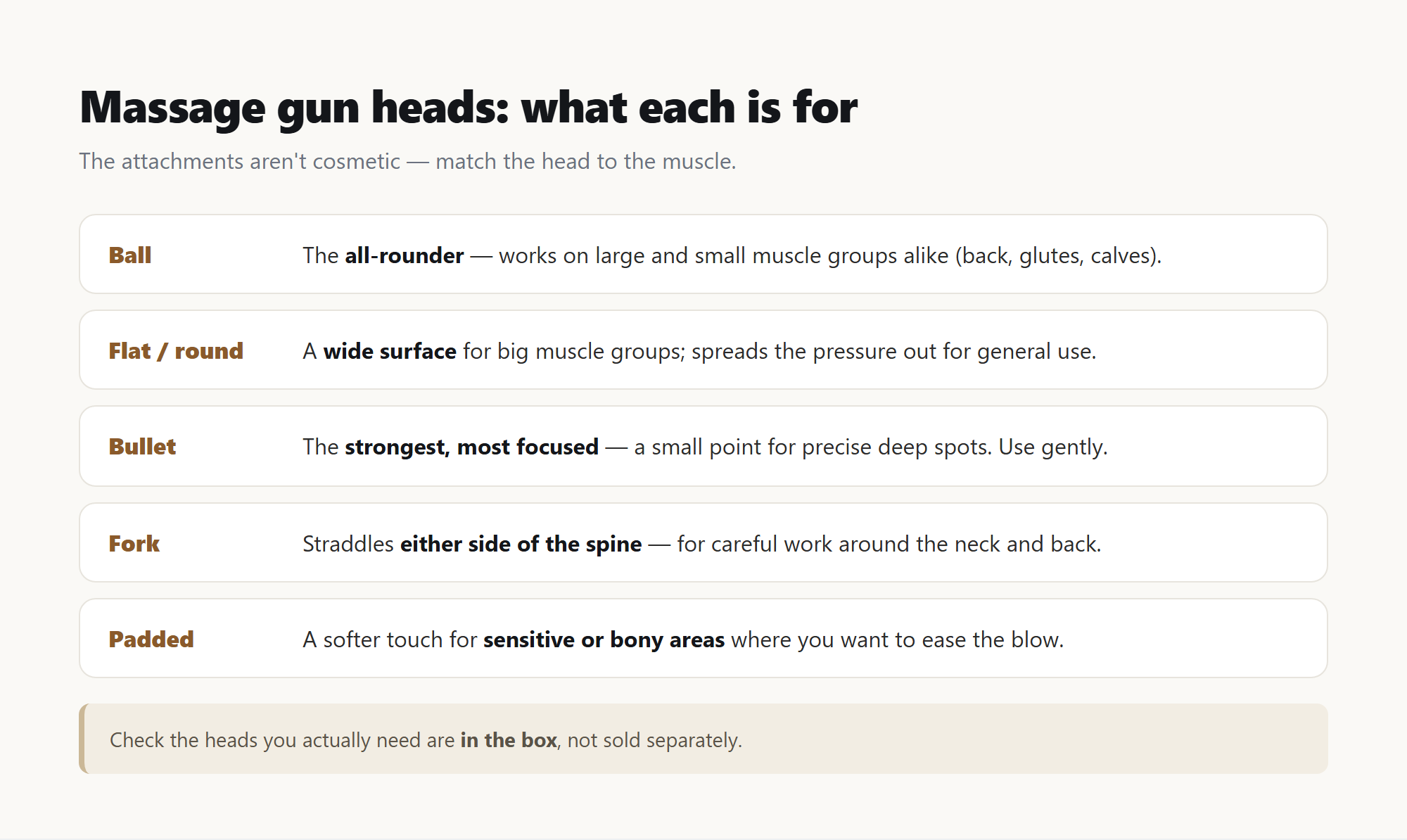
- Ball — the all-rounder, good for large and small muscle groups alike.
- Flat / round — a wide surface for big muscle groups; spreads the pressure out.
- Bullet — the strongest and most focused; a small point for precise deep spots. Use it gently.
- Fork — straddles either side of the spine, for careful work around the neck and back.
- Padded / cushion — for sensitive or bony areas where you want to soften the blow.
Make sure the heads you actually need are in the box, rather than sold separately.
Budget vs premium — what the extra money buys
Now the real question. Here is how the tiers compare on the numbers that count.
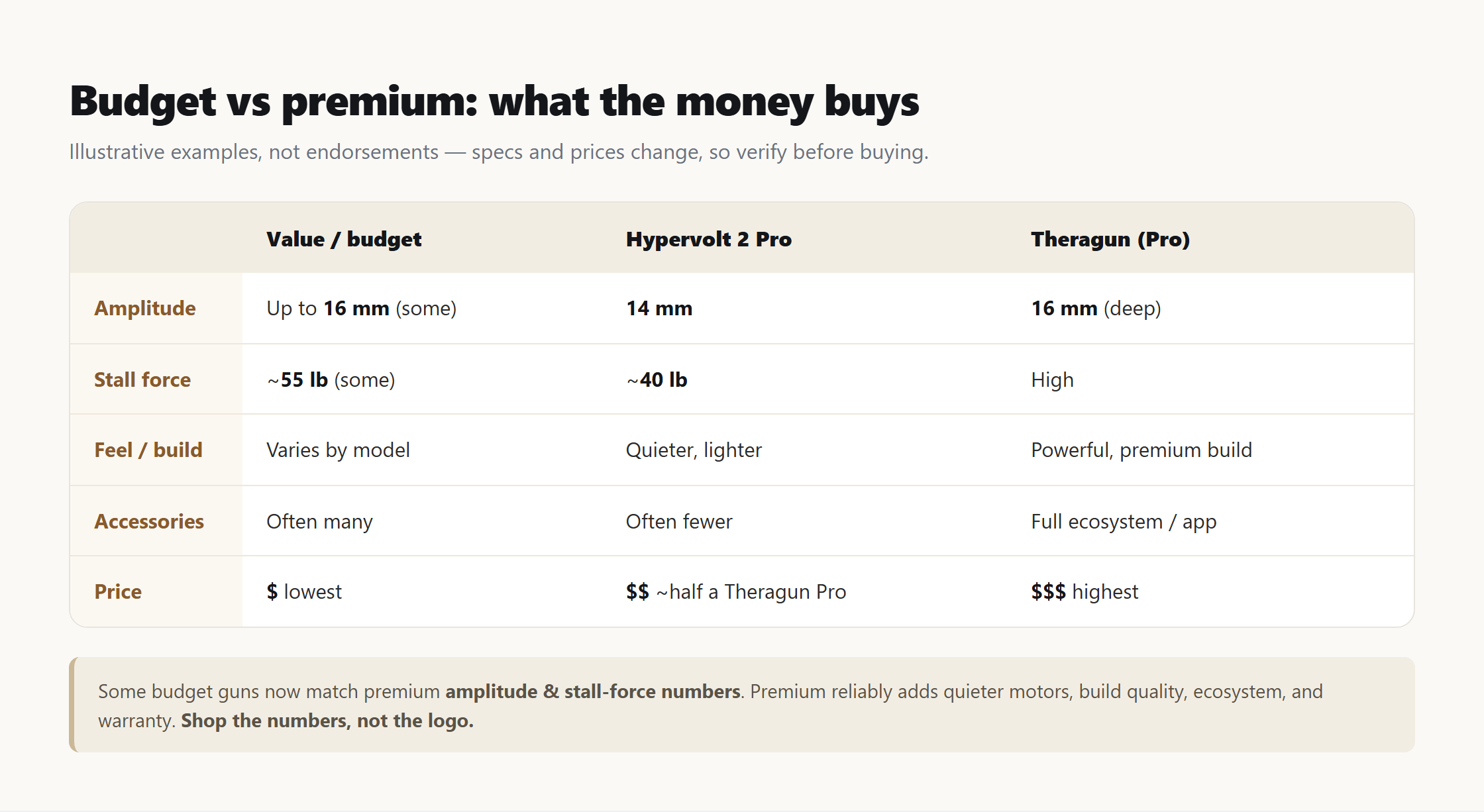
On the premium end, Theragun’s full-size models (Elite, Prime, Pro) use a deep 16 mm amplitude with high stall force. The Hypervolt 2 Pro runs a 14 mm amplitude and around 40 pounds of stall force, and tends to be quieter and lighter — though often with fewer bundled accessories. Notably, the Hypervolt 2 Pro costs roughly half of a Theragun Pro.
Here is the part that surprises people: some budget models now match those numbers on paper. Certain value guns advertise a 16 mm amplitude and around 55 pounds of stall force — matching, or even beating, premium depth specs at a fraction of the price.
So what does the extra money reliably buy? Usually a quieter motor, better ergonomics and build quality, app or ecosystem features, and stronger warranty and support. Whether that is worth roughly double the price depends entirely on how hard, and how often, you will use it.
- Casual, light tension: around 10 to 12 mm amplitude, 20 to 30 lb stall force, light and quiet. A good budget gun is plenty.
- Regular training, deeper work: 12 to 16 mm amplitude, 40 lb-plus stall force — and this is where premium build and lower noise start to earn their keep.

Photo: Alexandru Cojanu / Pexels
One important note on safety
This part is not optional, because a massage gun is more powerful than it looks.
First, the honest framing: this is a device, not a treatment. It can help with everyday soreness and recovery, but it will not replace a trained professional, and it does not fix the underlying cause of pain.
A few rules worth taking seriously:
- Keep it to about 2 to 3 minutes on any one muscle group, and start on a low, slow setting before increasing.
- Avoid the neck — especially the front — any spot where you feel a pulse, bony areas, and any bruises, cuts, scabs, or varicose veins.
- Do not use it on a fresh injury — recent strains, sprains, torn ligaments, or surgical areas. It can make things worse.
- Misuse and overuse carry rare but real risks, including blood-vessel injury and, from extreme overuse, muscle breakdown that can affect the kidneys.
And the line that matters most: if you are pregnant, take blood thinners, or have an injury or medical condition, talk to a healthcare professional before using one. If pain persists, see a doctor — the device is not diagnosing what is actually wrong.

Photo: Vitaly Gariev / Pexels
The short version
If I had to compress all of this into a few lines, it would be this.
Ignore the RPM headline. Read amplitude (how deep — 8 to 10 mm budget, 12 to 16 mm premium) and stall force (whether it holds up under pressure — 20 to 40 lb for home, 40-plus for serious work) first. Then check the things you will actually feel every day: weight, noise, battery, and the right attachments.
Premium buys you quiet, polish, and support. But because some budget guns now match the core specs, the smartest move is to shop the numbers, not the logo — and buy for how you will really use it.
And keep one line in mind: a massage gun is a nice tool for a tired muscle, not an answer for pain that will not leave. That answer belongs to a person, not a device.
Because the best recovery tool in the world still cannot tell you what is actually wrong.
References
- LifestarPro; MassageGunAdvice; TechGearLab — massage gun specs explained and independent testing (amplitude, stall force, noise, weight)
- Cybernews — Theragun vs Hypervolt 2026 (amplitude, stall force, price)
- Forbes / Healthline — best massage guns (weight, noise, battery ranges)
- PTProgress / Bob & Brad — head attachments and their uses
- University of Utah Health; Bob & Brad — massage gun safety (limits, areas to avoid, when to consult a professional)


