Skinny-Fat Men: Why a Pot Belly on a Thin Frame Is Risky
Let me describe a body you might recognize. Maybe it is yours.
Thin arms. Thin legs. A face that looks lean. But sitting right in the middle of all that is a firm, round belly that no shirt quite hides. On paper your weight is “normal.” Your BMI looks fine. So every checkup tells you that you are healthy, and something about that never quite adds up.
I want to be honest with you about what that belly usually is. And first, the standard disclaimer: I am not a doctor, and this is general information, not medical advice. But this particular pattern is common enough — and quietly risky enough — that it is worth understanding properly.

Photo: Towfiqu barbhuiya / Pexels
The “skinny-fat” body has a name
Doctors have a slightly blunt term for it: TOFI — Thin Outside, Fat Inside.
It describes a person with a normal BMI and lean-looking limbs who is nonetheless carrying too much visceral fat — the deep fat packed around your internal organs, your liver, pancreas, and intestines. Little fat under the skin, a lot of it inside. That is why you can look slim and still have a belly that sticks out.
Here is the counterintuitive part. Visceral fat makes up only about 10% of your total body fat. But it is the dangerous 10%. It is metabolically active in a way that the soft fat under your skin simply is not.

Why the inside fat is the dangerous kind
The fat you can pinch — subcutaneous fat, just under the skin — is, in Harvard Health’s words, the kind that “appears to cause few health issues.” It is mostly a storage problem, not a health emergency.
Visceral fat is a different animal. Because it sits around your organs and is metabolically busy, it is tied to a stack of heart-disease risk factors: higher blood pressure, higher blood sugar, and worse cholesterol. Push a little further into the research and visceral fat is linked to insulin resistance, type 2 diabetes, fatty liver disease, unhealthy triglycerides, and cardiovascular disease.
Read that list again, because here is the uncomfortable truth: a “skinny-fat” man with a normal weight can carry the same metabolic risk as someone who looks visibly overweight. The thin frame is hiding it, not preventing it. That is exactly what makes this pattern sneaky — the scale keeps telling you everything is fine.
How to actually check — because the scale can’t
Since your weight and BMI can miss this entirely, you need a better ruler. Literally.
Waist circumference is the simplest home check. For men, a waist of 40 inches (102 cm) or more signals excess visceral fat. Measure at the level of your navel, standing relaxed, without sucking in or compressing the tape.
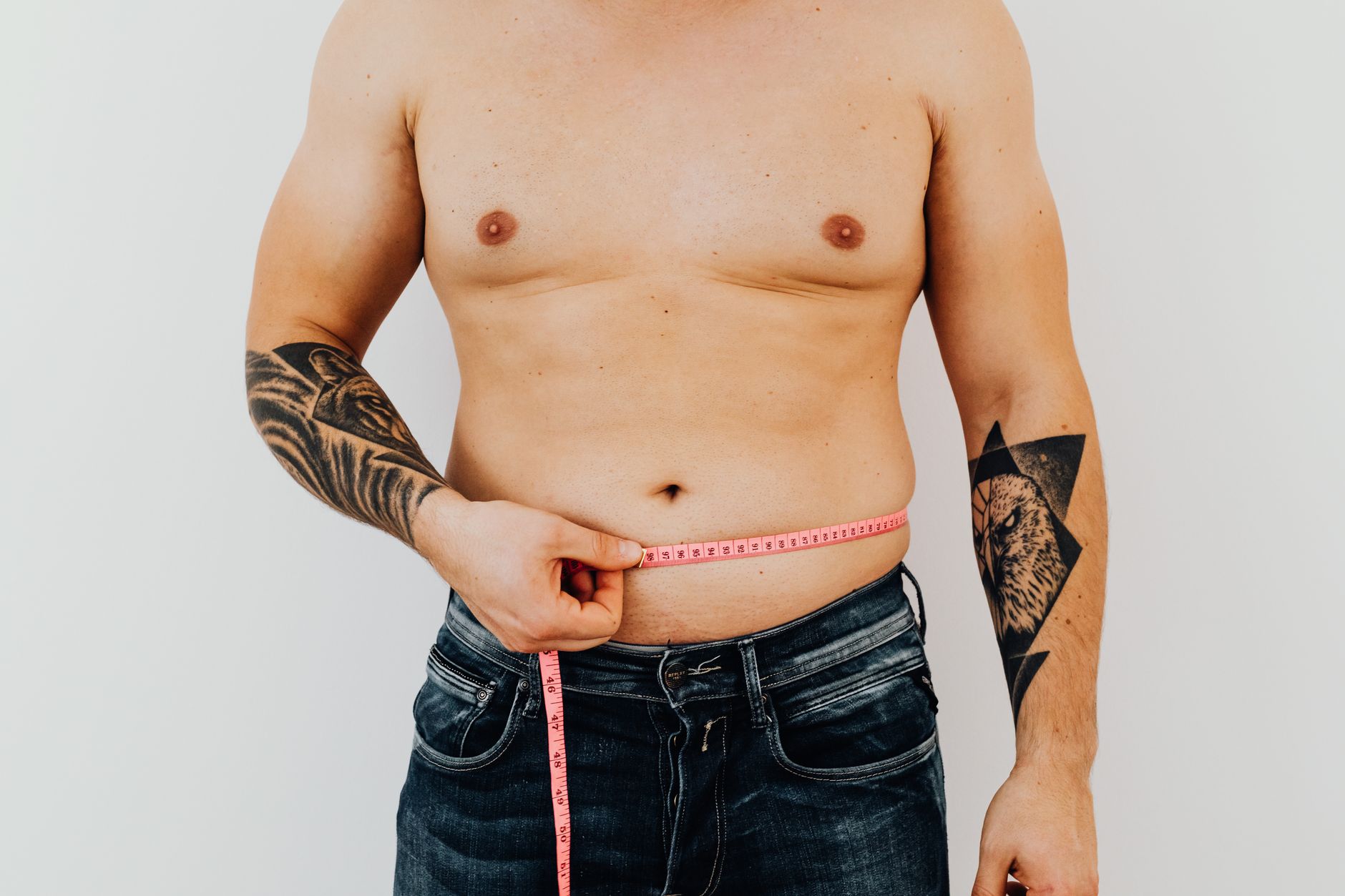
Photo: www.kaboompics.com / Pexels
That number is not just cosmetic. Men whose waist crosses 40 inches face roughly double the risk of cardiovascular disease, along with higher type 2 diabetes risk. If you want a fuller picture, a body-composition scan (like a DEXA) measures visceral fat directly — and this is genuinely a case where a clinical evaluation beats the bathroom scale. If your waist is over the line, that is worth a conversation with a doctor, not a private worry.
Cutting it: start with the refined carbs
The good news is that visceral fat responds to lifestyle changes — often better than the stubborn fat under your skin.
The first lever is diet, and the target is specific. Refined carbohydrates and added sugar — white flour, sugary drinks, processed snacks — are strongly linked to storing more visceral fat. Cutting them is where the biggest, fastest wins tend to come from.

Photo: Odin Reyna / Pexels
What to lean into instead:
- Soluble fiber — vegetables, fruit, legumes, whole grains. Aim for roughly 28–34 grams of fiber a day.
- Adequate protein, to hold onto muscle while you lose fat.
- Fewer liquid calories — sodas and sweet drinks are the easiest large cut most men can make.
Then move — cardio and strength, together
Exercise is the second lever, and the research is refreshingly clear: both aerobic activity and strength training trim visceral fat or stop it from growing. You do not have to pick a side. In fact, the combination beats either one alone.
A practical, Harvard-cited prescription looks like this:
- 30 to 60 minutes of moderate-to-intense aerobic exercise, 2–3 days a week (brisk walking counts).
- 2 resistance-training sessions a week to build metabolically active muscle.
- Interval training as a useful add-on when you want more return on limited time.

One honest expectation to set. Visceral fat is willing, but not instant. When you start losing weight, only about one-third of the early loss comes from visceral fat — your body sheds the surface stuff first. So the belly may hold on a little longer than the scale suggests. That is normal. Keep going.

Photo: MART PRODUCTION / Pexels
One myth worth clearing up
You have probably heard that fasted cardio — working out on an empty stomach — burns more fat. It is one of the stickiest ideas in fitness, so let me give you the careful version.
The evidence does not support it as a fat-loss trick. A systematic review found no meaningful difference in weight loss or body composition between fasted and fed cardio. You may burn a bit more fat during the fasted session, but your body compensates for the rest of the day. What actually drives results is your total activity and overall diet — the energy balance across the week, not the timing of one workout.
And there is a safety note here, especially for men over 40. Training fasted can risk low blood sugar, and it tends to blunt performance on longer or harder sessions. If you take glucose-lowering medication, have any heart concerns, or have a history of disordered eating, talk to a clinician before making empty-stomach workouts a habit. There is no prize for skipping breakfast.
The short version
If I had to compress this down, it would be this.
Looking thin is not the same as being healthy. A pot belly on a slim frame is usually visceral fat — the deep, metabolically active fat that raises your risk of diabetes, high blood pressure, fatty liver, and heart disease, even when your weight looks normal. Check your waist (40 inches is the line for men) rather than trusting the scale. Cut refined carbs and sugary drinks first, then combine regular cardio with strength training. Skip the fasted-cardio shortcut — total effort and diet matter far more.
The belly is not a cosmetic footnote. It is the one part of a “thin” body that is actually worth paying attention to.
Because the risk you cannot see is still the risk that counts.
References
- Harvard Health Publishing — “An inside look at body fat,” “Taking Aim at Belly Fat,” “Should you worry about your waistline?”
- WebMD — “What is visceral fat”
- TOFI (Thin Outside, Fat Inside) clinical overviews — visceral fat and metabolic risk
- Examine.com — “Is it better to do aerobic exercise fasted?”
- Systematic review/meta-analysis — aerobic exercise and waist circumference (PMC)