Probiotics Not Working? Pair Them Right for Gut Health
Let me be honest about something.
For a long time, I bought probiotics the way I buy phone chargers — grab the one with the biggest number on the box and hope for the best. Fifty billion CFU. A hundred billion. Surely more is better, right?
Then I read how these things actually behave in the gut, and I felt a little silly.
Because here is the uncomfortable truth: taking a probiotic all by itself can be close to wasting money. Not always, but often. The live bacteria are fragile, most of them don’t move in and stay, and without a few supporting players they have very little to work with. If your gut routine feels like it isn’t doing much, this is worth reading — the fix is usually not a stronger probiotic, but a smarter combination.
One thing before we go further, though.
I am not your doctor, and none of this is medical advice. It is general information drawn from sources like ISAPP, peer-reviewed reviews on PubMed, the American Gastroenterological Association, and Cleveland Clinic. Supplements complement a balanced diet — they are not treatments. If you have IBS or any chronic gut condition, the honest first step is a real diagnosis from a doctor, not a new bottle.

Photo: Mikael Blomkvist / Pexels
Why probiotics alone often underdeliver
Here is the part the label doesn’t tell you.
Probiotics are, by definition, live microorganisms — ISAPP defines them as “live microorganisms that, when administered in adequate amounts, confer a health benefit.” The word that matters there is live. They have to survive to do anything.
And they are fragile. Heat, stomach acid, and time on a shelf all kill them off. That is a well-known weakness of live probiotics. In a lab simulation of the gut, survival dropped significantly on the way through — though, to be fair, it still stayed above 50%. So some make it. But “some” is doing a lot of work in that sentence.
The bigger surprise for me was colonization.
We tend to imagine probiotics as settlers who arrive, build a house, and stay. Mostly, they don’t. They act while passing through, and once you stop taking them, their effect tends to fade. One study did find that three weeks of a multi-strain probiotic colonized the colon during use — but durable, permanent residence is not the norm.
So the number on the box was never really the point. How you support those bacteria matters just as much.
Prebiotics: the food your good bacteria actually eat
If you remember one word from this article, make it prebiotic.
A prebiotic, in ISAPP’s words, is “a substrate that is selectively utilized by host microorganisms.” In plain English: it is food for your good bacteria — usually a special kind of fiber. Send in probiotics without anything to feed the beneficial microbes, and you have invited guests to an empty fridge.
You have probably eaten prebiotics without knowing it. The common ones are inulin, fructo-oligosaccharides (FOS), and galacto-oligosaccharides (GOS). On a label you will rarely see the word “prebiotic” — you have to spot those names in the ingredient list instead.
From food, they show up in:
- Onions and garlic
- Bananas
- Chicory root and Jerusalem artichokes
- Some yogurts, breads, and cereals
Consumer guidance often points to at least 5 grams of prebiotics a day as a general target. Think of it less as a strict dose and more as a direction: feed the bacteria you are trying to grow.

Photo: Viktoria Slowikowska / Pexels
One honest caveat. Those same fibers — inulin, FOS — are FODMAPs, and in a sensitive or IBS-prone gut they can cause gas and bloating. Start low. Increase slowly. More is not automatically better here either.
Synbiotics and postbiotics: two smarter ways to combine
This is where the “combination” idea gets genuinely interesting.
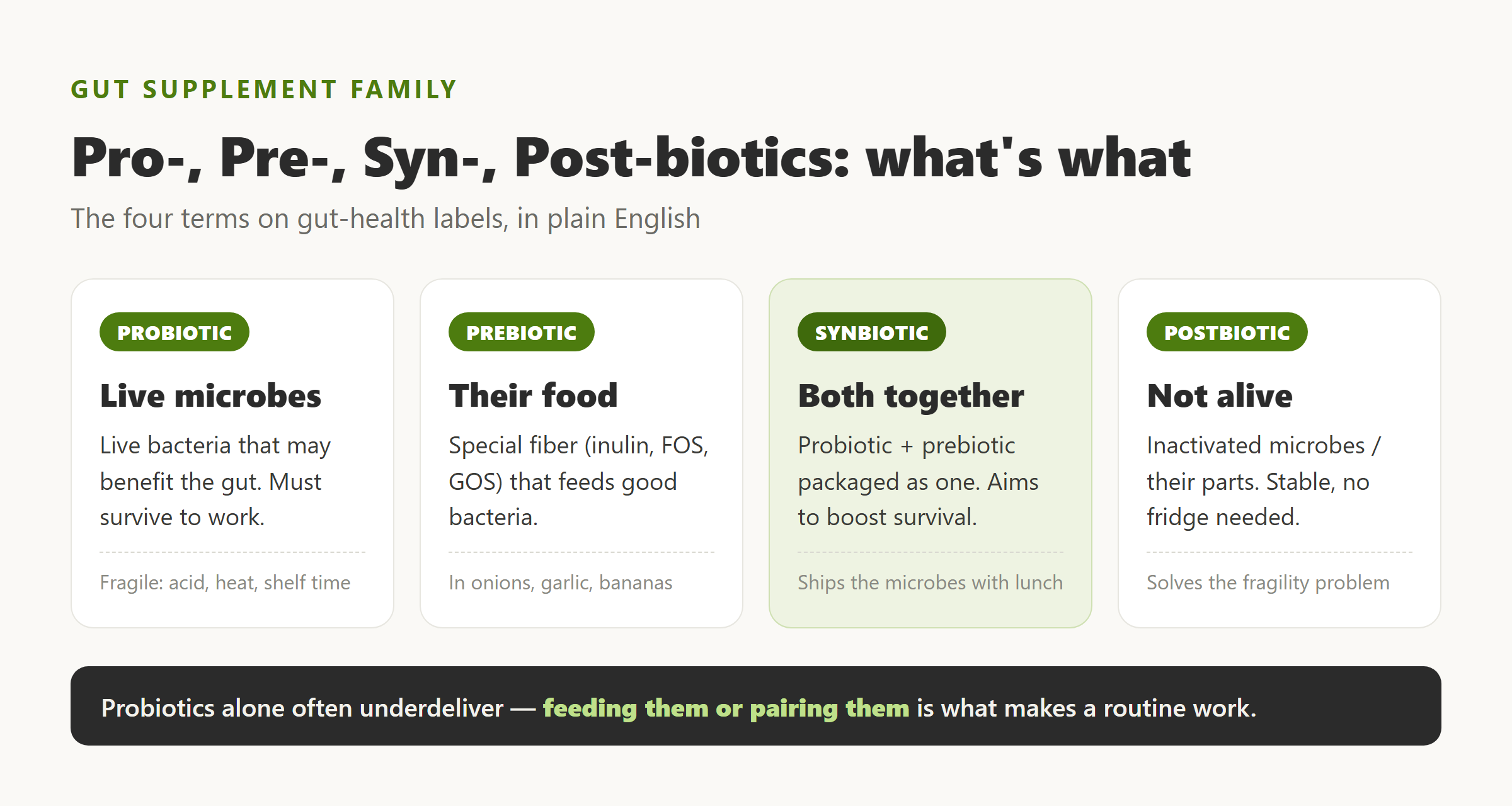
A synbiotic is simply a probiotic and a prebiotic packaged together. And this is not just marketing bundling — reviews describe synbiotics as mixtures that enhance the survival and colonization of the live microbes in the gut. You are shipping the bacteria with their lunch. Co-administering the two can enhance and prolong the beneficial effects.
A postbiotic is the plot twist. ISAPP defines postbiotics as “preparations of inanimate microorganisms and/or their components that confer a health benefit.” In other words — not alive. And that solves the fragility problem entirely: because there is nothing to keep alive, postbiotics don’t need refrigeration and stay potent through their shelf life.
So which is best? Honestly, that is not settled.
ISAPP itself frames probiotics and postbiotics as complementary, not competing — you choose based on the specific microbe, the person, and the goal. Synbiotics and postbiotics are mechanistically sensible and promising, but head-to-head proof that they beat a plain probiotic for the average healthy person is still being built. So I would choose based on a specific, documented product — not a bottle shouting “explosive synergy.”
Gut-barrier helpers: glutamine and zinc
There is one more layer, and it matters most if you deal with chronic gut trouble.
Your gut lining is held together by “tight junctions.” When those loosen — the thing people loosely call a “leaky gut” — larger molecules slip through, and that increased permeability shows up alongside conditions like IBS, IBD, and celiac disease. Two supplements have early evidence for supporting that barrier.
L-glutamine is a major fuel for intestinal cells and helps maintain the mucosal lining and tight-junction function. In one subgroup — people with post-infectious IBS-D and measurable leaky gut — glutamine reduced abdominal pain and helped restore the barrier, and it improved the results of a low-FODMAP diet. A trial context figure: about 0.5 g/kg/day over four weeks lowered intestinal permeability in Crohn’s patients. But — and this is important — larger trials have been mixed.
Zinc, especially zinc-L-carnosine, can help maintain gut-lining integrity and support tight-junction proteins like occludin. In one exercise study, 14 days of zinc-L-carnosine blunted an exercise-induced spike in gut permeability by around 70%. A randomized crossover trial used 37.5 mg twice daily.

I want to stay honest about all of this. These are mostly small studies, and the signal is strongest for specific subgroups, not everyone. Treat glutamine and zinc as adjunct support worth discussing with a clinician — not a cure you self-prescribe.
So how do you actually pick a combo that helps?
Let me try to make this practical.
- Feed them. Pair your probiotic with prebiotic fiber — from food (onions, garlic, bananas, whole grains, legumes) or a synbiotic product. This is the single highest-value move.
- Match the strain to the goal. Probiotic effects are strain- and combination-specific, not “more CFU wins.” Look for a named strain with evidence for your specific aim, not just a big number.
- Mind the form and storage. Live probiotics are fragile; postbiotics and encapsulated or synbiotic formats are designed to survive better. Check storage and expiration.
- For chronic symptoms, add support carefully. Barrier helpers like glutamine or zinc-L-carnosine may help some people — but loop in a professional.

Photo: John Joshua Mejia Jose / Pexels
The safety part — please don’t skip this
Most of this article is about getting more from your gut routine. This part is about not getting hurt.
Here is the biggest reality check: the American Gastroenterological Association does not recommend probiotics for most adults or children with IBS, for either overall symptoms or abdominal pain. The evidence is low-certainty and the benefits are strain-specific. So “probiotics fix IBS” is an overstatement. Some strains may help some people — but it is genuinely not settled, and anyone selling you certainty is selling you something.
And probiotics are not risk-free for everyone.
- For most healthy people, they are well tolerated. But in immunocompromised or critically ill people, live probiotics can rarely cause serious infection. Experts specifically advise avoiding S. boulardii in those who are immunocompromised, critically ill, or have a central venous catheter.
- High-risk conditions — severe pancreatitis, short bowel syndrome, certain heart-valve problems, premature infants — call for real caution.
- Pregnant, managing a chronic illness, or on prescription medication? Check with a clinician before starting anything new.
I know that is less fun than a synergy hack. But a two-minute question to your doctor or pharmacist is the cheapest insurance you will ever buy.
The short version
If I had to compress all of this onto a sticky note, it would read like this.
A probiotic alone is a guest with no food and no permanent home. Feed it with prebiotic fiber, or buy a synbiotic that ships the two together. Consider postbiotics if shelf stability matters to you. If you have chronic gut trouble, barrier support like glutamine or zinc might help — but that is a conversation with a professional, not a solo experiment. And keep your expectations honest: even the big gut-health society won’t promise probiotics will fix IBS.
None of this makes a supplement do more than it can. What it does is stop you from paying for live bacteria you then quietly starve.
Because the bottle was probably never the problem. It was what you sent in with it.
And that, at least, is something you can fix on your next grocery run.
References
- ISAPP — consensus statements on probiotics, prebiotics, and postbiotics
- PubMed Central — reviews on probiotics, prebiotics, synbiotics, and gut-barrier integrity
- American Gastroenterological Association — guidance on probiotics for GI disorders
- Frontiers in Nutrition (2021) — glutamine and low-FODMAP diet in IBS
- PMC — zinc-L-carnosine and small-bowel integrity
- CDC Emerging Infectious Diseases — safety of probiotic use