Mood Swings and the Dopamine Detox Myth, Explained
Mood Swings and the “Dopamine Detox”: What Overstimulation Really Does
Let me describe a day I know too well.
You wake up almost buzzing. By mid-morning you feel great. Then, somewhere after lunch, the floor drops out — you go flat, irritable, restless, and you could not tell anyone exactly why. The only thing that reliably lifts you is your phone: a reel, a short, a scroll. And ten minutes after you put it down, ordinary life feels a little grey again.
If your mood swings for reasons you cannot name, and the only thing that feels good is the screen, this article is for you.
One honest note before we go further, though.
I am not a clinician, and this is not a diagnosis. It is general information drawn from sources like the Cleveland Clinic, Ohio State Health, and Harvard Health. And I am going to be careful about one thing in particular, because a lot of what is said online about this is simply wrong. If your mood swings are frequent, severe, or getting in the way of your life, the honest answer is not a “detox” — it is a conversation with a mental health professional.
Photo: Ryszard Zaleski / Pexels
Why small things swing your mood
Let me start with what might actually be going on, without overstating it.
Your brain has a reward system, and dopamine is a big part of it. It evolved to reward the things that kept us alive — food, connection, progress. It works on a kind of contrast: a reward feels good relative to what your brain expected.
Now feed that system a steady stream of short-form video. Each clip is engineered to deliver a fast, reliable hit — and the next one is always one thumb-flick away. Over time, researchers who study this suggest the brain habituates. The baseline creeps up. What used to feel like plenty now feels like not enough, and you need something faster and more intense to feel the same spark.
Here is where the mood comes in. When your “normal” is set that high, ordinary calm stimuli — a walk, a chore, a slow conversation — start to feel flat and unsatisfying. And when the stimulation is suddenly gone, irritability can spike. Some studies also note that flipping between emotionally charged clips — something delightful, then something enraging, seconds apart — is linked to abrupt shifts in mood-related brain activity. Hours of that, and a certain emotional whiplash starts to make sense.
I want to be fair about the evidence, though. This “TikTok brain” research is still young, mostly correlational, and often more commentary than hard trial. So hold it as a plausible pattern, not a proven verdict. But if it describes your day, it is worth taking seriously.

The “dopamine detox” — a catchy phrase, not a cure
So the internet’s answer arrives, neatly packaged: do a dopamine detox. Strip away all pleasure for a day, “reset” your brain, and come back cured.
I have to be blunt here, because the framing matters more than almost anything else in this article.
You cannot reset or drain your dopamine. It is not a toxin. As Harvard’s Dr. Peter Grinspoon puts it, dopamine “does not accumulate or get depleted like fuel, and taking breaks does not flush it out.” Your body produces dopamine constantly, because you need it — to move, to focus, to feel motivated at all. Dr. Susan Albers of the Cleveland Clinic says it plainly: “We need dopamine in every system in our body — to move, to sleep, to experience pleasure.”
The Cleveland Clinic’s verdict on the trend is equally direct: dopamine detoxes are “a wellness trend based on bad science.” The popular story — that screens flood you with dopamine and that you can fast your way back to a clean slate — misunderstands how the brain works. Dopamine is not the “pleasure chemical” so much as the motivation and reward-prediction chemical, and it is not something you can purge in a weekend.

Photo: cottonbro studio / Pexels
Here is the twist, though: the underlying instinct is not entirely wrong. The term “dopamine fasting” was coined by a psychologist, Cameron Sepah, back in 2019 — and he meant something much more sensible than what went viral. His target was not dopamine at all. It was impulsive, compulsive behaviors: mindless scrolling, emotional eating. He even admitted the name was catchy branding, “not to be taken literally.” What he was really describing was plain cognitive behavioral therapy — changing a habit with awareness and structure.
So the accurate version is this. You do not lower your dopamine. But by doing less of a behavior that hands you constant cheap hits, you let your reward system grow more responsive again to slower, gentler rewards. That is not a chemical purge. It is habit change. And habit change actually works.
What actually helps — moderate, then feed it better
Once you drop the “reset” fantasy, a genuinely useful plan appears. It comes in two moves.
A weekly “detox” day — done the sensible way
Do not try to renounce all pleasure. That is the version that fails by Tuesday.
Instead, pick one behavior — short-form video is the usual culprit — and pull back on it in a contained way. A screen-light day once a week. Set hours where the phone lives in another room. As Dr. Albers says, “Behavior change doesn’t have to be really intense and complex” — modest, sustainable changes beat all-or-nothing extremes every time.
While you are at it, keep a small note of what triggers the reach for the phone, and how you feel afterward. That tracking is not busywork; it is the part that turns a vague resolution into an actual habit shift.

Photo: Valentin Ilas / Pexels
Feed the reward system slower food
Cutting back leaves a gap, and a gap wants filling. Fill it deliberately.
The most reliable replacements are the slow ones — the rewards your brain was built for before any of this existed:
- Walk, ideally outside. Time in green space is linked to lower stress, better mood, improved working memory, and less mental fatigue. Even 20 to 60 minutes of slow, unhurried walking helps renew your attention.
- Read something longer than a caption. Deep, focused reading gently retrains an attention span that short clips have chopped up.
- Do something with your hands. Cooking, gardening, music, drawing — all of them release dopamine naturally.
That last point is the quiet punchline. The goal was never less dopamine. Exercise, connection, good food, a hobby you lose yourself in — these all light up the same reward system. You are not starving it. You are shifting it from fast, cheap hits toward slower, deeper ones. And on that kind of input, the small stuff starts to feel like enough again.

Photo: Anna Shvets / Pexels
When it is more than a habit
I want to end on the caution I opened with, because it is the most important line here.
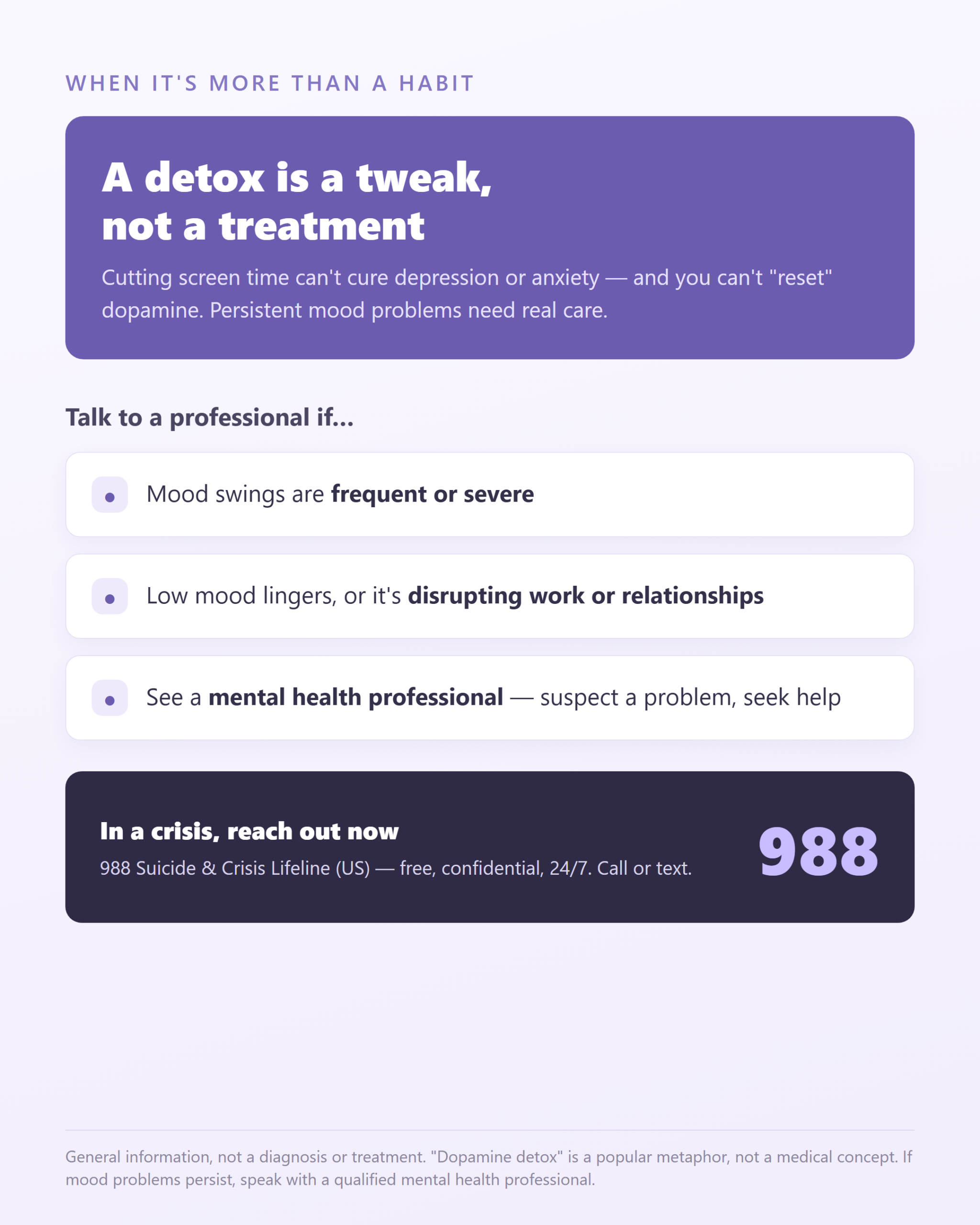
A digital detox is a lifestyle tweak. It is not a treatment for a mood disorder, and it cannot cure depression or anxiety — no matter how many videos promise otherwise. If your mood swings are frequent or severe, if a low mood settles in and will not lift, or if any of this is disrupting your work or your relationships, that is the signal to talk to a mental health professional — a psychiatrist, psychologist, or licensed therapist. Suspecting there is a problem is reason enough to ask.
And for the heavier moments — if the low ever brings thoughts of harming yourself, or a sense of hopelessness — please reach out right now. In the US, you can call or text 988 to reach the 988 Suicide & Crisis Lifeline. It is free, confidential, and available every hour of every day.
The short version
If I had to compress all of this, it would be these few lines.
Constant short-form stimulation may raise your reward baseline, which can leave ordinary life feeling flat and your mood swinging when the screen goes away. A “dopamine detox” is a catchy metaphor, not real science — you cannot reset or drain dopamine, and you should not believe anyone who says you can. But the sensible core survives: moderate one over-stimulating habit, and refill the space with slow, meaningful rewards like walking, reading, and making things. And when it is more than a habit, let a professional help.
You were never broken, and your brain does not need a factory reset.
It just got used to a very loud diet — and quietly, patiently, it can learn to enjoy a quieter one again.
References
- Cleveland Clinic — “What Is a Dopamine Detox and Does It Work?”
- Ohio State Health & Discovery — “Dopamine fasting: Does it work?”
- News-Medical (citing Harvard’s Dr. Peter Grinspoon) — “Is Dopamine Detoxing Actually Backed by Science?”
- Philadelphia Integrative Psychiatry — “The Impact of Social Media and Video Games on Dopamine Regulation”
- Southwest General / Mindful Ecotherapy Center — digital detox and nature attention-restoration
- 988 Suicide & Crisis Lifeline — 988lifeline.org
This article is general information and is not a substitute for professional diagnosis or treatment. “Dopamine detox” is a popular metaphor, not a medical concept — dopamine cannot be literally reset or depleted. If your mood swings or low mood persist or worsen, please speak with a qualified mental health professional. In a crisis, call or text 988 (988 Suicide & Crisis Lifeline).