Acid Reflux After Crash Dieting: Why the Binge Cycle Burns
Let me be honest with you first. I used to think a “crash diet” was just a fast way to a slower, healthier me. Skip enough meals, the logic went, and the rest would take care of itself.
Then came the nights.
By 11 p.m. I wasn’t dieting anymore. I was standing at the counter finishing something fried, something salty, whatever was closest. And an hour after lying down, there it was: that slow burn climbing up behind the breastbone. If you’ve searched for acid reflux after crash dieting, you probably already know the feeling. The good news is that the cascade behind it is understandable, and most of it is fixable. This article walks through what’s actually happening, which foods to watch, and a gentler recovery plan — the kind that treats the cause, not just the burn.
One thing up front. This is educational information, not medical advice. Reflux that keeps coming back deserves a real conversation with a clinician.

What acid reflux actually is
Acid reflux is stomach acid flowing backward, up into the esophagus and throat. There’s a small circular muscle at the bottom of the esophagus called the lower esophageal sphincter, or LES. It opens to let food into the stomach, then closes to keep the contents down.
Reflux happens when that muscle weakens or relaxes enough to let acid slip past. Lying down after a large meal is a classic way to trigger that temporary relaxation. When the reflux becomes frequent or chronic, it gets a name: GERD — gastroesophageal reflux disease.
The esophagus doesn’t have the stomach’s protective lining, so the acid burns. Over time it can irritate the tissue. According to Cleveland Clinic, the contributing factors read like a familiar list: LES weakening, hiatal hernia, obesity, pregnancy, smoking, certain medications — and, notably for us, overeating and late dinner timing.
There’s also a rough clinical line worth knowing. Symptoms showing up at least twice a week for several weeks point toward chronic GERD that’s worth getting evaluated.
How crash dieting feeds the reflux cycle
Here’s where I want to be careful, because this is the heart of the article and it’s easy to overstate.

Photo: Pavel Danilyuk / Pexels
The “crash diet leads to reflux” story is best understood as a model — a physiology-based explanation — rather than a single proven statistic. But each link in the chain is real and documented.
Think of it as three triggers arriving at the same time, late at night:
- A full stomach. Extreme fasting and severe calorie restriction tend to provoke rebound hunger. That hunger often shows up as disinhibited, late-night binge eating. A full stomach raises abdominal pressure, pushing contents up against the LES.
- The wrong foods. The things people binge on — high-fat, fried, spicy, salty — are exactly the direct triggers. High-fat foods delay stomach emptying and relax the LES (NIDDK, Cleveland Clinic).
- The horizontal position. Eat all that, then lie down, and you’ve stacked a full stomach, LES-relaxing food, and gravity working against you — all at once.
So the crash diet doesn’t cause reflux by magic. It sets up the behavior — the starve-then-binge swing — and the behavior lines up three well-known triggers in a single evening.

What the night-eating research suggests
There is one study worth naming, with an honest caveat attached.
A 2024 cross-sectional study of 554 university students found that 64.9% of night eaters had GERD symptoms, versus 29.8% of non-night eaters. Night Eating Syndrome came out as an independent predictor of GERD, with an adjusted odds ratio of 2.84 — roughly three times the likelihood. The proposed mechanism: late-night eating raises gastric acid production, and shorter dinner-to-bedtime intervals significantly increase the odds of reflux.
Now the caveat, because it matters. This was cross-sectional research — it shows association, not proven cause — in a student population in Palestine, not a U.S. clinical trial. It points in a direction. It doesn’t close the case. I’d rather tell you that than dress it up as more than it is.
The symptoms worth recognizing
Reflux is more than heartburn, though heartburn is the headline. Common GERD symptoms include:
- Heartburn — burning chest pain behind the breastbone, often worse at night, after large or fatty meals, or when bending over or lying down.
- Regurgitation — acid, food, or liquid washing back up into the throat or mouth, with a bitter or sour taste.
- Hoarseness, sore throat, or laryngitis — from acid reaching the throat.
- Globus — that sensation of a lump in the throat.
- Chronic cough, wheezing, or aggravated asthma.
- Noncardiac chest pain that can mimic heart pain, plus nausea and reduced appetite.
The pattern is telling: symptoms characteristically worsen at night, after large or fatty meals, when bending over, and after smoking or alcohol. If that sounds like your late-night binge described back to you, that’s not a coincidence.
Foods and drinks that commonly trigger reflux
Some foods are repeat offenders (NIDDK, AGA, Cleveland Clinic):
- High-fat and fried foods
- Spicy foods
- Caffeine — coffee and other sources
- Chocolate
- Carbonated beverages
- Acidic foods — citrus, tomatoes and tomato-based products
- Alcohol (experts advise avoiding it entirely with GERD, or keeping it to one drink a day)
- Mint and peppermint
Here’s a modern nuance I found genuinely reassuring. Doctors no longer recommend a blanket, restrictive elimination diet for everyone. Newer guidance from Mayo Clinic (2024–2025) is to avoid the foods you personally know worsen your symptoms, rather than cutting all of the above at once. Triggers vary from person to person. So the smarter move isn’t to fear food — it’s to pay attention to yours.
Foods that tend to help
The reflux-friendlier side of the plate (Johns Hopkins, AGA):
- High-fiber foods — oatmeal, whole grains, brown rice, whole-grain bread. Fiber fills you up on less, so you’re less likely to overeat in the first place.
- Alkaline, higher-pH foods — melons, bananas, cauliflower, fennel, nuts. Ginger belongs here too, and it’s often soothing. One honest exception: ginger triggers heartburn in some people, so test your own tolerance.
- Watery foods — celery, cucumber, watermelon, broth-based soups, non-caffeinated herbal teas. They dilute stomach acid.
- Lean proteins — chicken, turkey, fish, seafood. Low in fat, less likely to trigger reflux than fatty or fried meats.
- Non-citrus fruits — bananas, melons, apples, pears instead of oranges, grapefruit, or tomatoes.
As a pattern, the AGA recommends the Mediterranean diet as the most beneficial for GERD — whole foods, lean protein, healthy fats, minimal processed food. Their targets, if you like numbers: added sugar under 36 g a day for men and 24 g for women, saturated fat under 7% of calories, alcohol at one drink a day or less.
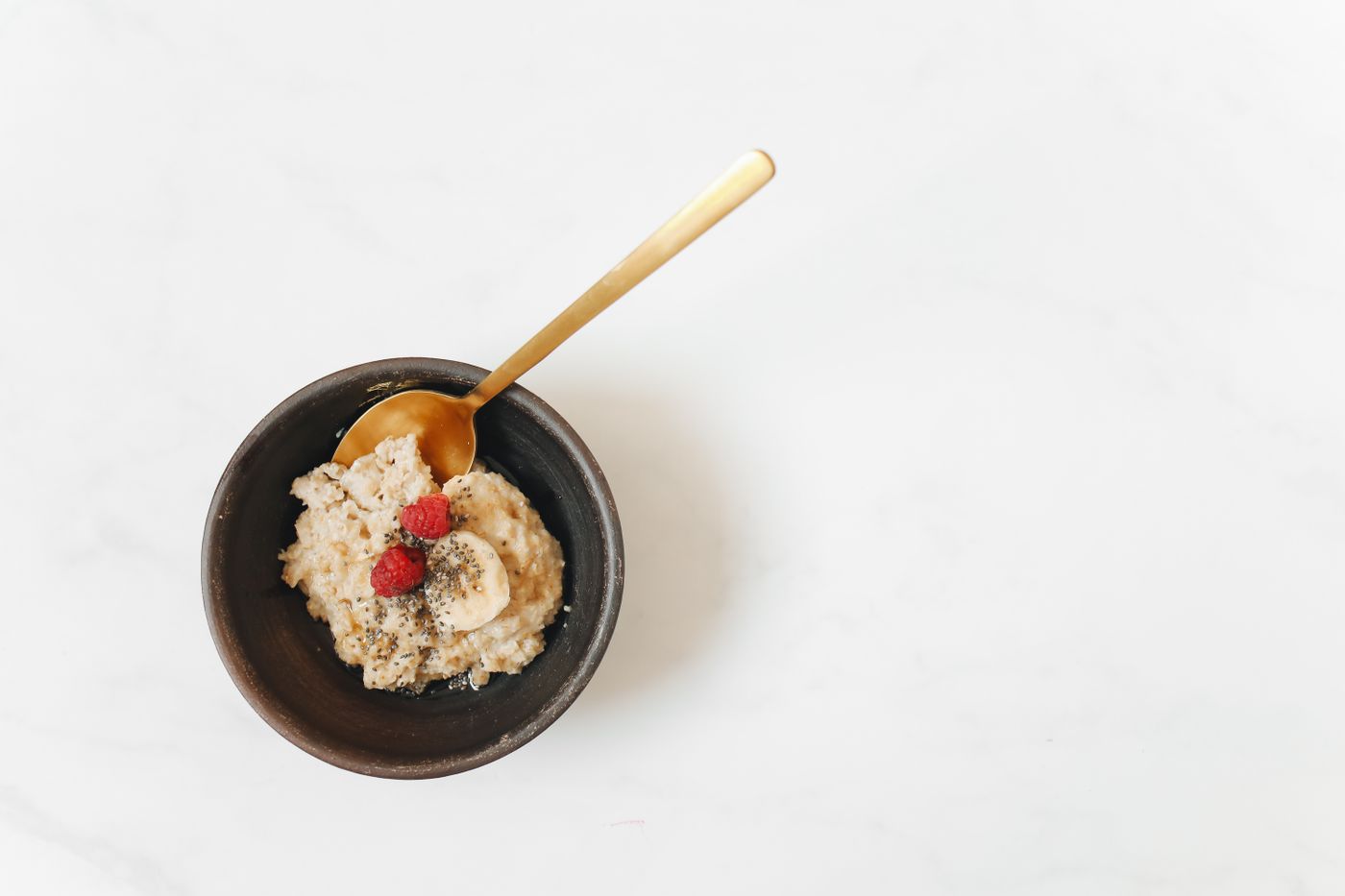
Photo: Polina Tankilevitch / Pexels
The lifestyle fix (this is where it turns around)
If the crash-diet cycle is a set of triggers arriving together, the fix is mostly about pulling them apart. Evidence-based habits (NIDDK, AGA, Mayo, Cleveland Clinic):
- Stop eating at least 3 hours before you lie down. NIDDK is direct about this, and it counters the late-night binge more than any single food swap.
- Eat smaller, more frequent meals instead of a few large ones, so your stomach isn’t overfilled.
- Sit upright while you eat, and don’t lie down right after. Skip the workout immediately after a meal, too.
- Elevate the head of the bed about 6 inches — blocks under the bedposts or a wedge, not just a stack of extra pillows (Mayo Clinic).
- Lose excess weight gradually if you’re carrying it. Extra weight raises abdominal pressure; easing that pressure eases reflux.
- Stop smoking, and limit or avoid alcohol.
- Move regularly — the CDC’s 150 minutes of moderate activity a week supports weight management. Just not right after eating.
Healthy weight loss vs. crash dieting
I want to close the loop on the diet question, because it’s easy to draw the wrong lesson.
Obesity clearly worsens GERD, and sustainable weight loss genuinely improves it. That much is well established. So the answer isn’t “don’t try to lose weight.”
The answer is that the method matters. Extreme starvation dieting can backfire — not because weight loss is bad, but because rapid, severe restriction tends to trigger the rebound late-night binges on exactly the trigger foods. It swaps one problem for another. And it’s rarely sustainable anyway.
The recommended approach is quieter than a crash diet, and that’s the point: gradual, sustainable weight loss through a balanced, reflux-friendly pattern, regular meal timing with no late-night eating, smaller portions, and steady activity. A plan that lowers the weight and removes the behavioral triggers. NIDDK notes a doctor can help build an eating plan for exactly this — and working with a clinician or dietitian is worth it.
When to see a doctor — and the symptoms that can’t wait
See a clinician if you’re getting reflux frequently — roughly twice a week or more for several weeks — if it’s hurting your quality of life, or if over-the-counter measures aren’t enough. For classic heartburn and regurgitation without warning signs, an 8-week trial of a once-daily PPI before meals is a standard first step, under medical guidance (ACG, 2022).
But some symptoms are not for waiting. Seek prompt medical care for any of these alarm symptoms (ACG):
- Difficulty swallowing (dysphagia)
- Painful swallowing (odynophagia)
- Unintentional weight loss
- GI bleeding — vomiting blood, or black, tarry stools
- Persistent vomiting
- Unexplained iron-deficiency anemia
These can signal advanced disease, including esophageal cancer, and need earlier evaluation. Untreated GERD can also lead to esophagitis, esophageal stricture, and Barrett’s esophagus, a precancerous change in the tissue. None of that is meant to frighten you — only to say that the burn is worth listening to.
If I could go back and tell my counter-standing, midnight self one thing, it wouldn’t be a food rule. It would be this: the diet wasn’t failing because I lacked willpower at 11 p.m. It was failing because starving all day was writing that 11 p.m. scene in advance.
The burn was never really about the food on the plate. It was about the empty hours before it.
So eat earlier, eat a little more evenly, and give the last three hours of your day back to your stomach. And if the burning keeps coming back anyway, don’t tough it out alone — because some fires are worth having someone else look at.
References
- Cleveland Clinic — Acid Reflux & GERD: Symptoms, Causes, Treatment
- NIDDK (NIH) — Eating, Diet & Nutrition for GER & GERD
- AGA GI Patient Center — GERD and Lifestyle Changes
- ACG Clinical Guideline (2022) — Diagnosis and Management of GERD
- Al-Najah et al. (2024), BMC/PMC — Night Eating Syndrome and GERD Symptoms Among University Students
- Mayo Clinic — Heartburn: Diagnosis & Treatment; and “Restrictive diet usually not necessary to control GERD symptoms”
- Johns Hopkins Medicine — GERD Diet: Foods That Help with Acid Reflux
- Systematic review, PMC9524852 — Non-pharmacological Interventions and Weight Loss in GERD Management
This article is for general education and is not a substitute for professional medical care. Talk with a licensed clinician about your symptoms, any medications, and any weight-loss plan.