Gynecomastia: Causes and Treatment for Male Chest Fullness
Gynecomastia: Why the Male Chest Enlarges, and What Actually Helps
Let me be honest about something first.
For a lot of men, the chest is the one part of the body they never talk about. Not with a doctor, not with a friend, sometimes not even to themselves. So they read late at night, in private tabs, trying to figure out whether the fullness they’re feeling is “just fat” or something else.
If that’s you, here’s the short version up front: gynecomastia is enlarged breast tissue in males, and it’s usually benign — noncancerous. It’s also far more common than most men assume. According to Cleveland Clinic, it affects over 50% of males at some point in their lives. You are not an outlier here.
But “common” and “harmless” are not the same as “ignore it.” The type matters, the cause matters, and there’s one small set of warning signs you should never wave away. Let’s walk through it calmly.
What gynecomastia actually is
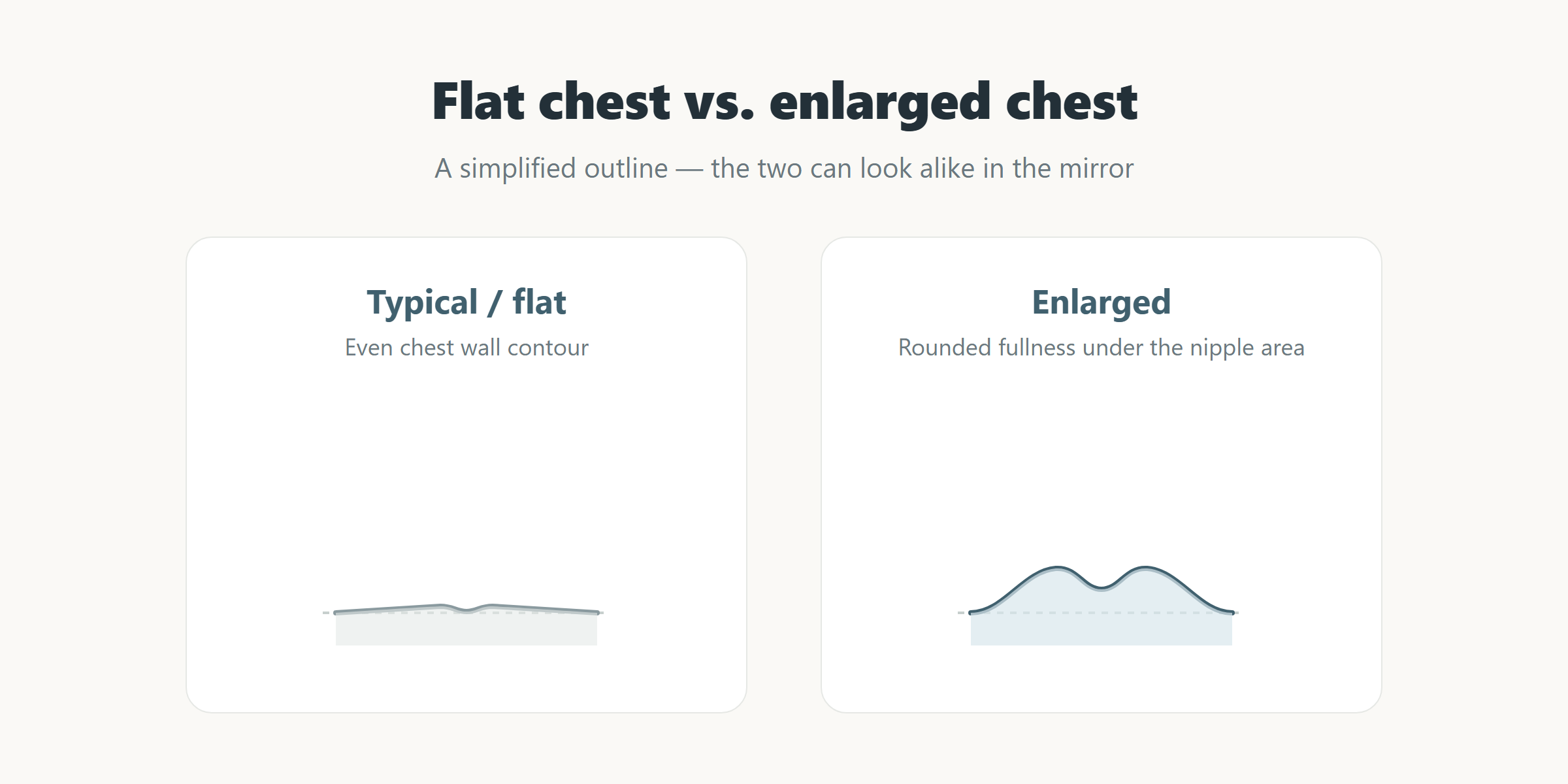
Gynecomastia is a benign increase in male glandular breast tissue. The core driver is a hormonal one: an imbalance between estrogen and testosterone — relatively too much estrogen, and/or too little testosterone — which stimulates that glandular tissue to grow.
There’s an important distinction hiding inside that definition, and it’s the distinction that changes everything about treatment.
- True gynecomastia is growth of actual glandular tissue.
- Pseudogynecomastia is enlargement from fat (adipose) tissue, not glandular growth — typically tied to obesity.
They can look identical in the mirror. They are not the same problem, and they don’t respond to the same fix. We’ll come back to how you tell them apart, because that’s the practical heart of this.
Just how common is it?
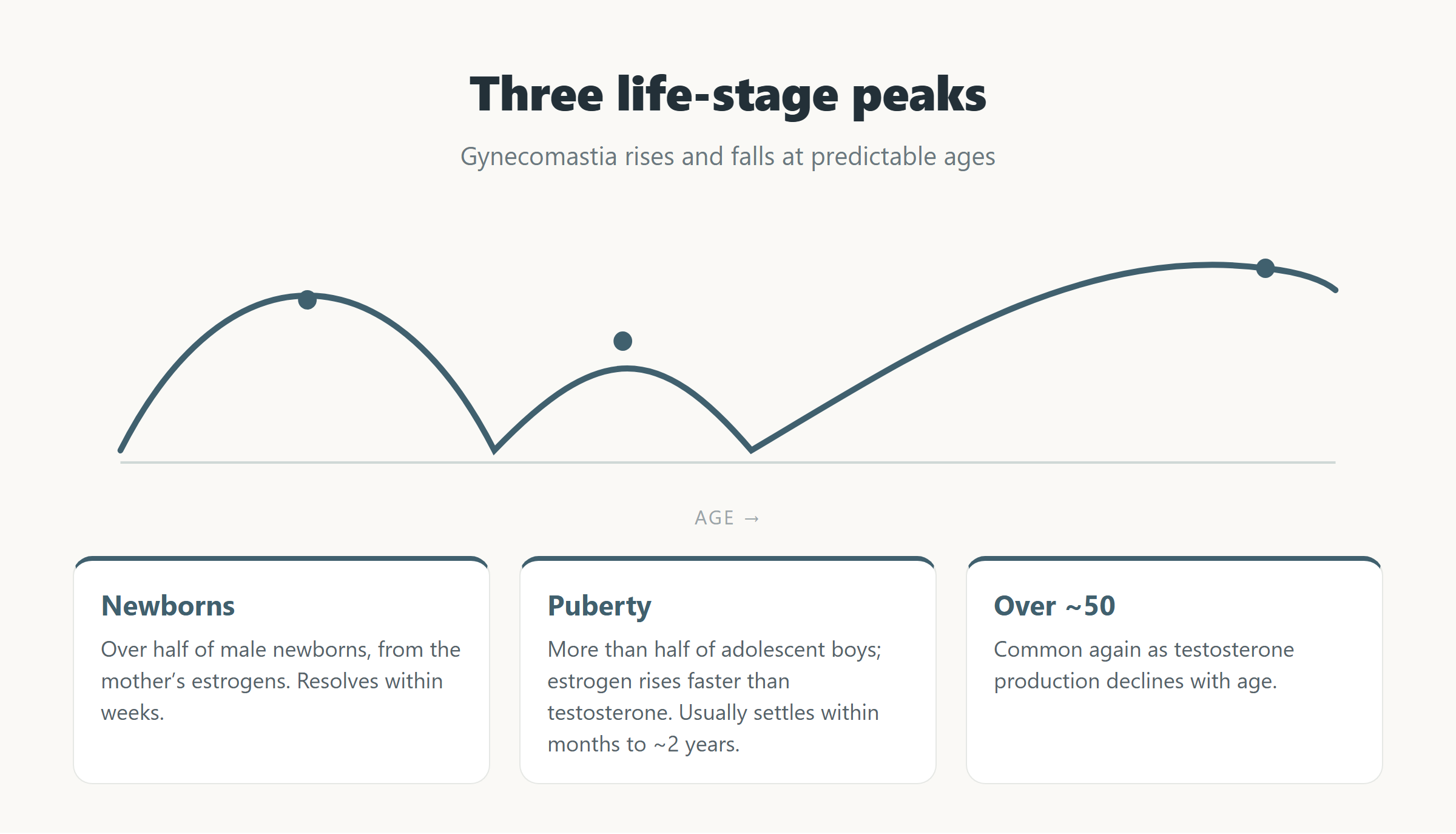
Common enough that there are three predictable peaks across a man’s life. Cleveland Clinic describes them like this:
- Newborns — more than half of male newborns have enlarged breast buds, from their mother’s estrogens. It resolves within weeks.
- Puberty — more than half of adolescent boys develop some breast enlargement, because estrogen rises faster than testosterone. It usually settles within months to about two years.
- Older men (over ~50) — it becomes common again as testosterone production declines with age.
So if you’re a teenager wondering why this is happening, or a man past fifty noticing a change — you’re sitting squarely inside the two most ordinary windows for it.
What causes it
The mechanism is hormonal, but the reasons the hormones tip out of balance vary a lot. Here’s what the sources point to.
Hormones, age, and weight
The most common causes overall are simply puberty and aging — the natural hormone shifts described above.
Obesity deserves its own line, because it works two ways at once. Excess fat adds fatty tissue directly (that’s the pseudogynecomastia side), and it also increases the conversion of testosterone into estrogen, a process called aromatization. So carrying extra weight can both mimic the condition and quietly feed the real one.
Medications — a bigger cause than most men expect
This is the one people rarely suspect. A surprising number of common prescriptions list gynecomastia as a side effect. Reported agents include spironolactone, cimetidine, digoxin, finasteride, ketoconazole, thiazides, phenothiazines, theophylline, methotrexate, and imatinib, along with many blood-pressure medications (amlodipine, captopril, clonidine, diltiazem, enalapril, nifedipine, verapamil, and others).
The numbers on spironolactone show how dose-dependent this can get. Reported rates run from about 1% on placebo, to ~9% at 25 mg/day, up to as high as ~52% at doses over 150 mg/day.
I want to be very direct about one thing here.
Do not stop a prescribed medication on your own.
If you suspect a drug is behind the change, the move is to talk to the prescriber about whether it can be switched or adjusted — not to quit it quietly. Stopping some of these medications abruptly carries real risks of its own.
Substances and underlying conditions
A few other contributors show up in the research:
- Recreational and other substances — anabolic steroids (reported at around 52% among young users), amphetamines, marijuana, heroin, and chronic heavy alcohol use.
- Underlying medical conditions — liver disease or cirrhosis, kidney disease or failure, hyperthyroidism, low testosterone (male hypogonadism), Klinefelter syndrome, and hormone-secreting tumors (testicular, adrenal, or pituitary/prolactinoma).
That last category is exactly why persistent, unexplained gynecomastia in an adult deserves a proper look — not to alarm you, but because the chest can be the visible signal of something worth checking elsewhere.

True gynecomastia vs. pseudogynecomastia — the test that matters
Here’s the part I promised. The reason this distinction is worth the effort is simple: the two types are treated completely differently.
There’s a rough self-check that clinicians describe, based on a gentle pinch of the tissue just beneath the nipple:
- True (glandular) gynecomastia feels like a firm, rubbery, fibrous disc sitting concentrically under the nipple. It can be tender.
- Pseudogynecomastia feels soft and pliable — diffuse fat, with no firm disc under the nipple.
I’ll add the honest caveat, though: this is directional, not diagnostic. You can get a general sense at home, but you can’t confirm it yourself.
That’s where imaging comes in. Ultrasound — and sometimes mammography — is used to confirm whether true glandular tissue is actually present, to assess its size, and to help rule out other pathology, including cancer. In practice, a physical examination comes first, and imaging is ordered when the exam is unclear, or specifically to distinguish gynecomastia from male breast cancer.
So the sensible sequence is: notice it, feel for the disc, and if there’s any doubt — especially firmness — get it looked at rather than guessing.
How it’s treated
Treatment follows the cause, the duration, and the tissue type. There’s no single answer, which is actually good news, because it means most men have options.
Watchful waiting
For newborn and pubertal gynecomastia, the most common “treatment” is patience. These usually resolve on their own once hormones rebalance, and often need no intervention at all.
Fixing the underlying cause
Where there’s an identifiable driver, addressing it directly is the first step — switching a causative medication (with the prescriber), or treating an underlying condition like thyroid disease, liver disease, low testosterone, or a tumor.
Diet and strength training — with one honest catch
This is the part the internet oversimplifies. Weight loss, diet, and strength training genuinely help pseudogynecomastia — the fatty type. A caloric deficit combined with chest and resistance training reduces chest fat, and for a fat-driven chest, that can be the whole solution.
But here’s the catch worth knowing before you commit six months to the gym:
If significant true glandular tissue is present, building up the pectoral muscle underneath can actually make it look more prominent, not less. Muscle pushes the gland forward. In that case, surgery tends to be the more effective route — and no amount of training removes glandular tissue.
So diet and lifting are a smart, low-risk first move for a soft, fatty chest. They’re not a cure for a firm glandular disc.

Photo: Kaboompics.com / Pexels
Medication
For true gynecomastia — especially when it’s painful or recent — medication can help. The best-supported option is a SERM called tamoxifen (for example, 10 mg twice daily or 20 mg daily for about three to six months, with pain often improving within a month). Raloxifene has also been used, particularly in pubertal cases, though with less evidence behind it.
The critical detail is timing. These medications work best on early, active gynecomastia — roughly the first 6 to 12 months. Long-standing, fibrotic tissue responds poorly. One pubertal study found comparable nodule reduction between the two (tamoxifen ~2.1 cm vs. raloxifene ~2.5 cm), but tamoxifen remains the preferred choice overall.
This is off-label territory, so it should be physician-directed — not something to source and self-dose.
Surgery and other options
For persistent true glandular gynecomastia that doesn’t resolve or respond to medication, surgery (male breast reduction) is the most effective option — removal of the glandular tissue, sometimes with liposuction for accompanying fat.
There’s also low-dose radiation therapy (LDRT), used in some specific settings — for instance, as prophylaxis for men on anti-androgen therapy for prostate cancer — to prevent or reduce breast tissue growth.

When to see a doctor promptly — the red flags

Photo: Los Muertos Crew / Pexels
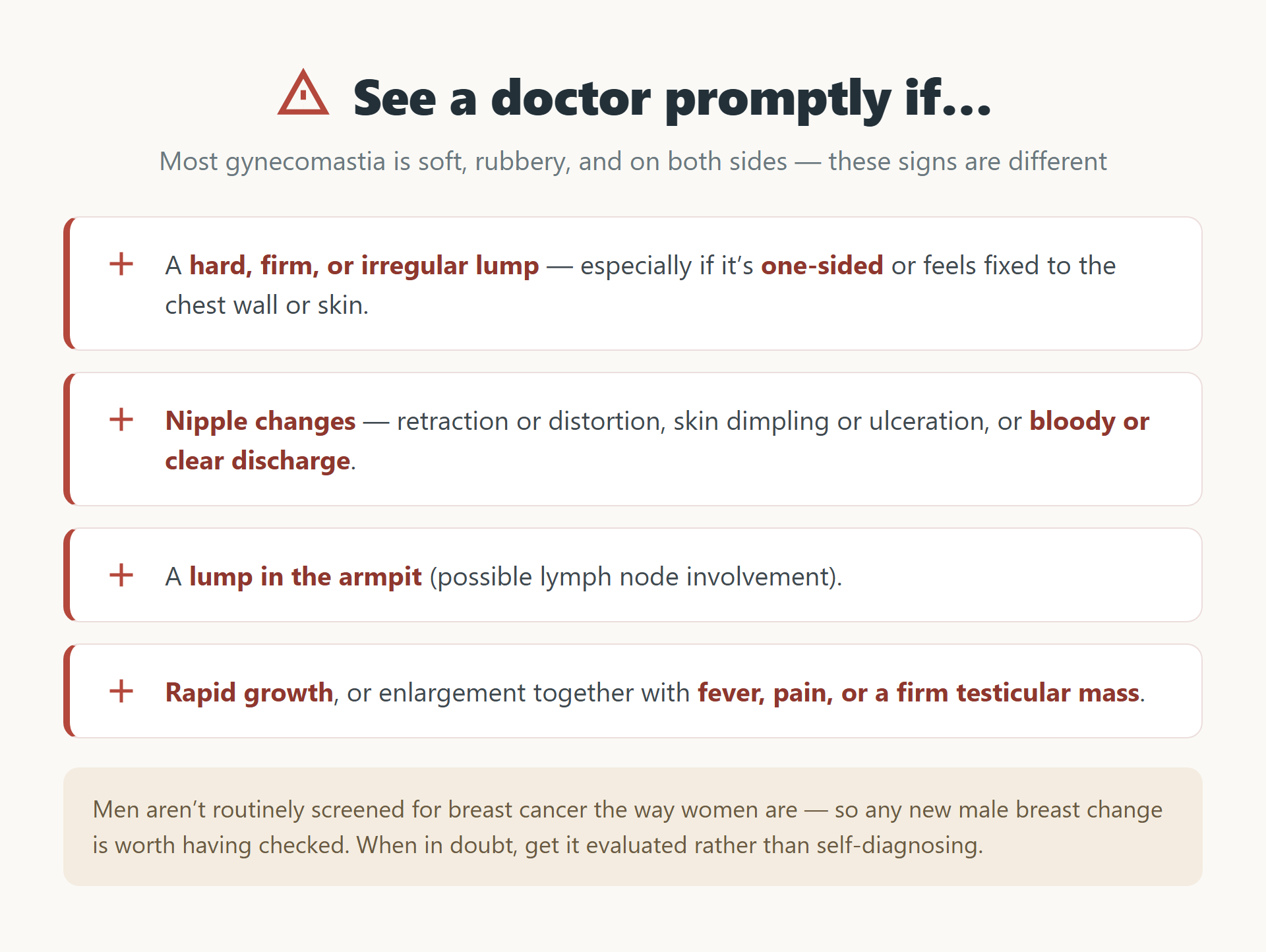
Most gynecomastia is benign, bilateral (both sides), and soft or rubbery. But a small set of signs deserves prompt medical evaluation, specifically to rule out male breast cancer or a hormone-secreting tumor. Please don’t sit on these:
- A hard, firm, or irregular lump — especially if it’s one-sided (unilateral), or feels fixed to the chest wall or skin.
- Nipple changes — retraction or distortion, skin dimpling or ulceration, or bloody or clear nipple discharge.
- A lump in the armpit (possible lymph node involvement).
- Rapid growth, or breast enlargement together with fever, pain, or a firm testicular mass.
One reason to take this seriously: men aren’t routinely screened for breast cancer the way women are. So any new male breast change is worth having checked. The pattern that points toward benign gynecomastia is soft, rubbery, tender, and on both sides. The pattern that points toward something needing imaging or biopsy is hard, one-sided, and fixed. When in doubt, get it evaluated — don’t self-diagnose.
A quick note before you go
Here’s what I’d hold onto from all of this.
Gynecomastia is common, usually benign, and often either resolves on its own or responds well to the right approach. The single most useful thing you can do is figure out which type you’re dealing with — soft fat, or firm gland — because that’s what decides whether the answer is the gym, a medication conversation, or a surgical consult.
But this article is educational information, not medical advice. It can’t feel your chest, read your prescriptions, or run an ultrasound. A new or one-sided breast lump in a man should always be evaluated by a physician — to confirm what it is, and to rule out the rare-but-serious causes.

Photo: Gustavo Fring / Pexels
So if reading this pushed you a little closer to actually booking that appointment, that’s the win. The chest you’ve been quietly worrying about deserves a real answer, not another midnight search.
Medical disclaimer: This content is for general educational purposes only and is not a substitute for professional medical advice, diagnosis, or treatment. Do not start, stop, or change any medication on your own. Consult a qualified physician about your specific situation, and seek prompt evaluation for any of the red-flag signs described above.
Sources
- Cleveland Clinic — Gynecomastia (Enlarged Male Breast Tissue)
- Mayo Clinic Proceedings — Gynecomastia: Pathophysiology, Evaluation, and Management
- US Pharmacist — Understanding Gynecomastia and Its Management
- American Cancer Society — Signs and Symptoms of Breast Cancer in Men
- Radiology Assistant — Pathology of the Male Breast
- The Journal of Pediatrics — Raloxifene and tamoxifen in pubertal gynecomastia
- Penn Medicine — Male Breast Cancer: Symptoms and Causes
- NIH / PMC — Drug-induced gynecomastia reviews