Childhood Asthma Symptoms vs. a Cold That Never Ends
The thing that finally sends most parents to the pediatrician isn’t a wheeze. It’s a calendar.
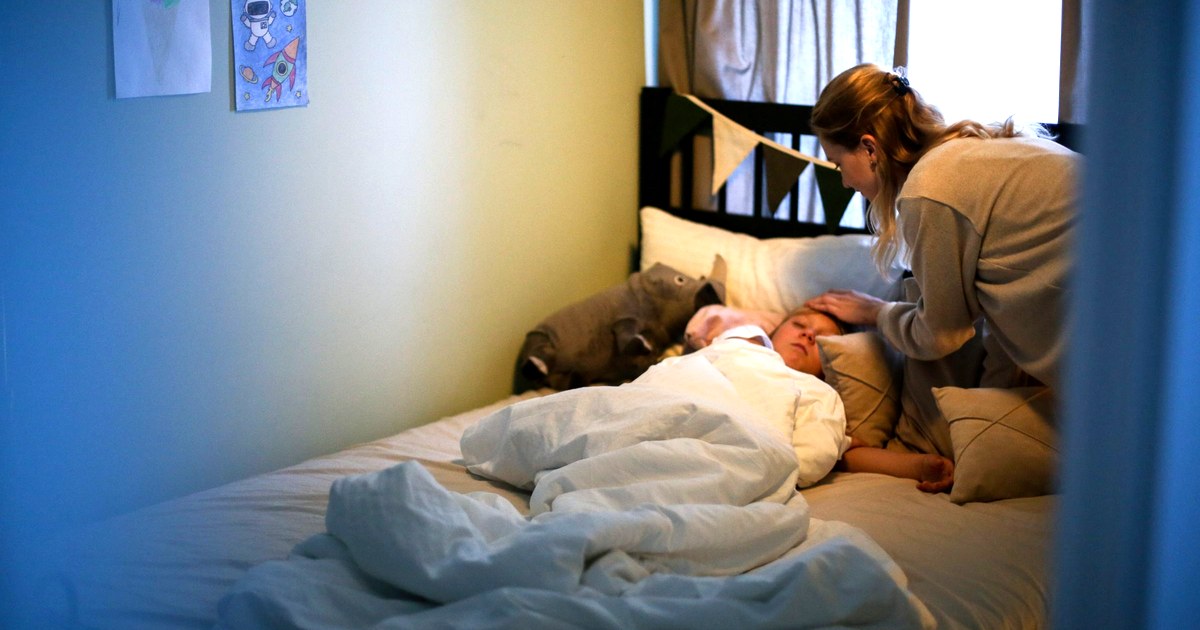
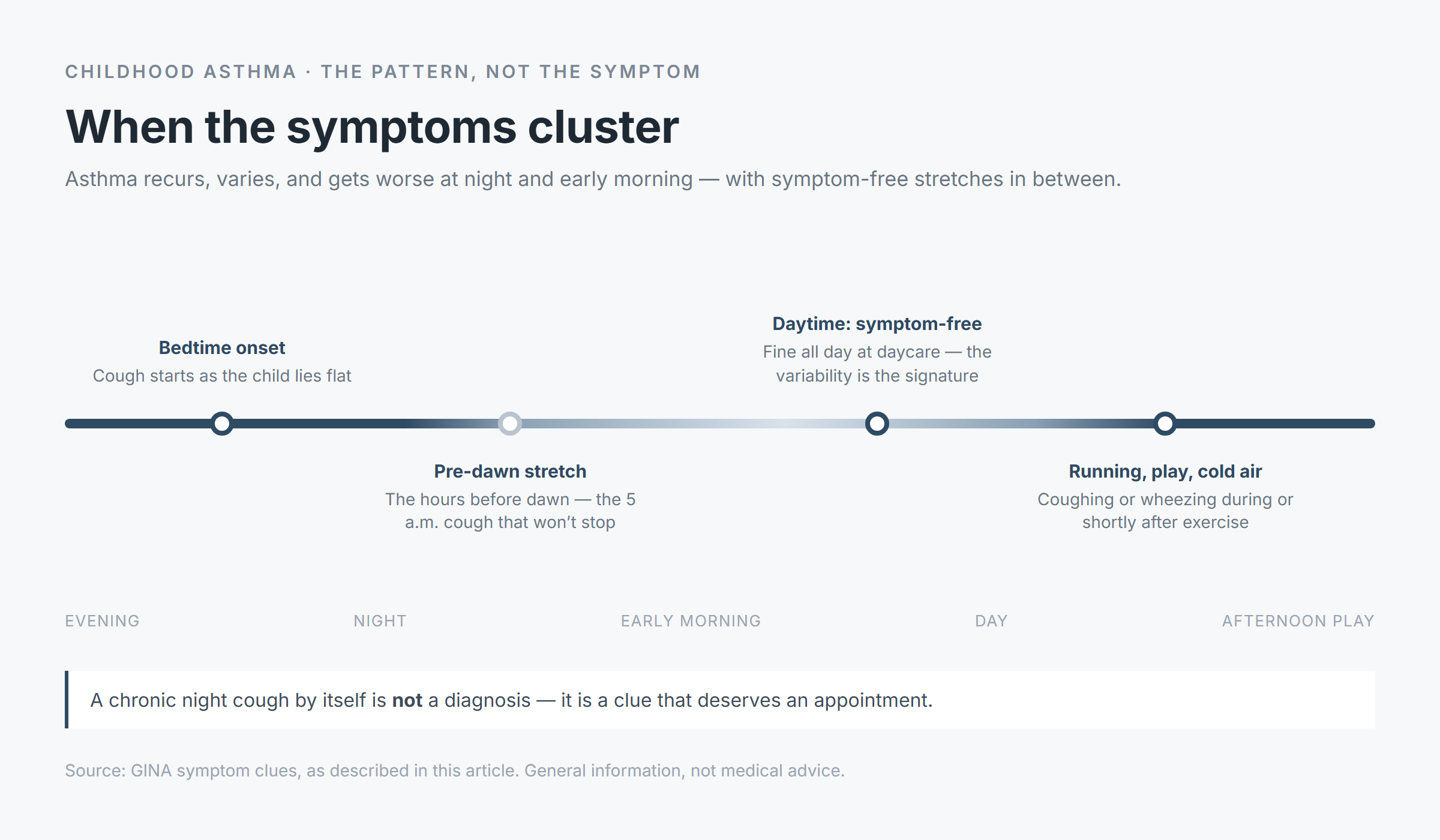
Three weeks of coughing. Fine all day at daycare. Then it starts around bedtime, and there’s a stretch near 5 a.m. where it just doesn’t stop. No fever anymore. The cold ended two weeks ago, apparently — except the cough didn’t get the message.
If that’s your house, here’s the honest headline: childhood asthma symptoms are usually mistaken for a lingering cold, because the individual symptoms are identical. What separates them is the pattern, not the symptom. Asthma recurs, varies, gets worse at night and early morning, flares with running and cold air, and improves quickly with a bronchodilator.
I want to walk through what that pattern actually looks like, how a doctor diagnoses this in a child too young to blow into a machine, what treatment really involves, and — the part I think is most often oversold to parents — exactly what cleaning and trigger control can and cannot do.
Photo: cottonbro studio / Pexels
A note before we start: this is general information, not medical advice. Diagnosis, and any decision to start, stop, or change a medication, belongs with your child’s pediatrician or a pediatric allergist or pulmonologist.
How common is childhood asthma, and at what age?
Two numbers from the CDC do most of the explaining here.
- 6.5% of US children under 18 currently have asthma (2024, National Health Interview Survey). For an earlier reference point, it was 7.0% in 2019, and the CDC counted about 4.68 million children with current asthma in 2021.
- But the age breakdown (2019 NHIS) is where the story is: 2.6% at ages 0–4, 7.8% at ages 5–9, and 9.1% at ages 10–17.
That gap — 2.6% versus 9.1% — is the whole toddler-wheeze question expressed as arithmetic. Most wheezy two-year-olds are not asthmatic children. Asthma tends to declare itself around school age.
Two more things worth saying plainly. Childhood asthma prevalence in the US decreased from 2010 through 2021, so nobody needs the “epidemic” framing. And the burden is not distributed evenly: 11.6% of Black children had asthma in 2019–2021, versus 5.9% of Hispanic and 5.5% of White children, with Medicaid-enrolled Black children visiting the ED at more than twice the rate of White children.
What the asthma symptom pattern actually looks like
Asthma is chronic inflammation of the airways with variable airflow obstruction. Three things are happening at once — the muscle around the airway tightens, the airway wall swells, and mucus plugs the passage. That matters later, when we get to why the daily inhaler targets inflammation rather than just opening the tube.
It is also often allergic, but not always. Allergic asthma is the most common childhood type, but in preschoolers, virus-triggered wheeze is a major pattern that isn’t allergy-driven at all.
The clues that point toward asthma, per GINA:
- Worse at night and in the early morning. Symptoms that wake the child, or a cough clustered in the hours before dawn. Airway caliber and cortisol both dip overnight, the child is lying flat, the air is cooler, and the bedding is right there.
- Brought on by exercise. Coughing or wheezing during or shortly after running and play. Among children who already have asthma, exercise-induced bronchoconstriction estimates run roughly 40–90%.
- Cold, dry air. Cold air inhalation increases bronchoconstriction specifically in asthmatic children, more than in children with other chronic lung conditions.
- Colds that “go to the chest” and take weeks to clear — recurrent wheeze with every single cold is a key preschool clue.
- Also: laughing, crying, dust, pollen, pets, tobacco smoke, strong odors, stress.
- Variability, with symptom-free stretches in between. That’s the signature. A fixed structural problem doesn’t come and go.

Photo: Connor Scott McManus / Pexels
Where the “night cough” idea goes too far
Here’s a correction I’d rather deliver early than let you find later.
A chronic night cough by itself is not a diagnosis. “Cough-variant asthma” is genuinely disputed as a distinct entity in children. A population-based study found that children with isolated night cough had no increased risk of future wheeze, and reviewers have pointed out that the older, more positive studies lacked comparison groups and used small selected samples. Clinical guidance warns explicitly against over-diagnosing asthma in children with chronic non-specific cough — many of whom need no treatment, improve with time, and end up with normal long-term lung function.
So: cough is a clue that deserves an appointment. It isn’t a verdict you can reach at 3 a.m. on your phone.
There are also patterns that point away from asthma and need a different workup entirely — coughing with every feed, choking spells, sudden onset in a previously well child (think foreign body), poor growth, a chronic wet productive cough, findings on only one side, symptoms present since birth, or no response to any asthma treatment trial.
Cold, bronchiolitis, croup, or asthma?

Photo: Pavel Danilyuk / Pexels
These four get confused constantly, and the fastest way to sort them is by where in the airway the trouble is and what noise it makes.
| Common cold | Bronchiolitis | Croup | Asthma | |
|---|---|---|---|---|
| Where | Upper (nose, throat) | Lower — bronchioles | Upper — voice box, windpipe | Lower — bronchi, bronchioles |
| Typical age | Any | Under 2, usually under 12 months | ~3 months–5 years | Usually declares after 2–5 years |
| Signature sound | Sniffles, ordinary cough | Wheeze + crackles, fast breathing | Barking cough + stridor (noise breathing in) | Wheeze (whistling, mostly breathing out) |
| Timing | Peaks days 3–5, gone in 7–10 days | One illness, worst days 3–5, up to 2–3 weeks | Abruptly worse at night, 3–5 days | Recurs over months and years |
| Fever | Common | Common | Common | Not caused by asthma itself |
| Bronchodilator response | No | Often little or none; not routinely recommended by the AAP | No — croup responds to steroids | Yes, and fast improvement is a diagnostic clue |
Three practical discriminators:
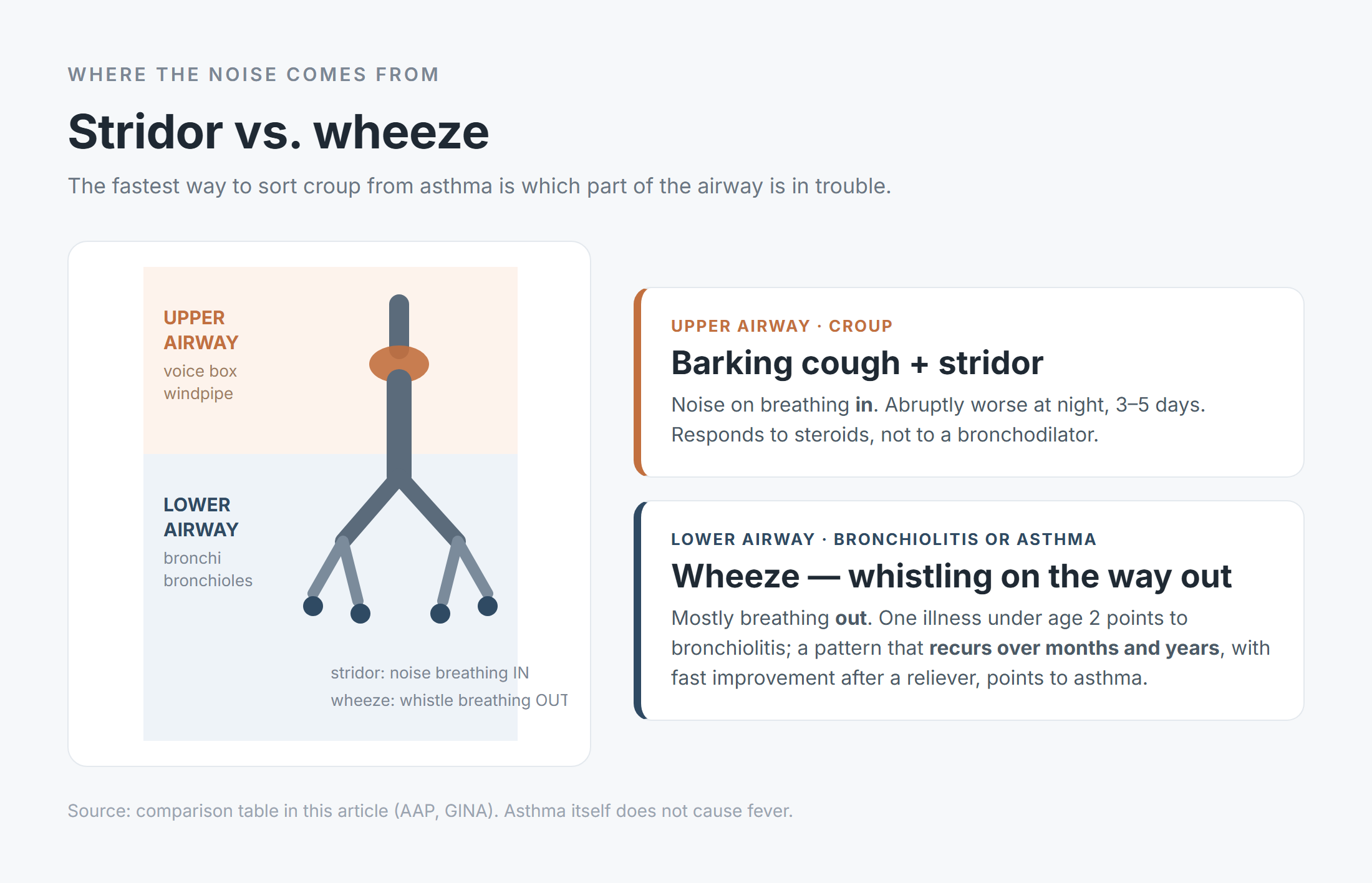
- Stridor versus wheeze. Noise on breathing in plus a barking, seal-like cough is croup, which is an upper-airway problem. Whistling on breathing out is lower airway — bronchiolitis or asthma.
- One episode versus a pattern. A first wheezing illness in an 8-month-old during RSV season is bronchiolitis until proven otherwise. It’s the third or fourth wheezing episode in a three-year-old that makes a clinician start thinking asthma.
- The practical threshold to ask. A cold lasting more than 10 days, a cough that returns after every single cold, or a cough that only happens at night. Not the first cold.
One more, because it comes up: a cohort study found an association between croup and later asthma, so a croup history is worth mentioning at the visit rather than filing away as ancient history.
How asthma is really diagnosed in a young child
Parents often arrive expecting a test. For a three-year-old, there usually isn’t one.
Spirometry generally isn’t feasible under age 5. It requires a hard, fast, sustained forced exhalation with a tight seal on a mouthpiece, repeated until the curves are reproducible. Most children under five can’t do that reliably. Usable spirometry typically becomes possible around age 5 or 6, sometimes later.
So GINA’s approach for children 5 and under requires all three of the following:
- Recurrent episodes of wheezing, with or without symptoms between episodes;
- An alternative diagnosis judged unlikely;
- A timely response to asthma treatment — either improvement within minutes of a reliever, or improvement during a diagnostic trial of daily inhaled corticosteroid plus as-needed reliever for 2–3 months, with symptoms returning when it’s stopped.
That trial is the workhorse test in this age group, and it’s worth understanding the design: the planned stop is part of the test, not a failure or a relapse. GINA specifies 2–3 months; some national guidelines use 4–8 weeks.
For children 6–11, documented variable airflow limitation supports the diagnosis — spirometry with bronchodilator reversibility, peak-flow variability, or an exercise challenge. But a negative test doesn’t rule asthma out, particularly if the child happens to be well that day or already took a reliever. A May 2026 summary of the GINA 2026 update reports a simplified diagnostic flowchart for this age group, and a note that the previous bronchodilator-responsiveness criteria contributed to underdiagnosis, “notably in young males.”
Which leaves the history doing most of the work: how many episodes, when, triggered by what, night waking, exercise limits, personal eczema or food allergy or hay fever, family history of asthma and allergy, and response to any inhaler already tried.
A few tests explained, since they get requested:
- Allergy testing (skin prick or specific IgE) does not diagnose asthma. It identifies sensitization — which matters later, because it’s the thing that decides whether allergen mitigation is worth doing at all.
- FeNO may be used when the diagnosis is uncertain, or for monitoring, in children aged 5 and older. It must never be used alone to diagnose asthma or grade severity, and under age 5 the evidence is insufficient. In children 5 and up, FeNO increased the odds of a correct asthma diagnosis roughly 5.9- to 17-fold in the evidence review — an adjunct, not a verdict.
- Chest X-ray isn’t an asthma test. It’s used to exclude other things when the story is atypical.
Most wheezy toddlers grow out of it — and the ones who don’t
This is the reframe I wish someone handed to parents on day one.
In the Tucson Children’s Respiratory Study, a birth cohort of 1,246 children, about 49% had wheezing episodes in the first six years. Roughly 34% wheezed in the first three years — and about 60% of those had stopped by age 6. Reported more broadly, around 80% of children who wheeze in the first year of life aren’t wheezing after age 3.
The transient early wheezers, about 20% of the whole cohort, were not atopic. No excess family history of asthma, no eczema, no high IgE. Their risk factors were smaller baseline lung function, maternal smoking in pregnancy, and younger maternal age.
The other groups are the ones to know about. Non-atopic, virus-triggered wheezers tend to fade by school age or adolescence. IgE-associated atopic wheezers persist — that’s the group that becomes classic childhood asthma.

So a wheezing toddler is a reason to see a doctor, not a life sentence. But “she’ll grow out of it” isn’t a plan either. The child who wheezes and has eczema, food allergy, or a family history of asthma sits in the phenotype that persists, and that’s precisely the child guidelines want treated.
Treatment basics: the daily inhaler, the rescue inhaler, and the spacer
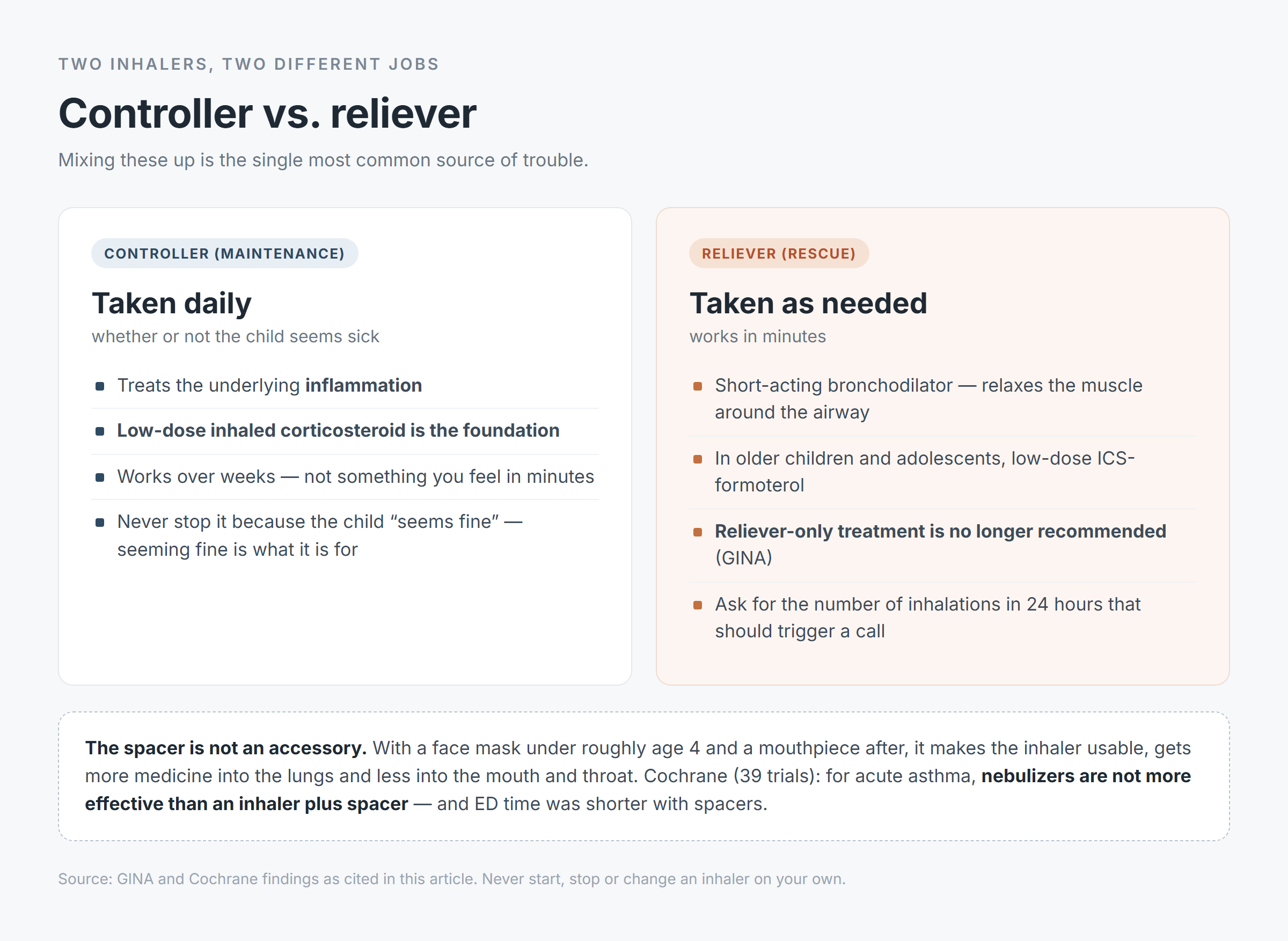
Two categories, and mixing them up is the single most common source of trouble.
- Reliever (rescue). Works in minutes. A short-acting bronchodilator, or in older children and adolescents, low-dose ICS-formoterol.
- Controller (maintenance). Taken daily whether or not the child seems sick. It treats the underlying inflammation. Low-dose inhaled corticosteroid is the foundation.
GINA’s central shift, from 2019 onward and reaffirmed since, is that reliever-only treatment is no longer recommended. Using the rescue inhaler alone leaves the inflammation untreated. Per that same May 2026 summary of GINA 2026, the anti-inflammatory reliever evidence now extends to children 6–11: as-needed low-dose budesonide-formoterol “reduced the risk of moderate-severe exacerbations by nearly 50%, compared with SABA alone.” For children 5 and under, the recommended reliever remains an as-needed short-acting bronchodilator by inhaler and spacer — but as a reliever alongside a daily controller where indicated, not on its own.
The spacer is not an accessory. Small children can’t coordinate pressing an inhaler with breathing in. A spacer (with a face mask under roughly age 4, mouthpiece after) makes the inhaler usable, increases how much reaches the lungs, and reduces deposition in the mouth and throat — which is what causes local steroid side effects like thrush.
And it beats the machine parents often assume is superior. A Cochrane review (39 trials, 1,897 children and 729 adults) found that for acute asthma, nebulizers are not more effective than an inhaler plus spacer. Admission rates didn’t differ, and time spent in the emergency department was shorter for children using spacers.
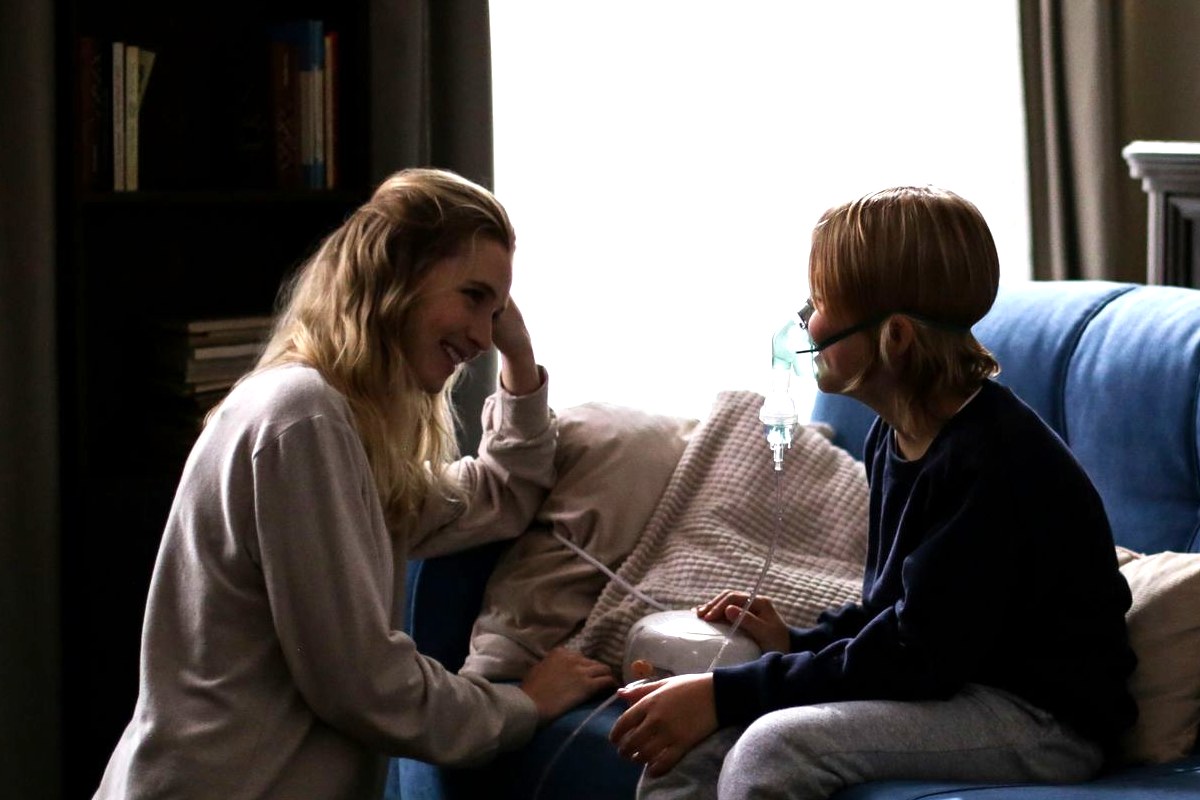
Photo: cottonbro studio / Pexels
Every child with asthma should have a written asthma action plan — typically green, yellow, and red zones, with copies at school and daycare. GINA 2026 reportedly added a concrete safety prompt: seek care if the child exceeds a specified number of reliever inhalations in 24 hours. Ask for that number in writing.
The steroid question, answered with the actual number
Almost every parent has this thought and almost none say it out loud. So here is the real evidence, neither minimized nor inflated.
Short term: inhaled corticosteroids cause a temporary reduction in growth velocity in prepubertal children, mostly in the first one to two years. A meta-analysis of 16 randomized trials found a mean reduction of 0.48 cm/year at one year.
Long term: the CAMP trial follow-up, published in the New England Journal of Medicine in 2012, measured adult height after roughly four to six years of childhood budesonide with about 20 years of follow-up. Mean adult height was 1.2 cm lower than placebo — 171.1 cm versus 172.3 cm — with 95% of participants falling between 0.5 and 1.9 cm shorter.
Three things make that number readable. The effect is one-time, not cumulative — it doesn’t compound year after year. It is dose-related, which is why guidelines say to use the lowest effective dose, review it regularly, step down when control holds, and check height at visits. And roughly 1.2 cm sits against an average adult height around 175 cm for men and 161 cm for women — about a 0.7% difference.
On the other side of the scale: exacerbations, ED visits, hospitalizations, missed school, and the fact that poorly controlled asthma itself impairs growth. Undertreated children also need oral steroid bursts more often, and those carry substantially larger risks than daily low-dose inhaled steroid.
That’s the trade-off, honestly stated. The decision itself belongs to you and your child’s clinician — and a controller inhaler should never be stopped just because the child “seems fine,” since seeming fine is what it’s for.
What trigger control can and cannot do
This is the section I’d most like parents to read before spending money.
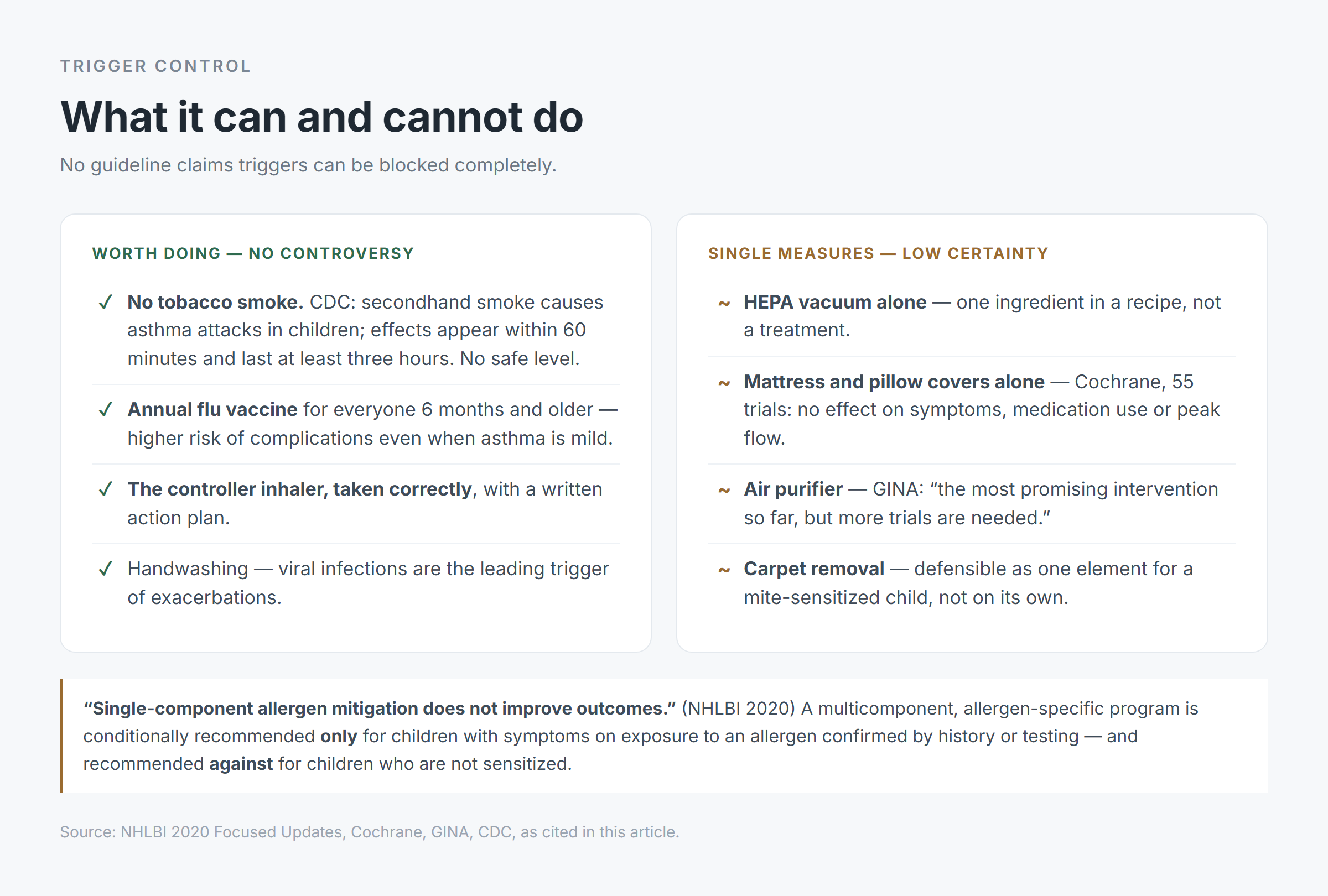
The popular version of asthma management is environmental: seal the mattress, tear out the carpet, buy a HEPA vacuum, and block the triggers completely. No guideline claims triggers can be blocked completely, and the strongest evidence base is uncomfortable about most of it.
Cochrane’s finding. Cochrane has reviewed house dust mite control measures repeatedly since 1998. The standing conclusion is blunt: “Chemical and physical methods aimed at reducing exposure to house dust mite allergens cannot be recommended.” The 2008 review pooled 55 trials and more than 3,000 patients and found no effect on asthma symptoms, medication use, or peak flow.
Both sides, because they exist. Those reviews have been criticized — heterogeneous methods, trials that never actually lowered allergen levels, and a mix of sensitized and non-sensitized patients thrown together. A 2024 hypothesis-generating meta-analysis in JACI: In Practice argued the picture might be more favorable in properly selected, sensitized patients. The honest synthesis: single-measure mite avoidance has not been shown to work; whether intensive, targeted avoidance helps confirmed-allergic children is genuinely unsettled.
What US guidance actually recommends. The NHLBI 2020 Focused Updates issued conditional recommendations, and the conditions are the whole point:
- For children with asthma who have symptoms on exposure to an identified indoor allergen, confirmed by history or allergy testing, a multicomponent, allergen-specific mitigation program is conditionally recommended.
- For children who are not sensitized, or who have no symptoms on exposure, routine allergen mitigation is conditionally recommended against.
- The explicit finding: “single-component allergen mitigation does not improve outcomes.” Multicomponent programs slightly reduce exacerbations and marginally improve control and quality of life. Certainty of evidence: low to moderate.
- Components listed as potentially beneficial within a multicomponent strategy — impermeable mattress and pillow covers, integrated pest management, HEPA vacuums, mold mitigation.
Translated: the HEPA vacuum is one ingredient in a recipe. Used alone, it’s the version that has been studied and found not to help. And if your child isn’t sensitized to dust mites, the entire program is recommended against.
On air purifiers, GINA describes HEPA air filtration as “the most promising intervention so far, but more trials are needed before recommendations can be derived.” Devices demonstrably remove airborne allergen and particles. Removing allergen is not the same as improving asthma. Please don’t buy one expecting it to prevent attacks.
The bedding temperature, and a myth to retire

Photo: kaboompics.com / Pexels
The number you want is 130 °F (about 55 °C), weekly, for sheets, pillowcases, and blankets — the figure carried through NAEPP-era guidance and standard US patient education. The AAP simply says “hot water” and doesn’t give a temperature at all.
“Boiling” appears in no guideline reviewed here. Nobody instructs parents to boil bedding, and it’s worth saying so directly because the advice circulates anyway.
Two practical caveats. Many US home water heaters are set to about 120 °F for scald safety, so a “hot” wash cycle may never reach 130 °F. A hot tumble-dry cycle or dry cleaning also kills mites, though the allergen still has to be washed out. And very hot washing wears out fabric and carries a real scald risk — a trade-off, not a free action.
Carpet removal falls under the same “single measure” caveat: defensible as one element of a plan for a mite-sensitized child, not a treatment on its own. Humidity control has the clearest mechanism, since mites need ambient moisture, and the AAP recommends dehumidifiers to reduce mold and mildew — though the outcome evidence sits in the same low-certainty pool.
Pets deserve honesty rather than a slogan. The AAP recommends strict avoidance of the animal when a child has a documented pet allergy, along with a thorough cleaning if a pet previously lived there. But cat and dog allergen persists in homes for months after the pet is gone, so rehoming doesn’t produce a quick improvement, and studies of allergen reduction with the pet still in the house have been largely disappointing. It’s a hard family decision and it deserves to be described as one.
The two environmental measures with no controversy
Eliminate tobacco smoke exposure. The CDC states that secondhand smoke causes asthma attacks in children and makes them more frequent and more severe, with harmful respiratory effects appearing within 60 minutes of exposure and lasting at least three hours. There is no safe level. Smoking on the balcony or in the car still reaches the child through residue and ventilation paths, and vaping is not established as safe for a child’s airway.

Photo: CDC / Pexels
Get the annual flu vaccine. The CDC recommends it for everyone 6 months and older, ideally by the end of October. People with asthma are at higher risk of serious flu complications even when the asthma is mild or well controlled. Injectable flu vaccines are approved from 6 months of age regardless of asthma. One caveat to raise with your clinician: children aged 2–4 with asthma, or with wheezing in the past 12 months, should not receive the nasal spray version — a 2025 Pediatrics systematic review is re-examining this, but the current precaution stands, so confirm against this season’s guidance.
Since viral infections are the leading trigger of childhood asthma exacerbations, vaccination and handwashing are legitimately trigger control — arguably more effective than the vacuum cleaner.
Air pollution is real too. PM2.5 and ozone are established risk factors for exacerbation, with the diesel-related elemental carbon fraction implicated most strongly among children living near roadways. Practical version: check the daily AQI, move hard outdoor play indoors on high-ozone afternoons, and don’t schedule sports beside a busy road at rush hour.
The bottom line: trigger control is a supporting actor. What has actually been shown to reduce attacks is the right controller medication, taken correctly, with a written action plan — plus no smoke and a flu shot.
Red flags: when to call 911
Print this part. Put it on the fridge and send a copy to daycare.
Call 911 or go to the nearest emergency department if your child has:
- Can’t speak in full sentences — or a baby who can barely cry because of the effort of breathing.
- Blue, purple, or pale gray lips, gums, or fingernails.
- Retractions — skin sucking inward around the ribs, between them, or at the base of the neck with each breath. Also nasal flaring, head bobbing, or grunting.
- No improvement 20 minutes after the reliever inhaler, or a reliever that wears off in under four hours or is needed far more often than the action plan allows.
- Struggling to walk, hunched forward, unable to lie flat.
- Drowsiness, confusion, or unusual lethargy. A child who suddenly goes quiet during an attack may be tiring, not improving.
- A silent chest — wheezing stops while the breathing effort continues. That is an ominous sign, not a good one.
Two additions. Ask your clinician for the specific number of reliever inhalations in 24 hours that should trigger a call — GINA 2026 added exactly that kind of prompt, and a number is easier to act on at 4 a.m. than a judgment call. And remember asthma itself does not cause fever; a high fever alongside wheezing needs evaluation for infection.

Related reading: Newborn nasal congestion: what actually helps
If I had to compress all of this into one line, it would be this:
“The vacuum cleaner is not the treatment. The pattern is the clue, the inhaler is the treatment, and the plan on the fridge is what gets you through 4 a.m.”
The pre-dawn cough is worth an appointment, not a diagnosis. Most wheezy toddlers really do grow out of it, and the ones who don’t tend to announce themselves with eczema, food allergy, or a family history. The diagnosis in a three-year-old will feel unsatisfying — a history, a trial, a planned stop — because that genuinely is the state of the science, not because your doctor is guessing.
And the cleaning still has a place. Just a smaller one than the internet promises, for the specific child it’s been shown to be worth it for.
This article is general information and does not replace individualized medical care. Work with your child’s pediatrician, pediatric allergist, or pulmonologist on diagnosis and treatment. Never start, stop, or change an inhaler on your own — including stopping a controller because your child seems well. For the red flags above, call 911.
Sources: Global Initiative for Asthma (GINA 2025 and 2026 Strategy Reports; 2026 items via a May 2026 published summary of the update), NIH/NHLBI 2020 Focused Updates to the Asthma Management Guidelines, CDC/NCHS National Health Interview Survey (2024 prevalence; 2019 age breakdown) and CDC Preventing Chronic Disease 2024, Cochrane Library (house dust mite control measures, CD001187; spacers versus nebulisers, CD000052), New England Journal of Medicine 2012 (CAMP adult height), PLOS One 2015 meta-analysis on inhaled corticosteroids and growth, JACI: In Practice 2024 (mite avoidance meta-analysis; cough-variant asthma review), ERJ Open Research (isolated night cough), Tucson Children’s Respiratory Study, American Academy of Pediatrics / HealthyChildren, CDC secondhand smoke and influenza guidance, EPA. Compiled August 2026. CDC figures were obtained via published summaries of CDC pages during research and should be re-verified against cdc.gov before republication.