
Panic Attack or Heart Attack? Why Grounding Comes Second
It starts in the chest. The heart goes so hard and so fast that it feels like it is about to tear through the ribs, the breath gets thin and useless, the hands go numb, and somewhere under all of it sits a single flat thought: I am going to die right here.
If that has happened to you, you have probably searched for the thing that makes it stop. And the internet has an answer ready — a grounding drill that supposedly snaps your brain back to reality in about five seconds.
I went looking for the evidence behind that promise, and I want to be straight with you about what came back, because two pieces of it matter more than anything else on this page.
First: the five seconds do not exist. No primary source I could find supports a panic attack resolving in seconds, or any technique producing relief in seconds.
Second, and this is the one that can actually hurt you: “it feels like my heart will burst” is not proof of panic. It is also how a heart attack, an arrhythmia, a pulmonary embolism, severe low blood sugar and an overactive thyroid announce themselves. An article that teaches you to file those sensations under “probably just panic” and wait them out is not a calming article. It is a dangerous one.
So let me do this in the right order. The medical question first. The technique second, honestly labeled. And then the treatment that actually has randomized trials behind it.
Please read this before anything else. This article is general health information. It is not a diagnosis, not medical advice, and not a substitute for evaluation and treatment by a qualified clinician. If you are having chest pain, trouble breathing, fainting, or symptoms you have not had before, call 911 — do not try to decide for yourself whether it is “just panic.”
Stop reading and call 911 if any of this is happening
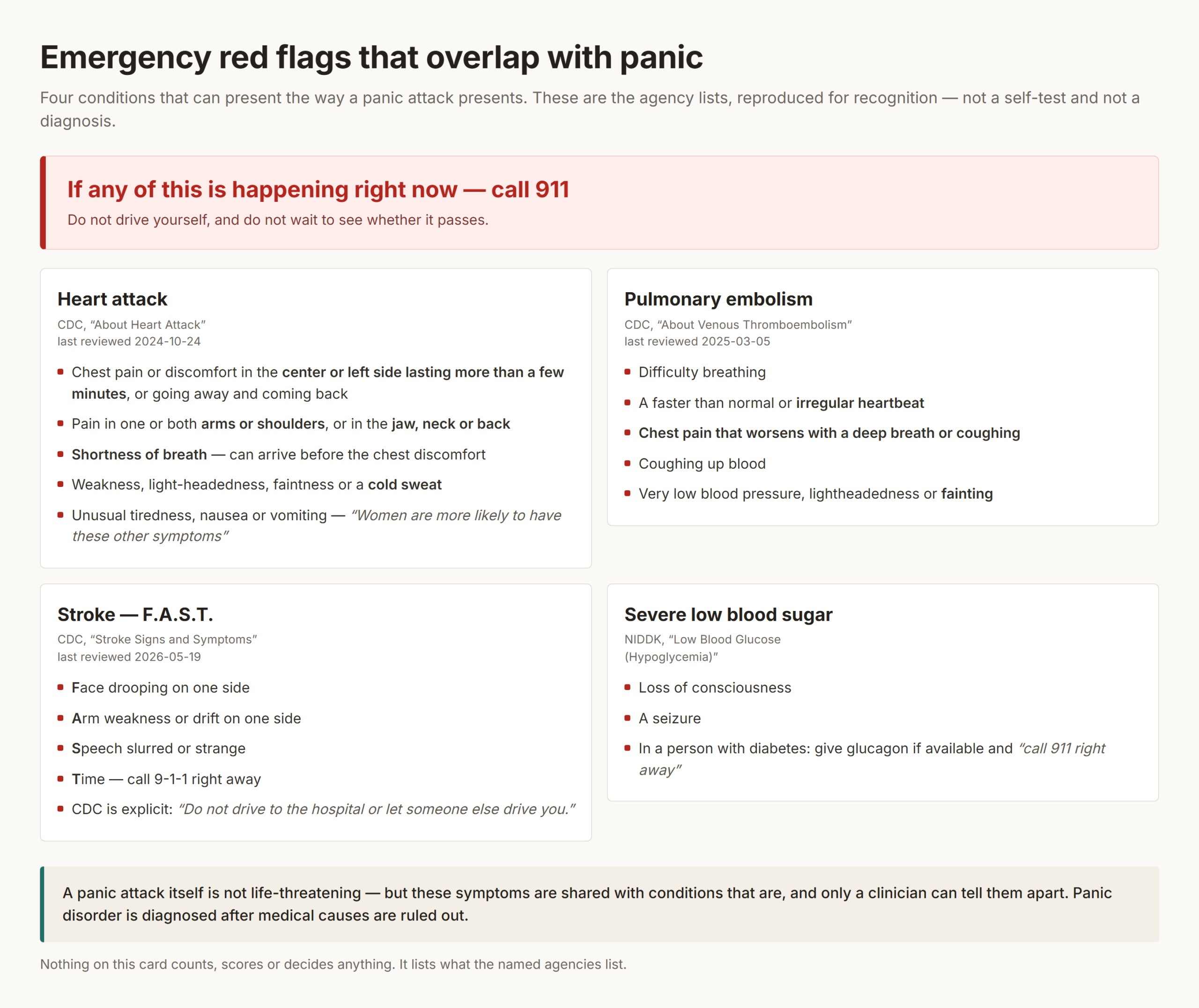
These are the signs the CDC lists for conditions that share a border with panic. If you have any of them right now, this is not the page you need.
Heart attack (CDC, last reviewed October 24, 2024):
- Chest pain or discomfort in the center or left side that lasts more than a few minutes, or that goes away and comes back
- Pain or discomfort in one or both arms or shoulders, or in the jaw, neck, or back
- Shortness of breath — which the CDC notes can arrive before the chest discomfort
- Feeling weak, light-headed or faint, or breaking into a cold sweat
- Unusual or unexplained tiredness, nausea or vomiting — the CDC adds that “Women are more likely to have these other symptoms”
Pulmonary embolism (CDC, last reviewed March 5, 2025): difficulty breathing; a faster than normal or irregular heartbeat; chest pain that usually worsens with a deep breath or coughing; coughing up blood; very low blood pressure, lightheadedness or fainting. Add urgency if a leg is swollen, painful, warm or discolored, or if you have had recent surgery, immobility, long travel, pregnancy or cancer.
Note that middle one carefully. Pain that gets worse when you breathe in deeply is often passed around online as “the reassuring kind.” The CDC lists it as a clot sign.
Stroke (CDC, last reviewed May 19, 2026) — F.A.S.T.: face drooping on one side, arm weakness or drift on one side, speech slurred or strange, and time — call 9-1-1 right away. Also sudden numbness on one side, sudden confusion, sudden trouble seeing, sudden trouble walking or loss of balance, or a sudden severe headache with no known cause. The CDC is explicit: “Do not drive to the hospital or let someone else drive you.” If you want the full version of that checklist, the walkthrough on stroke warning signs and treatment windows covers it properly.
Severe low blood sugar (NIDDK): loss of consciousness or a seizure. In a person with diabetes, give glucagon if available and “call 911 right away.”
And the one that belongs in the same tier, even though it is not a cardiac sign: thoughts of killing yourself, a plan, or intent. That is an emergency, and there is a number for it further down this page.
Why a panic article has to start with the cardiac question
Here is the study that changed how I think about this topic.
Fleet and colleagues, published in the American Journal of Medicine in 1996, studied 441 consecutive walk-in emergency department patients who arrived at a Montreal cardiac teaching hospital with chest pain as their chief complaint. About 25% of them — 108 of the 441 — met criteria for panic disorder under DSM-III-R.
That number alone gets quoted constantly, usually to reassure people. The next two do not.
Of those 108 panic disorder patients, 44% (47 of 108) had a prior documented history of coronary artery disease. Nearly half. Having panic disorder did not spare them from also having heart disease — the two sat in the same chests at the same time.
And: 98% of the panic patients were not recognized by the attending ED cardiologists.
Read that in both directions, because it cuts both ways. Cardiologists, standing next to the patient with an ECG available, missed the panic almost every time. You, at home, with your phone and your racing pulse, have strictly less information than they did.
One qualifier I have to carry with those figures: this was a single center, a Canadian cardiac teaching hospital, in 1996, using DSM-III-R criteria. It is directionally important. It is not a US population estimate.
Panic disorder is a diagnosis made by exclusion
This part is structural, not a matter of caution or temperament.
The Merck Manual Professional Edition (revised April 2026) states it plainly: “Panic disorder is diagnosed after general medical disorders that can mimic or cause anxiety are eliminated.” StatPearls (updated August 6, 2023) notes that “There are no specific laboratory, radiographic, or other tests required to diagnose panic disorder” — and still requires “a thorough examination of the patient to rule out an alternative diagnosis.”
The exclusion is written into the DSM itself. Criterion C excludes panic attacks that are “attributable to the physiological effects of a substance… or another medical condition.”
You cannot perform an exclusion diagnosis on yourself. There is no version of this where you reason your way to “it was panic” from the inside.
So the rule is simple, and it is the spine of this article: a first-ever attack, or any attack that feels different from your usual pattern, is a medical evaluation first and a psychiatric question second.
That is not fear-mongering. Panic attacks recur — you will have other chances to practice coping. A missed heart attack or pulmonary embolism does not give you a second chance.
What a panic attack actually is, by the criteria
A panic attack, in the DSM-5 definition (APA 2013, pp. 208–209), is an abrupt surge of intense fear or intense discomfort that reaches a peak within minutes, during which four or more of thirteen symptoms occur:
- Palpitations, pounding heart, or accelerated heart rate
- Sweating
- Trembling or shaking
- Sensations of shortness of breath or smothering
- Feelings of choking
- Chest pain or discomfort
- Nausea or abdominal distress
- Feeling dizzy, unsteady, light-headed, or faint
- Chills or heat sensations
- Numbness or tingling sensations
- Derealization or depersonalization — feelings of unreality, or of being detached from yourself
- Fear of losing control or “going crazy”
- Fear of dying
I am reproducing that list for recognition, not for a verdict. Counting four of them does not give you a diagnosis, and this is not a screening instrument. These are the symptoms clinicians look at. A diagnosis needs an evaluation.
A panic attack is an event. Panic disorder is a diagnosis.
The two words get used interchangeably online, and the difference is not a technicality.
NIMH (page revised 2025) puts it simply: “A panic attack is a one-time or occasional episode of intense fear with physical and emotional symptoms.” Panic disorder, by contrast, requires recurrent unexpected attacks, plus at least one month of persistent worry about more attacks or a significant change in behavior to avoid them (that is Criterion B), plus the medical, substance and other-disorder exclusions.
And most people who have a panic attack do not have panic disorder. In the National Comorbidity Survey Replication (Kessler et al., 2006, Archives of General Psychiatry, n = 9,282 US adults, DSM-IV lifetime criteria), 22.7% reported isolated panic attacks without agoraphobia — roughly one in four adults — while 3.7% met criteria for panic disorder without agoraphobia and 1.1% for panic disorder with agoraphobia.
There is one more wrinkle worth knowing. DSM-5 made the panic attack a specifier that can be applied to any DSM diagnosis rather than a diagnosis of its own (Craske et al., 2010). A person having panic attacks may have PTSD, social anxiety, depression, a substance problem or a medical condition — not panic disorder. That is exactly why self-sorting does not work.
How common is panic disorder in the US?
From NIMH, drawing on the NCS-R (n = 9,282 US adults, fielded February 2001 to April 2003, face-to-face interviews, DSM-IV criteria):
| Measure | Figure | Population |
|---|---|---|
| Past-12-month panic disorder | 2.7% | US adults 18+ |
| — women / men | 3.8% / 1.6% | US adults 18+ |
| — age 60+ | 0.8% | US adults 60+ |
| Lifetime panic disorder | 4.7% | US adults |
| Adolescents 13–18 (NCS-A, n = 10,123) | 2.3% | US adolescents, DSM-IV |
Roughly 1 in 37 US adults in a given year, and about 1 in 21 at some point in life.
One caution about numbers you may see elsewhere. The WHO World Mental Health surveys (de Jonge et al., 2016; n = 142,949 adults across 25 countries, DSM-5 definitions) report lifetime panic disorder at 1.7%. That is a different population and a different diagnostic system. It is not the US figure, and the US 4.7% is not a world figure. They should never be blended.

Panic attacks are common; panic disorder is not. Roughly 22.7% of US adults report an isolated attack at some point (NCS-R, DSM-IV).
Photo: Görkem Cetinkaya / Pexels
So how long does an attack actually last?
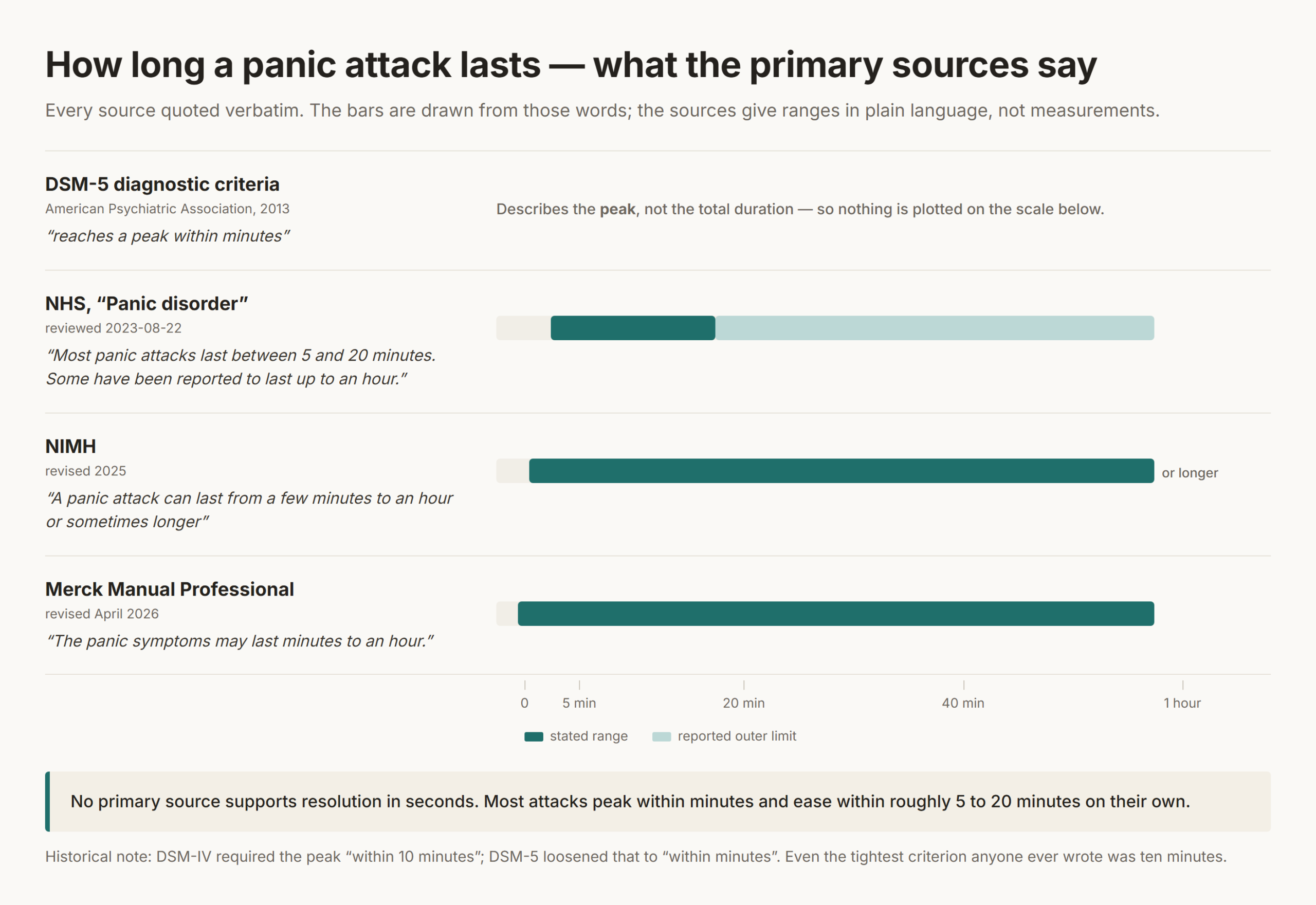
This is the direct answer to the five-second promise, and every source says a version of the same thing.
| Source | What it says |
|---|---|
| DSM-5 criteria (APA 2013) | The surge “reaches a peak within minutes” |
| NHS, “Panic disorder” (reviewed August 22, 2023) | “Most panic attacks last between 5 and 20 minutes. Some have been reported to last up to an hour.” |
| NIMH (revised 2025) | “A panic attack can last from a few minutes to an hour or sometimes longer… panic attacks themselves are not life-threatening, and the physical symptoms usually resolve with time.” |
| Merck Manual Professional (rev. April 2026) | “The panic symptoms may last minutes to an hour.” |
There is a historical detail I find quietly useful here. DSM-IV required the peak to arrive “within 10 minutes”; DSM-5 loosened that to “within minutes.” Even the tightest criterion anyone ever wrote was ten minutes — not five seconds.
Which means the honest sentence is this one: most attacks peak within minutes and ease within roughly 5 to 20 minutes on their own.
Hold onto “on their own.” It matters more than it looks, and I will come back to it.
Is panic really a “brain malfunction”?
The popular version goes: the brain mistakes a harmless moment for a lethal threat and blows the sympathetic nervous system wide open. A wiring fault. A broken part.
The false alarm idea does have real backing in the literature. The word “malfunction” is where it overshoots.
Three named models sit behind this, and all three are labeled as hypotheses by their own authors.
Clark’s cognitive model (1986), as restated by Salkovskis, Clark and Gelder in 1996: “The cognitive theory of panic disorder proposes that panic attacks occur as a result of an enduring tendency to misinterpret bodily sensations as a sign of imminent catastrophe such as a heart attack.” In this account panic is not a random misfire — it is a loop. Sensation, catastrophic reading of the sensation, more arousal, more sensation.
Klein’s false suffocation alarm (1993): “We hypothesize more broadly that a physiologic misinterpretation by a suffocation monitor misfires an evolved suffocation alarm system.” The paper’s own subtitle is “An integrative hypothesis.”
Gorman and colleagues (2000), on the neuroanatomy: an amygdala-centered “fear network” demonstrated in animals, extended to people with the paper’s own hedge attached — “It is speculated that a similar network is involved in panic disorder.”
Notice what none of them produced: a lesion, a measurable defect, or a test. StatPearls says it flatly — there are no laboratory or imaging tests required to diagnose panic disorder, because there are none that do it.
There is a second overshoot in the popular version, and it becomes practical in the next section. “Sympathetic explosion” is not the whole physiology. Meuret’s trials found panic patients were hypocapnic — carbon dioxide too low from over-breathing — and that correcting it drove improvement. Arousal and breathing dysregulation are both in play.
So the safer framing, and the one the source literature actually uses, is false alarm. With one rider attached: a false alarm and a real alarm feel identical from the inside. That is precisely why the first one gets checked.

Clark, Klein and Gorman all label their accounts as hypotheses. There is no lesion, no measurable defect, and no diagnostic test.
Photo: Katia Miasoed / Pexels
About 5-4-3-2-1 grounding — what I found, and what I did not
Five things you can see. Four you can touch. Three you can hear. Two you can smell. One you can taste. It is everywhere, and it is usually presented as clinically proven.
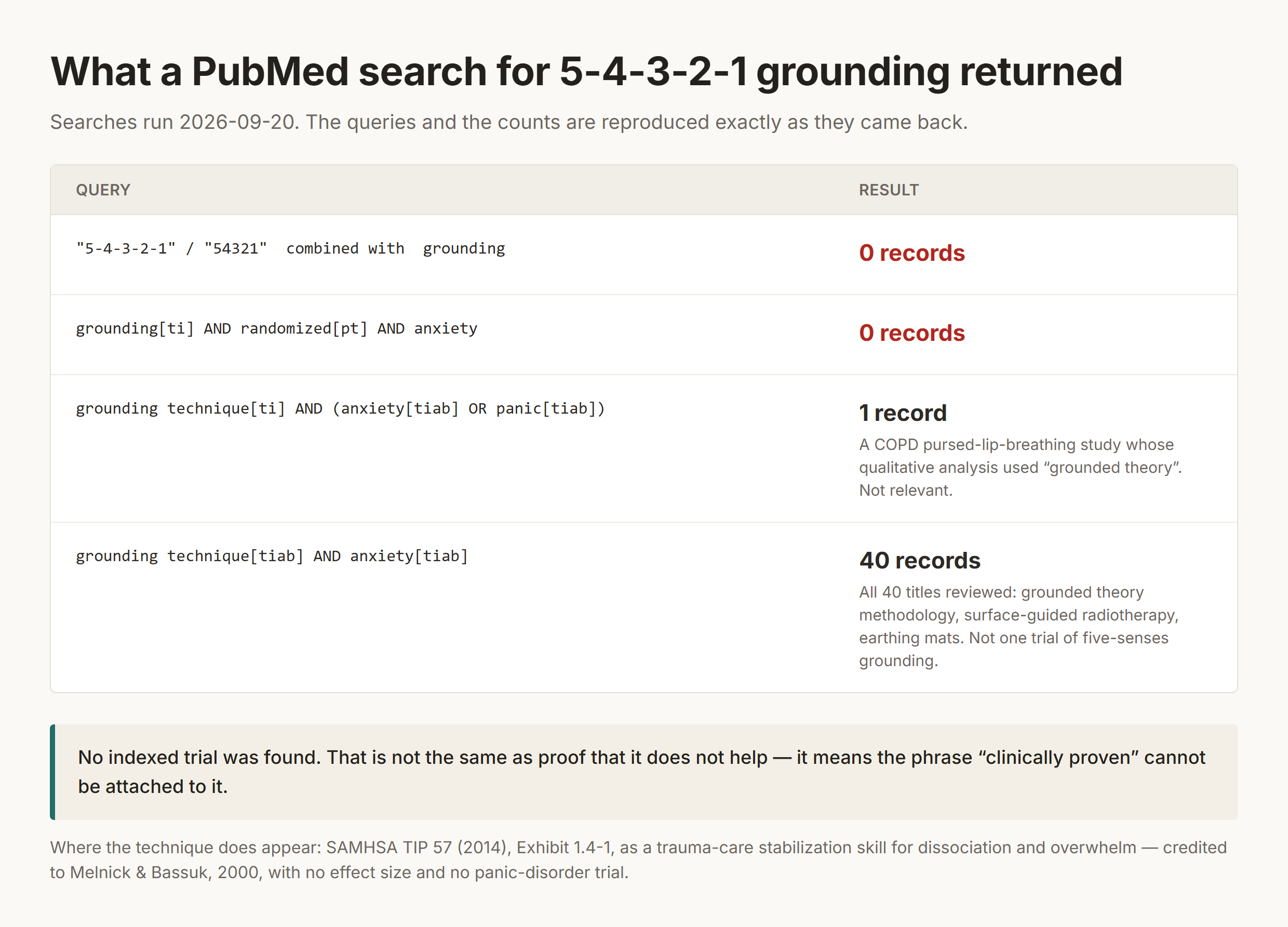
I searched PubMed for the trial on September 20, 2026. Here is exactly what came back.
"5-4-3-2-1"/"54321"combined with grounding — 0 recordsgrounding[ti] AND randomized[pt] AND anxiety— 0 recordsgrounding technique[ti] AND (anxiety[tiab] OR panic[tiab])— 1 record, a COPD pursed-lip-breathing study whose qualitative analysis used “grounded theory”. Not relevant.grounding technique[tiab] AND anxiety[tiab]— 40 records, all 40 titles reviewed. Grounded theory methodology, surface-guided radiotherapy, earthing mats. Not one trial of five-senses grounding.
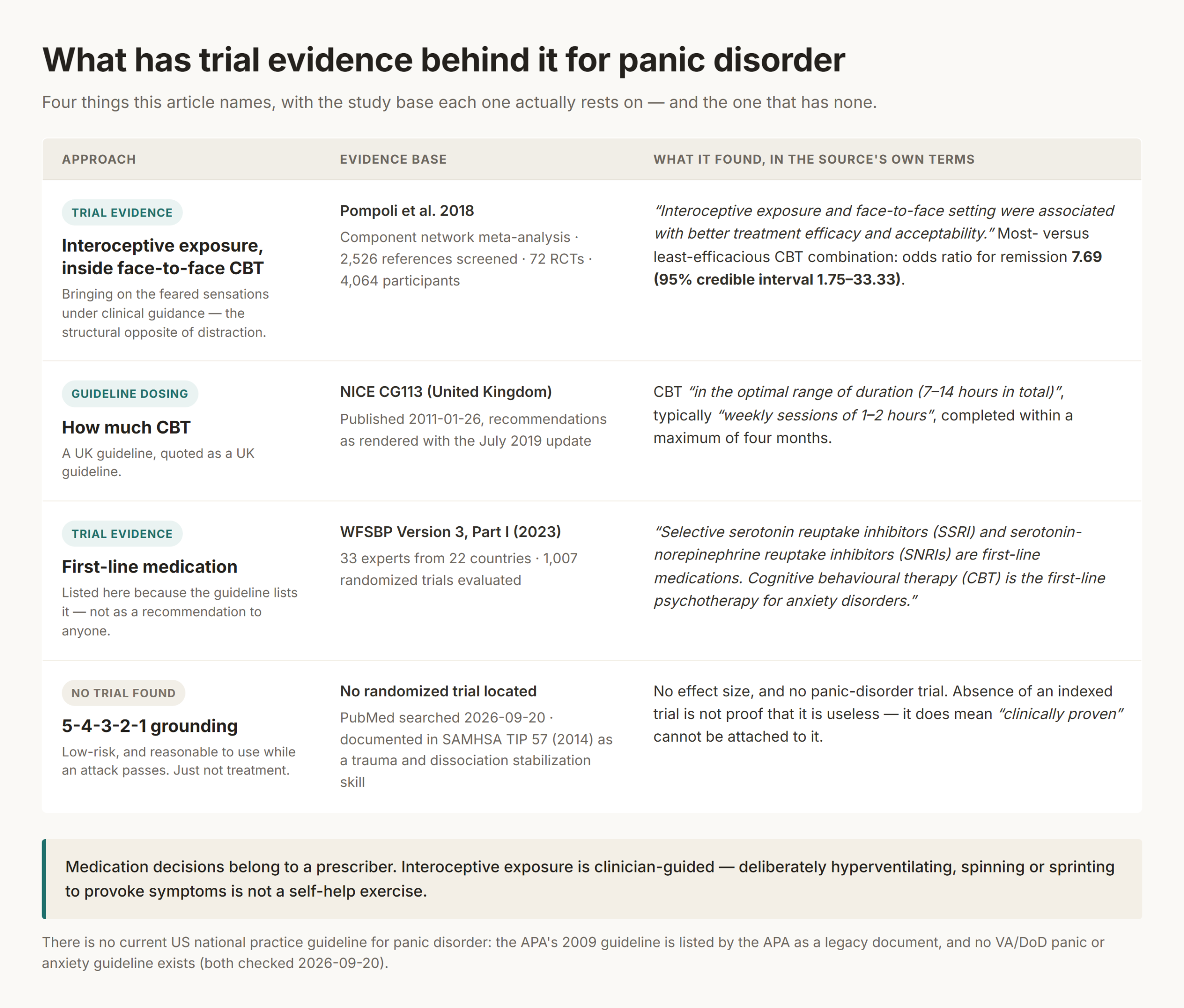
So the finding I can report is this, with its limits intact: as of September 2026, I could not find a randomized controlled trial testing 5-4-3-2-1 grounding on its own for panic attacks or panic disorder in PubMed. Absence of an indexed trial is not proof that something is useless. It does mean the phrase “clinically proven” cannot be attached to it.
Where the technique actually comes from
Not the panic literature. The trauma literature.
Grounding appears in SAMHSA’s TIP 57, Trauma-Informed Care in Behavioral Health Services (2014), Exhibit 1.4-1, described there like this: “Grounding techniques help a person who is overwhelmed by memories or strong emotions or is dissociating; they help the person become aware of the here and now.”
TIP 57 positions it as a provider skill — something a clinician uses during an assessment, and one the document calls “particularly useful—perhaps even critical—to achieving a successful interview when a client has dissociated.” The exhibit is credited to Melnick and Bassuk, 2000. No effect size. No panic disorder trial.
That gives us an accurate sentence and a dishonest one, and they are very close together:
- Accurate: a technique from federal trauma-care guidance for bringing someone back into the present, applied to panic without panic-specific trial evidence.
- Dishonest: a clinically proven treatment for panic attacks.
One boundary while we are here. Because grounding lives in the trauma literature, it often arrives bundled with advice about revisiting difficult memories. Do not do that on your own. Deliberately going back into traumatic memories without a clinician is not a self-help exercise, and if body-focused attention makes your distress worse rather than better, the right move is to stop and get professional support — not to push harder.
The honest demotion: it helps you get through, not stop
This is the part I would most want someone to say to me.
There is a line in the panic literature about safety behaviors, and it comes from Salkovskis, Clark and Gelder’s 1996 study of 147 panic disorder patients: “within-situation safety seeking behaviours also have the effect of maintaining catastrophic cognitions in the face of repeated panics during which the feared catastrophe does not occur.”
A safety behavior is anything you do during an attack that you believe prevented the catastrophe. And the trap is elegant and awful. The attack ends — because attacks end — and you credit the drill. You never get to find out that your heart was never going to burst, because the drill took the credit. So the belief survives, intact, waiting for next time.
Which means the framing matters more than the technique:
- Not this: “5-4-3-2-1 is what stops my panic attack and keeps me safe.”
- This: “The attack was going to peak and fade regardless. Counting things gives my attention somewhere to be while it does.”
Use it if it helps you ride out the minutes. Name what it is. It is a way to pass the time through something that was going to pass anyway, and it is low-risk. It is not a rescue, and it is not treatment.

Four things you can touch. Something to do with your attention while the wave passes — not what stops it.
Photo: Mara Cotta / Pexels
Breathing: the part most articles get backwards
If you take one counter-intuitive thing from this page, make it this one.
The standard instruction — “take a deep breath” — points in the wrong direction for panic, and it is worth understanding why before you use it again.
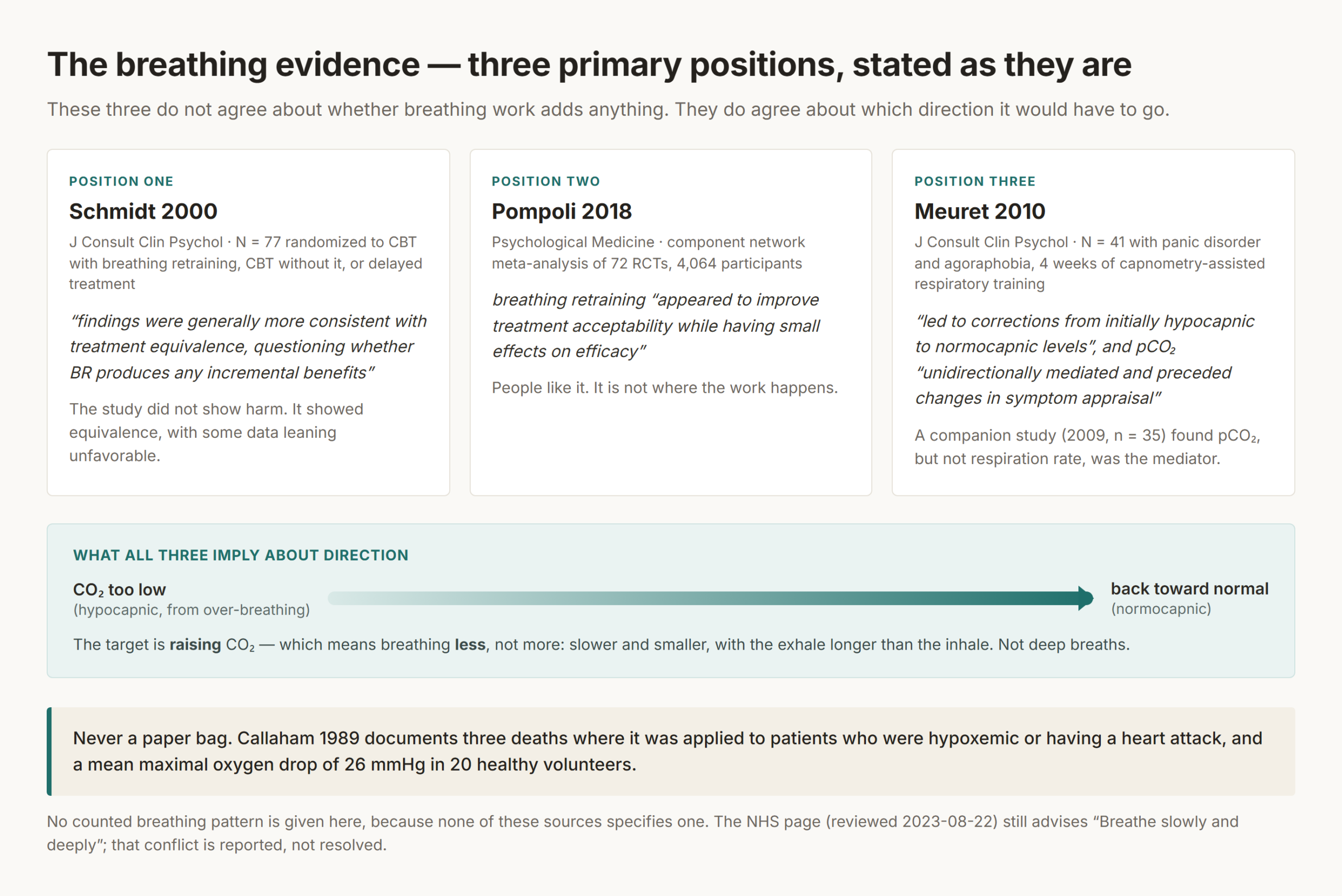
Side A: breathing retraining may not be doing what people think. Schmidt and colleagues (2000, Journal of Consulting and Clinical Psychology) randomized 77 patients with panic disorder to CBT with breathing retraining, CBT without it, or a delayed-treatment control. Their summary, verbatim: “Some data suggested that the addition of BR yielded a poorer outcome. However, findings were generally more consistent with treatment equivalence, questioning whether BR produces any incremental benefits.”
Note the precision there. The study did not show harm. It showed equivalence, with some data leaning unfavorable. Consumer articles routinely overstate this as “breathing exercises make panic worse.” They did not find that.
The meta-analytic view agrees. Pompoli and colleagues (2018, Psychological Medicine) screened 2,526 references and analyzed 72 randomized trials with 4,064 participants, finding that breathing retraining “appeared to improve treatment acceptability while having small effects on efficacy.” People like it. It is not where the work happens.
Side B: breathing that targets carbon dioxide has mechanistic support. Meuret and colleagues (2010, Journal of Consulting and Clinical Psychology) randomized 41 patients with panic disorder and agoraphobia to four weeks of capnometry-assisted respiratory training or cognitive training. Both improved comparably — but only the breathing arm “led to corrections from initially hypocapnic to normocapnic levels,” and the analysis found that pCO₂ mediated and preceded the changes in how patients appraised their symptoms. A companion study (2009, n = 35) found that pCO₂, but not respiration rate, was the mediator.
Here is what both sides agree on, and it is the opposite of the popular advice. Panic patients in these studies started out with too little carbon dioxide, not too much. The therapeutic target was raising CO₂ back toward normal — which means breathing less, not more. Big deep breaths push CO₂ further down, and low CO₂ produces exactly the tingling, lightheadedness and chest tightness people are panicking about in the first place.
So: do not take a big deep breath. If you use breathing at all during an attack, keep it slow and small, with the exhale longer than the inhale.
And I should disclose the conflict rather than pretend it away. The NHS page on panic disorder (reviewed August 22, 2023) tells the public to “Breathe slowly and deeply.” That is mainstream public-health advice, and in the word “deeply” it sits against the CO₂ mechanism. Three positions, all from primary sources, and I am not going to resolve them by fiat. What I can say is that the mechanistic evidence points toward less air, and that breathing is a comfort component rather than the active ingredient. If you want the longer-exhale approach spelled out for a narrower situation, social anxiety and public speaking covers performance anxiety specifically.
Never a paper bag
This one is settled, and it is old enough that most people have forgotten why.
Callaham’s 1989 paper in Annals of Emergency Medicine reports it directly: “The author reports three cases in which this treatment, erroneously applied to patients who were hypoxemic or had myocardial ischemia, resulted in death.”
The same paper ran a volunteer experiment — 20 healthy subjects, 14 men and 6 women, mean age 36 — who hyperventilated and then rebreathed into a brown paper bag. The mean maximal drop in oxygen was 26 mmHg. Meanwhile the carbon dioxide it was supposed to restore often did not arrive: “A few subjects achieved CO2 levels as high as 50, but many never reached 40.”
So the bag reliably removes oxygen and unreliably restores carbon dioxide. In someone whose actual problem is low blood oxygen or a heart attack — which is to say, precisely the person who gets mistaken for a panicker — that combination is lethal.
Why does the advice survive? Partly because a neurology review published the very same year called rebreathing into a paper bag “the most effective form of treatment.” Emergency medicine moved on. Old textbook lines did not, and they are still being copied into blog posts.

The next part is not something to do to yourself at home. It is what to ask a clinician for.
Photo: Curtis Adams / Pexels
What the evidence actually supports for panic
If grounding is a comfort measure, what is the treatment?
Interoceptive exposure, inside CBT. Pompoli’s component network meta-analysis (72 RCTs, 4,064 participants) found that “Interoceptive exposure and face-to-face setting were associated with better treatment efficacy and acceptability,” while “Muscle relaxation and virtual-reality exposure were associated with significantly lower efficacy.” Comparing the most efficacious CBT package against the least — both of which get sold as “evidence-based CBT” — the odds ratio for remission was 7.69 (95% credible interval 1.75 to 33.33).
Interoceptive exposure means deliberately bringing on the feared sensations under clinical guidance, until the body learns they are not a catastrophe. Breathing through a straw. Spinning. Raising the heart rate on purpose. The Merck Manual describes it as therapy that “exposes and desensitizes patients to the specific physical symptoms of panic attacks, such as dyspnea and palpitations.”
Notice that it is the structural opposite of distracting yourself away from the sensations.
And notice that I am describing it, not assigning it. Pompoli found the face-to-face setting itself was associated with better efficacy. Do not try this at home — deliberately hyperventilating, spinning or sprinting to provoke symptoms is not a self-help exercise, and it is genuinely unsafe for anyone with undiagnosed cardiac, respiratory, vestibular or seizure conditions. This is what to ask a clinician for, not homework.
Therapy dosing and medication, as the guidelines state it. NICE CG113 — and I should label this clearly, it is the UK guideline, published January 2011 with recommendations as rendered in a July 2019 update — says CBT “in the optimal range of duration (7–14 hours in total)”, typically “weekly sessions of 1–2 hours” completed within a maximum of four months, and that “an SSRI licensed for panic disorder should be offered.” It also states that benzodiazepines “should not be prescribed for the treatment of individuals with panic disorder,” and neither should sedating antihistamines or antipsychotics.
The WFSBP guidelines Version 3, Part I (2023) — 33 experts from 22 countries, evaluating 1,007 randomized trials — state that “Selective serotonin reuptake inhibitors (SSRI) and serotonin-norepinephrine reuptake inhibitors (SNRIs) are first-line medications. Cognitive behavioural therapy (CBT) is the first-line psychotherapy for anxiety disorders.”
NIMH names CBT and exposure therapy as psychotherapies, and lists SSRIs, SNRIs, beta-blockers and benzodiazepines among medications — with an explicit caution on the last group: “Some people build up a tolerance to these medications and need increasingly higher and higher doses… Some people even become dependent on them.” The Merck Manual adds somnolence, ataxia and memory problems.
There is a real disagreement here that I will not paper over. NICE says benzodiazepines should not be prescribed for panic disorder; StatPearls allows short-term use while an antidepressant takes effect, particularly in severe cases. That is a prescriber’s call about a specific person, not something to settle from a blog. Nothing on this page is a reason to start, stop, or adjust any medication.
One caveat about US guidelines specifically. There is no current American national practice guideline for panic disorder. The APA’s Practice Guideline for the Treatment of Patients With Panic Disorder, Second Edition dates to 2009 and is listed by the APA as a legacy document, not a current one. And there is no VA/DoD clinical practice guideline for panic or anxiety at all — their mental-health list covers bipolar disorder, depression, PTSD, schizophrenia, suicide risk and substance use. If you see an article citing “the US guideline” for panic, it is citing something that is not there.
The treatment gap is the real problem. In the same NCS-R analysis, lifetime treatment rates were high, but 12-month treatment meeting published guidelines ranged from just 18.2% to 54.9% depending on the subgroup. Most people carrying this are not getting the version of care with the trials behind it.
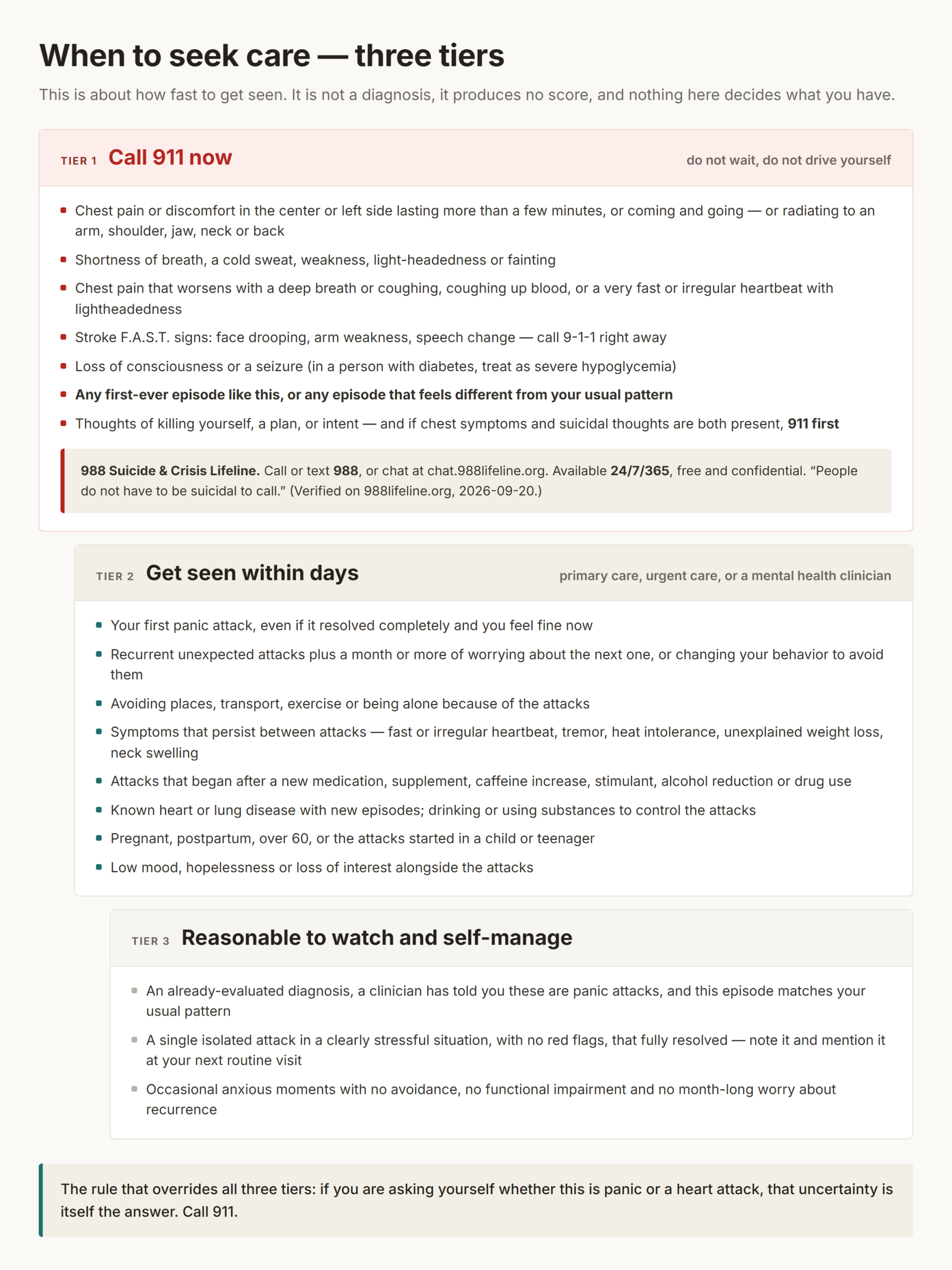
When to seek care — the three tiers

Tier 2 is the one most people skip: a first attack gets an appointment, even when it has already passed.
Photo: picjumbo.com / Pexels
Tier 1 — Call 911 now (do not wait, do not drive yourself)
Cardiac and vascular: chest pain or discomfort in the center or left side lasting more than a few minutes or coming and going; pain radiating to one or both arms or shoulders, or to the jaw, neck or back; shortness of breath with or before chest discomfort; cold sweat, weakness, light-headedness or faintness; unusual fatigue, nausea or vomiting (more common as a presentation in women, per the CDC); chest pain worse with exertion and easing with rest; fainting or near-fainting, especially with palpitations; breathlessness lying flat that forces you to sit up; chest pain that worsens with a deep breath or coughing, coughing up blood, or a very fast or irregular heartbeat with lightheadedness. And any first-ever episode like this, or any episode that feels different from your usual pattern.
Neurologic: face drooping, arm weakness or drift, slurred or strange speech; sudden numbness or weakness on one side; sudden confusion, trouble seeing, trouble walking, loss of balance; a sudden severe headache with no known cause. Do not drive — call 9-1-1.
Metabolic: loss of consciousness or a seizure. In a person with diabetes, treat as severe hypoglycemia — glucagon if available, and call 911 right away.
Mental health emergency: thoughts of killing yourself, a plan, or intent; a suicide attempt in progress; thoughts of harming someone else. Call 911. And if chest symptoms and suicidal thoughts are both present — 911 first.
988 Suicide & Crisis Lifeline. Call or text 988, or chat at chat.988lifeline.org. The Lifeline is available 24/7/365, and your conversations are free and confidential. Spanish: dial 988 and press 2, or text AYUDA to 988. Deaf and hard of hearing: TTY users dial 711 then 988; ASL users can use the 988 Videophone for Deaf/HoH American Sign Language users. Veterans and service members: call 988 and press 1, or text 838255. “People do not have to be suicidal to call.” (Verified on 988lifeline.org, September 20, 2026.)
I want to add one figure here, because panic in an emergency setting is a suicide-risk signal and not only a cardiac question. In that same Fleet cohort, 25% of the panic disorder patients had thoughts of killing themselves in the week before their ED visit, compared with 5% of the patients without panic disorder — and in the 1997 follow-up analysis, panic disorder was an independent risk factor for recent suicidal ideation, odds ratio 4.3 (95% CI 2.09 to 8.82). Again: one Canadian emergency department, 1996 to 1997, DSM-III-R criteria. It tells you the association is real. It does not give you a US population rate.
Tier 2 — Get seen within days
Primary care, urgent care, or a mental health clinician:
- Your first panic attack, even if it resolved completely and you feel fine now. Panic disorder is diagnosed only after medical causes are excluded.
- Attacks that are recurrent and unexpected, and you have spent a month or more worrying about the next one or changing your behavior to avoid them. That is Criterion B territory — get it evaluated rather than self-labeling.
- You are avoiding places, transport, exercise, or being alone because of the attacks.
- Symptoms that persist between attacks — a fast or irregular heartbeat, tremor, heat intolerance, unexplained weight loss, or a swelling in the neck. Those point away from panic and toward the thyroid; the symptoms and diagnosis of hypothyroidism covers the other end of that spectrum, and either way it is a blood test, not a breathing drill.
- Attacks that began after a new medication, supplement, caffeine increase, stimulant, alcohol reduction, or drug use.
- You have known heart or lung disease and are getting new episodes. Do not assume panic.
- You are drinking or using substances to control the attacks.
- Low mood, hopelessness, or loss of interest alongside the attacks. Sleep is often the first thing to go, and the racing-mind-at-night guide is a reasonable companion read while you wait for an appointment.
- You are pregnant, postpartum, over 60, or the attacks started in a child or teenager.
- Persistent suicidal thoughts without a plan or intent — contact a clinician promptly and keep 988 available.
Tier 3 — Reasonable to watch and self-manage
- You have an already-evaluated diagnosis, a clinician has told you these are panic attacks, and the current episode matches your usual pattern.
- A single isolated attack in a clearly stressful situation, with no red flags, that fully resolved. Note it, and mention it at your next routine visit. Remember that 22.7% of US adults report an isolated panic attack at some point (NCS-R, DSM-IV).
- Occasional anxious moments with no avoidance, no functional impairment, and no month-long worry about recurrence.
The rule that overrides all three tiers: if you are asking yourself whether this is panic or a heart attack, that uncertainty is itself the answer. Call 911.
What to actually take away
Let me put the qualifiers back on everything, because summaries are what people screenshot.
- “It feels like my heart will burst” is not diagnostic of panic. It overlaps with heart attack, arrhythmia, pulmonary embolism, severe hypoglycemia and thyroid disease. In Fleet’s 1996 cohort of 441 ED chest-pain patients, 25% (108/441) met panic disorder criteria — and 44% of those (47/108) already had documented coronary artery disease, while 98% of the panic cases went unrecognized by the attending cardiologists. Single Canadian center, 1996, DSM-III-R.
- A panic attack itself is not life-threatening — but the symptoms are shared with conditions that are, and only a clinician can tell them apart. First attack, or an attack unlike your usual, gets checked.
- The five-second promise has no source behind it. DSM-5 says the surge peaks “within minutes”; the NHS says most attacks last 5 to 20 minutes; NIMH says a few minutes to an hour or sometimes longer.
- “Brain malfunction” is model language, not a measured defect. Clark, Klein and Gorman all label their accounts as hypotheses, and there is no diagnostic test for panic disorder.
- On 5-4-3-2-1: I could not find a randomized trial of this technique on its own for panic in PubMed as of September 2026. That is not the same as proving it useless. Its documented home is SAMHSA’s trauma-care guidance, as a stabilization skill for dissociation and overwhelm, with no effect size attached. Use it as something to do with your attention while the wave passes — not as what stops the attack, because that framing is how a coping move turns into a safety behavior (Salkovskis 1996, N=147).
- Do not take a big deep breath, and never use a paper bag. The mechanism that helped in Meuret’s trials was raising CO₂, which means slower and smaller breaths with a longer exhale. Callaham’s 1989 paper documents three deaths from paper-bag rebreathing and a mean maximal oxygen drop of 26 mmHg in healthy volunteers.
- What has the trials behind it is CBT with interoceptive exposure, and SSRIs or SNRIs — 72 randomized trials and 4,064 participants for the CBT component analysis; 1,007 trials reviewed for the WFSBP medication position. Interoceptive exposure is clinician-guided. It is not homework.
The thing I keep coming back to is how the honest version is less comforting for about thirty seconds and much more comforting after that. There is no five-second switch. But there is a body that peaks and settles on its own within minutes, a clear line at which you stop managing and call 911, and a treatment with decades of randomized trials behind it that most people never get offered.
Counting five things you can see is fine. Just know what it is doing — and what it is not doing for you while you wait for the wave to pass on its own.
This article is general health information. It is not a diagnosis, not medical advice, and not a substitute for evaluation and treatment by a qualified clinician. The symptom list above is reproduced for recognition, not as a screening test, and it produces no score or verdict. If you are having chest pain, trouble breathing, fainting, or symptoms you have not had before, call 911 — do not try to decide for yourself whether it is “just panic.” Nothing here is a reason to start, stop, or change any medication; that is a conversation with a prescriber. Children, pregnancy and the postpartum period, older adults, and anyone with existing heart or lung disease are outside the scope of the self-management guidance here — please take those to a clinician. If you are having thoughts of suicide or self-harm, call or text 988, or call 911 if there is immediate danger.
Sources: Fleet RP et al., Am J Med 1996 (PMID 8873507); Fleet RP et al., Am J Emerg Med 1997 (PMID 9217521); DSM-5 diagnostic criteria, APA 2013 pp. 208–209 (reproduced in SAMHSA TIP, NCBI Bookshelf); Craske MG et al., Depress Anxiety 2010 (PMID 20099270); Kessler RC et al., Arch Gen Psychiatry 2006 (PMID 16585471); de Jonge P et al., Depress Anxiety 2016 (PMID 27775828); NIMH panic disorder statistics and “Panic Disorder: When Fear Overwhelms” (revised 2025); NHS “Panic disorder” (reviewed 2023-08-22); Merck Manual Professional Edition, “Panic Attacks and Panic Disorder” (rev. April 2026); StatPearls “Panic Disorder” (updated 2023-08-06); Clark DM, Behav Res Ther 1986 (PMID 3741311); Klein DF, Arch Gen Psychiatry 1993 (PMID 8466392); Gorman JM et al., Am J Psychiatry 2000 (PMID 10739407); Salkovskis PM, Clark DM, Gelder MG, Behav Res Ther 1996 (PMID 8687367); SAMHSA TIP 57, Exhibit 1.4-1 (2014, sourced to Melnick & Bassuk 2000); Pompoli A et al., Psychol Med 2018 (PMID 29368665); Schmidt NB et al., J Consult Clin Psychol 2000 (PMID 10883558); Meuret AE et al., J Consult Clin Psychol 2010 (PMID 20873904); Meuret AE et al., J Psychiatr Res 2009 (PMID 18835608); Callaham M, Ann Emerg Med 1989 (PMID 2499228); Watanabe et al., Neurol Clin 1989 (PMID 2671637, cited only as the obsolete position); NICE CG113 (UK, published 2011-01-26, July 2019 update); Bandelow B et al., WFSBP Version 3 Part I, World J Biol Psychiatry 2023 (PMID 35900161); American Psychiatric Association Clinical Practice Guidelines index (2009 panic guideline listed as legacy, checked 2026-09-20); VA/DoD Clinical Practice Guidelines index (no anxiety/panic CPG, checked 2026-09-20); CDC “About Heart Attack” (2024-10-24), “About Venous Thromboembolism” (2025-03-05), “Stroke Signs and Symptoms” (2026-05-19); NIDDK “Low Blood Glucose (Hypoglycemia)” and “Hyperthyroidism (Overactive Thyroid)”; 988 Suicide & Crisis Lifeline, 988lifeline.org (checked 2026-09-20).