

Subtle Signs Your Dog or Cat Is Sick: 5 to Watch
The Subtle Signs Your Dog or Cat Is Sick — 5 Quiet Signals I Learned to Watch
Photo: Hải Nguyễn / Pexels
I’ll be honest. For a long time, I thought I’d know right away if my pet got sick.
I pictured something obvious. Limping. Vomiting. A dog that wouldn’t stop whining.
But that’s not usually how it goes. The subtle signs your dog or cat is sick tend to show up much quieter than that, in places most of us aren’t looking. And there’s a reason for it, which I’ll get to in a moment.
This is one of those things I wish I’d understood sooner. So I want to walk through five quiet signals — the ones that are easy to miss — and, just as important, the moments when “keep an eye on it” turns into “go to the vet now.”
One thing first. I’m not a veterinarian, and none of this is a diagnosis. Symptoms alone can’t diagnose anything. A hands-on vet exam with blood, urine, and hormone testing is what actually tells you what’s wrong. This is meant to help you notice sooner, not to replace that exam.
Photo: Ivan Babydov / Pexels
Why pets hide it in the first place
Here’s the part that reframed everything for me.
Dogs and cats instinctively hide pain and illness. In the wild, showing weakness makes an animal a target, so the instinct is to mask it. That instinct doesn’t switch off just because they live on our couch.
The practical result is uncomfortable. By the time we notice something is “off,” a pet may already be quite sick. With cats especially, veterinary sources note that the only early sign an owner catches is sometimes just this — the cat has gone quiet and withdrawn.
So the real tool here isn’t a checklist of dramatic symptoms.
It’s knowing your pet’s normal.
Their usual habits, their usual personality, their usual energy. The changes are subtle, so your sense of what’s “normal for them” is what makes early detection possible.
Sign 1 — Hiding, withdrawing, or a personality that shifts
The first signal is behavioral, and it’s easy to explain away.
Cats often become withdrawn — hiding in unusual spots, avoiding the interaction they normally seek out. Dogs may go the other direction: restless, pacing, generally uneasy. Either way, the pet stops acting like itself.
I used to tell myself things like “she’s just having a lazy day.” Sometimes that’s all it is. But a personality change that lingers is worth taking seriously, because withdrawal is one of the quietest ways discomfort shows up.
Watch for the pattern, not the single moment.
- A cat tucking itself somewhere it never used to hide.
- A normally calm dog that can’t settle, pacing the room.
- A social pet that suddenly wants to be left alone.
None of these prove illness on their own. Together, over a few days, they’re a nudge to pay closer attention.
Sign 2 — Flinching from touch, and changes in grooming
The second sign is about touch, and it’s a fairly direct pain signal.
A pet that suddenly resents being touched, held, or brushed — or resents having one specific area handled — may be telling you it hurts. Changes in posture can say the same thing: an arched back, favoring one leg, shifting weight oddly when sitting or lying down.
Grooming is another quiet tell, especially in cats.
Over-grooming one spot until the fur thins or goes bald can be a cat trying to soothe a painful area. The opposite matters too — a cat that stops grooming altogether, leaving a dull, unkempt coat. Dogs may lick or chew one spot until it turns red or raw.
There are subtler eating cues, as well, even when appetite looks normal. Chewing on one side. Dropping food. Taking much longer to finish, or avoiding hard biscuits and chews. That’s often dental pain rather than fussiness.

Photo: WEI WU / Pexels
One more, for dogs specifically. Panting while at rest — when there’s been no exercise and it isn’t hot — can sometimes point to pain. Normal panting after a walk is a different thing entirely. It’s the unusual resting pant that’s worth noting.
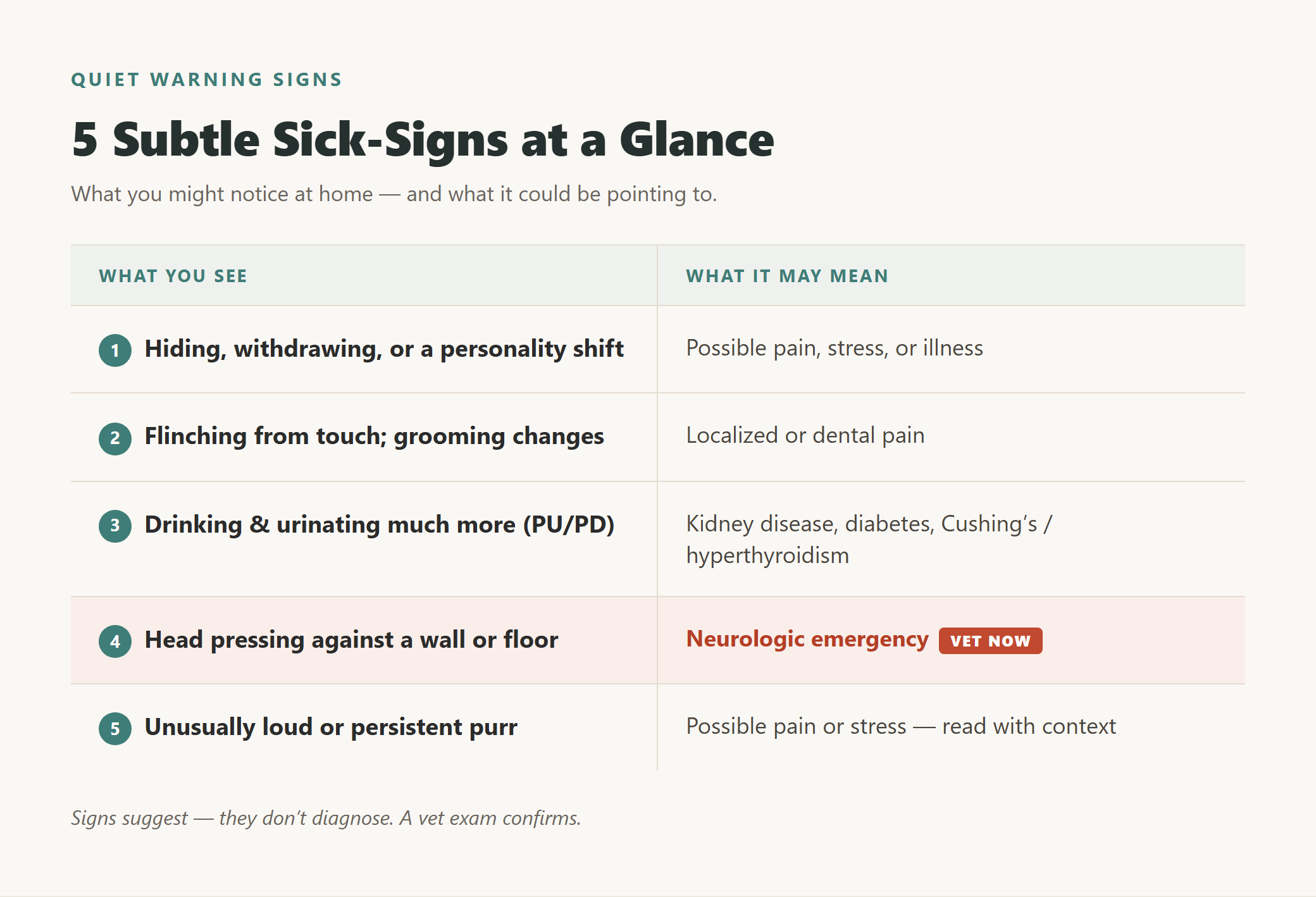
Sign 3 — Normal appetite, but drinking a lot more and peeing a lot more
This is the one I’d most want a friend to know about, because it looks so harmless.
The pet eats fine. Acts mostly fine. But the water bowl empties faster than it used to, and there’s more urine in the litter box or on the walks. Vets call this PU/PD — polyuria and polydipsia, increased urination and increased thirst.
It’s a common reason pets end up at the vet, and here’s the catch: there are over 30 possible causes. So this single quiet change can point to several serious internal diseases.
The most common causes break down by species:
- Dogs: chronic kidney disease, Cushing’s disease (hyperadrenocorticism), and diabetes mellitus.
- Cats: chronic kidney disease, diabetes mellitus, and hyperthyroidism.
How much drinking is “too much”?
There are rough numbers, and I want to share them carefully — because they’re guides, not verdicts.
Normal water intake usually doesn’t exceed about 90 ml/kg/day in dogs or 45 ml/kg/day in cats. Drinking above those levels is evidence of polydipsia, and over 100 ml/kg/day is considered definitive polydipsia. On the urine side, output above roughly 45 ml/kg/day in dogs or 40 ml/kg/day in cats lines up with polyuria.
But read those thresholds with a grain of salt.
Intake varies with the individual animal, with diet (dry food versus wet), with climate, and with activity. A pet can be meaningfully drinking more while still sitting under the cutoff. That’s why your pet’s own baseline matters more than any single number.

Because the treatments and outcomes for these diseases differ so much, symptoms alone aren’t enough to tell them apart. Vets use urine specific gravity and blood work — bile acids, tests for Addison’s and Cushing’s, thyroid levels, blood glucose, and screens for infections like leptospirosis — to narrow the list.
If you want to help, do one simple thing: measure and log daily water intake for a few days, and note how often your pet urinates. It’s exactly the kind of concrete information a veterinary team can work with.
Sign 4 — Head pressing: the one that means “go now”
Not every sign on this list is subtle. This one is quiet in appearance but loud in meaning, and I think everyone with a pet should be able to recognize it.
Head pressing is a dog or cat actively pressing its forehead against a solid object — a wall, the floor, a piece of furniture — in a repeated, deliberate, prolonged way while awake.
I want to be clear about what it is not.
It is not a head-bump of affection. It is not your cat leaning into your hand. It’s a pet standing with its head pushed against a wall as if trying to hold it there, and it looks wrong when you see it.

Photo: Chiper Catalin-Marian / Pexels
Head pressing is a neurologic emergency sign. Common causes include brain tumors, encephalitis (brain inflammation), meningitis, stroke, traumatic brain injury, or hydrocephalus. It can also come from hepatic encephalopathy — liver dysfunction letting toxins build up — or from toxin exposure like lead or household cleaners. In cats, toxoplasmosis and rabies can cause it too.
It rarely shows up alone. It often comes with other abnormal signs: behavior changes, continuous pacing, circling, disorientation, or seizures.
If you see it, contact a veterinarian without delay. And if you can, take a short video of the behavior first — it genuinely helps the vet.
Sign 5 — An unusually loud, persistent purr
The last one surprised me the most, and it’s where I have to present both sides honestly.
We’re taught that a purring cat is a happy cat. Often that’s true. But purring is not only a sign of contentment.
Here’s the tension in the evidence. Some sources emphasize the purr as comfort and even self-healing — the theory being that the low-frequency vibrations help the body heal. Others emphasize that cats also purr when stressed, anxious, or in pain, as a way to self-soothe. Both readings show up in the literature, which is exactly why you can’t judge on the purr alone.
So don’t. Read it with the context around it.
A purr while a cat is hunched, hiding, or tense — especially alongside changes in appetite, activity, or litter-box habits — may be discomfort wearing the mask of happiness. The purr is a data point, not a diagnosis. Record a short video and let the vet weigh it with everything else.
When “watch it” becomes “go to the vet now”
Most of these signs earn a closer look and a call to your vet. A few earn an immediate trip. Based on the veterinary sources behind this piece, don’t wait on any of the following:
- Head pressing, seizures, disorientation, or persistent circling. This is a neurologic emergency.
- A cat that hides and won’t come out, eats nothing, and goes very quiet. A cat can be seriously ill before obvious signs appear.
- Rapidly worsening PU/PD, especially with vomiting, appetite loss, or lethargy. That needs a prompt diabetes, kidney, or Cushing’s workup.
- Straining in the litter box with little or no urine coming out — particularly in male cats. This can be a urinary blockage, and it’s an emergency.
If you’re reading one of those back and recognizing your pet, please stop reading and call. An emergency or after-hours hospital counts.

Photo: Samson Katt / Pexels
A few honest limits before you go
I’ll say the uncomfortable part plainly, because it matters more than any single sign above.
None of these signals diagnose anything. Symptoms suggest; they don’t confirm. The numbers, the behaviors, the purr — they can all point in a direction, but the direction still has to be checked. A hands-on veterinary exam with blood, urine, and hormone testing is what actually names the problem.
Much of what I’ve described comes straight from veterinary hospitals and professional references. It’s meant to help you notice earlier and speak more clearly to your vet. It is informational only, and it is not a substitute for that exam.
If there’s one thing I’d leave you with, it isn’t a symptom at all.
It’s attention. The kind where you know your pet’s normal well enough to feel it the day something quietly shifts. Our dogs and cats are built to hide this from us — that’s the whole problem — so the noticing has to come from our side.
They can’t tell us when something’s wrong.
So the least we can do is learn to read the quiet parts, because they’re counting on us to catch what they can’t say out loud.
Sources: VCA Animal Hospitals; Veterinary Partner/VIN; Today’s Veterinary Practice; PetMD; VetSpecialists and VetFolio fact sheets; Roundwood Vets; Grace Animal Hospital; Sunset Animal Hospital; Maplewood Vet. See research.md for full URLs.


