Constipation in Older Adults: Causes, Meds, and Red Flags
I want to start with something I got wrong.
For most of a year, my father’s answer to “how are you feeling?” was the same word. Fine. No stomach pain. No complaints. Nothing that looked like a problem from the outside, so nobody in the family flagged anything.
It turned out he had been straining for months.
That is the quiet part about constipation in older adults — it often arrives without the symptom everyone is watching for. And when it does get noticed, the advice that follows is usually a glass of warm water and “eat more fiber,” which is, at best, half of an answer.
So this is the careful version. What actually causes it at this age, why the medicine cabinet deserves the first look, what food and fluids can and cannot do, what the guidelines actually recommend, and the signs that mean stop reading and call a clinician.
Photo: Ketut Subiyanto / Pexels
Why constipation in older adults gets missed
The numbers are not subtle. The National Institute of Diabetes and Digestive and Kidney Diseases (NIDDK) puts constipation at about 16 per 100 U.S. adults overall, and about 33 per 100 adults aged 60 and older. Roughly one in three.
But here is the correction that matters most, and every major source agrees on it.
This is not a normal consequence of getting older.
The National Institute on Aging is explicit that constipation is not a physiologic consequence of normal aging. The rise with age is driven mainly by medications, other medical conditions, reduced mobility, and problems with the rectum and pelvic floor — not by the calendar itself. Increasingly, the geriatrics literature frames it as a geriatric syndrome: several mechanisms running at once, which is why single-fix advice tends to fail.
The definition problem
Older adults and their doctors often mean different things by the word.
Under the Rome IV criteria, functional constipation is defined by symptoms over the last three months (with onset at least six months earlier) and at least two of the following in a quarter of bowel movements: fewer than three spontaneous movements a week, straining, hard or lumpy stools, a sense of incomplete emptying, a sense of blockage, or needing manual maneuvers.
Notice how much of that has nothing to do with frequency. Older adults frequently define constipation by straining and hard stool, not by how often they go. So “I go every day” does not rule it out — which is exactly how months pass without anyone raising it.
What actually changes with age
The old phrase for this was “atonic” or “lazy” bowel. That isn’t current clinical language, and it’s worth replacing with the two terms that actually describe what’s happening.
The first is slow-transit constipation (sometimes called colonic inertia) — stool simply moves through the colon too slowly. One thing to be honest about here: slow transit commonly comes with bloating and abdominal discomfort. It is not a silent condition by rule.
The second is rectal hyposensitivity — a reduced perception of rectal fullness. It’s present in roughly one-quarter of constipated adults, those patients tend to be older, and age correlates positively with all three rectal sensory thresholds. When that signal weakens, the urge to go weakens with it. Stool is retained, the rectum gradually stretches, and the whole thing builds without an obvious alarm. Patients with rectal hyposensitivity also report more severe obstructive symptoms overall and respond poorly to biofeedback.
So the accurate framing isn’t “painless constipation.” It’s this: the warning signal is blunted, so the problem gets under-reported. Which is a different, and more useful, thing to know.
The medication angle — the part most articles skip
If you only do one thing after reading this, make it this one.
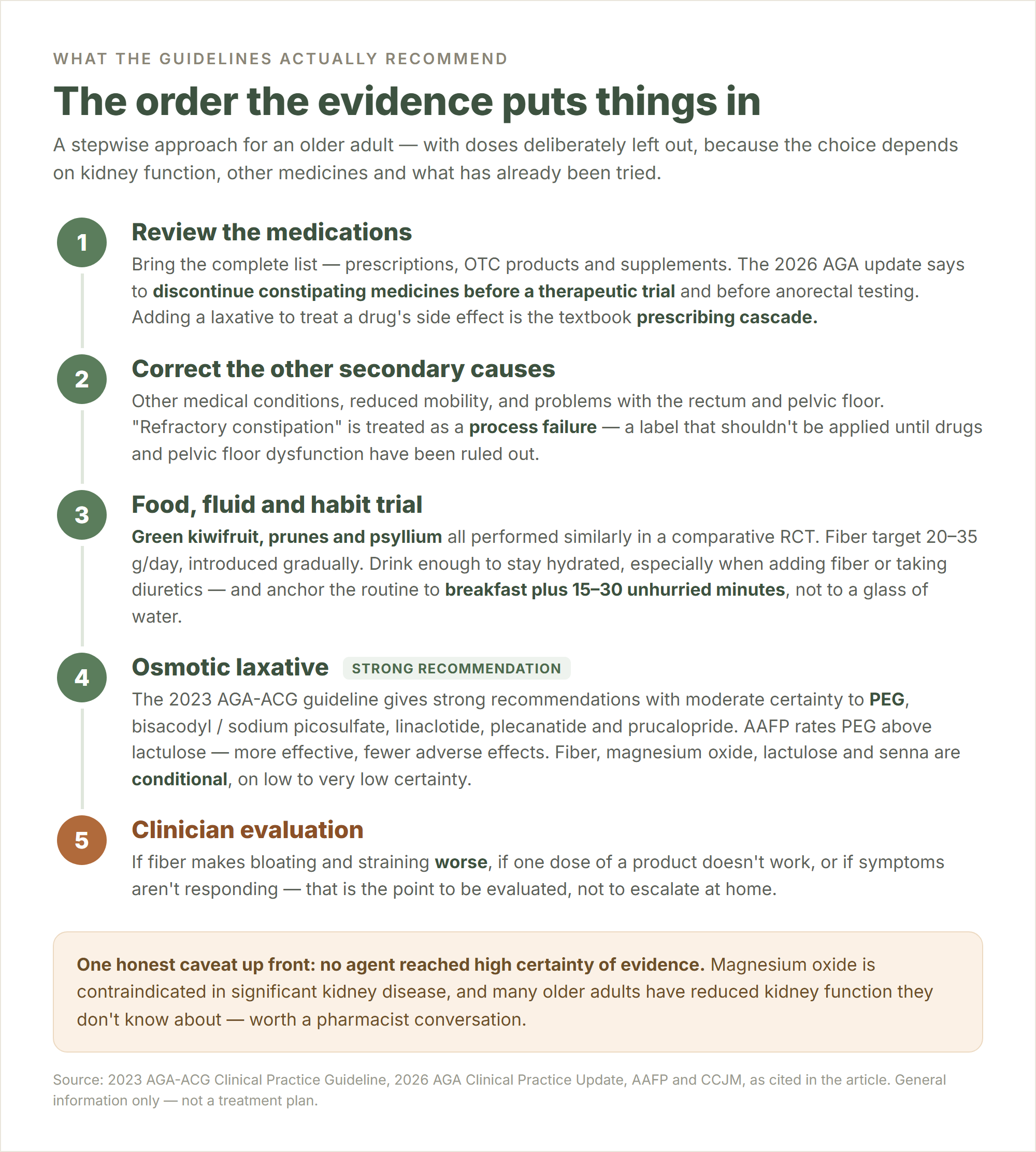
The 2026 AGA Clinical Practice Update on Refractory Constipation says clinicians should thoroughly evaluate for secondary causes such as medications and discontinue constipating medications before a therapeutic trial and before anorectal testing. In that framework, “refractory constipation” is treated as a process failure — a label that shouldn’t be applied until drugs and pelvic floor dysfunction have been ruled out.
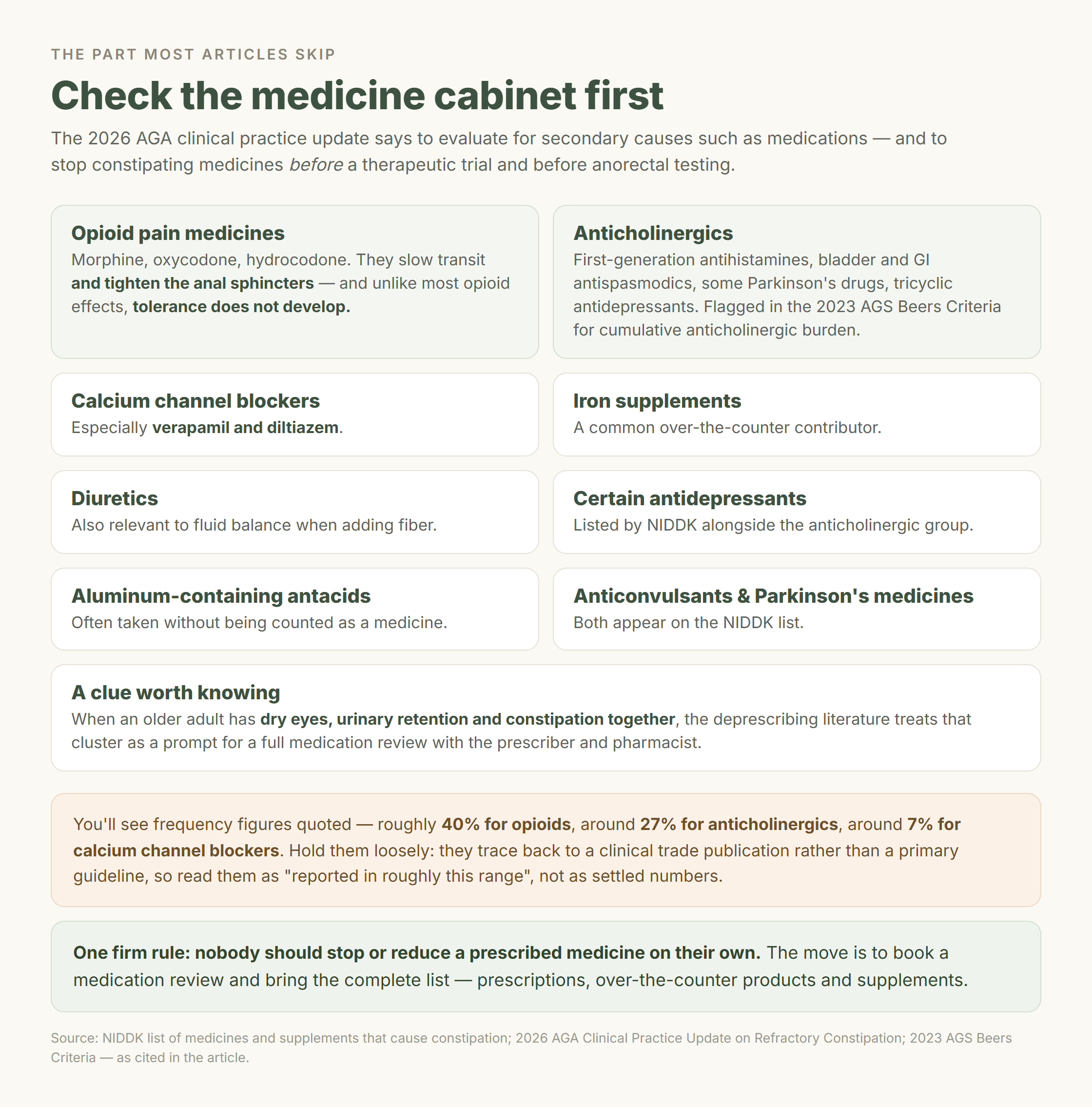
NIDDK’s own list of medicines and supplements that cause constipation covers most of the usual suspects:
- Opioid pain medicines (morphine, oxycodone, hydrocodone)
- Anticholinergics — first-generation antihistamines, bladder and GI antispasmodics, some Parkinson’s drugs, tricyclic antidepressants
- Calcium channel blockers, especially verapamil and diltiazem
- Iron supplements
- Diuretics
- Certain antidepressants
- Aluminum-containing antacids
- Anticonvulsants and medicines for Parkinson’s disease
Opioids deserve a line of their own. They reduce bowel tone and contractility, slow colonic transit, and tighten the anal sphincters, which makes evacuation harder. Unlike most opioid effects, tolerance does not develop — the constipation lasts as long as the opioid does.
You’ll see figures quoted for how often each class causes this — roughly 40% for opioids, around 27% for anticholinergics, around 7% for calcium channel blockers. I’d hold those loosely. They trace back to a clinical trade publication rather than a primary guideline, and the honest use of them is “reported in roughly this range,” not as settled numbers.
Anticholinergic burden, and the cascade
The 2023 AGS Beers Criteria flags anticholinergics for avoidance in older adults specifically to reduce cumulative anticholinergic burden, which is associated with falls, constipation, delirium, and possibly dementia. First-generation antihistamines get particular attention — highly anticholinergic, with reduced clearance in advanced age.
There’s a practical clue in the deprescribing literature worth knowing. When an older adult has dry eyes, urinary retention, and constipation together, that cluster is a prompt for a full medication review with the prescriber and pharmacist.
And the trap to avoid has a name: the prescribing cascade. Adding a laxative to treat a drug’s side effect, instead of addressing the drug, is the textbook example.
One firm rule: nobody should stop or reduce a prescribed medicine on their own. The move is to book a medication review and bring the complete list — prescriptions, over-the-counter products, and supplements.

Photo: cottonbro studio / Pexels
Two specifics worth carrying into that appointment
Docusate — the stool softener that doesn’t work. In older patients, docusate did not outperform placebo, psyllium, or sennosides; psyllium and sennosides beat it. In hospitalized adults it showed a 13% deprescription rate against a 33% new-prescription rate, with 80% of patients already on it continued at discharge — described in the literature as a missed deprescribing opportunity.
Opioid-induced constipation is handled separately. The 2019 AGA Institute guideline puts traditional laxatives first-line, and for laxative-refractory cases recommends naldemedine (strong recommendation, high-quality evidence), naloxegol (strong, moderate), and methylnaltrexone (conditional, low). These agents act peripherally and do not reverse pain relief. In phase 3 data, about 52% on naldemedine reached three or more spontaneous bowel movements a week versus 35% on placebo. Also worth knowing: fiber alone can make opioid-induced constipation worse, by adding bulk without improving movement.
What water and food can — and cannot — do
Now the advice everyone gives, tested against what’s actually been shown.
The warm water in the morning claim
The gastrocolic reflex is real. Colonic activity increases after eating, sometimes within 15 minutes, and the reflex is strongest in the morning. That part holds up.
But the trigger is mainly calories and meal composition — fat meals produce a prolonged colonic response, carbohydrate meals a shorter one. Gastric stretch contributes, so water isn’t nothing. It just isn’t the active ingredient.
The fluid evidence is thinner than the advice suggests. Constipated and non-constipated people drink similar amounts day to day. Hydration reviews conclude that extra intake helps mainly where there’s a genuine deficit — useful in “institutionalized, dehydrated, elderly, or hospitalized patients,” while for people already drinking normally the advice is “probably anecdotal.” Of four intervention studies, two showed benefit and two showed none. In children, extra water above usual intake changed neither stool frequency nor consistency, and the pediatric societies state that increased fluid should not be part of the treatment plan.
The one RCT people cite is Anti et al. 1998, and its details matter. It studied 117 patients aged 18–50 — not older adults. Everyone was already on a 25 g/day fiber diet. The comparison group was drinking only about 1.1 L/day, below typical adequate intake, while the intervention group drank 2 L. Both groups improved; the higher-fluid group improved more. Which is a reasonable case for correcting low intake alongside fiber, not proof that extra water fixes constipation.
So the defensible version, which the AAFP and the 2023 AGA-ACG guideline both point toward: drink enough to stay hydrated, especially when adding fiber or taking diuretics — and pair it with breakfast plus unhurried time afterward. The meal is the part with a mechanism behind it.
Fiber, and where it backfires
The 2023 AGA-ACG guideline gives fiber a conditional recommendation with low-certainty evidence, and among supplements only psyllium demonstrated effectiveness. It’s recommended first-line particularly for people with low intake. AAFP’s target for older adults is 20–35 g/day, introduced gradually.
Here’s the limit nobody mentions. Fiber works for normal-transit constipation. It is much less effective in slow-transit constipation and in defecatory (pelvic floor) disorders, and excess fiber can make slow transit worse. Up to 60% of patients report adverse effects from insoluble fiber within a month, and soluble fiber can cause bloating too.
The practical rule for an older reader: if adding fiber makes bloating and straining worse rather than better, that’s a signal to stop escalating fiber and get evaluated — not a signal to add more.
Seaweed and kelp — I have to be blunt
There is essentially no human evidence that seaweed or kelp treats constipation.
The best available human data is a randomized, placebo-controlled trial of low-molecular-weight alginate and agar polysaccharides, which increased fecal bulk by about 20–30% but did not alter gut-health markers. Fecal bulk is a surrogate, and that wasn’t a constipation-treatment trial in older adults. The rest of the supportive work is in mice. Reviews say plainly that well-designed human studies are lacking.
There’s also a safety note specific to this age group: kelp is iodine-dense, which is a genuine consideration for anyone with thyroid disease or on thyroid medication — a common situation after 60.
What to eat instead, with actual trials behind it
A comparative effectiveness RCT in U.S. patients with chronic constipation tested green kiwifruit (2/day), prunes (100 g/day), and psyllium (12 g/day) over four weeks. Responder rates for complete spontaneous bowel movements were similar across all three. All three increased weekly movements and improved straining; stool consistency improved significantly with kiwifruit and prunes.
A 2023 meta-analysis added that kiwifruit was as effective as psyllium for consistency and straining, and more effective for stool frequency. The NHS also points to sorbitol-containing fruit — apples, apricots, grapes, prunes.
Three ordinary foods, three real trials. That’s a better place to spend effort than a kelp supplement.

Photo: Gundula Vogel / Pexels
What the guidelines actually recommend
The current U.S. reference standard is the 2023 AGA-ACG Clinical Practice Guideline on chronic idiopathic constipation. One honest caveat up front: no agent reached high certainty of evidence.
| Strength | Agents |
|---|---|
| Strong (moderate certainty) | Polyethylene glycol (PEG), bisacodyl / sodium picosulfate, linaclotide, plecanatide, prucalopride |
| Conditional (low to very low certainty) | Fiber (psyllium), magnesium oxide, lactulose, senna, lubiprostone |
Osmotic laxatives lead. AAFP gives it a SORT A rating: PEG is preferred over lactulose because it’s more effective with fewer adverse effects. Cleveland Clinic Journal of Medicine notes PEG maintains efficacy for up to two years, with adverse event rates similar to placebo, and it’s the preferred osmotic in chronic kidney disease because it isn’t systemically absorbed. Lactulose’s gas and bloating limit its use in people who are already bloated.
Notably, this was the first major guideline to recommend the over-the-counter products magnesium oxide and senna as evidence-based treatments — which brings us to the two places the sources genuinely disagree.
Conflict 1 — magnesium
The deciding variable is kidney function, and both sides deserve stating.
Among patients taking daily magnesium oxide, 5.2% developed hypermagnesemia, with stage 4 chronic kidney disease a significant risk factor. A case series described four elderly patients with symptomatic hypermagnesemia from magnesium oxide, one fatal — all over 65 with renal dysfunction. Magnesium oxide is contraindicated in significant kidney disease.
Against that, CCJM’s more measured line is that the risk of hypermagnesemia is low with magnesium-based products in people without renal or cardiac disease, and the 2023 guideline conditionally recommends magnesium oxide.
The practical point for a senior audience is the one in between: many older adults have reduced kidney function they don’t know about. An OTC magnesium laxative is not automatically benign — worth a pharmacist conversation if there’s any kidney or heart disease, or if taking ACE inhibitors, ARBs, diuretics, or NSAIDs.
Conflict 2 — stimulant laxatives
Clinicians long avoided long-term stimulants believing they damage the enteric nervous system. More recent studies have not shown that effect. But evidence beyond four weeks isn’t validated, so the four-week convention reflects missing long-term data rather than proven harm. In older adults specifically, stimulants can cause electrolyte disturbance, dehydration, and abdominal pain, and long-term use is linked to tolerance. AAFP says use them after fiber and osmotic agents have failed; the 2023 guideline is more permissive. Both positions are on the table, which is precisely why this belongs with a clinician rather than a shopping cart.
Two safety items I’d underline
The FDA warning on sodium phosphate products. A 2014 FDA Drug Safety Communication warned that using more than one dose in 24 hours of OTC sodium phosphate products for constipation can cause rare but serious harm to the kidneys and heart, and death. It applies to both oral solutions and rectal enemas. The higher-risk groups named include people older than 55, dehydrated patients, and people with kidney disease, bowel obstruction or inflammation, or taking diuretics, ACE inhibitors, ARBs, or NSAIDs. That list describes a very large share of the senior population. The message is simple: if one dose doesn’t work, call a clinician instead of repeating it.
Fecal impaction and “diarrhea” that isn’t. Impaction is most common in older adults. Liquid stool from higher in the colon can bypass the impacted mass, producing overflow incontinence that looks exactly like diarrhea. Treating it with an antidiarrheal medication makes it worse. It’s diagnosed by digital rectal examination and treated by relieving the impaction — AAFP recommends mineral oil or warm water enemas and avoiding phosphate enemas because of electrolyte risk. Manual removal succeeds in about 80% of cases. This is a clinic problem, not a home project.
I’ve deliberately left out doses throughout this section. Choosing an agent depends on kidney function, other medicines, cost, and what’s already been tried — and that’s a conversation, not a paragraph.
Toileting habits — the cheap part that gets skipped
This is the least glamorous section and possibly the highest-yield one.
Work with the reflex, not against it. Scheduled toileting after meals is a standard recommendation in AAFP guidance and in impaction-prevention practice, and the NHS advises keeping a regular time and place with plenty of time allowed. In practice that means breakfast, then 15–30 unhurried minutes afterward. This is the evidence-consistent version of “the morning routine” — anchored to the meal rather than the water glass.
The footstool. The mechanism is straightforward: a Western-style seated posture narrows the anorectal angle and keeps the puborectalis muscle from fully relaxing. Raising the knees above the hips opens that angle. In Sikirov’s 2003 study of 28 healthy volunteers across three positions, both time to satisfactory emptying and degree of straining were sharply reduced in the squatting position. A study of 52 healthy individuals using a stool reported less straining and faster movements. The NHS recommends it directly.
Be clear about the limits, though. These are small, short studies in mostly healthy volunteers with subjective outcomes, and there’s no large trial in older adults. A footstool can also be impractical or unsafe for someone with balance problems or hip and knee limitations. Low-risk and low-cost, worth trying — not proven therapy.
Reducing straining has its own payoff regardless: chronic straining is linked over time to hemorrhoids, rectal prolapse, diverticula, and anal fissures.

Photo: kaboompics.com / Pexels
Movement — where the sources genuinely disagree
I can’t tidy this one up, so I’ll present it as it stands.
Against: AAFP’s 2015 older-adult review carries a SORT A rating — the strongest rating in this literature — for the statement that increased exercise does not improve symptoms of constipation in nursing home residents or older adults. The strongest older-adult-specific evidence is negative.
For: a systematic review and meta-analysis of 9 RCTs with 680 participants found constipation symptoms significantly reduced by exercise, particularly qigong and walking. In older adults, walking more than 5,500 steps a day has been associated with better stool consistency and bowel habits. CCJM notes physical activity increases intestinal gas clearance and decreases bloating.
So: don’t promise a parent that walking will fix this, especially if they’re frail or in a care facility. Frame it as worth doing for many other reasons, with mixed and mostly weak evidence for constipation specifically. Severe immobility is still a recognized contributor, which is its own argument for moving.

Photo: Robert So / Pexels
Red flags — when to stop managing at home
Some findings mean an appointment, not a new laxative.
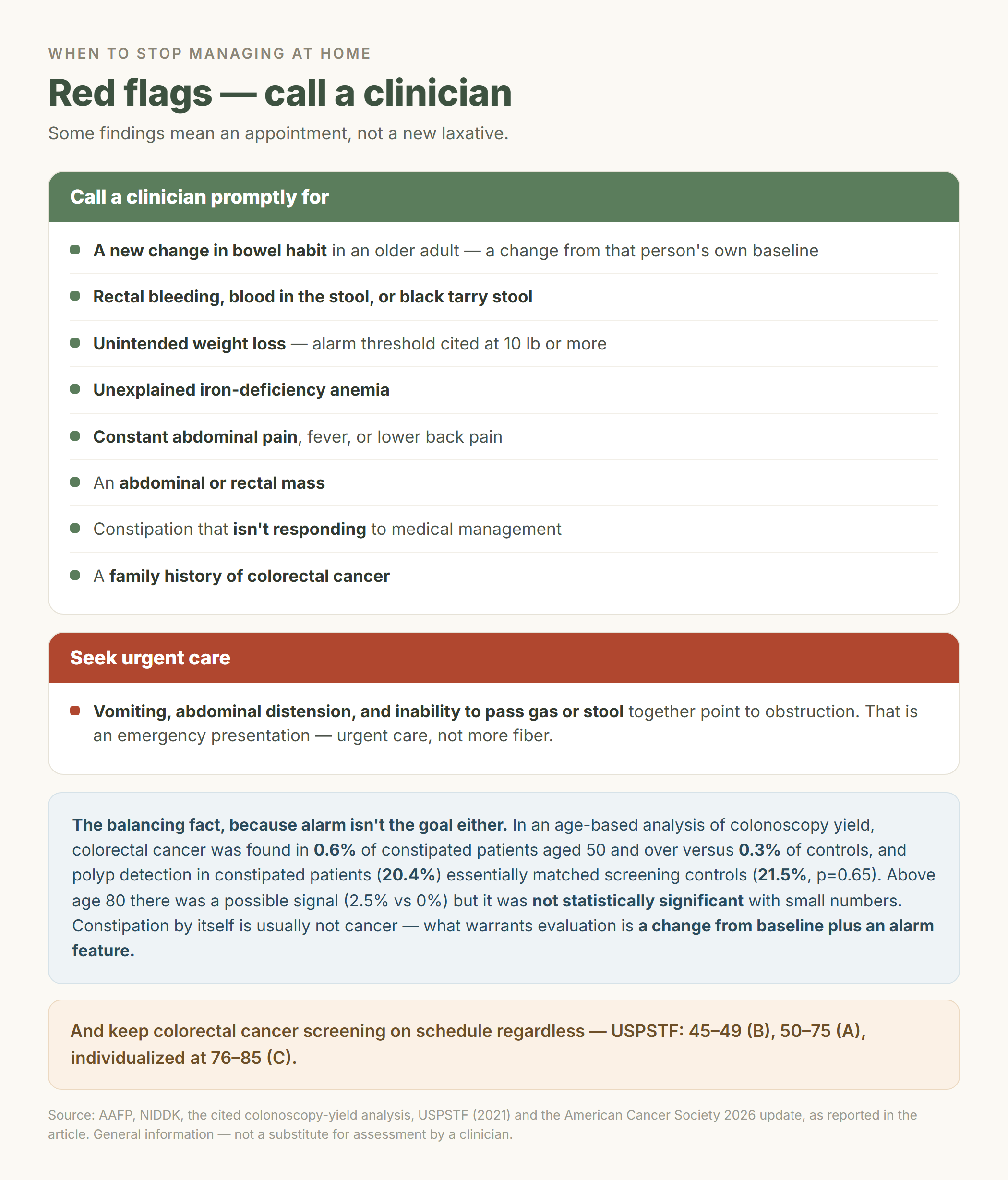
Call a clinician promptly for:
- A new change in bowel habit in an older adult — a change from that person’s own baseline
- Rectal bleeding, blood in the stool, or black tarry stool
- Unintended weight loss (alarm threshold cited at 10 lb or more)
- Unexplained iron-deficiency anemia
- Constant abdominal pain, fever, or lower back pain
- An abdominal or rectal mass
- Constipation that isn’t responding to medical management
- A family history of colorectal cancer
Vomiting, abdominal distension, and inability to pass gas or stool together point to obstruction. That is an emergency presentation — urgent care, not more fiber.
Now the balancing fact, because alarm isn’t the goal either. An age-based analysis of colonoscopy yield in constipated patients found colorectal cancer in 0.6% of constipated patients aged 50 and over versus 0.3% of controls, and polyp detection in constipated patients (20.4%) essentially matched screening controls (21.5%, p=0.65). Above age 80 there was a possible signal (2.5% vs 0%) but it was not statistically significant with small numbers. The authors concluded constipation did not confer increased risk across most age groups.
So constipation by itself is usually not cancer. What warrants evaluation is a change from baseline plus an alarm feature.
Separately, keep screening on schedule. The USPSTF recommends screening at 45–49 (B), 50–75 (A), and individualized decisions at 76–85 (C). The American Cancer Society’s 2026 guideline update reaffirmed starting at 45, continuing through 75 for those with a life expectancy over 10 years, discussing continuation at 76–85, and stopping after 85 or when life expectancy is under 10 years. That update also kept visual exams and stool-based tests as the recommended and preferred options, with newer blood-based tests recommended but not preferred at this time.
Looking back, what bothers me isn’t that we missed it. It’s why we missed it.
We were waiting for pain. And the one thing this condition reliably does at that age is arrive without the signal we were watching for — while three of the medicines already on the counter were quietly making it worse.
If you take one action from all of this, I’d skip the water glass and the kelp aisle. Sit down with an older parent, write out every medicine and supplement they take, and bring that list to their next appointment. Ask for a medication review by name.
It’s a smaller ask than a diet overhaul. And it’s the one part of this that the guidelines put first.
This article is general information and is not medical advice, diagnosis, or treatment. Do not start, stop, or change any prescribed medicine on your own — talk with your prescriber or pharmacist. If you or a family member has rectal bleeding, vomiting, severe abdominal pain or distension, or an inability to pass gas or stool, seek medical care right away.
References
- NIDDK (NIH) — Definition & Facts, and Symptoms & Causes of Constipation
- National Institute on Aging (NIH) — Concerned About Constipation?
- AGA + ACG — Clinical Practice Guideline: Pharmacological Management of Chronic Idiopathic Constipation (2023), Am J Gastroenterol
- AGA — Clinical Practice Update on Evaluation and Management of Refractory Constipation (2026), Clin Gastroenterol Hepatol
- AGA Institute — Guideline on the Medical Management of Opioid-Induced Constipation (2019)
- American Geriatrics Society — 2023 AGS Beers Criteria
- FDA — Drug Safety Communication on OTC sodium phosphate products (January 2014)
- AAFP — Management of Constipation in Older Adults (2015); Diagnostic Approach to Chronic Constipation in Adults (2011)
- Cleveland Clinic Journal of Medicine — Chronic Constipation: Update on Management (2017)
- Am J Gastroenterol (2021) — Comparative effectiveness trial of green kiwifruit, psyllium, or prunes
- Aliment Pharmacol Ther (2023) — Foods, drinks and diets and their effect on chronic constipation in adults
- Anti M et al. (1998) — Water supplementation and high-fiber diet
- Nutrients — Low-molecular-weight seaweed-derived polysaccharides and faecal bulk; NIH LiverTox — Kelp
- Sikirov D, Dig Dis Sci (2003) — Straining during defecation in three positions
- USPSTF (2021) and American Cancer Society (2026) — Colorectal cancer screening
- NHS — Constipation