Shingles Early Symptoms and the 72-Hour Antiviral Window
I want to start with the part I got wrong for years.
I always assumed shingles announced itself with a rash. That the blisters came first, and everything else followed. So when an older relative of mine spent the better part of a week convinced he had pulled something in his back — a deep, burning ache along one side of his ribs, nothing visible at all — nobody in the family said the word “shingles.” Why would we? There was nothing to see.
The rash showed up four days later.
That gap is the whole reason this article exists. Shingles early symptoms usually begin as nerve pain, not as a rash — and the days right after the rash finally appears are the days that matter most for treatment. Below is what the pain actually feels like, what the much-quoted “72-hour window” really means (it is a target, not a cutoff), and which complications are genuinely worth worrying about.
Photo: Andrea Piacquadio / Pexels
What shingles actually is — a virus that never left
Shingles is not a new infection you catch. It is the chickenpox virus — varicella-zoster virus, or VZV — coming back.
After chickenpox, VZV settles into the sensory nerve ganglia and stays there for life. It does not leave the body. Years or decades later, when VZV-specific cell-mediated immunity declines, the virus replicates, travels back down one sensory nerve, and inflames the strip of skin that nerve supplies. That is why shingles shows up as a single band on one side.
The scale is larger than most people expect. About 1 in 3 Americans will get shingles in their lifetime, and there are roughly 1 million cases a year in the US, according to CDC figures (cross-checked here against NIH/StatPearls and Cleveland Clinic, since CDC pages could not be retrieved directly for this research).
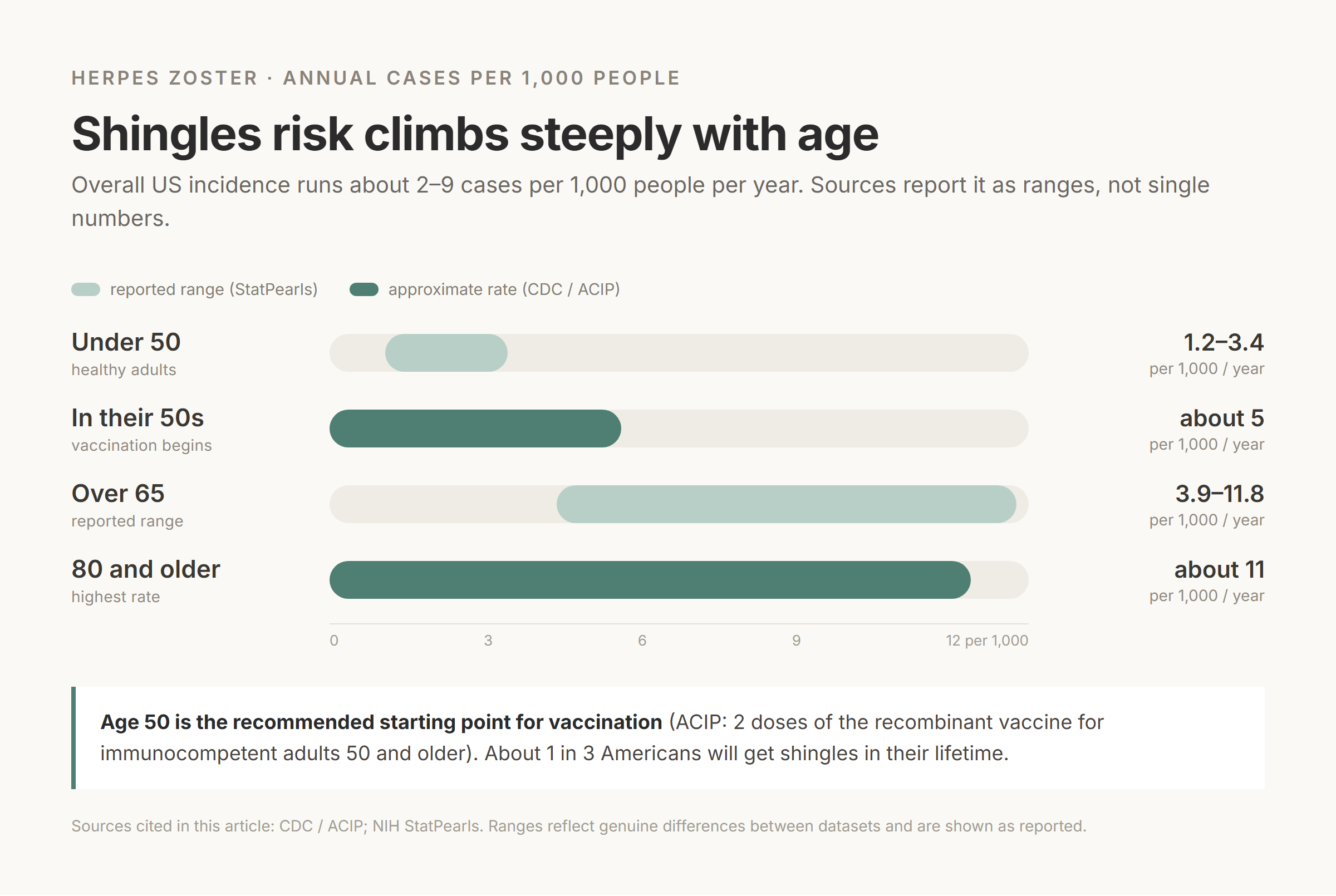
Overall incidence runs about 2–9 cases per 1,000 people per year, and it climbs steeply with age — roughly 5 per 1,000 per year in the 50s, and about 11 per 1,000 per year at 80 and older (CDC/ACIP). StatPearls puts it at 1.2–3.4 per 1,000 in healthy adults under 50, and 3.9–11.8 per 1,000 over 65.
One correction worth making, because it changes how people read their own risk. The driver is not vaguely “immunity dropping in middle age.” It is the specific decline in VZV-specific T-cell immunity, which is why risk rises sharply after 50 and accelerates again after 70, and why immunosuppression matters so much.
The prodrome most people miss
Here is the part I wish my family had known.
In most people, the pain comes first.
Burning, stabbing, shooting, deep aching, itching, tingling, numbness — in a single band, on one side of the body only. Often the skin becomes so hypersensitive that light touch hurts. A shirt seam. A bedsheet. That symptom has a name: allodynia.

Photo: cottonbro studio / Pexels
Some people describe it as an electrical sensation (AAD). It can come with malaise, headache, low-grade fever, light sensitivity, and occasionally nausea (AAFP, StatPearls, Cleveland Clinic).
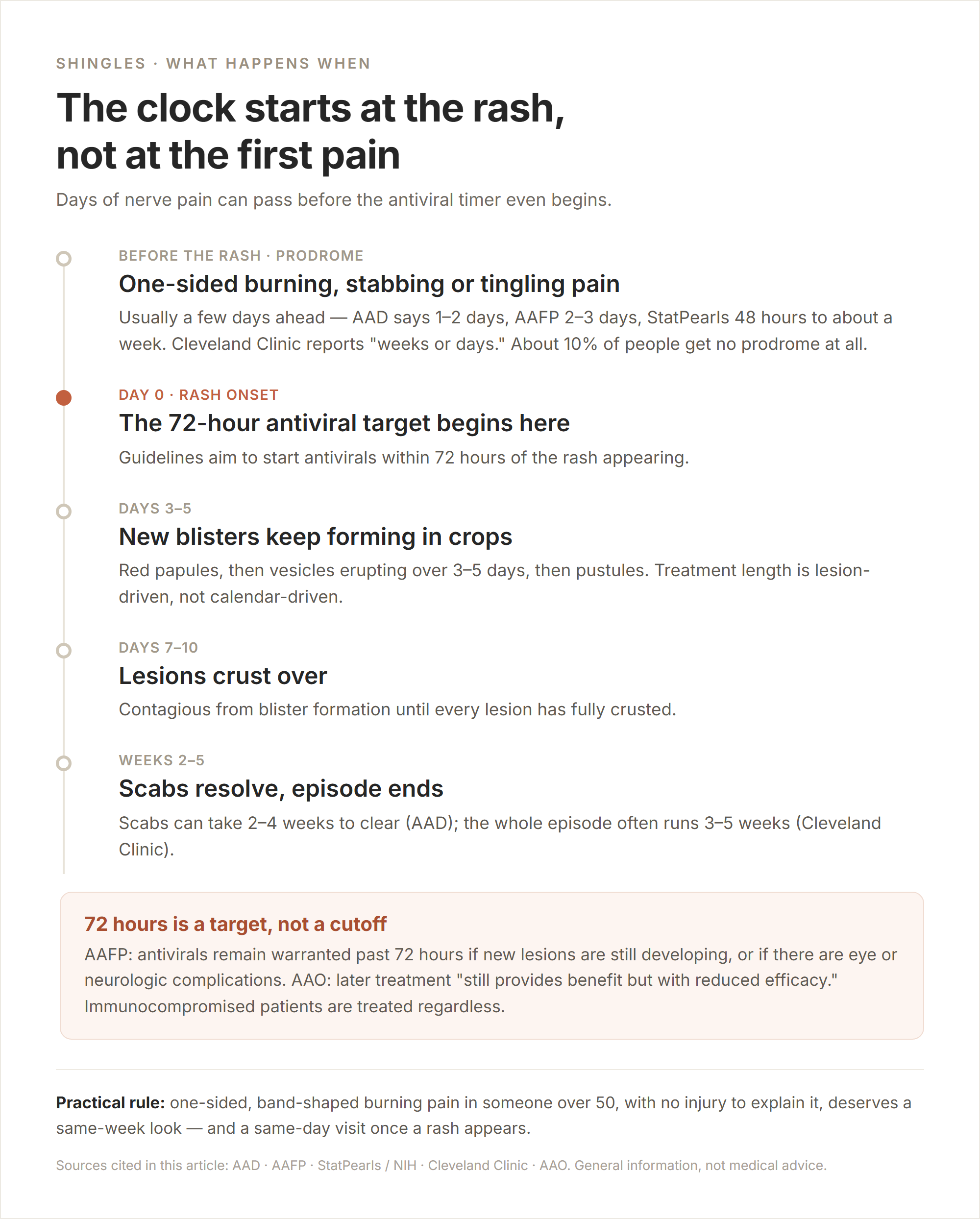
How many days before the rash?
Sources give a range rather than a single number, and I’d rather show you the spread than pretend there’s a clean answer.
| Source | Prodrome-to-rash interval |
|---|---|
| AAD | 1–2 days |
| AAFP | 2–3 days |
| StatPearls / NIH | 48 hours to about one week |
| Cleveland Clinic | “weeks or days” before the rash — the long outlier |
The honest summary: usually a few days, sometimes up to a week, occasionally longer. And about 10% of people get no prodrome at all — pain and rash arrive together.
Why this stage gets missed so often
Because there is nothing to see, dermatomal prodromal pain gets read as almost anything else. Depending on which nerve is involved, it has been mistaken for cardiac chest pain, pleurisy, gallbladder or kidney colic, appendicitis, disc or sciatic pain, migraine, and dental or sinus pain. Case reports document patients going through full cardiac or GI workups before the rash finally declares the diagnosis (BMC Infectious Diseases, 2023).
There is also zoster sine herpete — VZV reactivation that produces the dermatomal nerve pain with no rash at all. It is easy to miss entirely, and those patients often never get near the antiviral window. I won’t put a frequency on it, because I couldn’t find a reliable US figure.
So the practical rule I’d offer, and it costs nothing:
One-sided, band-shaped burning or stabbing pain in someone over 50, with no mechanical injury to explain it, deserves a same-week medical look — and an immediate call back if a rash appears.
If shingles is on your mind, say the word out loud to your clinician. Naming the suspicion is what starts the clock early.
The rash, and where it tends to appear
When the rash comes, it follows the same band the pain did: unilateral, dermatomal, and it does not cross the midline.
By location, StatPearls reports roughly 53% thoracic, 20% cervical, 15% trigeminal (face), and 11% lumbosacral. Another dataset gives slightly different splits with the same ranking. The takeaway most people need: about half are on the trunk, and a meaningful share are on the face — which is where things get more serious.
The course runs red papules, then vesicles erupting in crops over 3–5 days, then pustules, then crusting at about 7–10 days. Scabs can take 2–4 weeks to fully resolve (AAD), and the whole episode often runs 3–5 weeks (Cleveland Clinic).
What the 72-hour antiviral window actually means
This is the point where consumer articles do real harm, and I want to be careful.
The guidance is genuine. AAFP says antiviral therapy should ideally be started within 72 hours of the appearance of the rash, to shorten symptoms and reduce pain severity. CDC, StatPearls, AAO, NHS and Cleveland Clinic all repeat that goal.
Two nuances change how you should use it.
First, the clock starts at rash onset — not at your first twinge of nerve pain. Days of prodrome can pass before the timer even begins.
Second — and this is the part usually left out — 72 hours is a target, not a cutoff.
- AAFP states that antivirals remain warranted beyond 72 hours if new skin lesions are still developing, or if ophthalmic or neurologic complications are present.
- AAO notes that treatment started past the window “still provides benefit but with reduced efficacy.” Reduced — not zero.
- The German S2k guideline (Gross et al., 2020) explicitly recommends starting antivirals at a later time point when those conditions are met, while candidly acknowledging that this rests on consensus and existing guidelines rather than trials built for that scenario.
- Duration is lesion-driven, not calendar-driven — treatment continues until no new blisters are forming and lesions have crusted.
- Immunocompromised patients are treated regardless of a strict window.
Several observational studies have also found antivirals reduced zoster pain even when started after the 72-hour mark.
So the message I’d want an older reader to walk away with is this:
Move fast — inside 72 hours of the rash is the target, because that is where the best evidence sits. But do not decide you’ve missed your chance at hour 73. If new blisters are still forming, if the rash is anywhere near your eye, if there are neurological symptoms, or if you’re immunocompromised, guidelines still support treatment. See a clinician the same day.
The oral antivirals a doctor may prescribe are acyclovir, valacyclovir, and famciclovir. Which one, at what dose, for how long, is entirely a clinician’s decision — nothing in this article is a substitute for that visit.

Photo: SHVETS production / Pexels
The complications that actually matter
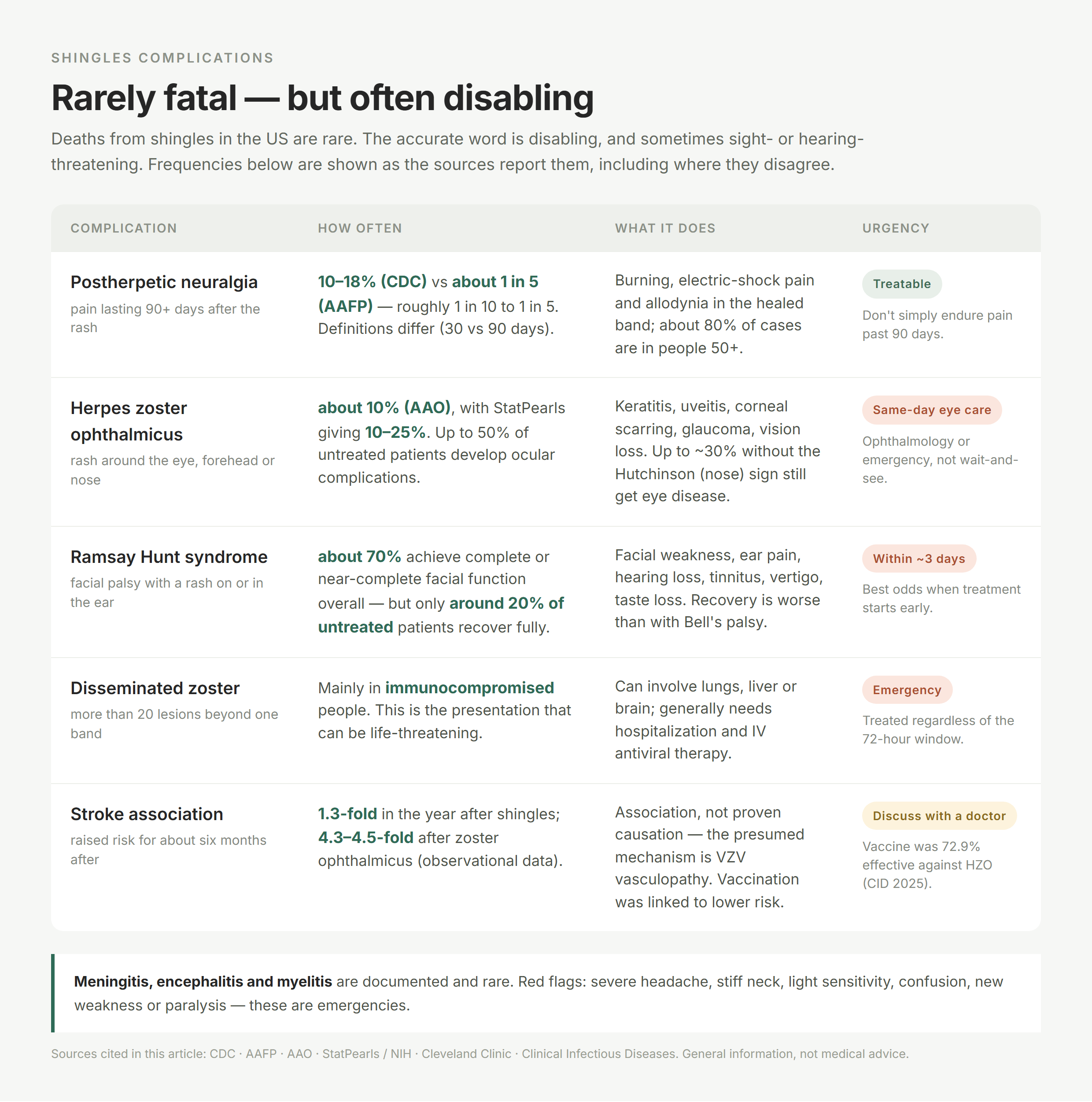
I’ve seen shingles described as potentially “fatal,” and that framing is misleading. Deaths from shingles in the US are rare, and concentrated almost entirely among older adults and immunocompromised people; Cleveland Clinic describes it as rarely fatal.
The accurate word is not fatal. It is disabling — and sometimes sight- or hearing-threatening. That is still urgent enough.
Postherpetic neuralgia (PHN) — the common one
PHN is pain that persists 90 days or more after the acute rash (AAFP, StatPearls).
How often? Sources genuinely disagree, so here are both: CDC puts it at 10–18% of shingles patients, while AAFP says approximately one in five (~20%), and Cleveland Clinic says “up to 1 in 5.” The gap comes from different definitions of pain persistence (30 vs 90 days) and different age mixes. Call it roughly 1 in 10 to 1 in 5.
It is heavily an older-adult problem: about 80% of PHN cases occur in people 50 or older (AAFP), and it is uncommon under 40.
The risk factors are worth knowing because one of them loops back to the beginning of this article. Per AAFP: older age, severe prodromal pain, severe rash, severe acute pain, ophthalmic involvement, immunosuppression, and chronic conditions like diabetes and lupus.
Read that again — the intensity of the pain before the rash predicts the risk of pain after it.
PHN feels like burning, aching, electric-shock pain, itching, and allodynia in the healed band. It can last months to years, and in older adults it corrodes sleep, appetite, mood, and independence.
Treatments exist: topical lidocaine 5% and capsaicin 8% patches, oral gabapentin or pregabalin, and tricyclic antidepressants such as amitriptyline or nortriptyline. Every one of those is a prescription decision, and gabapentinoids and tricyclics carry real burdens in older adults — sedation, falls, anticholinergic effects. This is a conversation to have with a doctor, not a list to act on.
Herpes zoster ophthalmicus (HZO) — the sight emergency
This is the one I’d want every reader to remember.
HZO accounts for about 10% of all zoster cases (AAO), with StatPearls giving a wider 10–25% — so roughly 1 in 10, with some series up to 1 in 4.
Vesicles on the tip or side of the nose are the Hutchinson sign, indicating nasociliary nerve involvement and strongly predicting eye disease. But here is the critical caveat: its absence does not rule anything out — up to about 30% of patients without the Hutchinson sign still develop ocular complications (AAO).
Up to 50% of untreated HZO patients develop ocular complications: keratitis, anterior uveitis, conjunctivitis, corneal scarring or perforation, secondary glaucoma, and vision loss. Prompt treatment sharply reduces those rates.
Any zoster rash on the forehead, scalp, eyelid, around the eye, or on the nose means same-day ophthalmology or emergency evaluation. Not wait-and-see.
Ramsay Hunt syndrome — where “3 days” is strongest
When VZV reactivates in the geniculate ganglion and facial nerve, the result is peripheral facial palsy plus a vesicular rash on or in the ear (or in the mouth). It often comes with ear pain, hearing loss, tinnitus, vertigo, nausea, and loss of taste on the front of the tongue.
Recovery is worse than with Bell’s palsy. About 70% achieve complete or near-complete facial function overall — but only around 20% of untreated patients recover fully. Cleveland Clinic notes that the odds of full recovery are best when treatment starts within about three days of symptom onset.
If there is one place in this whole article where the urgency message is fully earned, it is here.
Disseminated zoster and neurologic complications
Disseminated zoster means more than 20 lesions outside the primary and adjacent bands — it starts to look like chickenpox spreading across the body. It occurs mainly in immunocompromised people, can involve the lungs, liver, or brain, and generally requires hospitalization and IV antiviral therapy. This is the presentation that can be life-threatening.
Meningitis, encephalitis, and myelitis are documented and rare. The red flags are severe headache, stiff neck, light sensitivity, confusion, and new weakness or paralysis.
The stroke association
This one surprised me. Adults have an increased risk of stroke for roughly six months after zoster, per a self-controlled case-series in Clinical Infectious Diseases, with a more than three-fold increase following zoster ophthalmicus. Taiwanese cohorts cited in the same journal found a 1.3-fold increase in stroke risk in the year after shingles, and 4.5-fold after HZO. AAO cites HZO raising stroke risk 4.3-fold within a year.
These are associations from observational data — the presumed mechanism is VZV vasculopathy, inflammation of the cerebral arteries. Associated with, not proven to cause.
There is a hopeful counterpart. A Kaiser Permanente cohort (102,766 two-dose recombinant vaccine recipients vs 411,064 matched unvaccinated controls, CID 2025) found the vaccine 72.9% effective against HZO and associated with lower risk of heart attack and stroke in adults 50 and over.
Is stress really the trigger?
You will read everywhere that stress causes shingles. I can’t tell you that, because the evidence doesn’t settle it.
Studies finding an association: a nationwide population-based cohort in the British Journal of Dermatology (2021) linked higher perceived psychological stress to increased zoster risk, and a Korea Health Panel analysis reported increased risk with stress and sleep deprivation.
Studies finding none: population-based case-control work in Denmark and the UK found that partner bereavement or a spouse’s catastrophic health event did not raise herpes zoster risk, with no increase in the 90 days after the stressor. One PubMed commentary is titled, plainly, “Psychological stress as a trigger for herpes zoster: might the conventional wisdom be wrong?”
They disagree largely because stress is hard to measure and stressor definitions vary between studies.
So: stress is commonly cited, and some large studies support it. Several equally large ones don’t. The consistently proven driver is declining immunity with age or immunosuppression — and that is the one you can actually act on.
Can you give it to someone else?
Yes and no, and the distinction matters for grandparents.
You cannot catch shingles from someone with shingles. What transmits is VZV itself, and in a non-immune person it causes chickenpox, not shingles.
- Route: direct contact with fluid from the blisters. Severe or disseminated cases can also spread through airborne particles.
- Contagious period: from blister formation until all lesions have fully crusted over. A covered rash is much lower risk.
- Who to protect (NHS is explicit): non-immune pregnant people, immunocompromised people, and babies under one month.
- Precautions: keep the rash covered, don’t scratch it, wash hands thoroughly, don’t share towels or bedding, skip pools and contact sports while lesions weep, and stay home from work if the rash is oozing and can’t be covered.

Photo: Kaboompics.com / Pexels
For the grandparent question specifically: a vaccinated or previously infected child is at very low risk. The real concern is a non-immune infant or an immunocompromised household member.
Vaccination — the strongest lever you have
Everything above is damage control. This is the part that’s actually preventive.
The recombinant zoster vaccine (RZV, Shingrix) is non-live, adjuvanted, and given as 2 doses. The older live vaccine (Zostavax) has not been available in the US since November 18, 2020; anyone who received it should still get the recombinant vaccine.
ACIP recommendations:
| Group | Recommendation | Dose interval |
|---|---|---|
| Immunocompetent adults 50 and older | 2 doses, regardless of prior shingles or prior Zostavax | 2–6 months apart (minimum 4 weeks) |
| Adults 19 and older who are or will be immunodeficient or immunosuppressed from disease or therapy | 2 doses | 2–6 months; may be shortened to 1–2 months when faster protection is needed |
For immunocompetent adults 50+, there is no need to ask about a chickenpox history or test for varicella antibody.
Efficacy is unusually strong for a vaccine aimed at older adults: about 97% at ages 50–69 and 91% at 70 and older (ZOE-50/ZOE-70, NEJM), about 91% against PHN, and — this is the number that impressed me most — 82.0% still in year 11, with 87.7% overall through the end of long-term follow-up (ZOE-LTFU final analysis, 2025).
Now the honest downside, because pretending it doesn’t exist is why people skip dose two.
Shingrix is notably reactogenic. Injection-site pain, redness and swelling, plus fatigue, muscle aches, headache, shivering, fever, and GI upset — typically for 2–3 days. In ACIP’s immunocompromised studies, Grade 3 local reactions occurred in 10.7–14.2% and Grade 3 systemic reactions in 9.9–22.3% of recipients, with serious adverse events comparable to placebo.
Plan the shot for a day when a rough 24–48 hours is tolerable. That reaction is not an allergy, and it is not a reason to skip the second dose.
And if you’ve already had shingles? Still recommended. A prior episode doesn’t confer reliable protection — recurrence runs roughly 1 in 20 over several years (about 6.2% at 8 years, Mayo Clinic Proceedings) — and ACIP recommends vaccination regardless of zoster history. Timing is simply after the acute episode has resolved; there’s no fixed mandatory interval, so let your clinician advise.
On cost: ACIP-recommended adult vaccines are covered without cost-sharing under Medicare Part D following the Inflation Reduction Act, and are typically covered as preventive care under Medicaid, marketplace, and most employer plans. One point that trips up the 65+ crowd constantly — Shingrix falls under Part D, not Part B. Coverage rules change, so check with your plan rather than trusting any figure you read online, including here.

Photo: Kaboompics.com / Pexels
When to get seen urgently
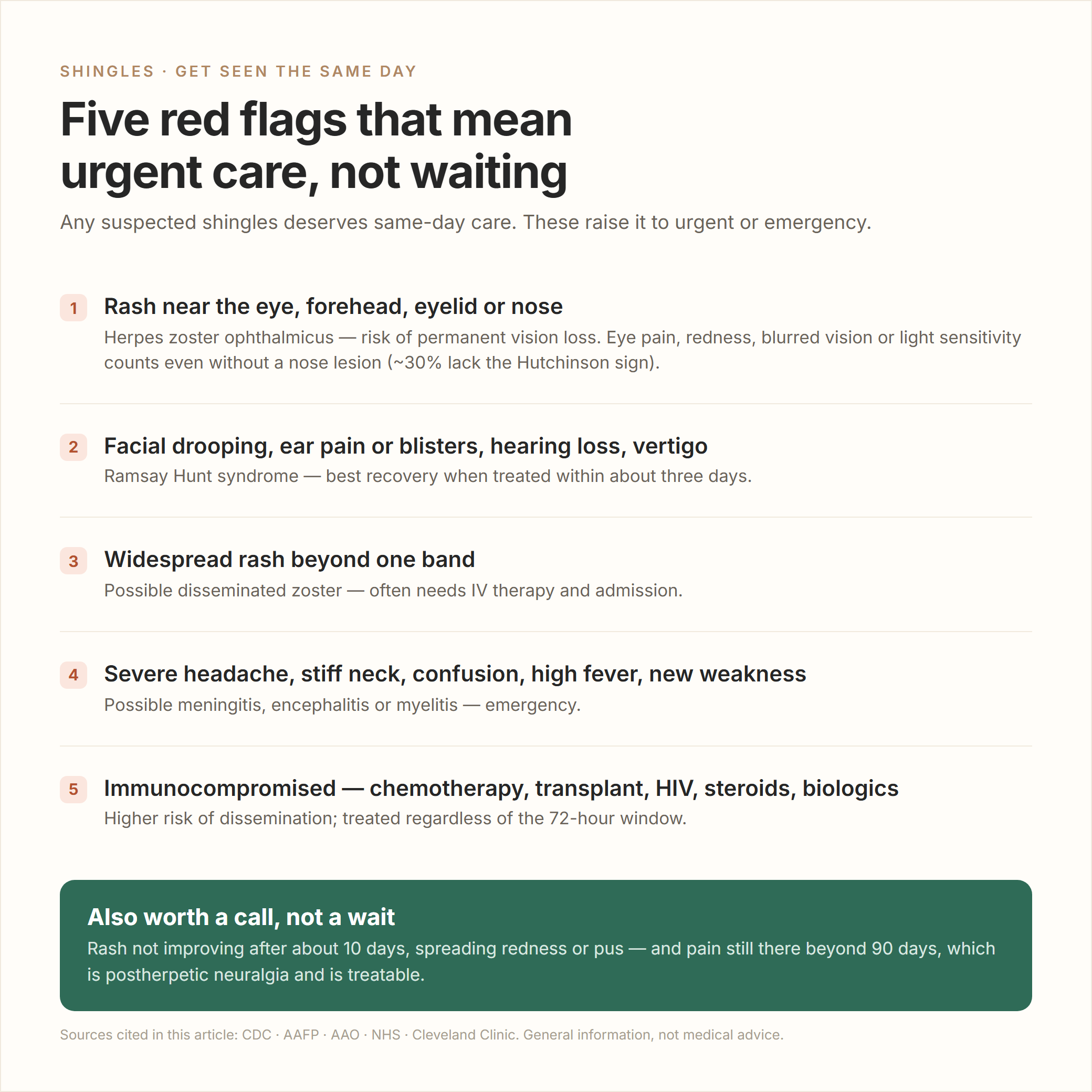
Get medical care the same day for any suspected shingles, ideally within 72 hours of the rash. Escalate to emergency or urgent care for any of these:
| Red flag | Why it matters |
|---|---|
| Rash on the forehead, eyelid, around the eye, or on the tip or side of the nose | Herpes zoster ophthalmicus — risk of permanent vision loss; needs same-day ophthalmology |
| Eye pain, redness, blurred vision, light sensitivity | Eye involvement can occur even without a nose lesion (~30% lack the Hutchinson sign) |
| Facial weakness or drooping, ear pain, blisters in or around the ear, hearing loss, vertigo, ringing | Ramsay Hunt syndrome — best recovery when treated within about 3 days |
| Severe headache, stiff neck, confusion, high fever, new weakness or paralysis | Possible meningitis, encephalitis, or myelitis — emergency |
| Widespread rash beyond one band, or lesions all over the body | Possible disseminated zoster — often needs IV therapy and admission |
| Immunocompromised (chemotherapy, transplant, HIV, steroids, biologics) | Higher risk of dissemination; treat regardless of the 72-hour window |
| Pregnant, breastfeeding with a rash on the breast, or under 18 | NHS lists these as urgent-contact situations |
| Rash not improving after about 10 days, or spreading redness, pus, worsening fever | Possible secondary bacterial infection |
| Pain persisting beyond about 90 days after the rash heals | PHN — treatable, and not something to simply endure |
Related reading: Osteoporosis and fall prevention for aging parents
I keep coming back to those four days my relative spent thinking he’d strained his back.
Nothing about that week looked like an emergency. There was no rash to point at, no fever worth mentioning, nothing a family member would think to call a doctor about. Just a strange one-sided burning that he kept trying to stretch out.
What I understand now is that those days weren’t wasted time — they were an opportunity nobody recognized. The pain wasn’t a warning about a muscle. It was a warning about a nerve.
So if you take one thing from all of this, let it be the small, unglamorous version: one-sided burning pain that doesn’t add up, in someone over 50, is worth a phone call. And a rash that follows it is worth a same-day visit, not a weekend of waiting.

Photo: Pavel Danilyuk / Pexels
Because the window doesn’t slam shut at hour 73 — but it never gets wider than it is right now.
This article is general information only. It is not a diagnosis, a treatment recommendation, or a substitute for professional medical care. Suspected shingles needs prompt in-person evaluation, and all decisions about antivirals, pain treatment, and vaccination timing belong to a licensed clinician.
References
- CDC — Clinical Overview of Shingles (Herpes Zoster); Signs, Symptoms and Complications; Vaccine Recommendations
- ACIP / MMWR (2018, 2022) — Herpes zoster vaccine recommendations, including immunocompromised adults ≥19
- NIH / NCBI StatPearls — Herpes Zoster
- AAFP (2017) — Herpes Zoster and Postherpetic Neuralgia: Prevention and Management
- AAO / EyeNet and EyeWiki — Herpes Zoster Ophthalmicus
- AAD — Shingles: Signs and Symptoms
- Cleveland Clinic — Shingles; Ramsay Hunt Syndrome
- NHS UK — Shingles
- JDDG (Gross et al., 2020) — German S2k guidelines on herpes zoster and postherpetic neuralgia
- NEJM — ZOE-50 / ZOE-70; ZOE-LTFU final analysis (2025)
- Clinical Infectious Diseases — Stroke risk following herpes zoster; RZV effectiveness against HZO (2025)
- British Journal of Dermatology (2021) and population-based bereavement case-control studies — conflicting evidence on stress
- Mayo Clinic Proceedings — Frequency of herpes zoster recurrence