Cat Straining to Urinate: When FLUTD Is an Emergency
I’ll be honest about the assumption I walked in with. I thought of feline lower urinary tract disease — FLUTD — as a chronic condition. Something you manage over years. Something you watch.
That framing turned out to be the most dangerous thing in this entire topic, so I want to put the ending first.
A cat straining to urinate and producing nothing may be blocked. Urethral obstruction is not chronic and it is not slow. The AVMA and Cornell’s Feline Health Center both describe death following complete obstruction as coming often in less than twenty-four to forty-eight hours, from kidney failure and rising blood potassium.
So the correct framing isn’t “a chronic condition.” It’s a recurrent condition that can become a same-day emergency.
If your cat is straining right now, skip everything below and read the next section.
Photo: Sarah Dorweiler / Pexels
Red flags: when a cat straining to urinate is an emergency
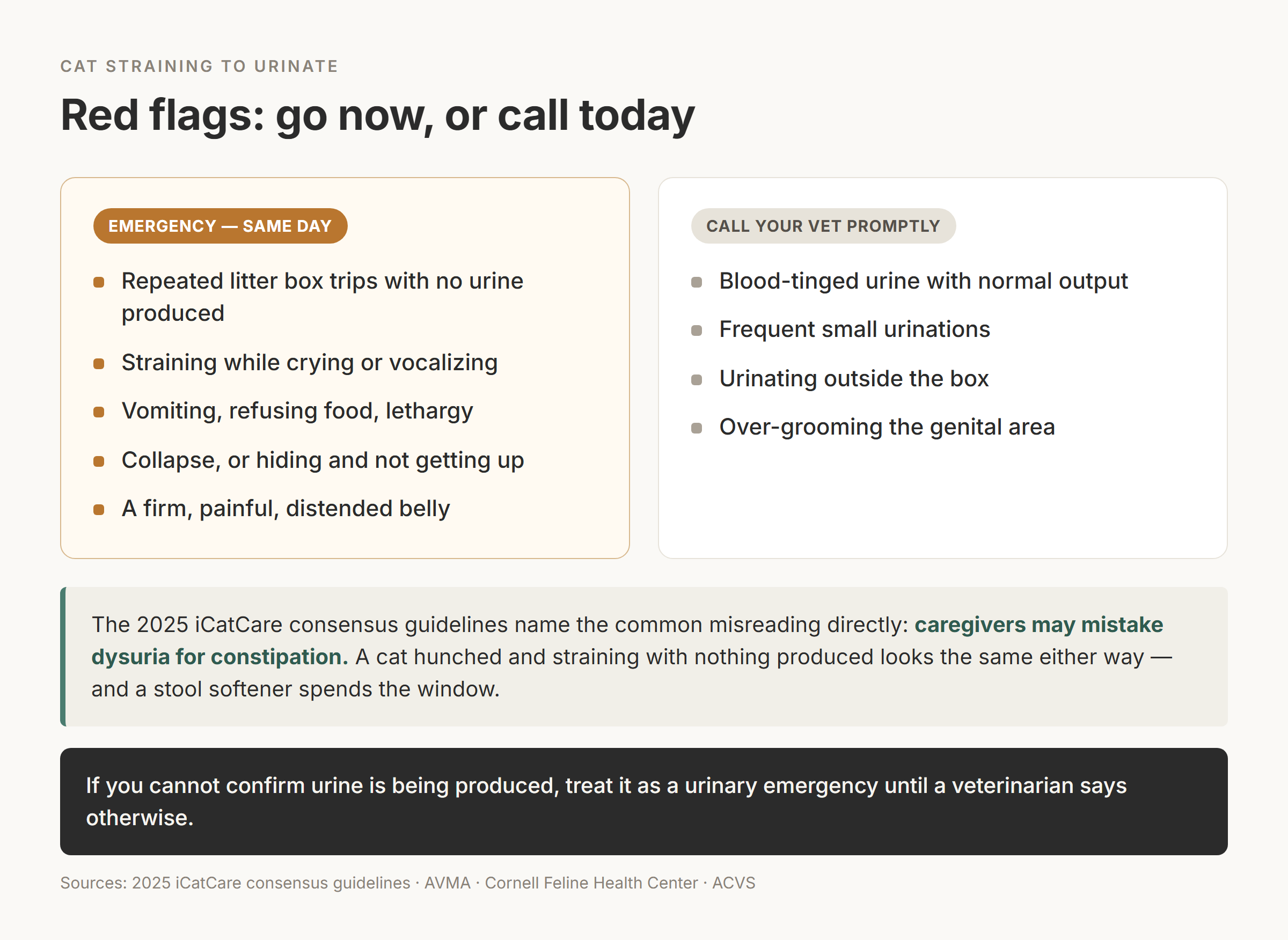
These come from the AVMA, Cornell, the American College of Veterinary Surgeons, and the 2025 iCatCare consensus guidelines. Any one of them means calling an emergency veterinarian now, not in the morning.
- Repeated trips to the litter box producing no urine, or only a few drops.
- Straining while crying or vocalizing, in or near the box. Cats may also move restlessly or hide.
- Vomiting, refusing food, lethargy, weakness. These are systemic signs, and in an obstructed cat they tend to appear after roughly a day.
- Collapse, or a cat lying on its side and not getting up.
- A firm, painful, distended belly — a bladder that can be felt easily.
There’s one more clinical detail worth knowing about, precisely so you don’t try it at home. In severe cases the emergency team checks for a slow heart rate and low body temperature, because together those carry over 98% predictive value for dangerous potassium levels. That is a triage finding for veterinarians with a thermometer and a stethoscope, not a home test. Don’t spend minutes on it. Spend them driving.
The specific mistake the guidelines name
The 2025 iCatCare consensus guidelines say it outright: “Caregivers may mistake dysuria for constipation.”
I find that line genuinely chilling, because the two look identical. A cat hunched in the box, straining, producing nothing. The reasonable owner reaction is to wait a day, or to reach for a stool softener. And that is exactly how the twenty-four to forty-eight hour window gets spent.
So here’s the practical rule I’d want a friend to use.
If your cat is straining and you cannot confirm urine is coming out, treat it as urinary until a veterinarian tells you otherwise.
The fastest check is the litter itself. Look for a wet clump. This is also, quietly, the best argument for open litter boxes over covered ones — you can’t monitor what you can’t see.
One honest note on the timeline. The ACVS describes death occurring in three to six days without treatment, which is longer than the AVMA and Cornell figure. Both are credible bodies. I’m using the conservative twenty-four to forty-eight hours, and the longer estimate is not permission to wait — the clinical instruction is identical either way. Same-day care.
Why it’s usually male cats
Male cats, neutered or intact, are at markedly higher risk because the male urethra is longer and narrower. The AVMA flags males roughly one to ten years old as the highest-risk group.
Female cats still get FLUTD, and they can obstruct, just far less often. So if you have a female cat with urinary signs, this doesn’t mean relax. It means the odds of a total blockage are lower — not zero.
Photo: Christy Rice / Pexels
What FLUTD actually is: an umbrella, not one disease
The AVMA defines FLUTD as an umbrella term for a group of problems of the bladder and urethra. Cornell notes that lower urinary tract disease is the number one reason cats visit veterinary practices.
That umbrella structure is the whole problem. A self-limiting inflammatory flare and a total blockage produce the same outward picture: straining, blood, frequent tiny urinations.
The signs do not tell you which one you have. Only a veterinarian can sort that out.
The cause breakdown — say the numbers
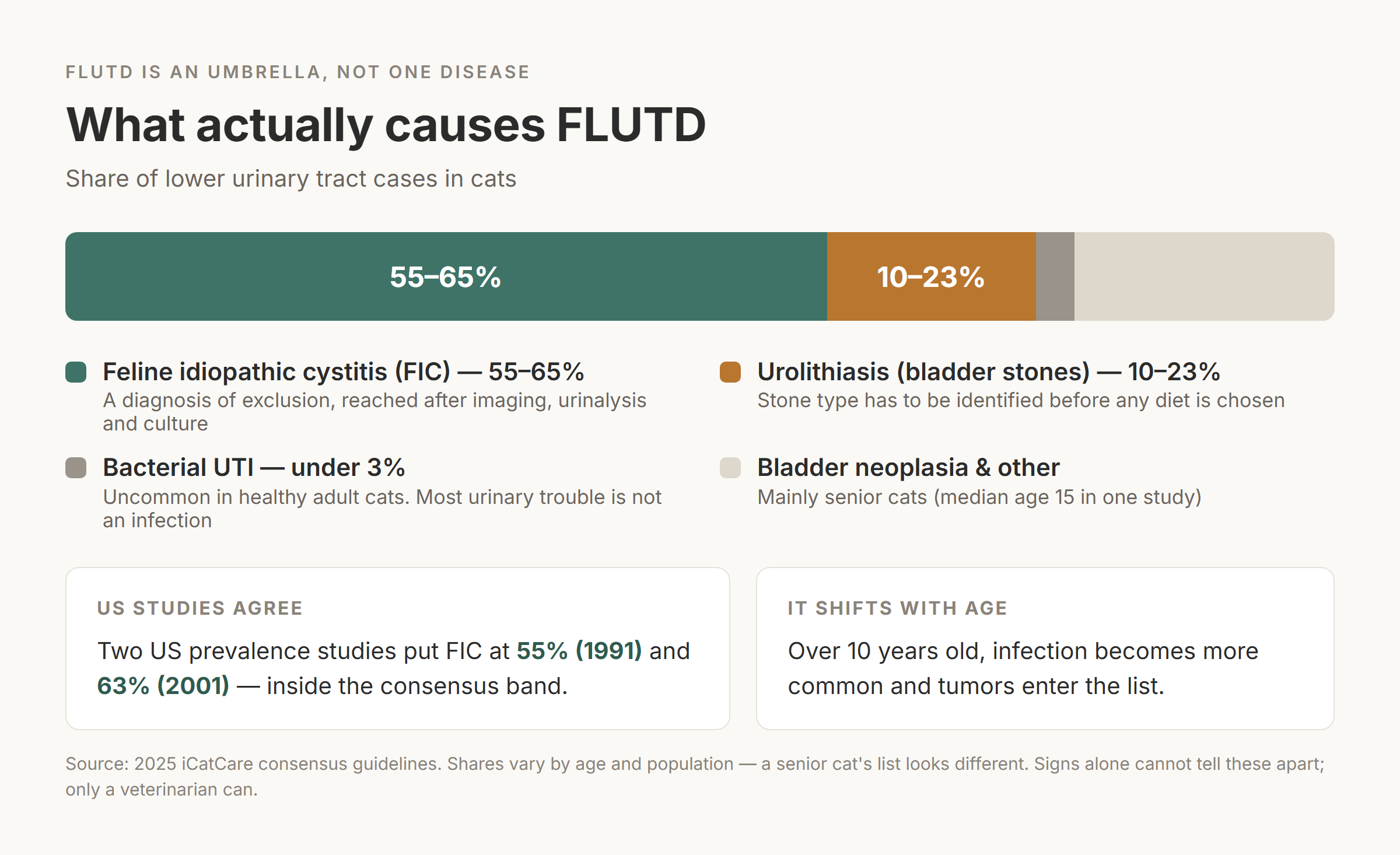
From the 2025 iCatCare consensus guidelines:
| Cause | Share of cases |
|---|---|
| Feline idiopathic cystitis (FIC) | 55–65% |
| Urolithiasis (bladder stones) | 10–23% |
| Bacterial UTI | Uncommon in healthy adults, under 3% |
| Bladder neoplasia | Mainly senior cats (median age 15 in one study) |
Two US studies in a prevalence review put FIC at 55% (1991) and 63% (2001) — right inside that consensus band. Studies from Switzerland, Germany, Norway, Poland, Korea, Thailand and Indonesia land between roughly 55% and 66%. One Indonesian study is a genuine outlier, finding stones dominant at 57.5% and FIC at only 21.9%, which is worth an honest mention — referral populations differ. For a US reader, the consensus figure is the right one.
Here’s why this matters more than it looks. Most cat urinary trouble is not an infection. The mental model most of us import from human urinary tract infections — bacteria, antibiotics, done — applies to under 3% of healthy adult cats. FIC is a diagnosis of exclusion, reached after imaging, urinalysis and culture rule out everything else.
It shifts with age
This is where one-size-fits-all advice falls apart.
In young to middle-aged adults, roughly two to seven years old, FIC dominates. Over ten years, the balance changes — urinary tract infection becomes meaningfully more common, especially in older females, often secondary to conditions like chronic kidney disease, hyperthyroidism or diabetes that produce dilute urine. In seniors, bladder tumors enter the picture.
“My four-year-old male cat is straining” and “my thirteen-year-old female cat is straining” are different situations from the first sentence onward.
“He just doesn’t drink enough water” — why that’s not the answer
This is the belief I most wanted to be true, because it’s the one with an easy fix. The evidence doesn’t support it as the cause.
Low water intake and dry food are real associations. Cats with FIC are more likely to eat dry food and drink less than controls. But look at what else sits in the risk-factor literature, at comparable or greater weight:
- Indoor confinement — 53% of FIC cats were strictly indoor, versus 35% of controls.
- Obesity and a high body condition score.
- Low activity levels.
- Multi-cat households with conflict over resources, and a lack of elevated perches or litter boxes.
- A nervous or fearful temperament, and household upheavals like a move.
- Being male — an odds ratio of 2.34 versus females in one epidemiological study — plus castrated males, purebreds, long-haired cats, ages two to seven.
The guidelines and reviews describe FIC as a poor adaptive response to environmental and physiological stress. Merck puts it as an interplay between the lower urinary tract, stress, and altered neurohormonal factors.
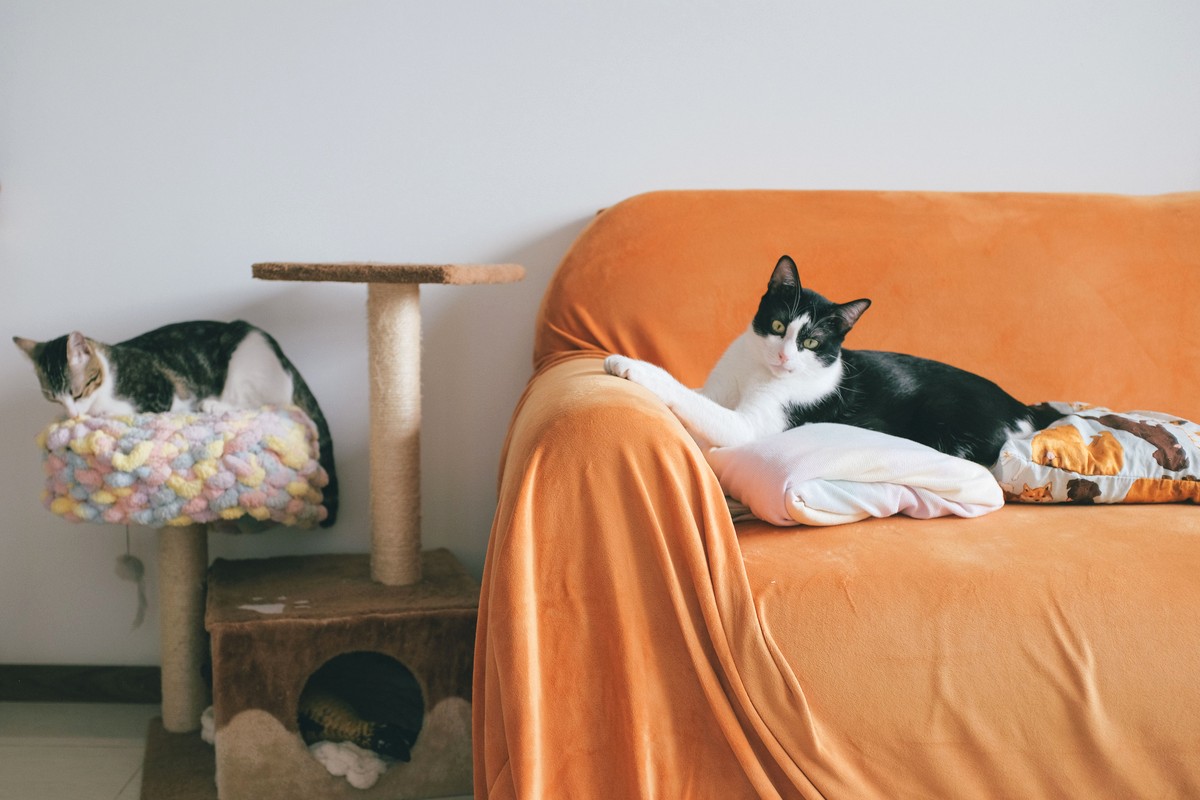
Photo: Huy Phan / Pexels
And then there’s the finding that settled it for me.
In the MEMO study, changing the cat’s environment alone significantly reduced not only urinary signs but also fearfulness, nervousness and respiratory signs, with trends toward less aggression and fewer lower-intestinal signs.
A hydration deficit does not improve a cat’s breathing. That result only makes sense if FIC is a stress-responsive syndrome that happens to show up in the bladder.
What the evidence does support: changing the environment
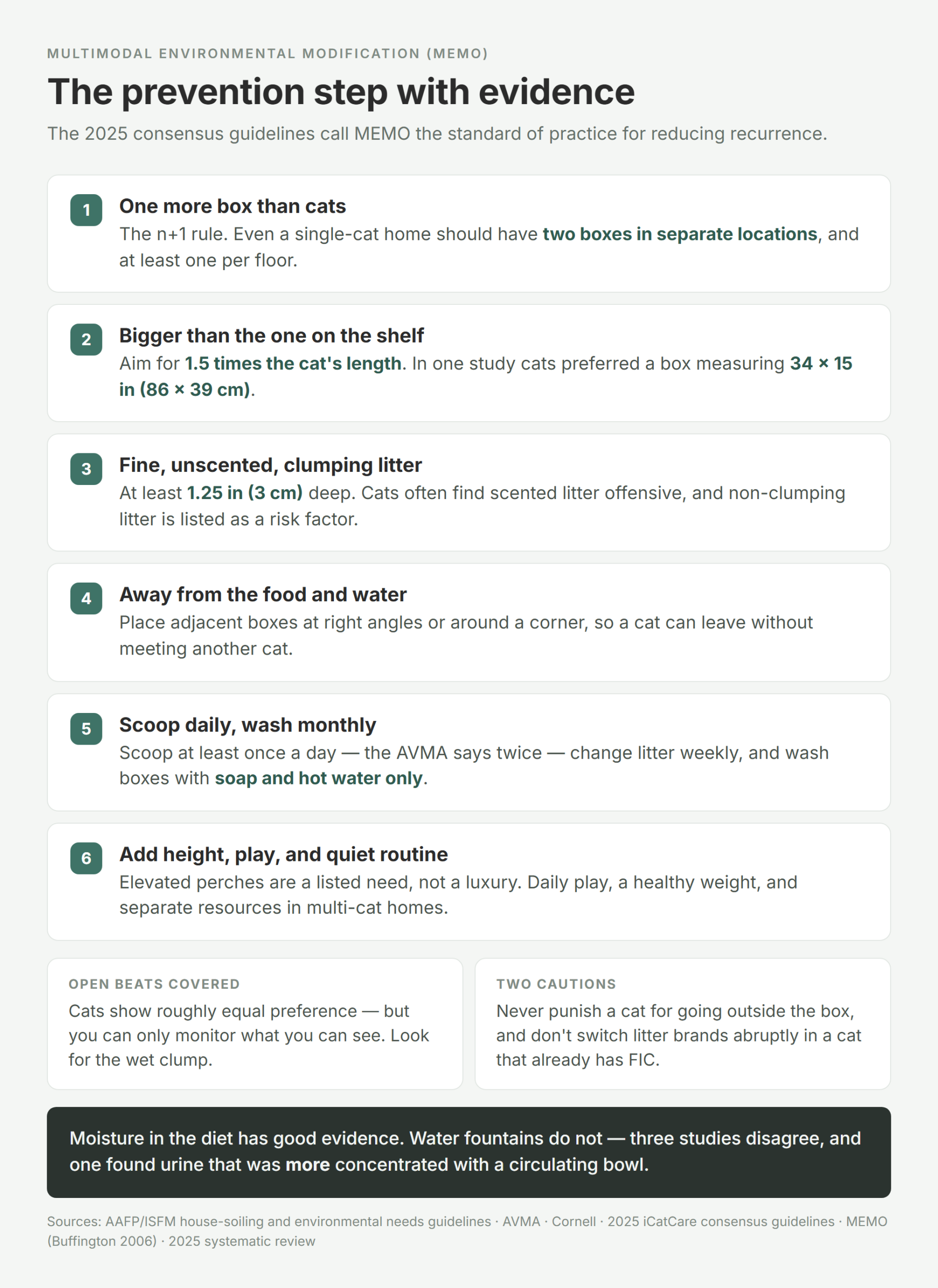
MEMO — multimodal environmental modification — is the intervention with the strongest backing. The 2006 study followed 46 client-owned indoor cats with idiopathic cystitis for ten months after tailored environmental recommendations, with significant reductions in urinary signs. The 2025 consensus guidelines call MEMO effective at reducing recurrence of all disease signs and say it is now the standard of practice. A 2025 systematic review of 22 studies found “encouraging evidence” for it.
Litter boxes, with actual numbers
From the AAFP/ISFM house-soiling and environmental needs guidelines:
- Number: at least one more box than the number of cats — the n+1 rule — though the guidelines note this isn’t an absolute requirement. Even a single-cat household should have two boxes in separate locations. Cornell and the AVMA independently say the same.
- Size: bigger is better. A rectangular box 1.5 times the cat’s length from nose to tail base. In one study, adult cats preferred a box measuring 34 × 15 inches (86 × 39 cm) — considerably larger than most retail boxes.
- Litter: fine, sand-like, unscented, clumping material at least 1.25 inches (3 cm) deep. Cats often find aromatic litters and deodorizers offensive, and the 2025 guidelines list non-clumping litter as a risk factor for FIC.
- Placement: not next to food and water. Place adjacent boxes at right angles or around a corner so a cat can leave without meeting another cat. At least one box per floor.
- Cleaning: scoop at minimum once daily — the AVMA says twice, and to change the litter at least weekly. Wash boxes every one to four weeks with soap and hot water only. Avoid strong chemicals and anything ammonia-based.
- Covered or open: cats show roughly equal preference, but open boxes are recommended where possible so you can actually see what your cat produced.
One more from the guidelines, and it’s easy to get wrong: if your cat already has FIC, don’t switch litter brands abruptly. Substrate preferences are worth replicating, not overhauling.
The rest of it
The AVMA’s framing is to keep the environment positive, consistent and predictable — daily play, healthy weight, and in multi-cat homes, separate areas for sleeping, eating, water and litter. The AAFP/ISFM five pillars add elevated perches as a distinct need, not a luxury.
And a small one with a big effect: the 2025 guidelines specifically say not to punish a cat for going outside the box. It does nothing for the behavior, it raises the cat’s stress, and stress is the engine of FIC. Urinating outside the box is very often a medical sign, not a protest.
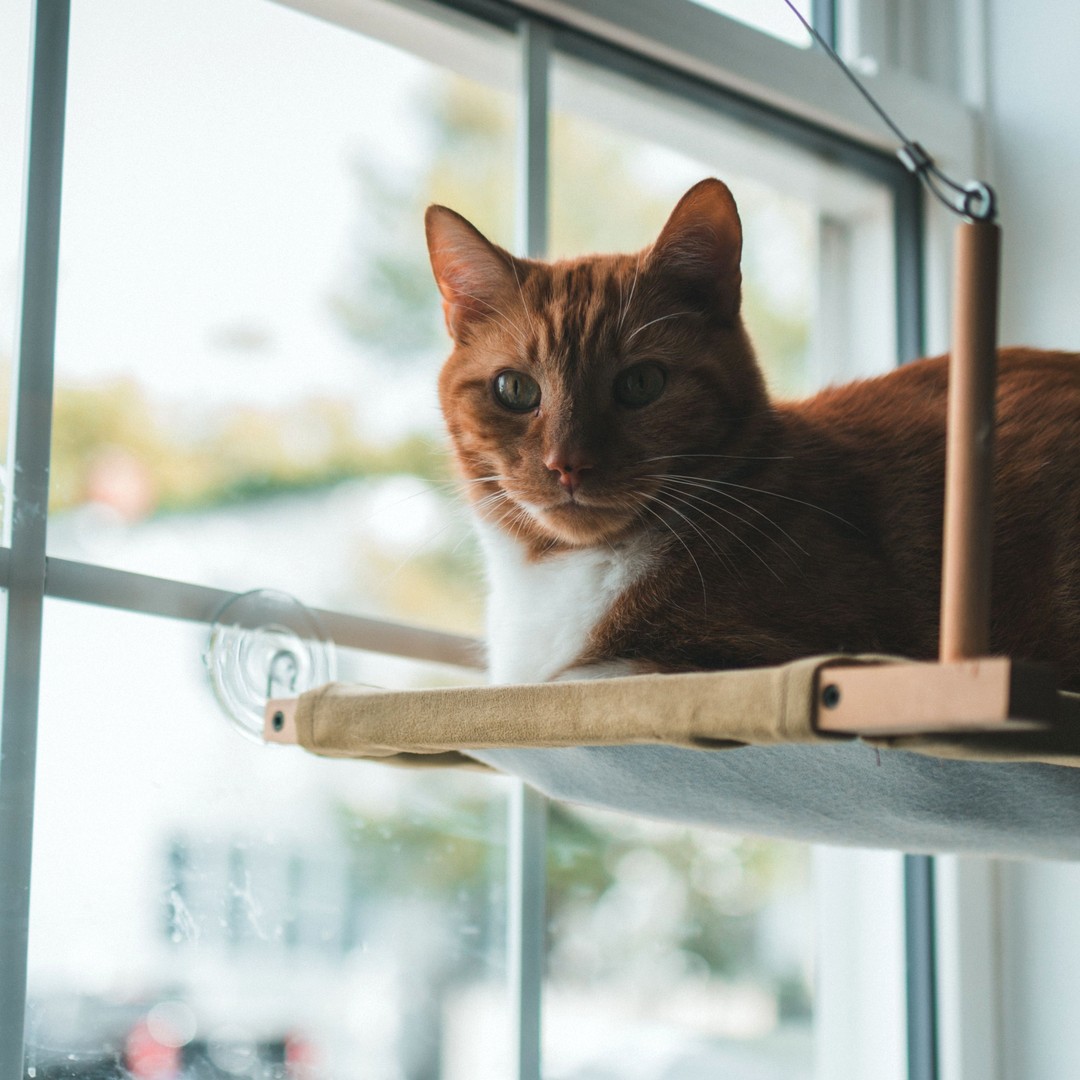
Photo: Jonathan Cooper / Pexels
Water fountains: the part I got wrong
I expected the fountain evidence to be solid. It isn’t. Three studies, and they disagree.
| Study | Design | Water intake | Urine concentration |
|---|---|---|---|
| Pachel & Neilson 2010 | Pilot, 9 cats, still vs. flowing | 115.44 vs. 109.83 mL — not significant | Not the primary endpoint |
| Robbins et al. 2019 | 16 cats, randomized 2-week crossover, still / circulating / free-falling | No significant difference in intake or urine volume | No difference in USG or relative supersaturation; osmolality significantly higher with the circulating bowl (P=0.009) |
| 2024 crossover | 12 cats analyzed, client-owned, 2×2 crossover | Fountain 31.6 vs. bowl 22.9 mL/kg/day — significant (P=0.0381) | Osmolality not different (P=0.6579); lowest USG recorded 1.044, against a target under 1.020 |
Read that third row carefully, because it’s the one fountain marketing quotes. Its own authors concluded that water fountains are “unlikely to lead to substantial increase in water intake or dilution of urine in cats” — suggesting the apparent gain may have been splashing rather than drinking.
Not one of the three studies showed a fountain meaningfully diluting urine. In Robbins, the circulating bowl produced more concentrated urine. And urine dilution — not milliliters missing from a bowl — is the outcome that matters for stones and for FIC.
The 2025 consensus guidelines make no fountain recommendation at all. They say only that a wet diet and increased water intake may help prevent recurrence, while noting the studies remain inconclusive.
So: a fountain is harmless and worth trying if your individual cat prefers it. Only three of sixteen cats in Robbins showed a real bowl preference, and one cat in the 2024 study reacted to the fountain with stress behaviors. It is not a treatment, and it is not a substitute for a veterinary visit.
Wet food: the lever that does hold up
Here the evidence goes the other way, and it’s worth stating plainly.
The 2025 systematic review found “good evidence” for increasing the moisture content of a cat’s diet and for therapeutic urinary diets. The most-cited direct comparison is Markwell 1999: 54 cats with idiopathic cystitis fed either the canned or the dry version of the same acidifying diet, followed a year. Recurrence was 11% on the moist food versus 39% on the dry.
The ACVIM urolith consensus recommends high-moisture diets over 75% water for calcium oxalate prevention, targeting a urine specific gravity under 1.030 in cats. Merck lists canned food among the FIC management levers. In comparative feeding data, crystalluria was never detected in cats fed all wet food.
Two honest limits. Markwell compared moist against dry of the same therapeutic formulation — it supports moisture, not any particular supermarket product, and it’s a 1999 study. And the 2025 guidelines add a caveat that surprised me: dietary changes “may in themselves be associated with stress because of the particularly sensitive nature of affected cats.”
Which means: increase moisture, yes. Gradually, and with your vet.
Photo: Pitipat Usanakornkul / Pexels
Why you shouldn’t pick the urinary diet yourself
This is a safety point, not a legal disclaimer.
Struvite prevention and calcium oxalate prevention pull in different directions. Struvite calls for acidifying diets low in magnesium and phosphorus, targeting a urine pH under 6.5. Calcium oxalate calls for dilution — and oxalate uroliths cannot be dissolved medically at all. They have to come out.
Feed a dissolution diet to an oxalate cat and you spend the days in which the stones should have been removed. Over-acidifying has its own cost: extremely acidic urine is an irritant in itself.
There’s also a trend worth knowing, because it flipped. Minnesota Urolith Center submission data shows that between 2005 and 2018, struvite rose from 41.8% to 54.5% while calcium oxalate fell from 50.1% to 37.7% — a reversal of the older pattern. Cornell’s page still describes oxalate as increasing, reflecting the earlier era. I’d trust the dated submission data, but the disagreement is real and I’d rather flag it than pretend it away.
You cannot determine stone type at home. It takes imaging, urinalysis, and often analysis of the stone itself.
“Urinary” on a bag is not a diagnosis.
Things you’ll hear about that the evidence doesn’t support
The 2025 systematic review looked at seven management categories. Several popular ones came up empty:
- Feline facial pheromone diffusers — little evidence.
- Glycosaminoglycan supplements — evidence lacking, across four papers.
- Anti-inflammatory drugs — no supporting evidence, across four studies.
- Prazosin — conflicting: one positive retrospective against three placebo-controlled studies showing no benefit.
I want to word this the way the review does. Current evidence does not support them — that is not the same as “these are useless,” and it is absolutely not a reason to stop something your veterinarian prescribed. If your cat is on any of these, that’s a conversation with your vet, not a decision to make after reading a blog post.
“Chronic” is half right — recurrence and prognosis
FIC really is recurrent. Most episodes resolve in two to seven days, with or without treatment. Then they come back.
The recurrence figures vary a lot by follow-up window: 17.1–24.3% within four to seven days, 65% at six months, 61.5% over the long term, 52% at ten to sixteen years. Cornell offers a gentler read — most cats have few recurrences, with “a few unfortunate cats” having frequent episodes. That partly conflicts with the 65% figure, and the difference may reflect referral bias in the studies. Both are worth holding.
For obstruction specifically, reported recurrence runs 11–58%, and the 2025 guidelines note this leads to 21% of cats eventually being euthanized.
Now the reassuring half, because it’s real. Reported mortality is 12.5–20% for FIC and 26% for obstructive FIC, but more than 70% of cats with FIC survive and live longer than ten years, and the review’s conclusion is that long-term prognosis is “quite positive.” For cats who block repeatedly, perineal urethrostomy surgery has good owner-assessed quality of life and low re-obstruction, with recurrent urinary infection in roughly 23–25% within a year as the main trade-off. One 86-cat series reported median survival of 3.5 years after surgery.
So “chronic” captures the management reality. It just can’t be the headline, because that word invites you to wait.
What it costs in the US, approximately
I’ll be upfront: these figures come from pet-insurance and consumer cost guides, not from peer-reviewed or veterinary-association data. No primary US cost study exists that I could find. Treat them as rough 2025–2026 ranges that vary widely by region and hospital.
- Emergency unblocking with a short hospital stay, no surgery: roughly $1,500–$3,500, with a broader range of $1,000–$4,000+ commonly cited.
- Perineal urethrostomy for repeat blockers: roughly $1,500–$3,000, and potentially $5,000+ with an emergency presentation or complications.
On insurance, one trap is specific to this disease. A urinary condition documented before enrollment or during the waiting period is generally excluded as pre-existing — and a cat whose signs are controlled by a prescription diet is usually not considered cured. If that cat blocks later, the episode may be classed as pre-existing. Some insurers reclassify after a symptom-free year. Policies differ substantially, so read yours rather than trusting a summary like this one.
One practical thing that costs nothing: know your nearest 24-hour emergency veterinary hospital before you need it. Signs that start on a Saturday night still need same-day care.
Photo: Batuhan Küçükdemir / Pexels
Never do these
| Don’t | Why |
|---|---|
| Give human pain relievers | No dose of acetaminophen is safe for a cat — even a small amount can be life-threatening, because cats lack the metabolic capacity to process it. Ibuprofen is likewise toxic. Signs include vomiting, chocolate-colored gums and trouble breathing. This is an emergency, not a home remedy. |
| Give any medication not prescribed for that cat | Never medicate a pet without veterinary guidance. |
| Wait because “he got better last time” | Episodes resolve in 2–7 days and recur — which is exactly how owners normalize the signs and miss a blockage. |
| Treat it as constipation | The guidelines name this misreading directly. |
| Try to squeeze or express the bladder | Not recommended; it causes pain and stress, and in an obstructed cat it risks bladder rupture. |
| Force water in with a syringe | It adds stress to a stress-driven disease, risks aspiration, and does nothing for a cat who physically cannot pass urine. |
| Home remedies — apple cider vinegar, cranberry | Little veterinary evidence, and over-acidified urine is an irritant in itself. |
| Punish the cat for going outside the box | It doesn’t help, it raises stress, and the behavior is often a medical sign. |
| Self-select a “urinary” prescription diet | The right diet depends on the stone type, and the types need opposite strategies. |
One thing that is part of proper treatment and worth asking about: pain control. The 2025 guidelines state that FIC is a painful condition and that analgesia should be prioritized. What that means specifically is your veterinarian’s call, not mine.
If I could hand you one sentence from all of this, it wouldn’t be a statistic.
It would be the litter check. Look for the wet clump. That’s the whole difference between a cat having a bad week and a cat with hours left, and it takes about four seconds.
I understand the appeal of the chronic framing now. It’s calmer. It suggests there’s time to research, to compare fountains, to read one more article. And for the recurrent inflammation underneath, there genuinely is time — the environment work, the moisture, the slow patient changes.
But the blockage doesn’t negotiate with any of that.
So manage the condition slowly, and treat the emergency fast. Those are two different clocks, and the second one is the only one that runs out.
Veterinary disclaimer. This article is general information about feline lower urinary tract disease, not veterinary advice, and it does not replace an examination. FLUTD is an umbrella term covering conditions with very different urgency, and the outward signs cannot tell you which one your cat has — that requires physical examination, urinalysis, and often bloodwork, radiographs or ultrasound. No medication, supplement, or therapeutic diet mentioned here should be started, stopped, or changed except on your veterinarian’s instruction. Never give a cat any human medication.
Emergency — go to a veterinarian now, day or night. Repeated litter box trips producing no urine or only drops · straining while crying or vocalizing · vomiting, refusing food, or lethargy · hiding, restlessness, or collapse · a firm, painful, distended belly. If your cat is straining and you cannot confirm urine is being produced, treat it as a urinary emergency until a veterinarian says otherwise. Complete urethral obstruction can be fatal in less than 24 to 48 hours. Do not wait for morning, do not give a laxative, and do not attempt to press on the bladder.
References
- Taylor S, Boysen S, Buffington T, et al. — 2025 iCatCare consensus guidelines on the diagnosis and management of lower urinary tract diseases in cats, J Feline Med Surg (2025)
- American Veterinary Medical Association — Feline Lower Urinary Tract Disease (FLUTD)
- Cornell Feline Health Center — Feline Lower Urinary Tract Disease
- Merck Veterinary Manual — Lower Urinary Tract Disease in Cats
- American College of Veterinary Surgeons — Urinary Obstruction in Male Cats
- Carney HC, Sadek TP, Curtis TM, et al. — AAFP and ISFM Guidelines for Diagnosing and Solving House-Soiling Behavior in Cats, J Feline Med Surg (2014); Ellis SLH, Rodan I, Carney HC, et al. — AAFP and ISFM Feline Environmental Needs Guidelines (2013)
- Lulich JP, Berent AC, Adams LG, et al. — ACVIM Small Animal Consensus Recommendations on the Treatment and Prevention of Uroliths in Dogs and Cats, J Vet Intern Med (2016)
- Buffington CAT, Westropp JL, Chew DJ, Bolus RR — Clinical evaluation of multimodal environmental modification (MEMO) in the management of cats with idiopathic cystitis, J Feline Med Surg (2006)
- Understanding the current evidence base for the commonly recommended management strategies for recurrent feline idiopathic cystitis: a systematic review, NZ Vet J (2025)
- Robbins MT, Cline MG, Bartges JW, et al. — Quantified water intake in laboratory cats from still, free-falling and circulating water bowls, J Feline Med Surg (2019); Pachel C, Neilson J — J Vet Behav (2010); Effect of water source on intake and urine concentration in healthy cats (2024)
- Markwell PJ, Buffington CAT, Chew DJ, et al. — Clinical evaluation of commercially available urinary acidification diets in the management of idiopathic cystitis in cats, JAVMA (1999)
- Prevalence, Risk Factors, Pathophysiology, Potential Biomarkers and Management of Feline Idiopathic Cystitis: An Update Review (2022); Defauw PAM et al. (2011); Norwegian and Seoul epidemiological studies
- Urolithiasis in cats: Evaluation of trends in urolith composition and risk factors (2005–2018) — Minnesota Urolith Center
- Initial treatment factors associated with feline urethral obstruction recurrence rate: 192 cases (2004–2010), JAVMA
- ASPCA Animal Poison Control Center — acetaminophen and ibuprofen toxicosis; VCA Animal Hospitals — Acetaminophen Toxicity in Cats
- ⚠ Cost and insurance figures: US pet-insurance and consumer cost guides, 2025–2026 — not primary data