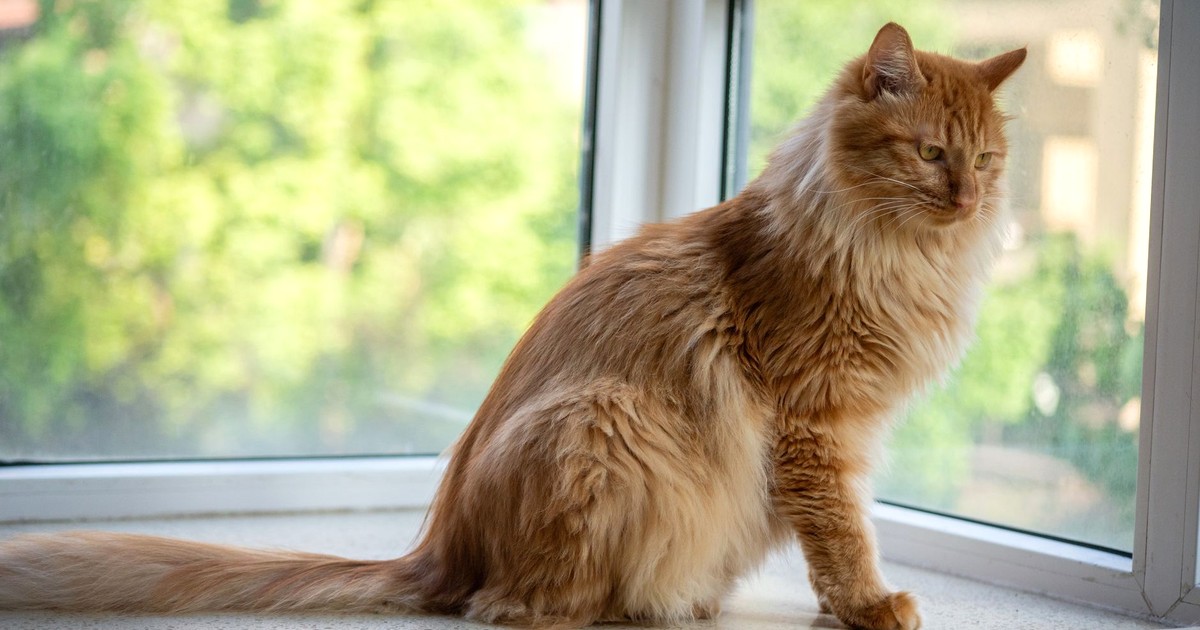
Cat Hairballs: How Often Is Normal, and When to Worry
I want to start by naming the belief I had, because I think most cat owners have it too.
A hairball is a chore. Something you clean off the rug, sigh about, and forget. Cats groom, cats swallow hair, hair comes back up. That’s just cats.
Board-certified feline practitioners have published a continuing-education paper on this topic. The title is “Hairballs Are Not Normal.”
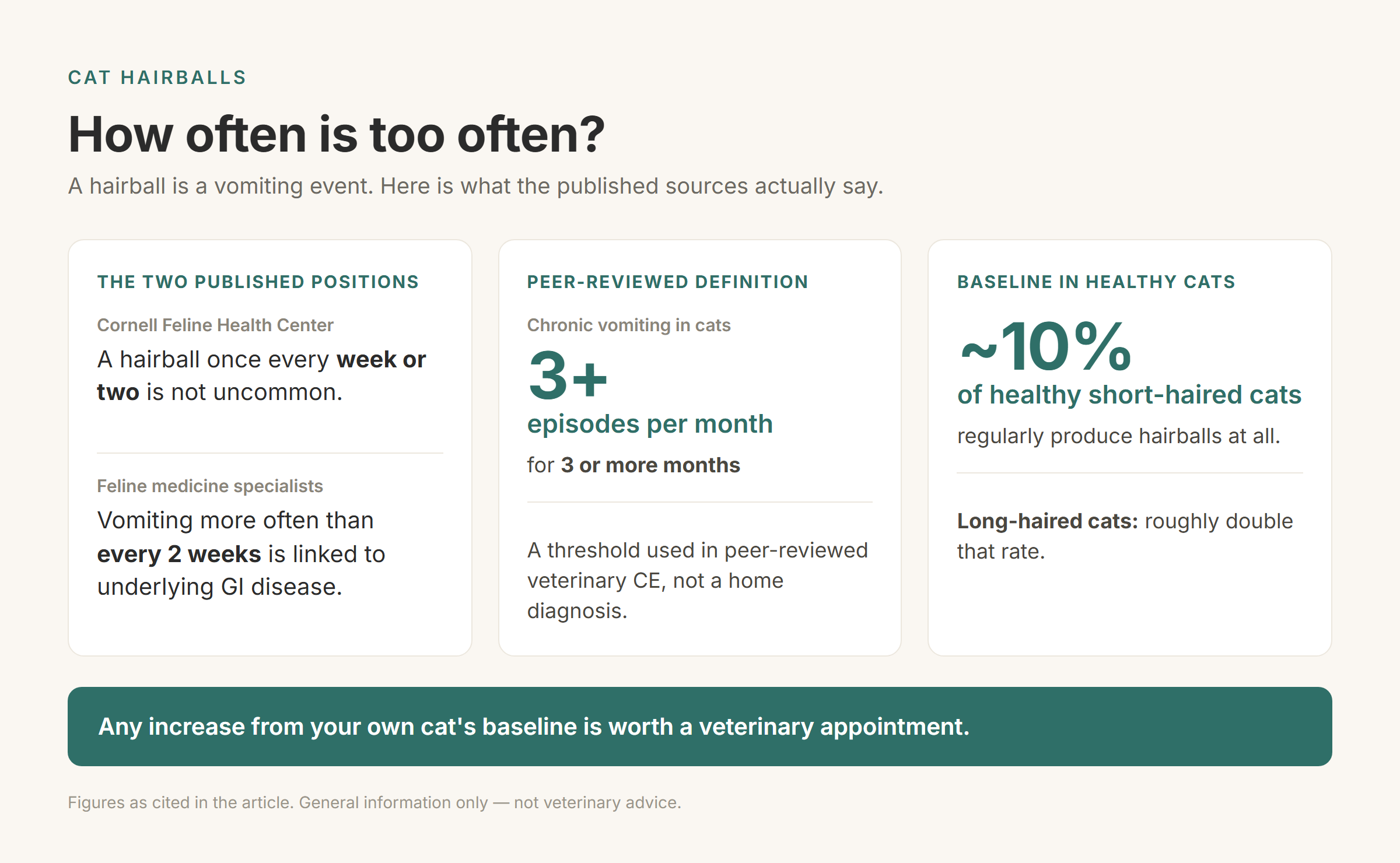
So let me put the useful part first, before anything else. Cat hairballs are a vomiting event, and vomiting more often than once every two weeks is associated with underlying gastrointestinal disease. Not “might be.” Is. And the most quoted baseline number in the veterinary literature is that only about 10% of otherwise healthy short-haired cats regularly produce hairballs at all.
Which means the ninety percent are the norm. Your cat is not “just a hairball cat.”
Photo: 大 董 / Pexels
Red flags first: when this is an emergency
Before any of the frequency discussion, these are the signs that mean same-day veterinary care. They come from Cornell’s Feline Health Center, the Merck Veterinary Manual, and peer-reviewed feline CE material.
- Blood in the vomit — bright red, or dark material that looks like coffee grounds. This is upper-GI bleeding. It is never a normal hairball finding.
- Repeated unproductive retching — heaving over and over with nothing coming up.
- Refusing food for more than a day or two.
- Lethargy, hiding, weakness.
- No stool being produced, or constipation.
- A swollen, distended, or painful belly.
- Diarrhea alongside the vomiting, increased thirst, or changed urination.
- Any string, thread, or ribbon in the picture. A linear foreign body is a distinct emergency that gets mistaken for a hairball, and vets specifically check under the tongue for it.
Hairball-related intestinal obstruction is genuinely rare — the published case series are single-digit, and overall incidence isn’t well established. I’m not going to inflate it. But it is potentially fatal without surgery, and the list above is how it announces itself.
How often is normal? Two credible answers that disagree
This is the heart of the topic, and I’d rather show you the disagreement than pretend it’s settled.
The permissive position comes from Cornell’s Feline Health Center: it is not uncommon for a cat to bring up a hairball once every week or two. Cornell adds a fair point — a hairball that comes up is better than one that travels down into the intestines and lodges there.
The stricter position comes from board-certified feline practitioners citing the primary case series: vomiting more often than every two weeks makes underlying GI disease significantly more likely. Peer-reviewed CE from the University of Tennessee defines chronic vomiting as three or more episodes per month for at least three months.
Notice that Cornell’s own vomiting page tells owners to see a vet if a cat vomits more than once a week. So even inside the more permissive source, “weekly” already sits at the edge.
Here’s how I’d reconcile it as an owner, without calling either side wrong.
More than one or two hairballs a month — or any increase from your cat’s own baseline — is a reason to book an appointment.
The statistic that changed how I read this
In a 300-cat case series published in JAVMA in 2015, 26% of the cats had come in for a routine wellness visit where the owner happened to mention chronic vomiting they assumed was normal for their cat.
Every one of those cats had disease. 38% of them had lymphoma.
That’s the number that stays with me. Not because it’s frightening in isolation, but because of how those cats arrived: not as emergencies. As healthy cats at a checkup, with an offhand comment.
Now the honest correction, because this is not a cancer scare
The same body of work reports that 96% of chronically vomiting cats had underlying pathology, with roughly half showing chronic enteritis and about 41% lymphoma. Those figures get quoted a lot, and they deserve a caveat that almost never travels with them.
In 2019, a study in the Journal of Veterinary Internal Medicine biopsied 20 clinically healthy client-owned cats. All twenty — 100% — had histological changes considered abnormal by current standards. Twelve were read as consistent with small cell lymphoma.
These were cats with nothing wrong with them. The authors concluded that healthy cats commonly had abnormal findings without apparent clinical relevance, and that current diagnostic metrics for chronic enteropathy in cats may need modification. A formal letter challenging the original conclusions was also published in 2016.
So what does that leave us with?
Frequent vomiting genuinely warrants investigation. It does not mean a 96% chance your cat has cancer or IBD. Those two sentences are both true, and I’d be misleading you if I gave you only the first one. The action is the same either way — get it looked at — but the emotional weight you carry into the appointment should be lighter than the raw statistic suggests.
What frequent hairballs usually turn out to be
Here’s the reframe that makes the rest of this practical. A hairball means either too much hair is going in, or the hair isn’t moving through the way it should.
Both point away from the hairball itself.
A 2013 clinical review in the Journal of Feline Medicine and Surgery concluded that in most short-haired cats, frequent hairballs indicate an underlying chronic disease driving either increased fur ingestion or altered GI motility. The named contributors:
- Flea infestation — and notably, it increases grooming whether or not the cat is allergic.
- Itchy skin disease.
- Food intolerance and inflammatory bowel disease.
- Altered upper-GI motility from chronic GI disease, pain, or stress.
Non-GI diseases cause chronic vomiting in cats too, which is why a real vet visit means a workup rather than a tube of paste: chronic kidney disease, hyperthyroidism, diabetes, pancreatitis, liver disease, FeLV/FIV/FIP, parasites, heartworm. Hyperthyroidism screening is warranted regardless of age — clinical hyperthyroidism has been reported in cats as young as eight months.
One more reason bloodwork matters: low B12 is present in 61% of cats with primary GI disease, and in some cats vomiting has been the only sign. Untreated, it can keep signs going even after the primary problem is treated.
The stress explanation is usually wrong
This one surprised me most.
When cats were referred with a presumed diagnosis of stress-related overgrooming — “psychogenic alopecia” — a 2006 JAVMA study looked at what was actually going on. Of 21 cats:
- 16 had itchy skin disease alone
- 3 had itchy disease plus a behavioral component
- only 2 — about 10% — were primarily behavioral
Medical causes of itch were identified in 76%, and 52% had more than one contributing factor. Of 20 skin biopsies, 14 showed inflammatory lesions. Adverse food reaction, environmental allergy, flea allergy dermatitis, parasites, and in one case hyperthyroidism.
So “my cat is just stressed” is the least likely explanation for overgrooming, not the first one. Itch is the front-runner.
Pain matters too, and it often comes from inside rather than the skin — arthritis in the hips or elbows, bladder discomfort. Worth holding onto for older cats, especially since signs of pain in cats are notoriously subtle: lip licking, blinking, wincing, guarding the belly.
The inversion worth knowing
Long-haired cats have roughly twice the hairball incidence of short-haired cats. Cornell names Persians and Maine Coons as higher-risk. In the 1999 case series of five cats with intestinal obstruction from hairballs, four were long-haired.
Which sets up the part most owners get backwards.
A short-haired cat with frequent hairballs is more suspicious, not less. The University of Tennessee CE says it plainly: hairball vomiting should not be dismissed, particularly in cats without long hair, because it may reflect altered GI motility from underlying disease.
If you’ve been reassured because your cat is a shorthair, that reassurance runs the wrong direction.
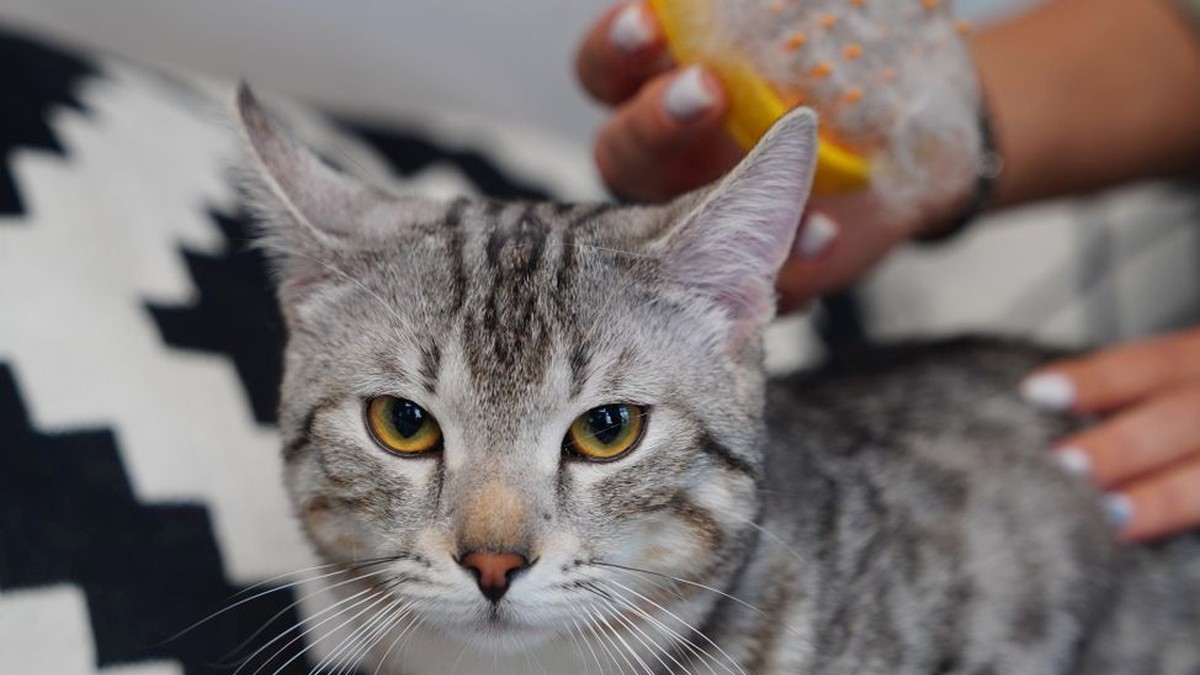
Photo: Nadin Sh / Pexels
What owners mistake for hairballs
Misreading the episode delays care in both directions, so this section is worth more than it looks.
Vomiting vs. regurgitation — different problems, different workups.
| Vomiting | Regurgitation | |
|---|---|---|
| Process | Active — retching, heaving | Passive — material just comes up |
| Preceded by | Nausea, drooling | Nothing in particular |
| Contents | Partially digested food | Undigested food |
| Appearance | May be discolored by bile | Often mucus-coated, no bile |
Hairball retching vs. feline asthma — and this one is urgent.
| Hairball episode | Asthma or cough episode | |
|---|---|---|
| Result | Usually ends with fur or mucus coming up | Usually nothing is produced |
| Posture | Back arched, cat often moves around | Hunched low, head and neck extended |
| Other signs | — | Wheezing, labored breathing |
Cornell states that frequent hacking may be a sign of another GI problem or of a respiratory ailment such as asthma, and that this would require emergency treatment.
The practical version: a cat that hacks repeatedly and never produces anything has a breathing problem until proven otherwise.
One cheap, genuinely useful thing you can do — film twenty or thirty seconds of the episode on your phone. Your vet will get more from that clip than from any description you or I could write.
Cat grass: the piece of advice that doesn’t hold up
I expected the evidence here to be thin. It’s worse than thin — it was tested and rejected.
A 2021 study in Animals surveyed cat owners about plant-eating behavior, with 1,021 usable responses in the second survey. It tested three hypotheses, one of which was that plant eating serves to expel hairballs.
If that were true, long-haired cats — who get roughly double the hairballs — should eat plants more often. They didn’t. Short-haired and long-haired cats showed similar plant-eating frequencies and similar vomiting patterns. The hairball hypothesis was not supported.
The study found something else useful. Only 6–9% of cats appeared ill before eating plants; 91% looked completely normal. And 27–37% frequently vomited afterward. The authors concluded plant eating is normal innate behavior, likely evolved for intestinal parasite control, and they do recommend offering safe grass to indoor cats.
There’s a counter-signal that belongs next to it. Feline specialists list eating grass to induce vomiting among the signs of nausea owners routinely miss — alongside a finicky appetite, periods of not eating, lip licking, and gagging.
I’d reconcile the two like this: baseline grass eating is normal and fine. A new or increased appetite for grass, especially with other changes, is worth mentioning to your vet.
The part of this advice that can actually kill a cat
If you’re putting greens out for your cat, this matters more than anything else in the section.
True lilies — Lilium and Hemerocallis species, which covers Easter, Tiger, Stargazer, Oriental, and Day lilies — are fatally toxic to cats. Cats are the only species susceptible to this particular toxicity.
Every part of the plant is dangerous. The pollen. The water in the vase. A cat that brushes past an arrangement and later licks pollen off its own fur can develop fatal kidney failure in under three days, per the FDA and ASPCA.
The prognosis is excellent when it’s caught early, which is exactly why it’s worth naming.
ASPCA Animal Poison Control Center: (888) 426-4435.
Photo: Huy Phan / Pexels
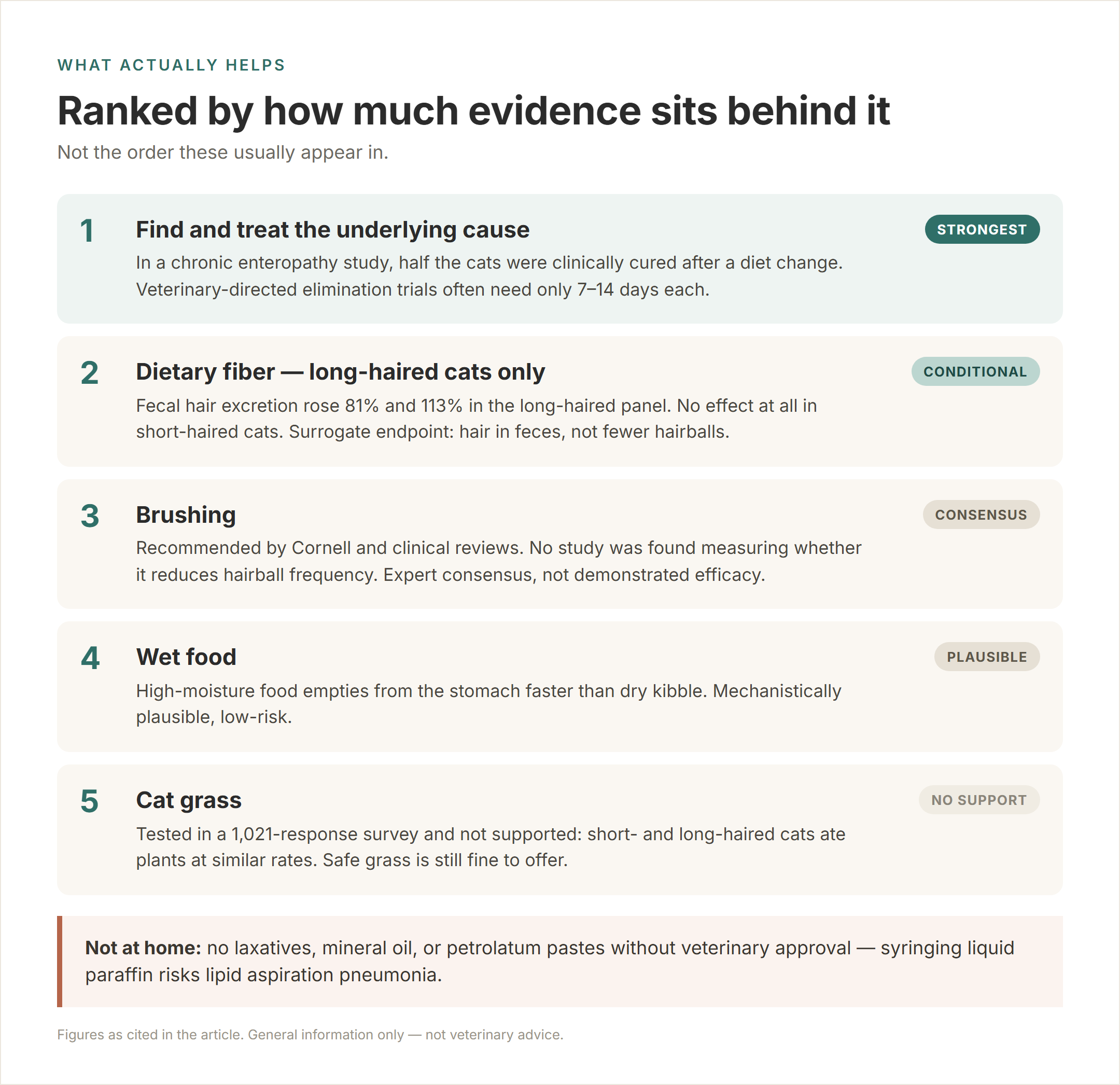
What actually helps, ranked honestly
I’ve put these in order of how much evidence sits behind them, which is not the order you usually see them in.
1. Finding and treating the underlying cause — strongest evidence.
This is the real prevention. In a chronic enteropathy study, half the cats achieved clinical cure after a diet change, with vomiting stopping almost immediately and other signs resolving in most cats within three days. Diet trials often need only 7–14 days each. On rechallenge with the original food, 40% stayed in remission and the rest relapsed within three to four days.
That said — this is a veterinary-directed elimination trial, requiring strict removal of treats, human food, flavored medications, and vitamins. It is not a shopping trip.
2. Dietary fiber, but only if your cat is long-haired.
A 2015 study in Veterinary Medicine and Science fed 21 adult cats diets at 6%, 11%, and 15% total dietary fiber with psyllium. In the long-haired panel, fecal hair excretion rose 81% and 113%. In the short-haired panel, no effect at all.
Two honest limits. The measured outcome was hair in the feces, not fewer hairballs vomited — a surrogate endpoint. And a research diet at defined fiber levels isn’t the same thing as a retail hairball formula; the 2013 review specifically notes commercial hairball diets lack robust published efficacy data. Cornell advises against using them without professional guidance.
3. Brushing — recommended by everyone, proven by nobody.
Cornell recommends daily brushing and combing, plus professional grooming once or twice a year. The 2013 review agrees, and mentions clipping for severe cases.
But I looked for the trial, and there isn’t one. No study was found measuring whether brushing reduces hairball frequency, with a sample size or an effect size. It is expert consensus, not demonstrated efficacy.
So brush your cat. It’s free, it’s low-risk, it’s pleasant for both of you. Just don’t expect it to fix a cat vomiting weekly — if the cause is fleas, IBD, or pain-driven overgrooming, a brush will not touch it.
4. Wet food — mechanistically plausible, low-risk.
High-moisture food empties from the stomach faster than dry kibble. That’s a reasonable, harmless thing to try.
5. Cat grass — no supporting evidence for hairballs. See above.
What not to do at home
- Don’t give laxatives, mineral oil, or petrolatum pastes on your own initiative. Cornell says to avoid laxatives without veterinary approval. Syringing liquid paraffin into a cat carries a real risk of lipid aspiration pneumonia, which is severe and often fatal.
- Don’t induce vomiting, withhold food, or give any oral oil.
- Don’t pick a “hairball” or prescription diet yourself.
- Don’t wait out a pattern that’s changed. Motility drugs exist and vets use them, but only after obstruction and underlying disease have been addressed. That’s a clinical decision with a physical exam behind it.
Photo: Arina Krasnikova / Pexels
The single most useful thing you can do before the appointment
Count them.
Feline specialists recommend that veterinarians ask owners to keep a calendar record when frequency is unclear, and it’s the most quietly valuable idea in this entire literature. “Sometimes” is not data. “Four times in October, two in September” is.
Write down the date, whether hair came up, whether food came up, and what the cat did afterward. Take it in with you.
And one thing worth knowing about why vets weigh cats at every visit: subtle weight loss can be the first and only sign of GI disease. That’s an argument for regular checkups rather than crisis visits.
Photo: Claudia Schmalz / Pexels
What this tends to cost in the US
Some context, because “see your vet” has a price attached and pretending otherwise isn’t useful.
Nationwide’s analysis of more than 3.3 million pet insurance claims in 2025 put gastroenteritis as the number one condition for cats, for the second year running. It averaged $802 within the first 30 days of diagnosis. Inflammatory bowel disease ran $1,464 a year.
Look at the rest of that feline top ten and you’ll see why this article keeps circling back to a vet visit: IBD, hyperthyroidism, and skin allergies all appear independently — and all three are named causes of frequent hairballs.
The uncomfortable part: US pet insurance enrollment rose 9% in 2025, but more than 95% of American cats and dogs remain uninsured. Most of us pay out of pocket. Which is exactly why “wait and see” on chronic vomiting is a financial risk as well as a medical one. A two-week diet trial is cheap. A lymphoma diagnosis after eighteen months of ignored vomiting is not.
One US-specific footnote your vet may consider: histoplasmosis is a regional differential for chronic vomiting, concentrated in the Ohio River Valley and the southeastern states.
I keep coming back to how those 26% of cats arrived at the clinic.
Not carried in at midnight. Not with blood or a swollen belly. They came in for a routine checkup, and somewhere in the small talk the owner said something like “oh, and he throws up hairballs sometimes, but that’s normal for him.”
That sentence was the diagnosis. It just didn’t sound like one.
I’m not asking you to panic about a hairball on the rug. Cats groom for about a quarter of their waking hours, hair gets swallowed, and occasionally one comes back up. That happens.
But keep a count. Notice when the pattern changes. And if you’ve been telling yourself your cat is just a hairball cat, consider that roughly nine out of ten healthy shorthairs never do this at all.
The hairball isn’t the chore. It’s the sentence your cat is trying to say.
Veterinary disclaimer. This article is general information about hairballs and vomiting in cats. It is not veterinary advice and does not replace an examination. Frequent hairball vomiting can reflect skin disease, parasites, food intolerance, inflammatory bowel disease, motility problems, or conditions entirely outside the gut — none of which can be identified at home. No medication, laxative, oil, supplement, or therapeutic diet mentioned here should be given, started, stopped, or changed except on your veterinarian’s instruction. Never give a cat any human medication.
Emergency — see a veterinarian the same day. Blood in the vomit, bright red or like coffee grounds · repeated retching that produces nothing · refusing food for more than a day or two · lethargy, hiding, or weakness · no stool being produced · a swollen, distended, or painful belly · diarrhea with the vomiting, increased thirst, or changed urination · any string, thread, or ribbon involved. A cat that hacks repeatedly and never brings anything up may have a breathing problem, not a hairball. If your cat may have contacted a true lily — including the pollen or the vase water — call your veterinarian or the ASPCA Animal Poison Control Center at (888) 426-4435 immediately.
References
- St. Denis KA, DABVP (feline), & O’Brien L, DABVP (feline) — Hairballs Are Not Normal: A Practical Approach to the Vomiting Cat, veterinary association CE
- Restle K, Whittemore J — Chronic Vomiting in Cats: When to Recommend Endoscopy, Today’s Veterinary Practice peer-reviewed CE, University of Tennessee (2017)
- Cannon M — Hair balls in cats: a normal nuisance or a sign that something is wrong?, J Feline Med Surg (2013)
- Norsworthy GD, Estep JS, Hollinger C, et al. — Prevalence and underlying causes of histologic abnormalities in cats suspected to have chronic small bowel disease: 300 cases (2008–2013), JAVMA (2015); Norsworthy GD, Scot Estep J, Kiupel M, et al. — Diagnosis of chronic small bowel disease in cats: 100 cases (2008–2012), JAVMA (2013); summarized by MSPCA-Angell Animal Medical Center
- Marsilio S, Ackermann MR, Lidbury JA, et al. — Results of histopathology, immunohistochemistry, and molecular clonality testing of small intestinal biopsy specimens from clinically healthy client-owned cats, J Vet Intern Med (2019); and Questioning conclusions involving cats with suspected chronic small bowel disease (letter, 2016)
- Waisglass SE, et al. — Underlying medical conditions in cats with presumptive psychogenic alopecia, JAVMA (2006)
- Hart BL, Hart LA, Thigpen AP, Willits NH — Characteristics of Plant Eating in Domestic Cats, Animals (Basel) (2021)
- Weber M, et al. — Influence of the dietary fibre levels on faecal hair excretion after 14 days in short and long-haired domestic cats, Veterinary Medicine and Science (2015)
- Barrs VR, Beatty JA, Tisdall PLC, et al. — Intestinal Obstruction by Trichobezoars in Five Cats, J Feline Med Surg (1999); Woerde DJ, et al. — Oesophageal obstruction due to trichobezoars in two cats, JFMS Open Reports (2019)
- Cornell University College of Veterinary Medicine, Feline Health Center — The Danger of Hairballs, A Hairy Dilemma, Vomiting
- Merck Veterinary Manual — Gastrointestinal Obstruction in Small Animals
- U.S. FDA — Lovely Lilies and Curious Cats: A Dangerous Combination; ASPCA Animal Poison Control Center; MSPCA-Angell — Lily Toxicity
- Guilford WG et al., JVIM (2001), diet trial response, cited in Restle & Whittemore
- Veterinary Practice News / dvm360, reporting Nationwide 2025 claims analysis — most common feline conditions and average costs; US pet insurance enrollment 2025