
Men’s Vitality Supplements: Why You’re Still Tired
I want to start with the sentence that got me into this.
“I sleep seven hours and I’m still exhausted, so there must be something my body is missing.”
I have said a version of that out loud. Most men I know have. And the internet has an answer ready before you finish typing it: a men’s vitality supplement built around arginine for blood flow, zinc for hormones, maca for stamina. Three ingredients, one bottle, problem named and solved.
So I went looking for the evidence behind that promise. What I found changed the shape of this article completely.
Here is my conclusion up front, because it is not the one I expected. Persistent fatigue in a middle-aged man is a symptom that deserves a workup, not a nutrient gap to be filled. The three-ingredient story is partly overstated, partly unsupported, and — in one specific case — carries a safety signal far more serious than the stomach upset everyone warns you about.
None of what follows is medical advice, and there are no doses in it on purpose.

Photo: Leticia Alvares / Pexels
The premise is backwards, and that matters more than any ingredient
The supplement framing assumes your tiredness is a deficiency. Clinically, tiredness is a starting point, not a diagnosis.
A review of fatigue in primary care (Medical Clinics of North America, 2014) describes it as a common complaint with causes ranging from benign to life threatening, worked up through the patient’s history rather than a shotgun panel. Sleep apnea, anemia, thyroid disease, diabetes, kidney disease, and depression are all common, testable, and treatable.
And here is the part that should stop anyone reaching for a bottle: several of those conditions also lower testosterone and libido — the exact symptoms “vitality” products are sold to fix.
So the honest question isn’t “which nutrients should I stack?” It’s “what am I treating, and how would I know?”
What arginine actually does — and where the evidence stops
Let me be fair to arginine first, because the mechanism is real.
Arginine is the substrate for nitric oxide synthase. Nitric oxide widens blood vessels and inhibits platelet activation, and arginine is also needed for creatine synthesis (Memorial Sloan Kettering Cancer Center, About Herbs). That biochemistry is not in dispute.
But a plausible mechanism is not a clinical effect. MSK’s own clinical summary calls arginine’s results mixed, and notes a meta-analysis of arginine for markers of cardiovascular disease, obesity, or diabetes that found no benefit.
Most of an oral dose never reaches your blood
Arginases in the intestinal lining and the liver convert arginine to ornithine and urea before it reaches circulation. In ten healthy volunteers given an oral dose, measured bioavailability ranged from 5% to 50%, averaging 21% — a different study using a smaller dose estimated 68% (Nutrients, 2019 review).
The inconsistency is the finding. You cannot know what fraction of a capsule you personally absorb, and neither can the label. That is also why trials use gram-scale amounts far beyond what food or a typical capsule provides.

Blood pressure: the one solid finding, and it cuts both ways
A systematic review and dose-response meta-analysis of 22 randomized trials found oral L-arginine lowered systolic blood pressure by 6.40 mmHg and diastolic by 2.64 mmHg (Advances in Nutrition, 2022). An earlier meta-analysis of 11 trials found a similar magnitude.
Evidence grade: moderate. This is the most credible thing arginine does.
Now read it the other way. A supplement that reliably lowers blood pressure is a supplement that can stack with blood-pressure medication. MSK states plainly that arginine may have additive hypotensive effects when combined with antihypertensives. That is a drug interaction, not a performance feature.
Erectile function: a positive meta-analysis with fragile foundations
Rhim and colleagues (Journal of Sexual Medicine, 2019) pooled 10 randomized trials and 540 patients with mild-to-moderate erectile dysfunction. Arginine supplements improved outcomes versus placebo or no treatment (odds ratio 3.37), with improvements in several IIEF subdomains.
Three caveats belong in the same breath.
- Heterogeneity was substantial, because dose and duration varied widely between trials.
- The analysis had to separate “arginine alone” from “arginine combined with other substances,” because many of the trials tested combination products — so single-ingredient efficacy is not cleanly established.
- Sexual desire did not change.
Evidence grade: low-to-moderate for mild or moderate ED. For “vitality,” “stamina,” or “energy” — the words on the front of the box — the grade is not low. There is no grade. Those were never measured as endpoints in any trial reviewed here.
The arginine risk that outranks stomach upset
Most articles tell you arginine can upset your stomach at high doses. That is true, and it buries the actual hazard.
VINTAGE MI (JAMA, 2006). A randomized, double-blind, placebo-controlled trial gave L-arginine or placebo to 153 patients after ST-elevation heart attack, three times a day at a gram-scale dose, for six months.
It never finished. The safety monitoring committee stopped it early.
There were 6 deaths (8.6%) in the arginine group and 0 in the placebo group (P=.01). Five of the six were aged 60 or older. There was no improvement in vascular stiffness or ejection fraction. The authors’ conclusion, in their words, was that L-arginine “should not be recommended following acute myocardial infarction,” and that supplementation may be associated with higher post-infarction mortality.
MSK independently warns that arginine may increase mortality risk in patients who have had an acute myocardial infarction, and that long-term supplementation may worsen peripheral artery disease.
I want to sit on that for a second.
The men most drawn to a circulation-and-vitality product are often men in their fifties and sixties who are tired, carrying extra weight, maybe on a blood-pressure medication, maybe with a cardiac history. That is not the “normal healthy adult” population in which safety was estimated. It is closer to the population in which a trial had to be stopped.
One more layer. The single randomized study combining arginine with a prescription ED drug (Sexual Medicine, 2020) reported adverse events of 11 in the arginine arm, 53 in the drug arm, and 67 in the combination arm — the most in the combination — and it had no placebo arm. A dedicated interaction study for arginine with PDE5 inhibitors or nitrates does not exist; the concern is clinically flagged, not quantified.
Which is exactly why this is a conversation with a pharmacist, not a purchase decision.
One older caution deserves an honest label rather than a confident one. You’ll see it claimed that arginine triggers cold-sore outbreaks. The arginine–lysine antagonism behind that idea comes from tissue culture work from 1981, and on the human side, a Cochrane review of herpes labialis prevention (32 randomized trials, 2,640 participants, 2015) found no evidence of efficacy for lysine. No trial establishes that arginine supplements cause outbreaks in people. It’s unresolved — worth raising with a clinician if it applies to you, not a settled fact in either direction.

Photo: Pavel Danilyuk / Pexels
Zinc helps if you’re actually low — and most US men aren’t
Zinc is where “true in biochemistry, misleading as a promise” applies most cleanly.
A systematic review of the zinc–testosterone relationship (Journal of Trace Elements in Medicine and Biology, 2023) covered 38 papers — but only 8 were clinical studies and 30 were animal studies. Serum zinc correlated positively with total testosterone, and the authors noted the effect depends on baseline zinc and testosterone levels, dosage form, elemental dose, and duration.
In sub-fertile men, a meta-analysis of folate plus zinc found no statistically significant effect on serum testosterone versus placebo (P = .86), even though sperm measures improved (Urology Journal, 2017).
Evidence grade: moderate that correcting a genuine deficiency helps. Low to none that adding zinc raises testosterone in men who are already replete.
And most American men are replete. An analysis of 26,282 adults in NHANES 2005–2016 found 15% of the US population below the Estimated Average Requirement for zinc — the lowest inadequacy rate of the five nutrients examined (Nutrients, 2020). Worth noting: those authors were employed by a supplement manufacturer, and even a source with an incentive to find gaps found zinc’s to be the smallest.
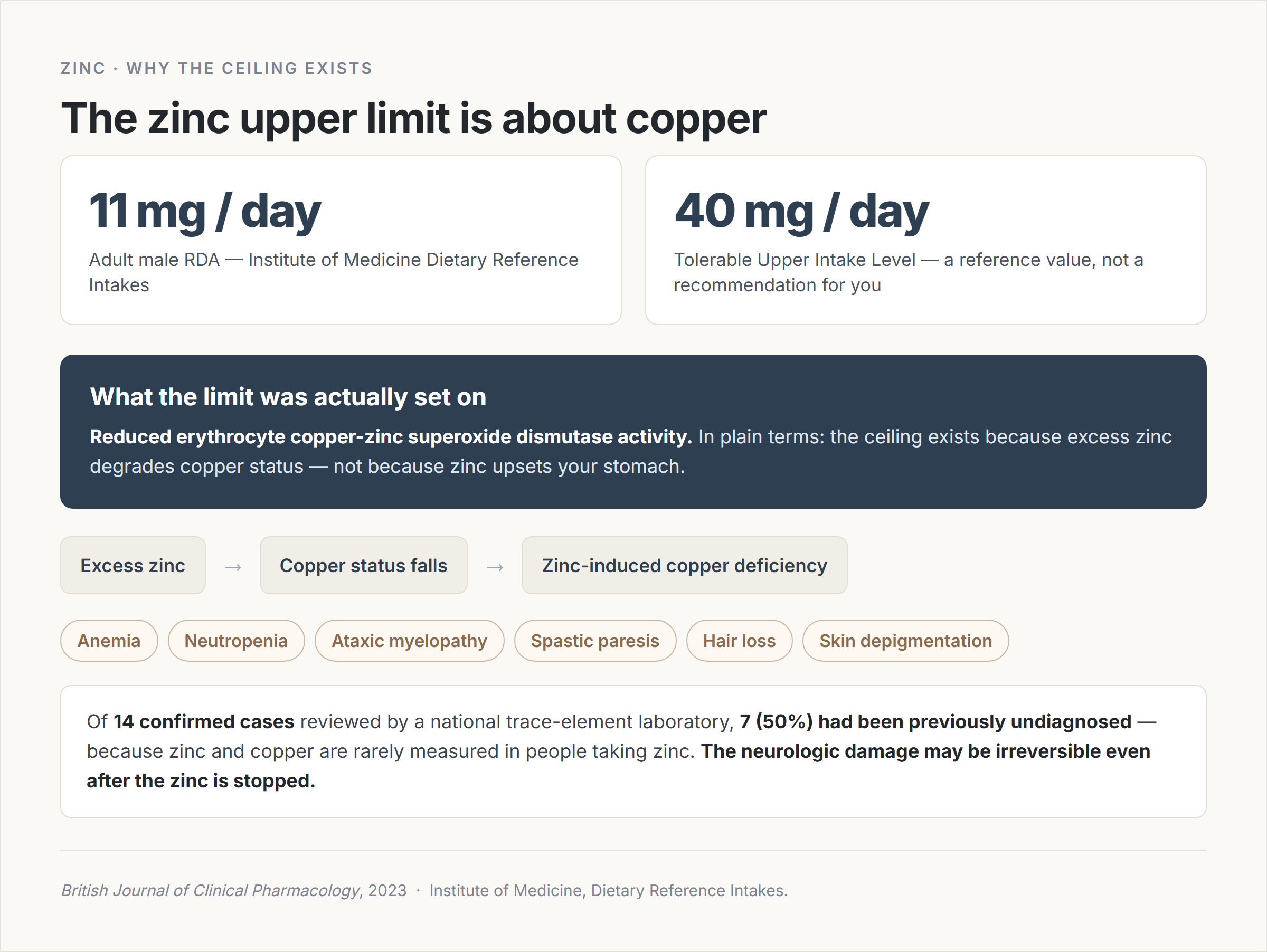
For scale, the Institute of Medicine’s Dietary Reference Intakes set the adult male RDA at 11 mg/day and the Tolerable Upper Intake Level at 40 mg/day. Those are reference values, not a recommendation for you.
The reason that upper limit exists is copper
This is the detail that changed my mind about casual high-dose minerals.
The zinc UL was set on reduced erythrocyte copper-zinc superoxide dismutase activity. In plain terms: the ceiling exists because excess zinc degrades copper status, not because zinc upsets your stomach.
Zinc-induced copper deficiency causes anemia, neutropenia, ataxic myelopathy, spastic paresis, hair loss, and skin depigmentation. A national trace-element laboratory review found that of 14 confirmed cases, 7 (50%) had been previously undiagnosed — because zinc and copper are rarely measured in people taking zinc — and the authors recommended that official dosing advice be revised (British Journal of Clinical Pharmacology, 2023).
The neurologic damage may be irreversible even after the zinc is stopped.
That is the whole argument against “a little extra can’t hurt,” in one line.
Maca is the thinnest evidence of the three
The pivotal systematic review (BMC Complementary and Alternative Medicine, 2010) pooled 4 randomized trials with 131 participants in total — the individual studies had 50, 57, 16, and 8 people.
The methodology section is the story. All were double-blind, but none reported sequence generation or allocation concealment, none reported power calculations, and — the line I keep coming back to — “none of included trials attempted to assess the adverse effects of maca.” The reviewers’ verbatim conclusion was that the number of trials, the sample size, and the methodological quality were “too limited to draw firm conclusions.”
Evidence grade: insufficient for sexual function.
For fatigue, it is worse than insufficient. Targeted searching found no qualifying human trial of maca with a fatigue or energy endpoint. The only fatigue-adjacent randomized trial in the review base was in cyclists, and it found nothing.
Even the most-cited positive trial (Andrologia, 2002) undercuts the hormone story it is used to sell: self-reported sexual desire improved, while serum testosterone and estradiol did not differ from placebo.
So the claim that maca helps with declining stamina and chronic fatigue isn’t a claim I can soften. There is no credible human evidence for it at all.
So why are you actually tired?
This is the section I would keep if I had to delete every other one.

Photo: Liuuu_61 / Pexels
Start with your breathing at night
Moderate-to-severe sleep-disordered breathing affects 10% of men aged 30–49 and 17% of men aged 50–70 (American Journal of Epidemiology, 2013). In a working population without obvious barriers to care, an estimated 82% of men with moderate-to-severe sleep apnea syndrome had never been clinically diagnosed (Sleep, 1997 — still the most-cited figure, though it predates modern home sleep testing).
Signs worth bringing to a clinician, per NHLBI: loud snoring, witnessed pauses in breathing or gasping during sleep, and heavy daytime sleepiness despite enough time in bed. Diagnosis is by a sleep study.
Now the loop that makes this urgent for anyone shopping for “low T” support. Obstructive sleep apnea in middle-aged men is associated with decreased testosterone secretion, and conversely, testosterone therapy can worsen sleep apnea and should probably be avoided in severe untreated cases (World Journal of Men’s Health, 2019).
Read that twice. The man self-treating low-testosterone symptoms may have an untreated breathing disorder that both causes his symptoms and makes hormone therapy hazardous.
One nuance I don’t want misread: the US Preventive Services Task Force’s 2022 “insufficient evidence” statement is about screening the general adult population who have no symptoms. It explicitly does not apply to people with recognized symptoms or those referred for evaluation. If you snore and you’re exhausted, “get it evaluated” is entirely consistent with that guidance.
The rest of the list is ordinary, testable medicine
- Anemia causes tiredness, weakness, shortness of breath, dizziness, headaches, and irregular heartbeat. Around 3 million Americans have it, and NHLBI notes it may signal something more serious — bleeding in the stomach, infection, kidney disease, cancer, or autoimmune disease. In an adult man, new anemia is a reason to find the cause, not a reason to buy iron.
- Hypothyroidism affects nearly 5 in 100 Americans aged 12 and over. It develops slowly, symptoms overlap with other conditions, and diagnosis requires blood tests, not symptoms alone (NIDDK).
- Diabetes often announces nothing at all. NIDDK is explicit that many people with type 2 diabetes have no symptoms, or symptoms mild enough to miss, developing over years.
- Chronic kidney disease carries NIDDK’s blunt line: “Testing may be the only way to know if you have kidney disease.”
- Medication effects are a recognized cause of fatigue across drug classes — worth reviewing your list with a pharmacist rather than guessing.
The cause that gets missed most in exactly this group
Among 200 men (mean age 48) referred for borderline testosterone levels, 56% had depression, depressive symptoms, or were taking an antidepressant — versus 6–23% in general populations (Journal of Sexual Medicine, 2015). Their most common complaints were erectile dysfunction, decreased libido, fewer morning erections, low energy, and disturbed sleep.
That is the exact symptom cluster men buy vitality supplements for. In that referred population, more often than not, it was something else — and the authors advised clinicians to screen for depression and lifestyle risk factors in men presenting for possible low testosterone.

Photo: Cedric Fauntleroy / Pexels
And if low testosterone really is the answer, here’s how that’s established
The American Urological Association guideline (2018, validity confirmed 2024) requires two separate early-morning total testosterone measurements, with a total testosterone below 300 ng/dL supporting the diagnosis, together with symptoms or signs. The guideline itself notes those symptoms are “very non-specific” and can reflect other conditions such as chronic fatigue or depression.
Standard workup adds LH, prolactin when LH is low or low-normal, hemoglobin and hematocrit before therapy, and PSA in men over 40.
The guideline does not endorse supplements. It also doesn’t recommend questionnaires to define candidacy. It’s a clinician’s process with a blood draw at a set time of day — none of which a label can substitute for.
What “supplement” legally means in the United States
This part is consumer protection, and I think it’s the strongest practical reason to be cautious.
Dietary supplements are regulated as a food category, not as drugs. Products are not approved for safety or effectiveness before they go on sale — responsibility for safety and truthful labeling sits with the manufacturer.
That sentence on the back of the bottle is the legal expression of it. Under 21 CFR 101.93, a product carrying a structure/function statement must display, verbatim: “This statement has not been evaluated by the Food and Drug Administration. This product is not intended to diagnose, treat, cure, or prevent any disease.”
It isn’t boilerplate. It is a notice that no agency checked whether this works.
The adulteration numbers
An analysis of FDA warnings published in JAMA Network Open (2018) examined the agency’s tainted-products database for 2007–2016:
- 776 adulterated dietary supplements, implicating 146 companies.
- 353 (45.5%) were sexual-enhancement products — the single largest category.
- Sildenafil, a prescription drug, was hidden in 166 of those 353 products (47.0%).
- 20.2% contained more than one unapproved ingredient.
- Of 28 products named in repeat warnings more than six months apart, 19 (67.9%) contained new unapproved ingredients the second or third time. The warnings did not stop them.

Why this is dangerous rather than merely dishonest: a man taking nitrates for angina, or already prescribed a PDE5 inhibitor, who unknowingly swallows hidden sildenafil can experience severe hypotension. You cannot dose-manage a drug you don’t know you’re taking.
And the label itself is not a reliable description of the contents. A 2024 chemical analysis of 44 supplements bought at retailers on or near US military bases found 36 (82%) had inaccurate labels, 61% did not contain ingredients listed on the label, 36% contained hidden ingredients, and none carried a third-party certification seal (Nutrients, 2024). Different product category, same market, same regulatory regime.
Third-party certification, where it exists, speaks to identity, potency, and contaminants. It never speaks to whether the ingredient works, or to whether a product is safe alongside your medications.
Cautions that apply to any men’s vitality supplement
- On prescription medication or living with a chronic condition? Clear any supplement with a clinician or pharmacist first.
- Cardiovascular disease is a stop sign for arginine, not a reason to take it.
- If you have kidney disease or surgery scheduled, disclose everything you take and follow your clinician’s or surgeon’s instructions. I’m deliberately not giving you a timeline — no reliable one was verifiable.
- Stacking multiplies risk. With a multi-ingredient formula, you can’t attribute a benefit or an adverse reaction to anything.

Photo: 1ndex / Pexels
Signs that warrant an actual evaluation, not a purchase
If any of these are in the picture, the supplement question can wait.
- Chest pain or pressure.
- Fainting or near-fainting.
- New shortness of breath.
- Unexplained weight loss.
- Blood in the stool, or black stools.
- New or worsening depression, or any thoughts of self-harm.
- Witnessed pauses in breathing during sleep, together with severe daytime sleepiness.
And the quieter one that sends most men down the supplement path in the first place: fatigue that has lasted weeks and doesn’t lift with rest, especially alongside low libido or poor sleep. That combination is a reason to book an appointment, not a reason to read reviews.
The short version
If I compress everything I read into a few lines, it’s these.
Arginine’s mechanism is real, but most of an oral dose is destroyed before it reaches your blood, its best-supported effect is a modest blood-pressure drop — which is an interaction risk — and it carries a mortality signal in post-heart-attack patients serious enough to stop a trial. Zinc matters if you’re genuinely low, and about 15% of US adults are; adding more on top of adequate intake hasn’t been shown to raise testosterone, and going high has a documented, sometimes permanent downside. Maca’s human evidence is four small trials and 131 people, and for fatigue there is no credible human evidence at all. And in a market where 45.5% of FDA-flagged adulterated products were sexual-enhancement products, the bottle itself is an unknown.
But the finding that actually stayed with me wasn’t about any of the three ingredients.
It was that 56% figure — the men referred for borderline testosterone, more than half of whom were carrying depression. They had the same symptoms as everyone reading this. They were, by definition, already in the system, already being taken seriously.
They still nearly got the wrong answer.
You’re tired for a reason. That reason is usually findable, and it’s usually treatable. The one thing I’d ask is that you let someone look for it before you decide what it is.
Because the question isn’t whether something can help you. It’s whether anyone has checked what’s actually wrong yet.
References
- Schulman SP, Becker LC, Kass DA, et al. — “L-Arginine Therapy in Acute Myocardial Infarction (VINTAGE MI),” JAMA, 2006;295(1)
- Memorial Sloan Kettering Cancer Center — About Herbs: Arginine
- Rhim HC, et al. — “The Potential Role of Arginine Supplements on Erectile Dysfunction: A Systematic Review and Meta-Analysis,” Journal of Sexual Medicine, 2019
- Gallo L, et al. — “Daily Therapy With L-Arginine and Tadalafil in Combination and in Monotherapy for ED,” Sexual Medicine, 2020
- Shiraseb F, et al. — “Effect of l-Arginine Supplementation on Blood Pressure in Adults,” Advances in Nutrition, 2022
- “The Effects of Oral l-Arginine and l-Citrulline Supplementation on Blood Pressure,” Nutrients, 2019 (bioavailability, arginase first-pass metabolism)
- Institute of Medicine — Dietary Reference Intakes: Zinc, 2001 (RDA, Tolerable Upper Intake Level, copper endpoint)
- Reider CA, et al. — “Inadequacy of Immune Health Nutrients: Intakes in US Adults, NHANES 2005–2016,” Nutrients, 2020
- Te L, et al. — “Correlation between serum zinc and testosterone: A systematic review,” Journal of Trace Elements in Medicine and Biology, 2023
- Irani M, et al. — “The Effect of Folate and Folate Plus Zinc Supplementation… in Sub-Fertile Men,” Urology Journal, 2017
- Duncan A, et al. — “Iatrogenic copper deficiency: Risks and cautions with zinc prescribing,” British Journal of Clinical Pharmacology, 2023
- Mims MH, et al. — “Zinc-Induced Copper Deficiency Mimicking Myelodysplastic Syndrome,” Cureus, 2025
- Shin BC, et al. — “Maca (L. meyenii) for improving sexual function: a systematic review,” BMC Complementary and Alternative Medicine, 2010
- Gonzales GF, et al. — “Effect of Lepidium meyenii (MACA) on sexual desire and its absent relationship with serum testosterone levels,” Andrologia, 2002
- Peppard PE, et al. — “Increased Prevalence of Sleep-Disordered Breathing in Adults,” American Journal of Epidemiology, 2013
- Young T, et al. — “Estimation of the clinically diagnosed proportion of sleep apnea syndrome,” Sleep, 1997
- Kim SD, Cho KS — “Obstructive Sleep Apnea and Testosterone Deficiency,” World Journal of Men’s Health, 2019
- US Preventive Services Task Force — “Obstructive Sleep Apnea in Adults: Screening” (2022), Grade I, asymptomatic adults
- NHLBI — Sleep Apnea; Anemia
- NIDDK — Hypothyroidism; Symptoms & Causes of Diabetes; Chronic Kidney Disease
- Westley CJ, Amdur RL, Irwig MS — “High Rates of Depression and Depressive Symptoms among Men Referred for Borderline Testosterone Levels,” Journal of Sexual Medicine, 2015
- Wright J, O’Connor KM — “Fatigue,” Medical Clinics of North America, 2014
- American Urological Association — Testosterone Deficiency Guideline (2018; validity confirmed 2024)
- 21 CFR 101.93 — Certain types of statements for dietary supplements (verbatim disclaimer text)
- Tucker J, et al. — “Unapproved Pharmaceutical Ingredients Included in Dietary Supplements Associated With US FDA Warnings,” JAMA Network Open, 2018
- Crawford C, et al. — “Label Accuracy and Quality of Select Weight-Loss Dietary Supplements Sold on or near US Military Bases,” Nutrients, 2024
- Balasubramanian A, et al. — “Testosterone Imposters: An Analysis of Popular Online Testosterone Boosting Supplements,” Journal of Sexual Medicine, 2019
This article is general information and is not medical advice. It does not establish a clinician–patient relationship and is not a substitute for individual diagnosis or treatment. It deliberately contains no dosing guidance, no product recommendations, and no regimen. Please talk with a physician or pharmacist before starting, combining, or stopping any supplement — especially if you take prescription medication, have cardiovascular disease or kidney disease, or have surgery scheduled. Nothing here is intended to diagnose, treat, cure, or prevent any disease. In an emergency, call 911.