Alternating Acetaminophen and Ibuprofen for a Child’s Fever
Let me be honest about where this question usually comes from.
It is 2 a.m. Your child is warm, restless, and miserable. You gave Tylenol two hours ago, the number on the thermometer barely moved, and somewhere in your tired brain a thought appears: could I just give the ibuprofen too?
I understand that instinct completely. When your child is uncomfortable, you want to do something.
So let’s walk through it calmly. What alternating acetaminophen and ibuprofen actually does, how the medicines are dosed, which ages simply cannot have them, and the one fever situation that is a true emergency.
One thing up front, and I mean it. I am not your pediatrician, and this is general information, not medical advice. Fever medicine for a child should always follow your own doctor’s guidance and weight-based dosing. When in doubt, call them.

Photo: KATRIN BOLOVTSOVA / Pexels
What do these fever medicines actually do?
Here is the part that quietly changes how you feel about the whole thing.
Acetaminophen (Tylenol) and ibuprofen (Motrin, Advil) both bring down fever and ease pain. But they are strictly for comfort. They do not cure the illness, and they do not shorten it.
Read that again, because it lifts a lot of pressure.
The goal is not to force the thermometer down to a “normal” number. The goal is a child who feels well enough to rest and drink. A child with a fever who is still sipping fluids, and perking up here and there, may not need any medicine at all.
So we treat the child, not the number.
Should you alternate acetaminophen and ibuprofen?
This is the heart of it, so I will be direct.
For most children, the American Academy of Pediatrics does not recommend routinely alternating the two medicines every few hours.
Alternating can lower a fever a little more than one medicine alone. That part is true. But it comes with a real cost: it makes dosing mistakes much more likely. Two bottles, two schedules, two different amounts, at 2 a.m., on no sleep. That is exactly how a child ends up double-dosed or over the daily limit.
So the honest default is this.
Use one medicine, dosed correctly, and track it.
Alternating is not forbidden. But it is meant to be a doctor-directed exception, not your first move. Pediatricians do sometimes recommend it, for example for a child with a history of frequent high fevers or febrile seizures, and when they do, they hand you a written schedule. If your own doctor has given you one, follow theirs over any article, including this one.
How much, and how often?
If you use a single medicine, here is the general shape of the dosing. The most important rule sits above all of it.
Dose by weight, not by age, using the chart on the product or from your pediatrician, and the measuring syringe that comes in the box. A kitchen spoon is not accurate.

- Acetaminophen: every 4 to 6 hours as needed, with no more than 5 doses in 24 hours.
- Ibuprofen: every 6 to 8 hours as needed, with no more than 4 doses in 24 hours.
Never go over the daily maximum for either one. And watch for hidden doses: many cold-and-flu products already contain acetaminophen, so check every label before you stack them.

Photo: Towfiqu barbhuiya / Pexels
If your pediatrician has approved alternating, the usual framing is to give acetaminophen on its 4-to-6-hour clock and ibuprofen on its 6-to-8-hour clock, staggered by about 2 to 3 hours, so something is always working for comfort. Write down every single dose: which drug, how much, what time. That written log is the whole safety net.
Which ages simply cannot have these medicines?
Age limits are not fussy fine print here. They are the safety core.

- Ibuprofen is not for babies under 6 months. It has not been shown safe in that age group and carries a risk of kidney injury, especially if the baby is even a little dehydrated.
- Acetaminophen should not be given under 12 weeks (3 months) without a doctor. A fever that early needs to be evaluated in a medical setting, not just medicated at home.
- Never give aspirin to a child for a fever. It is linked to a rare but serious condition called Reye’s syndrome.
If your child falls under these ages, the answer is not a different medicine. The answer is a phone call to the doctor.
When is a fever an emergency?
I want to slow down here, because this is the one part I would never want a tired parent to miss.
Any fever of 100.4°F (38°C) or higher in a baby 3 months or younger is a medical emergency.

Photo: Dobromir Dobrev / Pexels
Call your pediatrician immediately. If your newborn is under 2 months with that temperature, go to the emergency department.
Here is why the rule is so strict. In babies this young, a fever can be the only sign of a serious bacterial infection, and those infections can get worse fast. This is not a “watch and wait” situation.
And one more thing that feels counterintuitive but matters: do not give fever medicine before that baby is seen. Lowering the fever can hide the very signs the medical team needs to evaluate what is going on.
When should you call the doctor for an older child?
For babies past that newborn window and for older kids, medicine is often fine at home. But some signs mean stop dosing and pick up the phone.
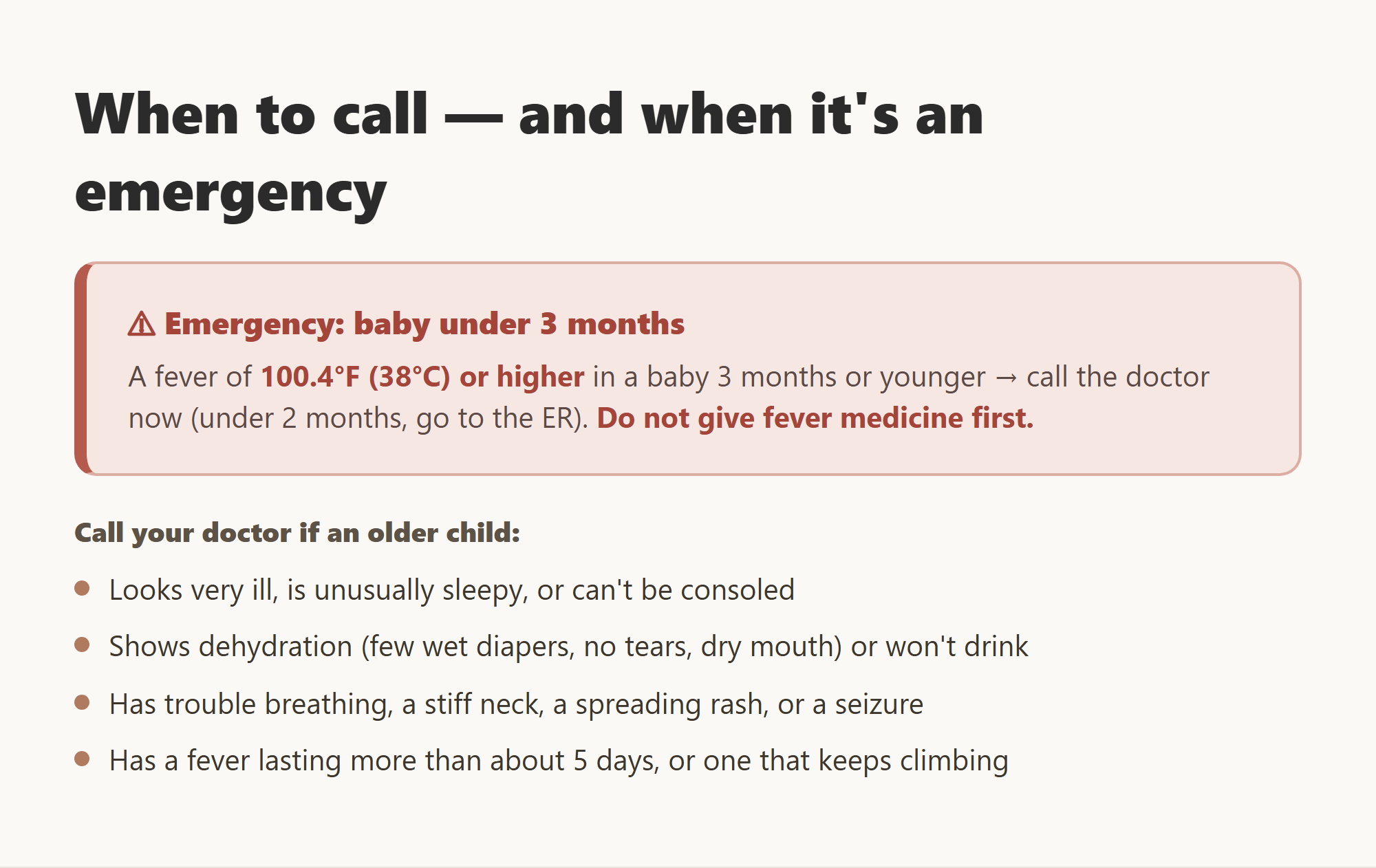
Call your doctor if your child:
- Looks very ill, is unusually sleepy or hard to wake, or cannot be consoled.
- Shows signs of dehydration, like very few wet diapers, no tears, or a dry mouth, or simply will not drink.
- Has trouble breathing, a stiff neck, a spreading rash, or a seizure.
- Has a fever lasting more than about 5 days, or one that keeps climbing.
And honestly, add one more: any time your gut says something is wrong. Parents notice the small changes first. That instinct is worth a phone call.
The short version
If I compress all of this into a few lines, here it is.
Fever medicine is for comfort, not for chasing a number. Use one medicine, dosed by weight, and track it. Alternating acetaminophen and ibuprofen is a doctor-directed exception, not a default, because the real risk is a dosing mistake. Ibuprofen is off-limits under 6 months, acetaminophen under 3 months without a doctor.
And the line to keep bright in your mind: a fever of 100.4°F or higher in a baby under 3 months is an emergency, and that baby should be seen before any medicine.
Everything else here is general information. Your pediatrician knows your child, and a two-minute call at 2 a.m. is exactly what that after-hours line is for.
Because a calm, well-dosed plan beats a frantic guess every time.
References
- AAP / HealthyChildren.org — Treating Your Child’s Fever; Fever and Your Baby; Ibuprofen Dosing Table
- Children’s Hospital of Philadelphia — Fever in a Newborn
- Seattle Children’s; CHOC — fever guidance and acetaminophen vs. ibuprofen for parents
- Mayo Clinic — Sick baby? When to seek medical attention
- St. Louis Children’s Hospital — Ibuprofen dosage table