Allergic Rhinitis Bedroom Setup: Dust Mite or Pollen?
Stuck in sneeze-and-runny-nose season every spring and fall — how to actually set up the room you sleep in
I spent two autumns following the standard bedroom advice for allergic rhinitis, the kind I had read in a dozen places, and I want to be honest about how that went.
Humidifier running at 50 percent. Windows cracked open twice a day, ten minutes each, late morning. Sheets washed on cold. By November my nose was worse, not better, and I assumed I simply had not been strict enough.
Then I went and read the actual sources. Three of the rules I had been following turned out to be wrong for me — and one of them was close to the worst thing I could have been doing.
So here is the honest version up front. Allergic rhinitis is an immune reaction to a specific allergen, not a reaction to dry air — and the single decision that reorganizes your whole bedroom is which allergen. If it is dust mite, drier is better and your windows are a humidity valve. If it is pollen, the windows are the problem for a few months of the year. Same room, opposite instructions.
This is general health information, not medical advice. There is a fuller note at the bottom, and a three-tier guide on when to stop reading and call someone.
First, the correction: dry air does not cause allergic rhinitis
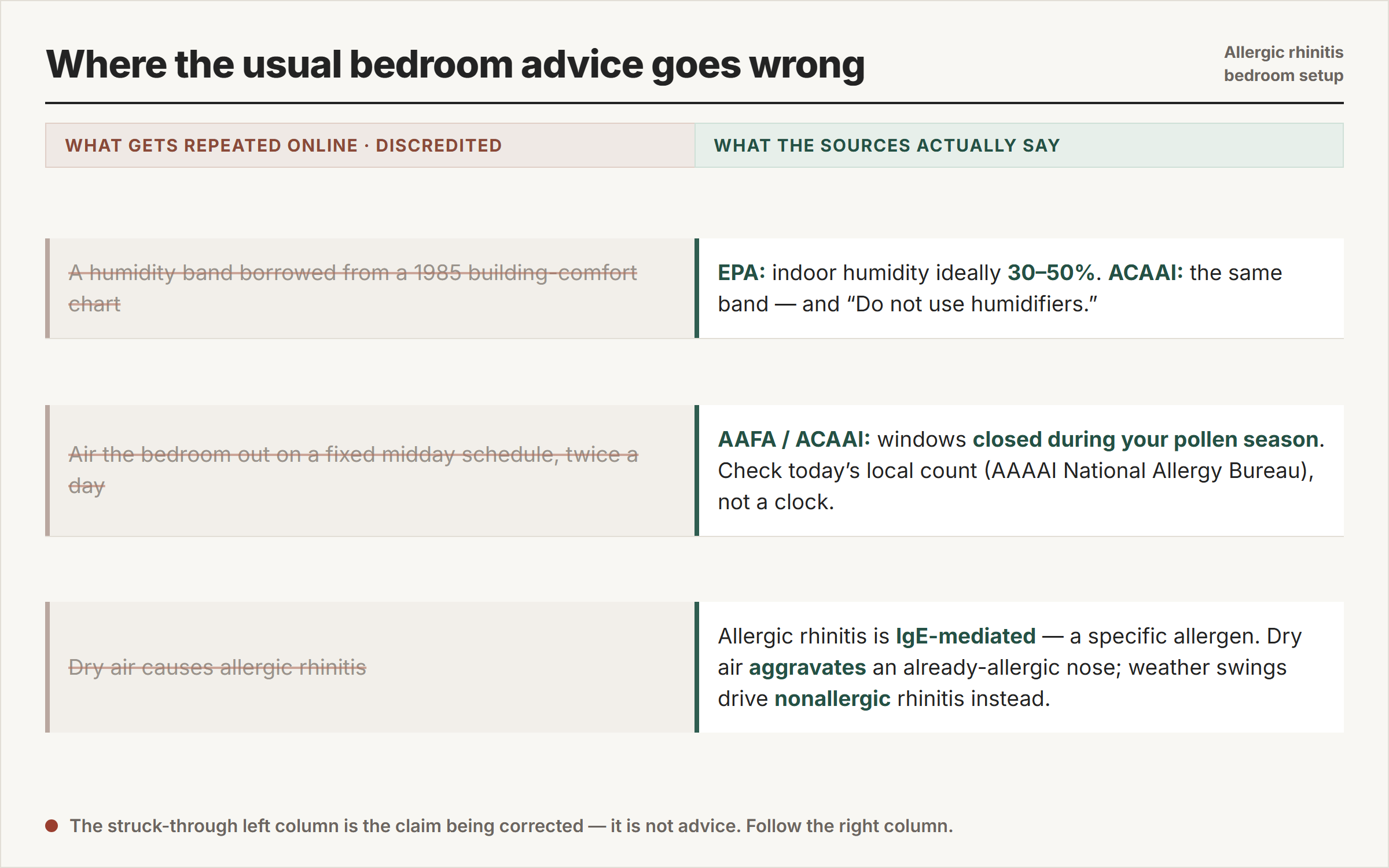
This sounds pedantic. It is not — it is the reason my humidifier plan failed.
Allergic rhinitis is IgE-mediated by definition. There is a specific allergen, and an immune system that has learned to overreact to it, with elevated allergen-specific IgE and increased mast cells and eosinophils in the tissue. Cold air does not sensitize anyone. Neither does a dry hallway in October.
What temperature swings and humidity changes do drive is a different condition: nonallergic (vasomotor) rhinitis. AAAAI describes it as chronic sneezing, congestion or runny nose that “doesn’t involve the same mechanisms of the immune system,” set off by odors, airborne pollutants, certain foods, some medications, and weather changes. StatPearls puts it the same way — symptoms “typically stimulated by nonspecific surroundings like the rise of temperature changes, strong smell, or alterations of humidity.”
There is a clinical tell worth knowing, and it is the one that made me re-read my own symptoms.
Nonallergic rhinitis typically does not produce an itchy nose, eyes or throat.
That itch is an allergy signature. If sneezing and a running nose are the whole picture and nothing itches, weather-driven nonallergic rhinitis is on the table.
What dry air actually does to the nose
It does plenty — just not what the headline claims. Nasal mucociliary transport slows measurably in dry air. In a chamber study, 14 healthy subjects held at 10% relative humidity for four hours showed prolonged saccharin transit times, likely from changes in the rheological properties of nasal mucus and slowed ciliary beating. In mice, low ambient humidity impaired barrier function and innate resistance to influenza infection (Kudo et al., PNAS 2019).
So dry air irritates, slows clearance, and makes an already-inflamed nose feel worse. That is aggravation, not causation — and plenty of people have mixed rhinitis, both at once. Rhinitis overall affects roughly 20% of the population in industrialized countries; the nonallergic kind typically emerges between ages 30 and 60 and is more common in women.
I am not going to tell you which one you have. Nobody can do that from a blog post — separating them requires allergy testing, specific IgE or skin testing, which is a clinician’s job.
The question that decides everything else: what is your trigger?
In the US, 25.2% of adults reported a diagnosed seasonal allergy in 2024 (NHIS; 29.5% of women, 20.7% of men). The spring and fall spikes are pollen, on a fairly predictable calendar from AAFA: trees February to April, grasses April to early June, weeds and ragweed August until the first hard frost.
Photo: Regina Tommasi / Pexels
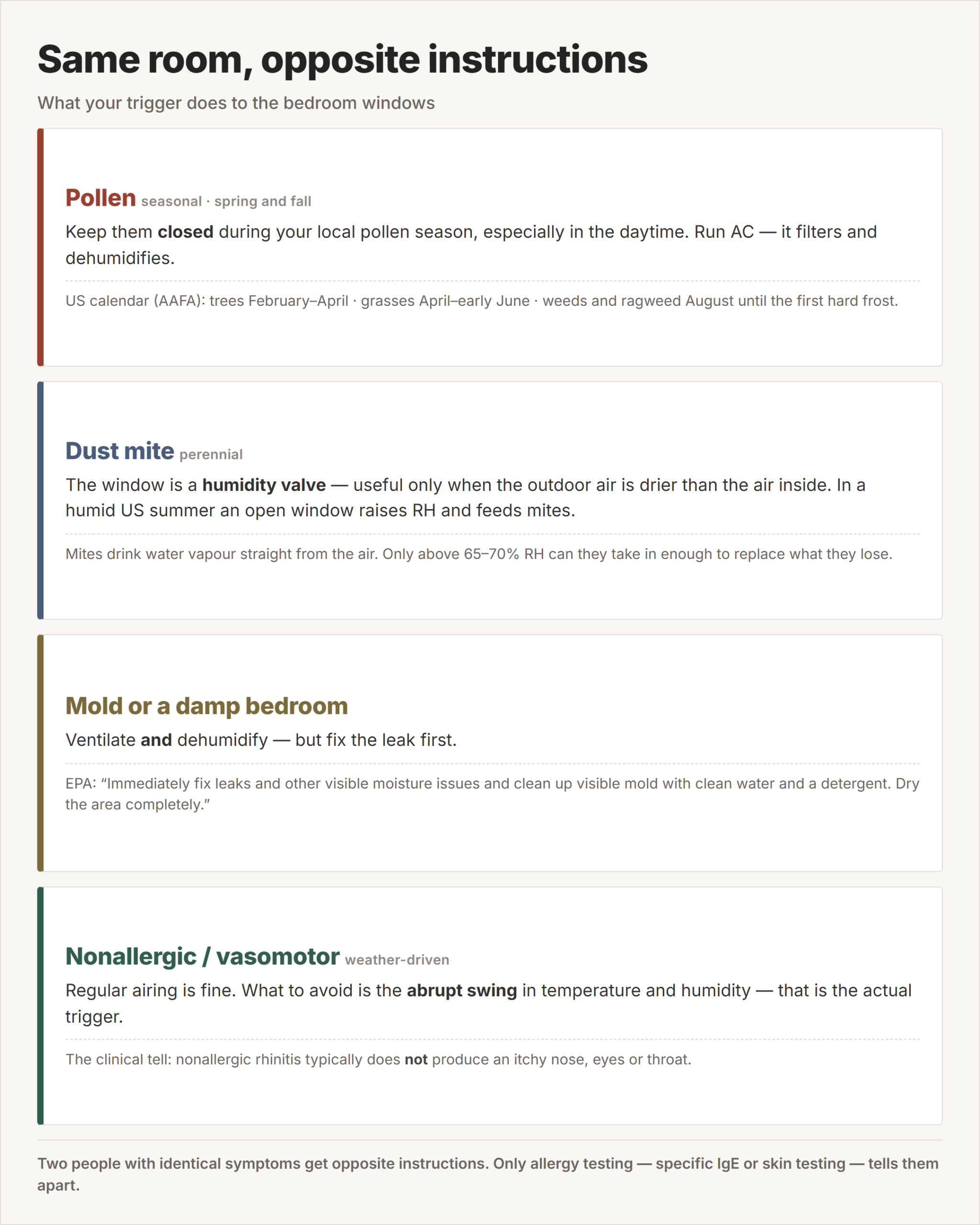
But bedroom advice for allergic rhinitis splits four ways depending on what you actually react to, and this table is the most useful thing in this article.
| Your trigger | What to do with the windows |
|---|---|
| Pollen (seasonal, spring and fall) | Keep them closed during your local pollen season, especially in the daytime. Run AC — it filters and dehumidifies. Check the same-day local count before deciding anything. |
| Dust mite (perennial) | Ventilation helps only when it lowers indoor humidity — that is, when the outdoor air is drier than the air inside. In a humid US summer, an open window raises RH and feeds mites. A dehumidifier plus AC beats open windows. |
| Mold or a damp bedroom | Ventilate and dehumidify. Fix the leak first. EPA: “Immediately fix leaks and other visible moisture issues and clean up visible mold with clean water and a detergent. Dry the area completely.” |
| Nonallergic / vasomotor | Regular airing is fine. What to avoid is the abrupt swing in temperature and humidity, since that is the actual trigger. |
Two readers with identical symptoms get opposite instructions. That is why guessing at your trigger is, in my experience, the most common reason all of this quietly fails.
Humidity: aim for 30-50%, not the figure you have read online
I had “40 to 60 percent for respiratory health” in my head as if it came from a health agency. It does not.
It comes from the Sterling chart, a 1985-86 building-science graphic (Sterling et al., “Indirect Health Effects of Relative Humidity in Indoor Environments”) that reviewed epidemiological data on respiratory infections in schools, army barracks and offices and shaded 40-60% as an optimum zone. Forty years old, endlessly reproduced, and criticized — the tidy striped bands are not supported by the underlying biology, and in cold climates holding 40% RH can condense moisture and grow mold on cold surfaces in a poorly insulated house.
Here is what the actual bodies say:
- EPA, the US government number: indoor relative humidity “should be kept below 60 percent — ideally between 30 percent and 50 percent, if possible.” EPA also notes that low humidity “may also discourage pests (such as cockroaches) and dust mites.”
- ACAAI, more pointed for allergy patients: keep humidity “between 30 and 50 percent,” and “Do not use humidifiers.”
- ASHRAE 55 sets no lower humidity limit at all. Its upper bound is a humidity ratio of 0.012 kg water per kg dry air — a dew point of 16.8°C (62.2°F).
The practical upshot: the upper half of 40-60% is the dust-mite growth zone. If dryness is genuinely your problem, aim at the 40-45% area rather than 50-60%, and treat the dryness locally — saline, fluids — instead of soaking the entire room.
The humidity paradox, in mite biology
Dust mites have no way to drink. They live in dwellings where there is no liquid water and pull water vapour straight out of the air. Their bodies are 70-75% water by weight, and that has to be maintained for them to reproduce. Arlian’s water-balance work is direct about the threshold: only “at relative humidities above 65-70%” can they extract enough water from unsaturated air to compensate for what they lose.
Below that, active mites do not survive longer than 6 to 11 days at RH of 50% or less.
Which sounds like a quick win. It is not, and this is where most advice oversells.
Populations decline over weeks and months, not days. Desiccation half-lives at 45% RH are 11.5 weeks for D. farinae and 1.2 weeks for D. pteronyssinus. At 50% RH those stretch to 86.3 weeks and 4.0 weeks — a year and a half for one of the two common species. At 50% RH, significant proportions of both populations were still alive at 10 weeks. The authors’ own conclusion was that 50% RH or below “would have to be maintained for long periods.”
And even then, you are suppressing, not clearing. Mites ride out dry spells by changing form into a desiccation-resistant protonymph that survives for months below the humidity that kills active stages. When conditions improve they rebound quickly — doubling times of 2.2 weeks (D. pteronyssinus) and 4.2 weeks (D. farinae). The honest verb here is suppress. Not eliminate.
The part that made me stop panicking about the shower
I had convinced myself that a steamy bathroom or a pot of pasta undid the whole week. The research says close to the opposite.
D. farinae populations were held at daily regimens of 2, 4, 6 and 8 hours at high humidity, with the rest of the day dry. At two hours, populations declined. At four, six and eight hours of 75% RH they grew only slightly — growth reduced by 98.2%, 98.0% and 97.3% at 10 weeks compared with continuous 75% RH. The conclusion: maintaining mean daily RH below 50% “effectively restricts population growth of these mites and thus the production of allergen,” even with those daily spikes. Complete prevention of growth was a different animal — that took RH below 35% for at least 22 hours a day.
So, in plain terms:
Steam from cooking or a shower is fine. What matters is the daily average.
Where the evidence genuinely disagrees
I would rather show you the disagreement than pretend it is settled.
| Study | Setting | Finding |
|---|---|---|
| Arlian et al., JACI 1999 | Lab cultures, D. farinae, controlled 24-hour RH cycles | Mean daily RH below 50% suppressed population growth 97.3-98.2% at 10 weeks, despite 2-8 hours a day above 50%. |
| De Boer et al., J Med Entomol 1998 | Lab, D. pteronyssinus, 16°C | Weight gain on just 1.5 hours a day of moist air; egg production with 3 hours a day or more while average RH stayed low. Average RH was “misleading as an indicator of mite survival and growth conditions.” |
| Crane et al., Allergy 1998 | Field pilot, 10 Wellington (NZ) homes, mechanical ventilation with heat exchange | Humidity fell significantly but there was no systematic effect on mite counts or Der p 1. RH sat below threshold for only 39% of measured 24-hour periods. |
Different species, different temperatures, so this is not a clean contradiction — but that is a hypothesis, not a resolution. What all three converge on is continuity: how consistently RH stays low matters more than how low it briefly dips.
Photo: NEOSiAM 18+ / Pexels
The one real-home result worth planning around
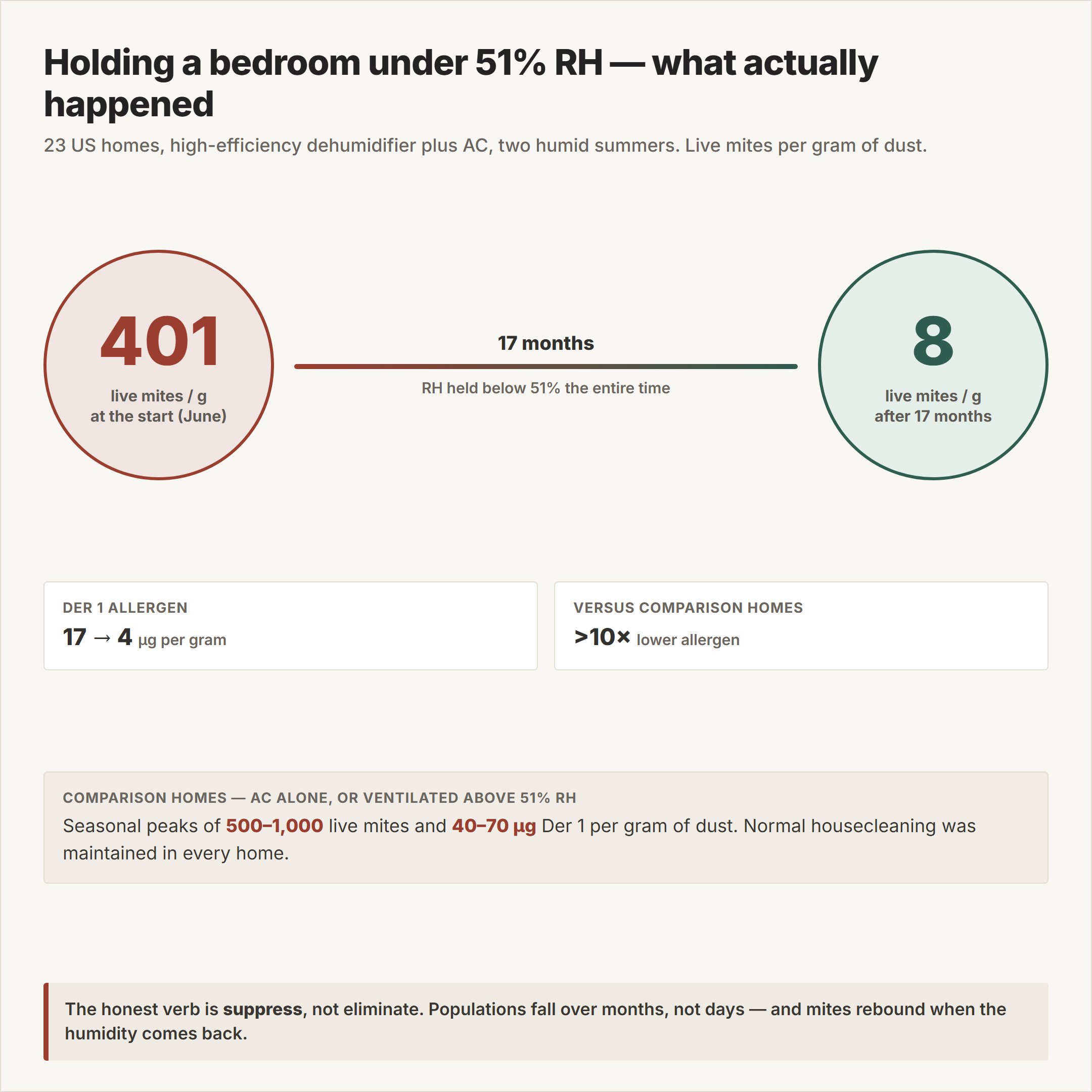
Over two humid summers, homes held below 51% RH with a high-efficiency dehumidifier plus AC (n=23) started in June at 401 ± 124 live mites and 17 ± 3 µg total Der 1 per gram of dust. After 17 months, that fell to 8 ± 3 live mites per gram and 4 ± 1 µg Der 1 per gram. Comparison homes — AC alone, or AC plus dehumidification without actually holding RH under 51%, and window-ventilated homes above 51% — ran seasonal peaks of 500 to 1,000 mites and 40 to 70 µg Der 1 per gram. Allergen ended up more than ten times lower in the low-RH homes. Normal housecleaning was maintained in all of them.
Read the timescale before you get excited. Seventeen months. This is a slow, cumulative intervention, and the thing that made it work was that the humidity stayed down the whole time — unlike the Wellington homes, which were below threshold 39% of the time and saw nothing.
Temperature: 18°C is a floor, not an optimum
The other thing I had wrong. “18-22°C for respiratory health” is not a specification any single body issued — it is two unrelated numbers glued together.
- WHO Housing and Health Guidelines (2018) set a minimum of 18°C (64.4°F) to prevent cold-related disease. Homes below 18°C carried greater risk of high blood pressure, rising further below 16°C. That is a floor, not a target.
- ASHRAE 55 gives a thermal comfort range — 20-23.5°C (68-74°F) in winter, 20.5-24.5°C (69-76°F) in summer. Comfort, explicitly not a health or respiratory standard.
If your rhinitis is the nonallergic kind, the exact number matters less than the stability. Abrupt swings are the trigger.
Windows: the daily midday airing habit backfires in ragweed season
This is the one that stung.
Hourly aerobiology from Kansas City (Annals of Allergy, Asthma & Immunology, 2001) found ragweed pollen lowest at 6am, at 3% of the daily total, and highest at noon, at 13%, with a pronounced peak around 9 to 11am. The authors put it bluntly: “the myth that highest ragweed exposure occurs in the early morning hours is not supported by this and previous studies.” A Washington, DC series (2007-2009) likewise found ragweed staying high through the day with peak levels at midday.
Which means that from August to the first hard frost, a 10am to 4pm airing routine sits almost exactly on the daily ragweed peak.
And the societies do not recommend daily airing for pollen-allergic people at all. AAFA: “Keep windows closed, if possible, during pollen season or peak pollen times,” with central air conditioning or HEPA filtration to reduce indoor airborne allergens. ACAAI: “Keep windows closed during pollen season, especially during the day.”
There is a genuine conflict on the hours, and you should see both sides. ACAAI’s patient guidance says tree and grass pollen runs highest in the evening while ragweed runs highest in the morning; the US aerobiology data above says midday. Both land on the same practical answer — windows shut in season — but I am not going to pick a winner on the clock.
Nighttime is not an automatic loophole either. An 18-year European series (Poznań, Poland, 1996-2013, 2,177 high-pollen days) found ragweed carried the highest nighttime risk: roughly 60% of days ran higher at night than during the day, with nighttime maxima over 30% above daytime levels. That is European data, so treat it as a caution rather than a US measurement.
So what replaces the clock rule?
Nothing does, and that is the point. The “twice a day, ten minutes” schedule has no source — there is no US standard specifying a duration or a count for opening a window. ASHRAE 62.2 governs mechanical residential ventilation rates, not a window schedule.
What replaces it is a same-day local number. AAAAI’s National Allergy Bureau (pollen.aaaai.org) runs certified counting stations; check yours before you decide anything. If you do need to air the room out, pick a genuinely low-count day — after sustained rain is a reasonable bet — and stay clear of the late-morning-to-midday ragweed peak.
And EPA’s own ventilation advice already carries the condition people drop: open doors and windows “when outdoor air quality and weather permit, and it is safe to do so.” Ventilation remains the primary tool against indoor moisture, CO₂, VOCs and cooking pollutants, all of which matter in a bedroom. It just is not a daily ritual you owe the room regardless of what is in the air outside.
Photo: Mateusz Pielech / Pexels
Bedding, floors, and the rest of the bundle
ACAAI’s line is to wash bedding frequently in hot water, at least 130°F (54.4°C). The primary laundry work behind that found all mites killed at water temperatures of 55°C (131°F) or greater.
Two caveats you will want before changing anything.
Cold water is not useless — it is incomplete. Cold-water washing removes more than 90% of allergen concentration but does not kill most live mites. Allergen is what your nose reacts to, so a weekly warm or cold wash is doing real work even so.
Do not turn up your water heater. US water heaters are commonly set to 120°F specifically to prevent scalding, and that is a good reason. If your washer cannot reach 130°F, run the items through a dryer above 130°F for at least 15 minutes, or wash weekly in warm water and finish with a hot dry cycle.
The rest of the bundle, with honest weighting:
- Allergen-impermeable encasings on pillows, mattresses and box springs are standard ACAAI advice — but the Cochrane review is direct that isolated use of impermeable bedding “is unlikely to prove effective.” One component of a bundle, never the fix.
- Damp-mop or damp-wipe floors rather than dry-dusting or sweeping, which re-aerosolizes exactly what you are trying to remove.
- Limit the number of stuffed animals in the bedroom, or keep them in containers.
- Carpet reduction is conventional advice resting on observational allergen-reservoir data rather than trials. Worth doing if it is easy; not worth a renovation loan on this evidence.
One framing note, because the internet gets this wrong in an anxious direction. The goal is less exposure in the room where you spend eight hours a night. Your bedroom is not an operating room and does not need to become one — that standard is unreachable, and going by the trial evidence below, it is not where the payoff lives anyway.
What the evidence actually delivers, stated plainly
I said I would be honest about the limits, so here they are.
Dust-mite avoidance in allergic rhinitis, as a package. The updated Cochrane review (Nurmatov et al., Allergy 2012) pooled nine trials and 501 participants across impermeable bedding, acaricides and HEPA filters. Seven of the nine reduced mite load. But the studies were “small and of poor methodological quality”; isolated impermeable bedding is “unlikely to prove effective”; acaricides “appear to be the most promising”; and extensive bedroom-based environmental control programmes “may be of some benefit in reducing rhinitis symptoms.” Bundle, do not single-shot.
HEPA filtration. A 2024 systematic review and meta-analysis of 8 RCTs found pooled standardized mean differences of −0.21 (95% CI −0.35 to −0.07) for nighttime symptom scores and −0.16 (−0.30 to −0.03) for daytime. Statistically significant, and small. In one multicenter randomized, double-blind, placebo-controlled trial, six weeks of filtration significantly improved medication scores and lowered indoor PM2.5, while symptom, VAS and quality-of-life scores did not differ from sham. A bedroom HEPA unit modestly reduces symptoms and may reduce how much medication you need. It will not clear your symptoms.
Saline nasal irrigation. Cochrane 2018, 14 studies and 747 participants (260 adults, 487 children): saline may reduce patient-reported disease severity up to 3 months, in adults and children, with no reported adverse effects. The catch is that overall evidence quality is low to very low, there is no data beyond 3 months, and there is not enough evidence to know whether it is better, worse or the same as an intranasal steroid. Use distilled, sterile, or previously boiled-and-cooled water — never untreated tap water, and there is more on the technique in the safe way to do nasal irrigation.
And if a humidifier is in the room at all — which ACAAI advises mite-allergic patients against — keep it under the 50% ceiling, use distilled water to reduce the potential for dispersing minerals into the air (EPA), follow the manufacturer’s cleaning instructions, and take the mold risk seriously. A dirty unit disperses exactly what you were trying to avoid — see how to clean and disinfect an ultrasonic humidifier.
What none of this does is cure anything. Allergic rhinitis is a chronic sensitization; a well-set-up room reduces exposure and symptom burden, and that is the whole claim. The joint AAAAI/ACAAI Rhinitis 2020 practice parameter update states that intranasal corticosteroids remain the preferred monotherapy for persistent allergic rhinitis, and that for nonallergic rhinitis either intranasal antihistamines or intranasal corticosteroids may be offered as first-line monotherapy. That is a description of what clinicians typically use, not a recommendation for you — which one, or whether any, is a conversation with someone who can examine you.
When to get help — three tiers
Keep this part. It is the section that matters most.
Emergency — use epinephrine first if prescribed, then call 911
- Shortness of breath, difficulty breathing, or audible wheezing
- Chest tightness, or a rescue inhaler not working, or needing it repeatedly
- Suspected anaphylaxis: throat or tongue swelling, trouble swallowing, hoarse voice or throat tightness, widespread hives with dizziness or faintness, vomiting with collapse, a sudden drop in blood pressure. Use an epinephrine auto-injector if one is prescribed, then call 911 — even if symptoms seem to be improving.
- Lips or face turning blue or gray; confusion or inability to stay awake
- In a child: rapid breathing, ribs visibly pulling in with each breath, flaring nostrils, or an inability to speak in full sentences
See a clinician within the same day to a few days
- Fever with facial pain or pressure, or thick discolored discharge lasting more than about 10 days without improving
- One-sided nasal blockage or discharge, or any bloody nasal discharge
- New or worsening loss of smell
- Symptoms bad enough to disrupt sleep, work, school, or safe driving
- Over-the-counter measures have not worked after about 2 weeks, or a decongestant spray has been used more than 3 days in a row
- Known asthma with any increase in cough, chest tightness, or reliever use during allergy season
- Symptoms in an infant or young child, in pregnancy, or in an older adult with heart or lung disease
- You have never been tested and do not know your triggers. This is the visit that makes everything above worth doing.
Watchful waiting — reasonable to self-manage first
- Mild, familiar seasonal sneezing, runny nose or itch that matches a pollen season you already know about, does not disturb your sleep, and fits a pattern of allergic rhinitis you have had before
- Symptoms that clearly improve indoors with the windows closed and AC running
- Mild dryness, crusting or morning stuffiness in a dry environment, without fever or pain
- In this tier: hold RH at 30-50%, keep the bedroom cool and stable, wash bedding weekly in hot water, keep windows closed during your pollen season, consider a HEPA unit in the bedroom, and try saline rinses. Re-evaluate after about 2 weeks — if nothing has improved, move up a tier.
The short version
If you take one thing from this, take the split.
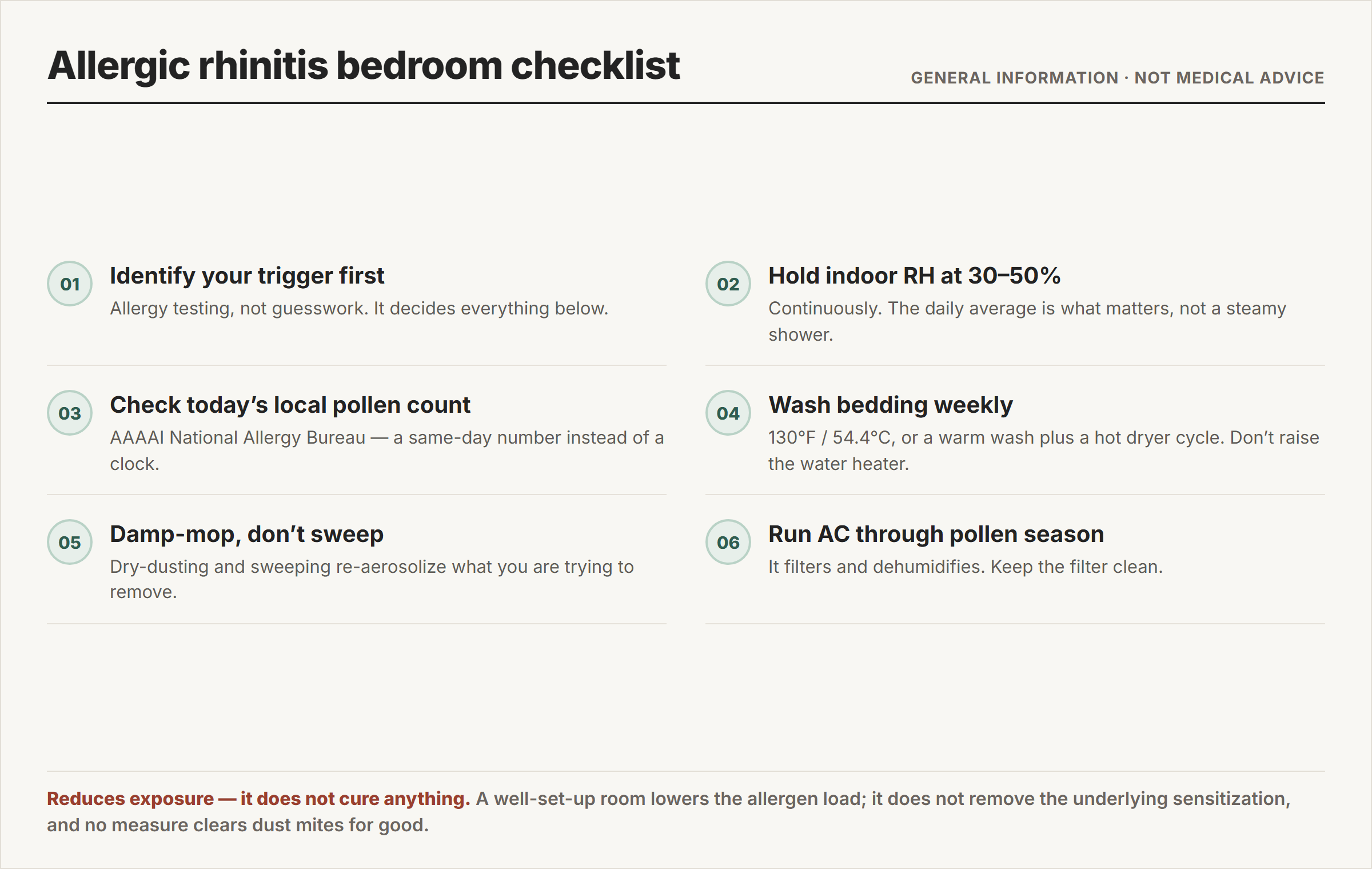
Find out what you are allergic to, and let that decide the windows. Pollen means shut them through your season and run the AC, checking the local count rather than the clock. Dust mite means the windows are a humidity valve — useful only when the outside air is drier than the inside — and the real work is holding RH in the 30-50% band, continuously, for longer than feels reasonable.
Everything else in an allergic rhinitis bedroom is supporting cast. A weekly hot wash, or a warm wash plus a hot dryer cycle. Damp-mop instead of sweep. A HEPA unit that helps a little. Saline that probably helps and will not hurt.
Photo: Ron Lach / Pexels
What I would do differently, if I could go back to that first October: book the allergy test before buying anything. [내부링크: Related post – US pollen calendar and what to check before you air out a room] And keep the AC filter clean, since it is quietly doing most of the filtering you are counting on — AC filter care and replacement timing.
My humidifier lives in a closet now. Not because humidifiers are villains, but because I was aiming at a number that came from a 1985 building-comfort chart and treating it as medicine.
Seventeen months is a long time to wait for a result. But the mites are working on a schedule of weeks, not minutes, and there is something almost restful in that — you do not have to be perfect today, you only have to be consistent for a while.
This article is general health information, not medical advice. It does not diagnose any condition and is not a substitute for evaluation by a licensed clinician. Allergic rhinitis and nonallergic rhinitis produce similar symptoms but have different causes and different treatments, and telling them apart generally requires allergy testing — specific IgE or skin testing — which only a clinician can arrange and interpret. Do not start, stop, or change any medication based on this article. If you are pregnant or breastfeeding, if the person affected is a child or an older adult, if you have asthma, COPD, a heart condition or a weakened immune system, or if you take other medications, talk to your clinician or pharmacist before making changes. Room setup reduces exposure; it does not remove the underlying sensitization, and the clinical trial evidence for single environmental measures is weak. Humidity and ventilation changes may do nothing at all if the real trigger has not been identified. Hot-water washing at 130°F carries a scald risk, which is why US water heaters are commonly set to 120°F — use a hot dryer cycle rather than raising the water heater. For nasal irrigation, use distilled, sterile, or previously boiled-and-cooled water only, and clean and dry the device between uses. Symptoms lasting beyond a season, one-sided symptoms, bloody discharge, loss of smell, facial pain or fever point away from simple allergic rhinitis and need a clinician.
Sources
- US EPA — Mold Course Chapter 2; Biological Pollutants’ Impact on Indoor Air Quality (indoor RH below 60%, ideally 30-50%; ventilation “when outdoor air quality and weather permit”; humidifier distilled-water guidance)
- CDC/NCHS — Diagnosed Allergic Conditions in Adults: United States, 2024. NCHS Data Brief No. 545
- WHO — Housing and Health Guidelines (2018), minimum indoor temperature 18°C
- ANSI/ASHRAE Standard 55 — Thermal Environmental Conditions for Human Occupancy
- ACAAI — Environmental Allergy Avoidance
- AAAAI — Nonallergic Rhinitis (Vasomotor) Defined; National Allergy Bureau (pollen.aaaai.org)
- AAFA — Pollen Allergy (US pollen calendar; windows closed during pollen season)
- AAAAI/ACAAI Joint Task Force — Rhinitis 2020: A Practice Parameter Update. JACI 2020;146(4):721-767
- Nurmatov U et al. House dust mite avoidance measures for perennial allergic rhinitis: an updated Cochrane systematic review. Allergy 2012
- Head K et al. Saline irrigation for allergic rhinitis. Cochrane Database Syst Rev 2018, CD012597.pub2
- Shih et al. Effectiveness of Air Filters in Allergic Rhinitis: A Systematic Review and Meta-Analysis. Indoor Air 2024
- Arlian LG et al. Reducing relative humidity is a practical way to control dust mites and their allergens in homes in temperate climates. JACI 2001;107(1):99-104
- Arlian LG, Neal JS, Vyszenski-Moher DL. Reducing relative humidity to control the house dust mite Dermatophagoides farinae. JACI 1999;104(4 Pt 1):852-6
- Arlian LG. Water balance and humidity requirements of house dust mites. Exp Appl Acarol 1992;16(1-2):15-35
- Arlian LG et al. Population dynamics of the house dust mites at specific relative humidities. J Med Entomol 1998;35(1):46-53
- De Boer R, Kuller K, Kahl O. Water balance of Dermatophagoides pteronyssinus maintained by brief daily spells of elevated air humidity. J Med Entomol 1998;35(6):905-10
- Crane J et al. A pilot study of the effect of mechanical ventilation and heat exchange on house-dust mites and Der p 1 in New Zealand homes. Allergy 1998;53(8):755-62
- Hourly Variation of Airborne Ragweed Pollen in Kansas City. Ann Allergy Asthma Immunol 2001
- Daily Fluctuations in Airborne Ragweed Pollen Levels in Washington, DC (2007-2009). JACI
- Pollen nightmare: elevated airborne pollen levels at night (Poznań, 1996-2013). Aerobiologia
- Mc Donald LG, Tovey E. The role of water temperature and laundry procedures in reducing house dust mite populations and allergen content of bedding. JACI 1992
- Kudo E et al. Low ambient humidity impairs barrier function and innate resistance against influenza infection. PNAS 2019
- StatPearls — Nonallergic Rhinitis (Vasomotor Rhinitis), NBK547704; Characteristics of Nonallergic Vasomotor Rhinitis (PMC3650965)
- Sterling et al. Indirect Health Effects of Relative Humidity in Indoor Environments (1985/86) — origin of the 40-60% chart, and its documented criticisms