Gout Flares: How to Lower Uric Acid and Stop the Pain
Let me start with the moment most men remember.
You are asleep, and something wakes you around 2 a.m. Your big toe is on fire. Not sore — on fire. By morning the joint is red, swollen, and so tender that even the weight of the bedsheet feels unbearable. A breeze from the window makes you wince. You have not injured it. You have no idea what happened.
That, in most cases, is gout.
And here is the part I want to be honest about up front. I am not a doctor, and this is general information, not medical advice. Gout is real, treatable inflammatory arthritis — and the internet is full of confident diet advice that quietly leaves out the single most important part. So let me give you the whole picture, including the part that gets skipped.

Photo: Katya Wolf / Pexels
What gout actually is
Gout is a form of inflammatory arthritis. It happens when there is too much uric acid in your blood, and that excess forms sharp, needle-shaped crystals that settle into a joint. Cleveland Clinic describes it plainly: extra uric acid forms sharp crystals that lodge in your joints, causing swelling and pain.
Those crystals are why the pain arrives so fast and so viciously. An attack comes on rapidly, reaching maximum intensity in under 12 hours — often overnight. In about half of first attacks, the joint at the base of the big toe is the target, a pattern doctors call podagra.
So no, you are not imagining it. Gout is widely described as one of the most painful forms of arthritis there is.

Where does the uric acid come from? Your body makes it when it breaks down purines — chemicals found naturally in your body and in certain foods. Normally your kidneys flush the uric acid out in urine. Gout starts when there is more uric acid than your body clears, a state called hyperuricemia (in men, often defined as a level above 7 mg/dL).
This is not a rare problem, either. Gout affects an estimated 3.9% of US adults — about 8.3 million people — and it hits men far harder, with rates roughly 2.5 to 3.5 times higher than in women.
The diet myth: it is not just beer and chicken
Ask around and you will hear the same story: gout is the “beer and meat disease.” Drink less beer, skip the chicken, done.
That is not wrong, exactly. It is just incomplete — and the missing pieces matter.
Yes, beer and distilled liquor raise your risk. Alcohol does double damage: it adds purines and it stops your kidneys from clearing uric acid, so the acid gets pulled back into your body and accumulates. And yes, red meat and organ meats are genuine culprits.
But here are the two that get left out.

Photo: alleksana / Pexels
High-fructose corn syrup and sugary drinks. This is the big blind spot. Fructose breaks down in your body in a way that releases purines and raises uric acid — so that daily soda, sweet iced coffee, or “healthy” fruit juice can be quietly driving your flares. Table sugar is about half fructose; HFCS is a concentrated form of it. If you cut alcohol but keep drinking soda, you have only solved half the problem.
The specific offenders worth limiting:
- Organ meats — liver, kidney, sweetbreads. The highest-purine foods.
- Red meat — beef, lamb, pork. Limit portion sizes rather than eliminating.
- Certain seafood — herring, scallops, mussels, tuna, trout.
- Beer and liquor — both raise risk and block uric-acid clearance.
- Fructose and HFCS — sodas, sweetened drinks, foods with corn syrup.
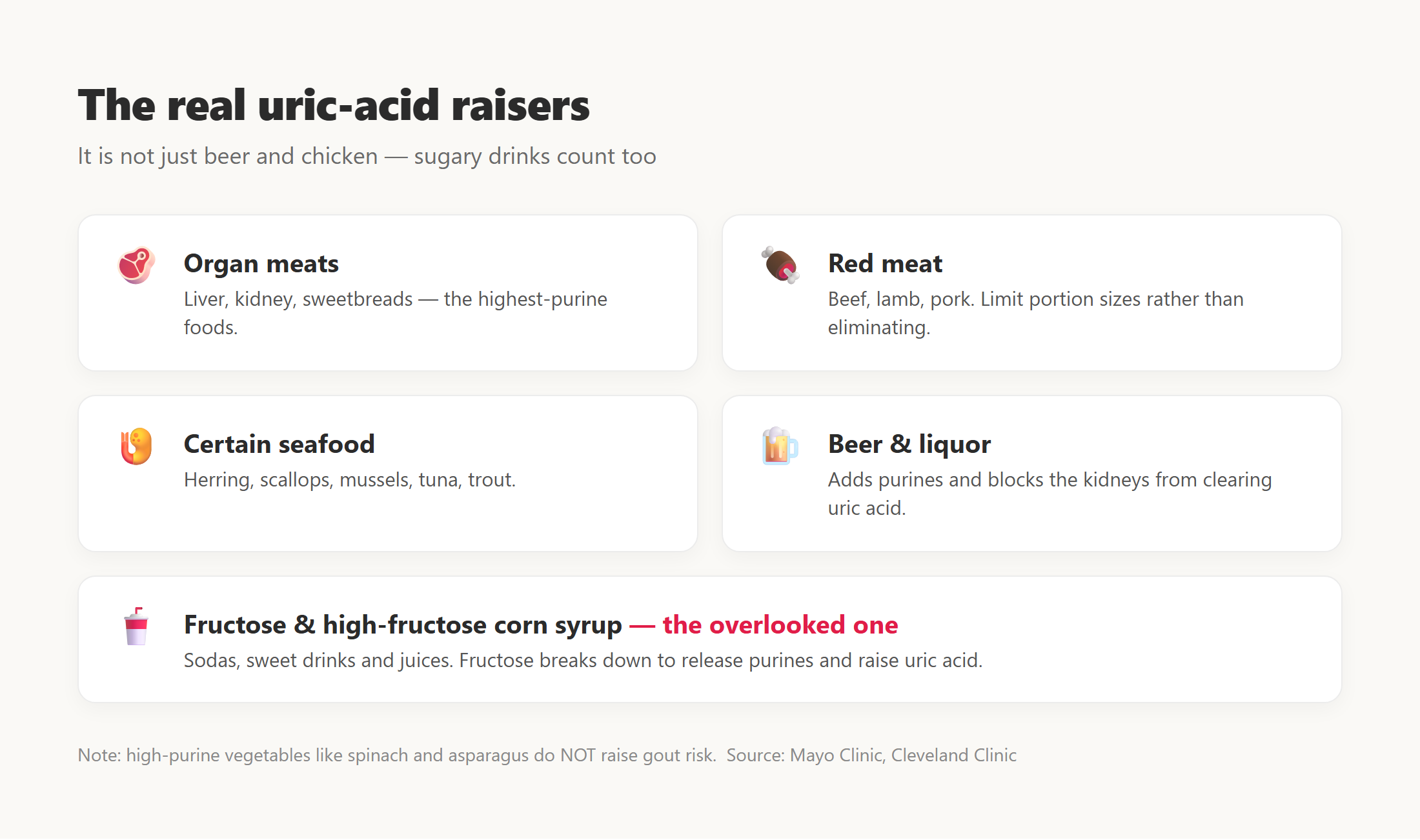
And one reassuring surprise: high-purine vegetables do not count. Studies show that vegetables like asparagus and spinach — high in purines on paper — do not increase gout risk or recurring attacks. Plant purines simply behave differently in the body. So you can stop worrying about your spinach.
Water helps — within limits
Since your kidneys clear uric acid through urine, staying well hydrated is a genuinely useful habit. Cleveland Clinic notes that people who drink five to eight glasses of water a day are less likely to experience gout symptoms.

Photo: cottonbro studio / Pexels
I like water as advice because it is simple, free, and hard to overdo. But I want to be careful here, because this is exactly where most gout articles go wrong. They stack up the diet tips — drink water, cut beer, limit meat — and quietly imply that this is the whole treatment.
It is not. And that brings me to the part that actually matters most.
The honest correction: diet alone will not fix recurring gout
Here is the sentence I wish more articles said plainly.
Diet and hydration are helpers, not a cure.
Mayo Clinic puts it directly: changing your diet is not a cure for gout. Cleveland Clinic is just as blunt — diet “may move the needle a little” on uric acid, but “not as much as medications do.” The best approach is medication combined with sensible eating.
So what does real treatment look like? For someone with recurring flares — the American College of Rheumatology’s 2020 guideline recommends starting urate-lowering therapy (ULT) when you have two or more flares a year, visible tophi (lumps of urate under the skin), or joint damage on X-ray.
- The preferred first-line medication is allopurinol — it is effective, inexpensive, and safe even for people with kidney disease. Febuxostat is an alternative.
- Treatment is guided by blood tests, aiming for a serum urate below 6 mg/dL — the “treat-to-target” number.
- When you first start the medication, doctors typically add an anti-inflammatory (like colchicine or an NSAID) for 3 to 6 months, because starting ULT can briefly trigger flares before it settles things down.

And an acute attack — the 2 a.m. fire — is its own thing. That needs anti-inflammatory treatment directed by a clinician (colchicine, NSAIDs, or a short course of steroids). Those medicines calm the attack; they do not lower the underlying uric acid. Both jobs matter, and they are different.
The takeaway is not “give up on diet.” Cutting fructose, easing off alcohol, limiting high-purine meats, and drinking water are all worth doing. They just work best as the supporting cast — not the whole show.
When to see a doctor
If you have had more than one gout attack, or a blood test has flagged high uric acid, that is the signal to have a real conversation with a doctor rather than managing it with willpower and water alone. Recurring flares slowly damage the joint, and that damage does not undo itself.

Photo: RDNE Stock project / Pexels
Also worth mentioning to your doctor: some common medications, like certain diuretics for blood pressure, can raise uric acid. That is a reason to review your prescriptions with a professional — not to stop anything on your own.
The short version
If I had to compress all of this into a few lines, it would be this.
Gout is sharp uric-acid crystals in the joint, and the pain is as bad as people say. The diet story is bigger than beer and meat — sugary, high-fructose drinks are a real and overlooked trigger, while your spinach is fine. Water and smarter eating genuinely help. But if the flares keep coming back, the thing that actually controls it is urate-lowering medication, aimed at a uric acid under 6 — with diet as the supporting habit, not the cure.
That midnight fire is your body asking for a proper plan, not just a smaller beer.
Because the second flare is easier to prevent than to sit through.
References
- Cleveland Clinic — “Gout (Low-Purine) Diet” and “Gout: What It Is, Symptoms & Treatment”
- Mayo Clinic — “Gout diet: What’s allowed, what’s not”
- American College of Rheumatology — 2020 Guideline for the Management of Gout (allopurinol first-line, treat-to-target <6 mg/dL, flare prophylaxis)
- StatPearls / NCBI — Gout (definition, symptoms, hyperuricemia thresholds)
- CDC / Arthritis Foundation — Gout overview and diet dos and don’ts