Parkinson’s Early Signs and How It’s Actually Diagnosed
I want to start with the thing I got backwards.
For about a year, I watched my father’s right hand shake when it was resting on the arm of his chair. I also noticed he’d started taking smaller steps — shorter, shuffling, a half-beat behind everyone else on the sidewalk. And in my head I had already written the whole story: the tremor was the disease, and if we caught it early enough, a pill would slow it down.
Both halves of that were wrong.
Parkinson’s early signs are not primarily about tremor, and starting medication earlier does not slow the disease. Those are two of the most common misunderstandings about this condition, and both of them come from the same place — the picture of Parkinson’s most of us carry in our heads, which is basically a shaking hand.
So this article is the version I wish I’d read first. What Parkinson’s actually is, which early signs matter and which ones get written off as aging, why most tremor in older adults turns out to be something else entirely, how the diagnosis is really made, and what the evidence says about when treatment should begin.
Photo: Liliana Drew / Pexels
What Parkinson’s disease actually is
Parkinson’s is a progressive movement disorder caused by the gradual deterioration of dopamine-producing brain cells, which impairs the brain’s ability to regulate movement. The NHS puts it plainly: it is caused by a loss of nerve cells in a part of the brain called the substantia nigra.
In the most common idiopathic form, an abnormally folded protein called alpha-synuclein accumulates into clumps known as Lewy bodies, which damage brain cells. The cause is unknown — the NHS attributes it to “a combination of genetic and environmental factors.”
But here is the part that matters for spotting it early.
Parkinson’s is not only a movement disease. It is a whole-body condition that also involves smell, the gut, sleep, mood and blood pressure. That is exactly why the early signs get missed — they don’t all look like a movement problem.
One more thing worth saying out loud, because it’s usually the first fear in the room. Cleveland Clinic notes that Parkinson’s “isn’t usually fatal on its own. It’s a long-term condition that slowly gets worse.” Life expectancy varies with age at diagnosis, overall health, and how well someone responds to treatment.
For scale: a Parkinson’s Foundation-led incidence study published in 2022 (analyzing 2012 data across five epidemiological datasets) found that nearly 90,000 Americans are diagnosed each year — a 50% increase over the older 60,000 estimate. Roughly 1 to 1.5 million Americans are living with it, and a 2018 projection put US prevalence at 1.2 million by 2030. Those figures rest on older data, so read them as a floor rather than a current headcount.
The early sign that isn’t tremor
Here’s the correction that changed how I read my father’s symptoms.
Under the MDS clinical diagnostic criteria (2015) — the global standard, published by the Movement Disorder Society — the first step is establishing parkinsonism, defined as bradykinesia, in combination with at least one of rest tremor or rigidity.
Bradykinesia is the required feature. Tremor is not.
Bradykinesia means slowness of movement with decrement — movements that are slow and that shrink as they repeat. A neurologist tests it by watching finger tapping, hand opening and closing, and toe tapping, looking for the amplitude to shrink and the speed to drop over repetitions.
No bradykinesia, no parkinsonism. That is the single most important correction to a tremor-centric view.
And in daily life, bradykinesia is precisely the thing families blame on age:
- Buttons and zippers taking noticeably longer
- Micrographia — handwriting that shrinks and crowds together
- Walking that slows, with shorter steps
- Masked face (hypomimia) — a less expressive face, read by everyone as “he seems down”
- A softer, breathier voice (hypophonia)

Rest tremor — real, but not required
When Parkinson’s tremor does appear, it has a specific signature. It is a moderate-frequency, low-to-moderate-amplitude resting tremor, typically 4–6 Hz, often described as “pill-rolling.” It occurs in a body part that is not being voluntarily used and is fully supported against gravity, and it usually vanishes the moment movement starts. It generally begins on one side and spreads later.
Roughly 70–80% of people with Parkinson’s experience tremor at some point (one commonly cited breakdown is about 69% at onset and 75% over the disease course). Which means the number worth remembering is the other one:
About 25–30% never develop a prominent tremor at all — the akinetic-rigid subtype.
Rigidity and posture
Rigidity is increased muscle tone, classically with a ratchet-like “cogwheeling” quality when a clinician passively moves the limb. Patients often experience it as stiffness or an aching shoulder that never behaves like a normal orthopedic problem.
The specific things my father showed — a reduced arm swing on one side and short, shuffling steps — are both well documented. The Parkinson’s Foundation lists reduced arm swing and “feet feeling stuck to the floor” among its early signs, along with stooped or hunched posture. A reduced arm swing on one side is very often the first thing a spouse notices.

Photo: Caleb Oquendo / Pexels
Postural instability — balance impairment — is also a cardinal sign, but with an important caveat: in true Parkinson’s it is a late feature. Prominent balance loss and falls in the first one to three years is a red flag pointing elsewhere. More on that below.
The signs that show up years before
This is the part almost nobody knows.
A prodromal phase precedes motor diagnosis by roughly 5 to more than 20 years. During that stretch, the neurodegeneration is underway but the classic motor picture isn’t diagnosable yet.
The strongest known prodromal marker is REM sleep behavior disorder (RBD) — acting out dreams. Shouting, punching, kicking during sleep, because the muscle paralysis that normally accompanies REM sleep fails.
The numbers here are striking. In the largest study ever performed in isolated RBD — a multicentre analysis pooling prospective follow-up from 24 centres of the International RBD Study Group (Postuma et al., Brain, 2019) — isolated RBD converted to a defined neurodegenerative disease (Parkinson’s, dementia with Lewy bodies, or multiple system atrophy) at about 6.25% per year. In that cohort, 74% of RBD participants met MDS criteria for probable prodromal Parkinson’s, versus 0.3% of controls. They also had worse constipation and markedly reduced sense of smell.
Other prodromal features include hyposmia (reduced sense of smell), constipation, depression and anxiety, subtle cognitive changes (which may precede diagnosis by up to about five years), and orthostatic dizziness.
Now the guardrail, and I want to be blunt about it.
Constipation is common. A dulled sense of smell is common. Occasional bad sleep is universal. None of these on their own means Parkinson’s. The signal isn’t any single item — it’s a persistent cluster of them alongside a motor change. And specifically dream-enactment behavior, which is genuinely uncommon and worth reporting to a doctor.
Ten early signs, and what else causes each one
The Parkinson’s Foundation publishes ten early warning signs, and to its credit it pairs each one with its innocent mimic. This table is the honest version of a symptom checklist.
| Early sign | What it looks like | What else can cause it |
|---|---|---|
| Tremor | Shaking while at rest | Exercise, stress, injury, medications |
| Small handwriting | Writing shrinks and crowds together | Stiff hands, poor vision, aging |
| Loss of smell | Trouble smelling bananas, pickles, licorice | Colds, flu, congestion — but these return |
| Trouble sleeping | Sudden movements during sleep | Occasional tossing and hypnic jerks are normal |
| Trouble moving or walking | Limb stiffness, reduced arm swing, feet feeling stuck | Injury, arthritis |
| Constipation | Straining daily for bowel movements | Diet, low fiber, pain medications |
| Soft or low voice | Voice becomes breathy, hoarse, softer | Colds and viruses — temporary |
| Masked face | Looking serious or angry regardless of mood | Some medications |
| Dizziness or fainting | Dizziness on standing, low blood pressure | Occasional standing dizziness is normal |
| Stooping or hunching | Posture noticeably bent | Injury, illness, bone problems |
The Foundation’s own framing is the right one: no single sign means you have Parkinson’s, but more than one should prompt a conversation with a doctor.
Why most tremor in older adults isn’t Parkinson’s
If you take one practical thing from this article, take this section.
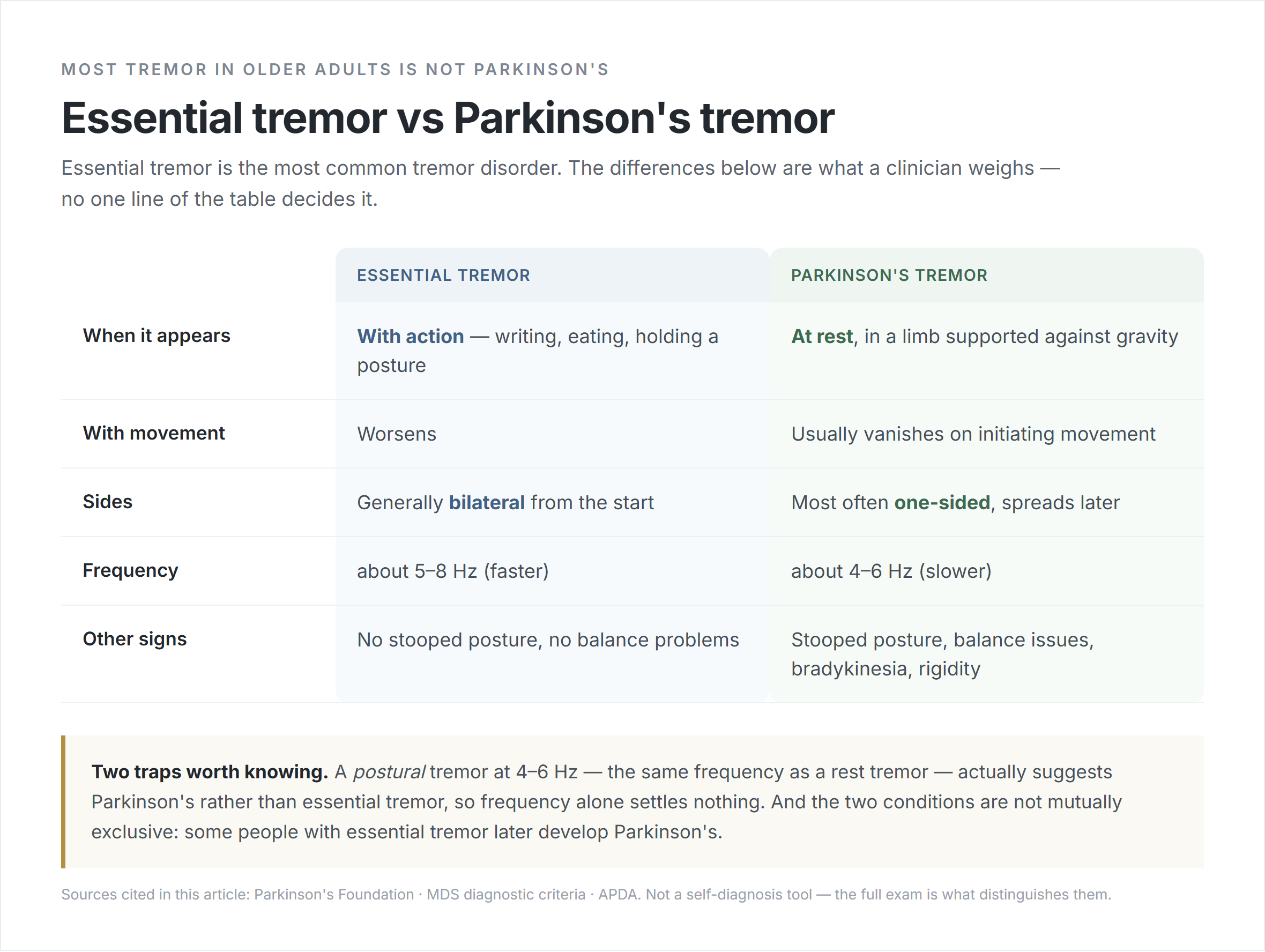
Essential tremor — the most common tremor disorder
| Essential tremor | Parkinson’s tremor | |
|---|---|---|
| When it appears | With action — writing, eating, holding a posture | At rest, supported against gravity |
| With movement | Worsens | Usually vanishes on initiating movement |
| Sides | Generally bilateral from the start | Most often one-sided, spreads later |
| Frequency | ~5–8 Hz (faster) | ~4–6 Hz (slower) |
| Other signs | No stooped posture, no balance problems | Stooped posture, balance issues, bradykinesia, rigidity |
There is a trap in here, though, and it’s worth knowing so nobody self-diagnoses off a table. A postural tremor at 4–6 Hz — the same frequency as a rest tremor — actually suggests Parkinson’s rather than essential tremor. Frequency alone doesn’t settle anything. The full exam does. And the two conditions aren’t mutually exclusive; some people with essential tremor later develop Parkinson’s, which is an active research question.
Drug-induced parkinsonism — the miss that’s actually fixable
This is the one I’d never heard of, and it may be the most useful paragraph here.
Drug-induced parkinsonism is the second most common cause of parkinsonian syndromes in older adults, after idiopathic Parkinson’s — accounting for roughly 15–25% of all parkinsonism in this age group.
The mechanism is dopamine D2 receptor blockade, most often from antipsychotics. Metoclopramide (Reglan — prescribed for nausea, gastroparesis and vertigo) carries an intermediate-to-high risk. Other dopamine-blocking and dopamine-depleting agents apply too.
It is often reversible once the offending drug is stopped — though in up to 25% of cases symptoms persist afterward, and in some of those an underlying Parkinson’s was simply being unmasked. Under MDS criteria, treatment with a dopamine receptor blocker in a temporal pattern consistent with drug-induced parkinsonism is an absolute exclusion for a Parkinson’s diagnosis.
So here is the concrete action item: bring a complete medication list to the appointment — including anti-nausea drugs and older antipsychotics. Not the ones you remember. All of them.

Photo: Towfiqu barbhuiya / Pexels
And sometimes it really is just aging
Aging alone produces slower gait, shorter stride, stiffer joints and some postural change. What distinguishes Parkinson’s is the pattern: asymmetry (one side clearly worse), progression over months, decrement on repetitive movement, and clustering with non-motor signs like smell loss, dream enactment and constipation.
Vascular parkinsonism (symmetric, lower-body predominant), normal pressure hydrocephalus, and enhanced physiologic tremor also sit in this differential.
How Parkinson’s is actually diagnosed
Cleveland Clinic states it directly: “There isn’t one single test that can confirm it.”
The Movement Disorder Society’s position is that Parkinson’s diagnosis is fundamentally clinical — it “requires sufficient training in neurology” and relies on “appropriate history taking and skilled neurological examination.” The MDS criteria run in two steps: establish parkinsonism (bradykinesia plus rest tremor and/or rigidity), then assign certainty as Clinically Established or Clinically Probable based on supportive criteria, absolute exclusion criteria, and red flags.
MDS also states plainly that “there is no reliable scientific evidence to support the use of blood tests or EEG as diagnostic tests.” The only laboratory finding included as a supportive criterion is cardiac sympathetic denervation on MIBG scintigraphy. Everything else supportive is clinical — a clear dramatic response to dopaminergic therapy, levodopa-induced dyskinesia, documented rest tremor, olfactory loss.
Where DaTscan helps — and where it doesn’t
A DaTscan measures the availability of the presynaptic dopamine transporter, which is depleted in Parkinson’s.
What it’s good for: its principal use is to rule out other causes of tremor. It reliably separates degenerative parkinsonism from essential tremor, vascular parkinsonism, and drug-induced parkinsonism — all of which produce a normal scan. A large European multicenter study reported mean sensitivity of 79% and specificity of 97% against clinical diagnosis; other studies report 87–98% sensitivity. One 2024 autopsy-comparison study reported 100% sensitivity and 100% negative predictive value, which is a striking single-study result rather than a universal property of the test. Consistently, MDS treats normal presynaptic dopaminergic imaging as an absolute exclusion for Parkinson’s.
What it can’t do: it cannot distinguish Parkinson’s from atypical parkinsonism. An abnormal DaTscan shows up in Parkinson’s, MSA, PSP, corticobasal syndrome and some dementias alike. It is not a screening test, and it doesn’t establish severity or prognosis on its own.
How accurate is the clinical diagnosis, honestly?
Not as accurate as people assume — and this is the argument for seeing the right specialist.
A meta-analysis of 20 studies put pooled diagnostic accuracy at 80.6%; other meta-analyses land between 73.8% and 79.6%. Broken down by who’s doing the diagnosing: movement disorder specialists report accuracy up to about 99% in tertiary settings, while nearly 24% of Parkinson’s diagnoses by general neurologists were incorrect at autopsy, and community primary care misdiagnoses it roughly 47% of the time.
Accuracy is worst in early disease — exactly when people most want an answer.
Two takeaways follow. If the diagnosis matters, and it does, seek a movement disorder specialist. And understand that a diagnosis may legitimately be revised over time.
The biomarker research — promising, not orderable
There has been real progress here, and it deserves an honest label.
In 2023, PPMI data validated an alpha-synuclein seed amplification assay (αSyn-SAA), allowing scientists for the first time to detect Parkinson’s pathology in living people. CSF αSyn-SAA showed 87.7% sensitivity and 96.3% specificity versus healthy controls in a three-lab study; a systematic review and network meta-analysis found overall 86% sensitivity and 92% specificity. Skin-based SAA reached 0.89 sensitivity, and one modified assay reported 92.46% sensitivity and 93.33% specificity across 332 patients and 285 controls. A related research framework, the NSD-ISS (Neuronal alpha-Synuclein Disease Integrated Staging System), stages disease by biology rather than symptoms.
Now the caveat that has to travel with all of that.
The MDS diagnostic position paper does not include SAA among accepted diagnostic criteria, and NSD-ISS is explicitly a research framework. These are not routine clinical screening tests, they are not universally available or covered, and a positive result in someone without symptoms is not a Parkinson’s diagnosis and not a reason to start treatment — because there is currently no proven disease-modifying therapy to offer. This is where the science is heading. It is not something to go ask for.
When should treatment start?
This is where my original assumption fell apart most completely, and where I’ve seen families swing from one error straight into the opposite one.
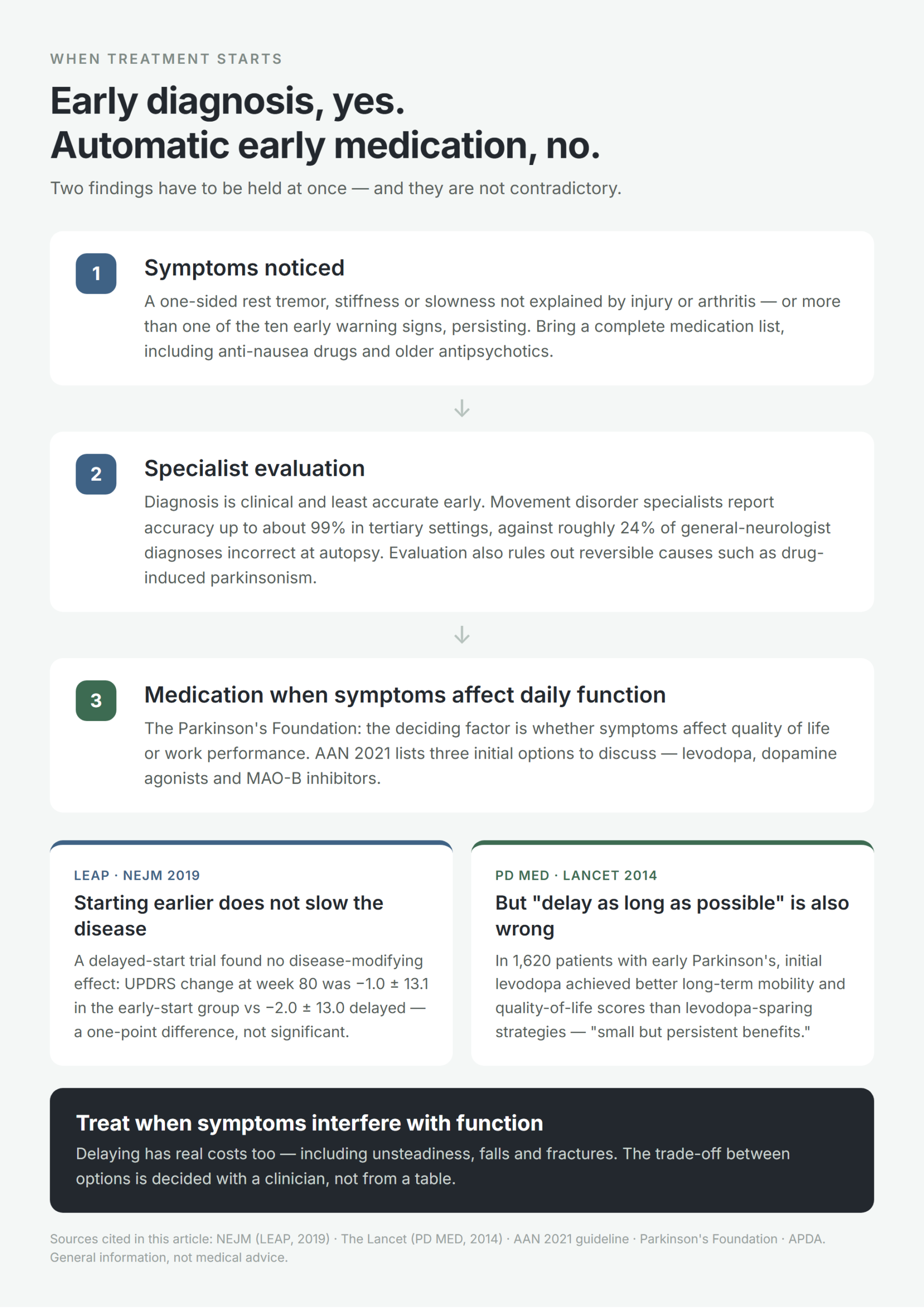
Early levodopa does not slow the disease
The LEAP trial (NEJM, January 2019) was a multicenter, double-blind, placebo-controlled delayed-start study. One group received levodopa/carbidopa for 80 weeks; the other received placebo for 40 weeks, then levodopa/carbidopa for 40 weeks.
The result: no disease-modifying effect. UPDRS change from baseline to week 80 was −1.0 ± 13.1 points in the early-start group versus −2.0 ± 13.0 in the delayed-start group — a one-point difference, not significant. Commentary at the time summarized it bluntly: the trial addressed whether levodopa might be neuroprotective, and it is not. A long-term follow-up published in 2024 continued the comparison.
So “catch it early and start medication because early is better for the disease” is not supported. Starting earlier treats symptoms earlier. It does not slow the underlying condition.
But “delay levodopa as long as possible” is also wrong
Here’s where people over-correct, and it costs them.
PD MED (Lancet, 2014) — a large pragmatic randomized trial of 1,620 patients with early Parkinson’s, assigned to initial levodopa (528), a dopamine agonist (632), or an MAO-B inhibitor (460) — found that levodopa achieved better long-term mobility and quality-of-life scores than the levodopa-sparing strategies. “Small but persistent benefits from initial therapy with levodopa,” in the authors’ words.
The APDA’s “Five Myths About Levodopa” takes the fear on directly:
- Myth: delay levodopa to prevent motor fluctuations. The onset of motor fluctuations and dyskinesias “has to do with how long you’ve had the disease and not with how long you have been taking levodopa.”
- Myth: levodopa stops working. A higher dose over time “does not mean that the medication is no longer working; it means that the disease is changing.”
- Myth: levodopa is toxic. It “has been shown to increase life expectancy in people with PD, which strongly argues that levodopa does not accelerate the disease.”
The Parkinson’s Foundation adds that Sinemet and other Parkinson’s therapies “have not been shown to be toxic or to accelerate disease progression.”
So what’s the actual rule?
Treat when symptoms interfere with function.
The Parkinson’s Foundation: “The most important factor in initiating medications for an individual patient is whether Parkinson’s symptoms are affecting quality of life, or alternatively whether symptoms are affecting work performance.” And: “Most experts agree that there is no benefit to delaying medication therapy if bothersome symptoms appear, and there may be risks in delaying treatment, especially if a treatment delay results in unsteadiness, falls, and fractures.”
Both halves have to be held at once, and they are not contradictory:
Earlier medication does not slow the disease. But once symptoms genuinely interfere with daily life, delaying has real costs.
Note also that early diagnosis and early medication are different things. Getting diagnosed early is genuinely valuable — it rules out reversible causes like drug-induced parkinsonism, gets you to the right specialist, and starts exercise and monitoring. That is not the same as reaching for a prescription on day one.
As for what the options are: the AAN’s 2021 guideline (published in Neurology, November 2021) recommends that neurologists counsel people with early Parkinson’s on three initial options — levodopa, dopamine agonists, and MAO-B inhibitors. Initial levodopa provides superior motor benefit but is more likely than agonists to cause dyskinesia; dopamine agonists carry a higher risk of impulse control disorders (compulsive gambling, shopping, eating, hypersexuality), which is a critical thing to be told about in advance. Dyskinesia estimates vary widely across sources — roughly 30% by three years, around 60% by five years, up to about 80% long-term — and risk is tied to total dose, rate of escalation, and duration of disease, which is why the practice is lowest effective dose escalated gradually.
That is a trade-off to be decided with a clinician, not from a table on the internet.
Exercise and falls — the part you can start now
Exercise is the single best-evidenced non-drug intervention. The Parkinson’s Foundation’s Parkinson’s Outcomes Project found that people with Parkinson’s who start exercising earlier in the disease course, for a minimum of 2.5 hours per week, experience a slowed decline in quality of life.
The Foundation recommends four components: aerobic activity, strength training, balance/agility/multitasking, and flexibility. Programs with evidence or wide use include non-contact boxing, treadmill training with body-weight support, tai chi, yoga, dance (tango showed benefit for motor symptoms and balance), and resistance training. Reported benefits span gait, balance, tremor, flexibility, grip strength and motor coordination, with potential benefit for cognition, depression and fatigue.
One caution I’d rather state than skip: whether exercise slows the underlying disease is still unproven at the phase 3 level. SPARX3, the phase 3 trial designed to answer exactly that question with high-intensity treadmill training, had an expected completion around mid-2025, and its final results are not yet confirmed. So the honest claim is that exercise is well supported for preserving function and quality of life — not that it is proven to slow progression.
On falls: between 45% and 68% of people with Parkinson’s fall annually, and 50–86% fall recurrently. Interventions with support include multisystem balance training, perturbation-based balance training, cognitive and dual-task training, treadmill training with cueing, and obstacle avoidance training. The recommended approach is supervised programs that challenge balance and impose cognitive demands. Evidence for fall prevention specifically is less definitive than evidence for exercise generally — the field openly describes “guidelines and gaps.”
And before starting anything: the Foundation advises seeing a physical therapist first for a full functional evaluation and recommendations.

Photo: Wellness Gallery Catalyst Foundation / Pexels
Red flags that point somewhere else
Atypical parkinsonian syndromes — PSP, MSA, corticobasal degeneration, dementia with Lewy bodies — can look like Parkinson’s early on, but progress faster and respond poorly to Parkinson’s medications. Any of the following should prompt a neurologist referral:
- Rapid progression of motor symptoms
- Poor or absent response to dopaminergic therapy (absent response to high-dose levodopa is an absolute exclusion for Parkinson’s)
- Early falls — frequent falls within the first few years points toward PSP
- Eye-movement abnormalities — downward vertical supranuclear gaze palsy or selective slowing of downward saccades (PSP; an absolute exclusion for Parkinson’s)
- Early, prominent autonomic failure — orthostatic hypotension, urinary incontinence, erectile failure. Early severe autonomic dysfunction is the most striking characteristic of MSA
- Cerebellar signs or pyramidal signs
- Early cognitive impairment or hallucinations (dementia with Lewy bodies)
- Cortical sensory loss, limb apraxia, or progressive aphasia (corticobasal degeneration)
- Symmetric presentation, or parkinsonism confined to the legs for more than three years
When to get evaluated
- A persistent, one-sided rest tremor, stiffness, or slowness not explained by injury or arthritis
- More than one of the ten early warning signs, persisting
- Dream-enactment behavior during sleep — shouting, punching, falling out of bed
- Any red flag above — promptly
- And bring that complete medication list
Ask for a movement disorder specialist if you can get one. The accuracy numbers above are the entire reason why.
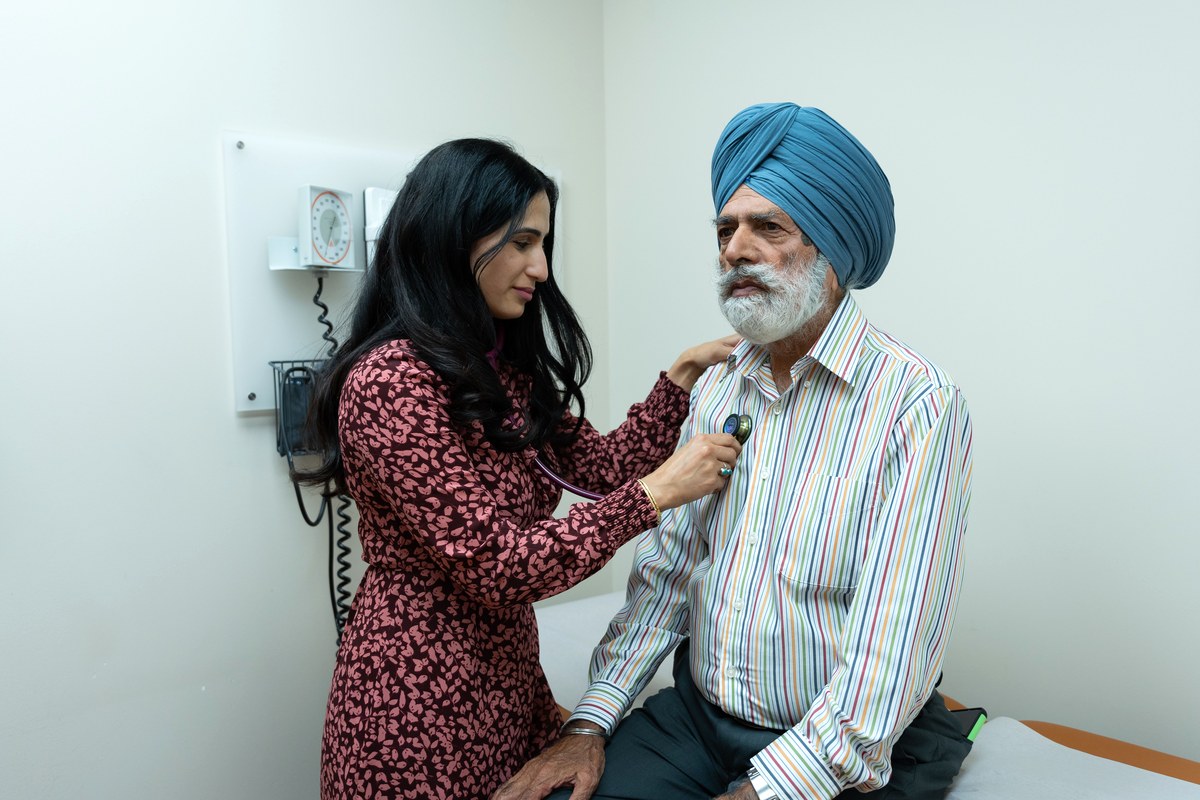
Photo: World Sikh Organization of Canada / Pexels
What I’d tell myself a year ago
If you’re the adult child in this story — the one who noticed the hand, or the arm that stopped swinging, or the steps that got shorter — here’s the short version.
The tremor is not the test. Slowness with decrement is. Most shaking in older adults turns out to be essential tremor or a medication effect, and the medication kind is often reversible, which is reason enough to bring the pill bottles and get looked at. Diagnosis is clinical, it’s least accurate early, and the specialist matters.
And when it comes to treatment — early diagnosis, yes. Automatic early medication, no. The trigger is functional impact, decided with a neurologist. Once symptoms genuinely get in the way, don’t stall out of fear of levodopa.
I spent a year quietly watching a hand shake and thinking that was the thing to watch. It wasn’t. The thing to watch was everything around it — and the sooner someone qualified looks at all of it together, the fewer wrong stories the rest of us have to tell ourselves.
Related reading: Osteoporosis and fall prevention for aging parents · Normal forgetfulness vs. dementia: free screening options
Medical disclaimer. This article is general health information, not medical advice, and it is not a diagnostic tool. Do not diagnose Parkinson’s disease — in yourself or a family member — from a symptom list. Do not start, stop, or change any medication without your clinician. If you’re concerned about the signs described here, see a doctor, ideally a neurologist or movement disorder specialist, for a proper evaluation. Seek prompt medical care for falls, fainting, or rapid deterioration.
References
- Parkinson’s Foundation — 10 Early Warning Signs; Prevalence & Incidence (2022 publication, 2012 data); Exercise; When should you start medication therapy
- Movement Disorder Society — MDS Position Paper on Diagnosis of Parkinson’s Disease; MDS Clinical Diagnostic Criteria (Postuma et al., 2015)
- NEJM (2019) — Randomized Delayed-Start Trial of Levodopa in Parkinson’s Disease (LEAP); Movement Disorders (2024) long-term follow-up
- The Lancet (2014) — PD MED trial
- American Academy of Neurology (2021) — Dopaminergic Therapy for Motor Symptoms in Early Parkinson Disease
- APDA — Five Myths About Levodopa; Diagnosing Parkinson’s Disease
- Brain (2019), Postuma et al. — Risk and predictors of dementia and parkinsonism in idiopathic REM sleep behaviour disorder
- Cleveland Clinic — Parkinson’s Disease: An Overview; NHS UK — Parkinson’s disease
- Michael J. Fox Foundation / PPMI (2023) — alpha-synuclein seed amplification assay; NSD-ISS research staging framework