
BPPV Vertigo at Home: What’s Safe and When to Call 911
Waking up, turning your head, and the ceiling spins — how to tell the loose crystals in your ear from the kind of dizziness that needs 911
Let me name the thing you are probably actually thinking.
You want to sort this out at home. You would like to know what this is, try whatever fixes it, and not spend six hours in an emergency-room waiting room over a spinning spell that was finished in forty seconds. Odds are decent that spell was BPPV — benign paroxysmal positional vertigo, the most common cause of vertigo there is. So that wish is reasonable. I have had it myself.
It is also the exact order of operations that gets people hurt.
Because the first question is not “how do I fix this.” It is “am I certain this is coming from my ear?” — and for a meaningful number of people who feel precisely what you are feeling right now, the answer turns out to be no. Which is why the emergency list in this article comes before anything about home care. That is deliberate, and the numbers behind it are in the very next section.
Now, the part where I was wrong.
If you had asked me about this a year ago, I would have given you a confident three-part answer. The little crystals in your inner ear’s balance canals slip out of place. You lie still and rest until it settles. Then you see an ENT for the Epley maneuver.
Three parts. Almost none of it survives contact with the actual guideline.
The crystals do not live in the balance canals. “Lie still and rest” is the opposite of what the US guideline says. And an ENT is not the front door for this in the United States.
The short version, because you probably came here mid-spin and do not want to scroll: BPPV is a brief, position-triggered spin, not a constant one. It is treatable, often in a single visit. But a specific set of symptoms means the spinning is not coming from your ear at all — and telling those two apart is the whole job of this page.
Before anything else. This article is general health information, not medical advice. It cannot diagnose your dizziness. Vertigo has both harmless and life-threatening causes, and they can feel very similar from the inside. If you have any of the emergency symptoms listed below, call 911 immediately. Otherwise, talk to a licensed clinician before trying any repositioning maneuver at home.
Photo: kaboompics.com / Pexels
Why the emergency list comes first
The honest reason is a set of numbers I did not expect.
Of everyone who arrives at a US emergency department acutely dizzy, roughly 3 to 5% turn out to have an ischemic stroke. Narrow it to people with acute vestibular syndrome — continuous, non-positional vertigo with nystagmus lasting hours to days — and it is about 25%. One in four.
And these get missed. About 35% of vertebrobasilar strokes that show up as dizziness are misdiagnosed at first contact. Other series put missed posterior-circulation stroke at first presentation around 20 to 25%.
Two details make it worse.
Most central cases do not look neurological. 66% of patients with a central cause of acute vestibular syndrome showed no obvious focal neurologic signs — no droop, no weak arm, nothing to point at. That is the strongest single argument against “if it’s only dizziness, it’s probably my ears.”
And young people are missed most. Stroke patients aged 18 to 44 are roughly seven times more likely to be misdiagnosed than those 75 and older. “Too young for a stroke” is a documented failure mode, not a reassurance.
So no, I am not going to open with a blanket reassurance and a maneuver. Most positional vertigo is benign — but a specific set of symptoms means stop and call 911. That list is next.
When to seek care: the three tiers
Read this block before you read anything else on the page. It is the part that matters most.
Tier 1 — Call 911 or go to the ER now. Do not drive yourself.
Any one of these, together with dizziness or vertigo:
- Sudden weakness or numbness in the face, arm, or leg — especially on one side
- Slurred speech, trouble speaking, or trouble understanding speech
- Double vision, or sudden loss of vision
- Facial droop
- You cannot walk, stand, or sit upright unassisted — severe imbalance. Inability to stand or sit without help is reported as about 99.1% specific for a central cause. This one alone is a 911 call.
- Sudden severe headache with no known cause
- New neck pain or back-of-the-head pain arriving with the vertigo
- Vertigo that is constant and does not stop when you hold still, lasting hours — as opposed to brief spells triggered by moving
- New hearing loss in one ear along with acute vertigo
- Fainting, chest pain, or shortness of breath with the dizziness
- Confusion, drowsiness, or altered consciousness
- Vertigo after a head injury or after a neck manipulation
- New, severe, unlike-anything-before vertigo in someone with stroke risk factors — high blood pressure, atrial fibrillation, diabetes, smoking, prior stroke or TIA. And again: being young does not exclude stroke.
The CDC’s stroke signs use the mnemonic B.E. F.A.S.T. — Balance, Eyes, Face, Arms, Speech, Time. Balance and eyes are in there for exactly this reason.
CDC’s timing language is blunt: every minute counts, and the most effective stroke treatments are available only if stroke is recognized and diagnosed within 3 hours of the first symptoms. Call 911 rather than driving yourself, so treatment can begin on the way.
Tier 2 — Same-day or next-available visit (primary care or urgent care)
- Your first-ever episode of positional vertigo. Get the diagnosis confirmed before you treat yourself.
- Vertigo severe enough to cause repeated vomiting, or to stop you keeping fluids down
- You are 65 or older, live alone, have had a fall, or are afraid of falling
- You take blood thinners, or have significant heart or vascular disease
- Symptoms are interfering with work, driving, or caring for someone else
- You have neck problems, spinal disease, or recent neck surgery and were thinking about a home maneuver — get evaluated instead
- You already tried a home maneuver and the symptoms changed character — a different direction of spin, a different trigger. That can mean the crystals moved into a different canal.
- You are not sure which tier you are in. That uncertainty is itself a reason to be seen.
When you call, ask specifically for a Dix-Hallpike test, and ask whether the clinician performs canalith repositioning or can refer you to a vestibular physical therapist.
Tier 3 — Watchful waiting is reasonable, with follow-up
Only when all of these are true:
- BPPV has been previously diagnosed by a clinician, and this feels like the same thing
- Spells are brief — under a minute — and clearly triggered by a change in head position
- No Tier 1 red flags. No hearing change, no fainting, no constant vertigo.
- You can walk safely and have a low fall risk
- You have support at home and can avoid driving during spells
Observation with follow-up is an explicitly guideline-endorsed option. Untreated posterior-canal BPPV settles on its own in a mean of about 39 days, and roughly a third of people remit within three weeks. Keep moving safely — no bed rest, no postural restrictions. And follow up within one month whether or not it resolved.

“My scan was normal” is not the all-clear
This is the part I find hardest to say gently, so I will just say it.
A normal non-contrast head CT does not rule out a stroke in the back of the brain. Its sensitivity for acute stroke is around 28.5%.
Early MRI is better, but not perfect either. In the original HINTS validation cohort, initial diffusion-weighted MRI was falsely negative in 12% of stroke patients, all scanned within 48 hours of onset. Broader reviews put early DWI false negatives at up to about 20% in the first 24 to 48 hours.
So if you were scanned early, sent home, and your symptoms are still doing something that belongs in Tier 1 — the symptoms still matter. Go back. Normal imaging early on does not fully rule out a posterior-circulation stroke.
Photo: Jo McNamara / Pexels
The bedside eye exam you cannot do at home
You may run across HINTS — Head-Impulse, Nystagmus, Test of Skew. It is a three-step eye examination, and in its original validation it was 100% sensitive and 96% specific for stroke in acute vestibular syndrome, outperforming early MRI-DWI in that same cohort, whose sensitivity there was 72%.
Three limits, and all three matter.
It is not a self-test. It requires someone else watching your eyes during a head thrust. There is no at-home version of it, and no version you can do on a family member from a video. Please do not try.
It does not apply to BPPV. HINTS is validated only for continuous vertigo with nystagmus lasting hours to days. BPPV’s pattern is the opposite — triggered, episodic, positional. Applied to an episodic patient, its accuracy drops substantially and the result means nothing.
Even clinicians misapply it. A systematic review concluded that HINTS used in isolation by emergency physicians has not been shown to be accurate enough to rule out stroke. In one emergency-department chart review of dizziness visits, HINTS was documented in only about 7% of cases — and where it was documented, it was interpreted as “peripheral” in a substantial share of patients who had no nystagmus at all, which is a result the test cannot actually produce.
The useful takeaway is a sentence you can say out loud: “My vertigo is constant rather than triggered — can you do the bedside eye examination for that?”
What BPPV actually is — the part almost everyone gets backwards
Now the anatomy, because the common version is wrong, and the wrong version leads people to the wrong mental model.
The crystals — otoconia, calcium carbonate — do not live in your semicircular canals. They normally sit in the utricle, which the American Academy of Otolaryngology–Head and Neck Surgery Foundation describes to patients as the center “pouch” of the inner ear. Resting there, they give your brain information about gravity and straight-line acceleration. That is their job, and that is their home.
BPPV is what happens when some of them come unglued from that pouch and drift into a balance canal where they do not belong.
The canals sense rotation, not gravity. Loose crystals rolling through one make the fluid move when your head tilts, the canal reports a spin that is not happening, and your eyes and brain believe it. Hence the ceiling.
A few specifics worth carrying:
- Most often the crystals float free inside the canal (canalithiasis, about 97.5% of cases). Less often they stick to the sensory cupula (cupulolithiasis, about 2.5%).
- The posterior canal is involved in roughly 60 to 90% of cases — by far the most common. Published series vary a great deal, which is why that is a range and not a tidy number. The lateral (horizontal) canal is next; the anterior canal is rare.
- In a 1,271-patient series, 91.8% were one-sided, and 74.8% had no identifiable cause. Post-traumatic cases accounted for 15%.
- Predisposing factors named in AAO-HNSF’s patient materials: trauma, migraine, other inner-ear problems, diabetes, osteoporosis, and prolonged bed rest — including a strongly preferred sleep side, surgery, or a long illness.
For scale: dizziness accounts for roughly 5.6 million clinic visits a year in the US, and 17 to 42% of people presenting with vertigo are eventually diagnosed with BPPV. Acute dizziness and vertigo make up 2.1 to 4.4% of all ED visits. NIDCD has reported that about 33 million American adults — roughly 1 in 7 — had a balance or dizziness problem, though that figure comes from 2008 data, so treat it as historical scale rather than a current count.

Does this actually match BPPV?
Consistent with BPPV:
- The spin is triggered by a change in head position — rolling over in bed, getting out of bed, looking up at a shelf, bending forward
- Each spell is brief, seconds to about a minute
- Spells repeat over days to weeks, with symptom-free stretches in between
- Nausea is common. Some people vomit; many don’t — vomiting appeared in about 22% of one 640-patient series
- A low-grade wobbliness and motion sensitivity lingers between spells
- It tends to get less bad. AAO-HNSF notes people often report that the very first spinning episode was the worst.
That fifth point is worth pausing on, because it confuses people. The spinning is under a minute. The aftermath is not. Nausea and an off-balance feeling can outlast the spin by a long way — AAO-HNSF puts it as lasting feelings of dizziness and instability, at a lesser level, once the episode has passed. So an hour of queasiness does not rule BPPV in or out. But continuous true spinning for hours is a different animal, and that is Tier 1 territory.
Arguing against BPPV, in the AAO-HNSF’s own words to patients: “BPPV does not cause constant severe dizziness and is usually triggered by movement. BPPV does not affect your hearing or cause you to faint.”
I think that is the most useful self-check on this whole page. Constant. Hearing. Fainting. Any of those three, and whatever this is, the simple explanation no longer covers it.
One exception, running the other way: in older adults, BPPV can show up as plain unsteadiness rather than spinning — on sitting up, looking up, bending, or reaching. So “no spinning” does not rule it out in a senior. Unrecognized BPPV in older adults is linked to reduced quality of life, to depression, and to increased fall risk, and there are published arguments for screening every older adult at risk of falling.
What actually happens at the visit
Diagnosis is a bedside test, not a machine.
The guideline test for posterior-canal BPPV is the Dix-Hallpike maneuver: you are brought from sitting to lying down with your head turned 45 degrees to one side and your neck extended about 20 degrees, affected ear down. The clinician watches your eyes. What confirms it is a torsional, up-beating nystagmus that starts after a short latency, resolves within about a minute, and fatigues on repetition. If the first side is negative, the maneuver is repeated on the other side.
If your history fits but Dix-Hallpike shows horizontal nystagmus or none at all, the next step is a supine roll test, which looks for the lateral-canal version.
Two things the guideline tells clinicians not to do when you meet BPPV criteria and nothing inconsistent is present: do not order radiographic imaging, and do not order vestibular lab testing. AAO-HNSF puts it plainly for patients — normal scans, X-rays, or lab tests cannot confirm BPPV. Atypical features are a different story, and those do justify looking further.
Here is the gap you should know about, though. Only about 4% of patients presenting with dizziness actually get a Dix-Hallpike test. In primary care, most BPPV diagnoses are made from the history alone. The test is simultaneously underused and misapplied — used on patients whose symptoms are not BPPV-like at all, which raises the risk of a central cause being labeled peripheral.
Which is why the single most practical thing in this article may be: ask for it by name. “Can you do a Dix-Hallpike test?” And if the clinic doesn’t do positional testing, ask to be sent to someone who does.
There is money in that question too. AAO-HNSF’s figures put the average diagnostic cost at roughly $2,000 per patient, with more than 65% of patients undergoing potentially unnecessary testing, and a total annual US cost approaching $2 billion. A bedside test that takes a minute is not a lesser version of a scan here. It is the better test.
The guideline says almost the opposite of “rest and stay still”
This is where my old mental model fell apart completely.
The AAO-HNSF 2017 clinical practice guideline — still the current US otolaryngology guideline on BPPV — contains two key action statements that read like a direct rebuttal of common advice:
- KAS 4b: clinicians should not recommend post-procedural postural restrictions after canalith repositioning for posterior-canal BPPV.
- KAS 6: clinicians should not routinely treat BPPV with vestibular suppressant medications such as antihistamines or benzodiazepines.
That second one lands on a very familiar drawer in the American medicine cabinet — meclizine, the over-the-counter motion-sickness antihistamines, and the sedatives often reached for alongside them. Reducing the inappropriate use of vestibular suppressants is listed among the guideline’s own four stated aims. These medications may still be used briefly for severe nausea under a clinician’s direction — but as routine BPPV treatment, guidelines advise against them. If you are unsure what is in that drawer and whether it still belongs there, that is a separate housekeeping job: how to dispose of expired medicines and stock a first aid kit.
And on rest, the AAO-HNSF patient materials are direct: “After your symptoms are slowly going away, it is important to return to normal activities that you can do safely. Exposure to motion and movement will help to speed your healing.” Supporting research points the same way — people who get back to their regular daily physical activity after repositioning report less residual dizziness, not more.
So what is correct at home? Fall prevention, not immobility
Your balance will be off for a while. That is the actual hazard, and AAO-HNSF names it: you need precautions so that you don’t fall, and the risk of injury is higher if you are a senior or already have a balance problem.
- Move slowly and deliberately, especially for the first movement of the day
- Sit on the edge of the bed for a moment before standing
- No ladders, no step stools, no heights while you are having spells
- Clear the trip hazards — cords, loose rugs, the thing left on the stairs
- Do not drive during active vertigo spells
- Arrange help if you live alone, even for a few days
- But do not lie rigidly still for days. That is the part to let go of.

Photo: Curtis Adams / Pexels
Can you just do the Epley yourself?
Sometimes, yes — with a real condition attached.
The guideline’s opening for home maneuvers is KAS 5, which says clinicians may offer vestibular rehabilitation, either self-administered or clinician-led. Note the words: may offer. It is an option, and it is framed as something a clinician offers you — not a green light for an undiagnosed reader to start experimenting.
AAO-HNSF spells out the condition: “You can also be taught to perform these maneuvers by yourself with supervision, which is called ‘self-repositioning.'” Taught. Supervised. After a diagnosis that identified which ear and which canal.
What the evidence says once that condition is met
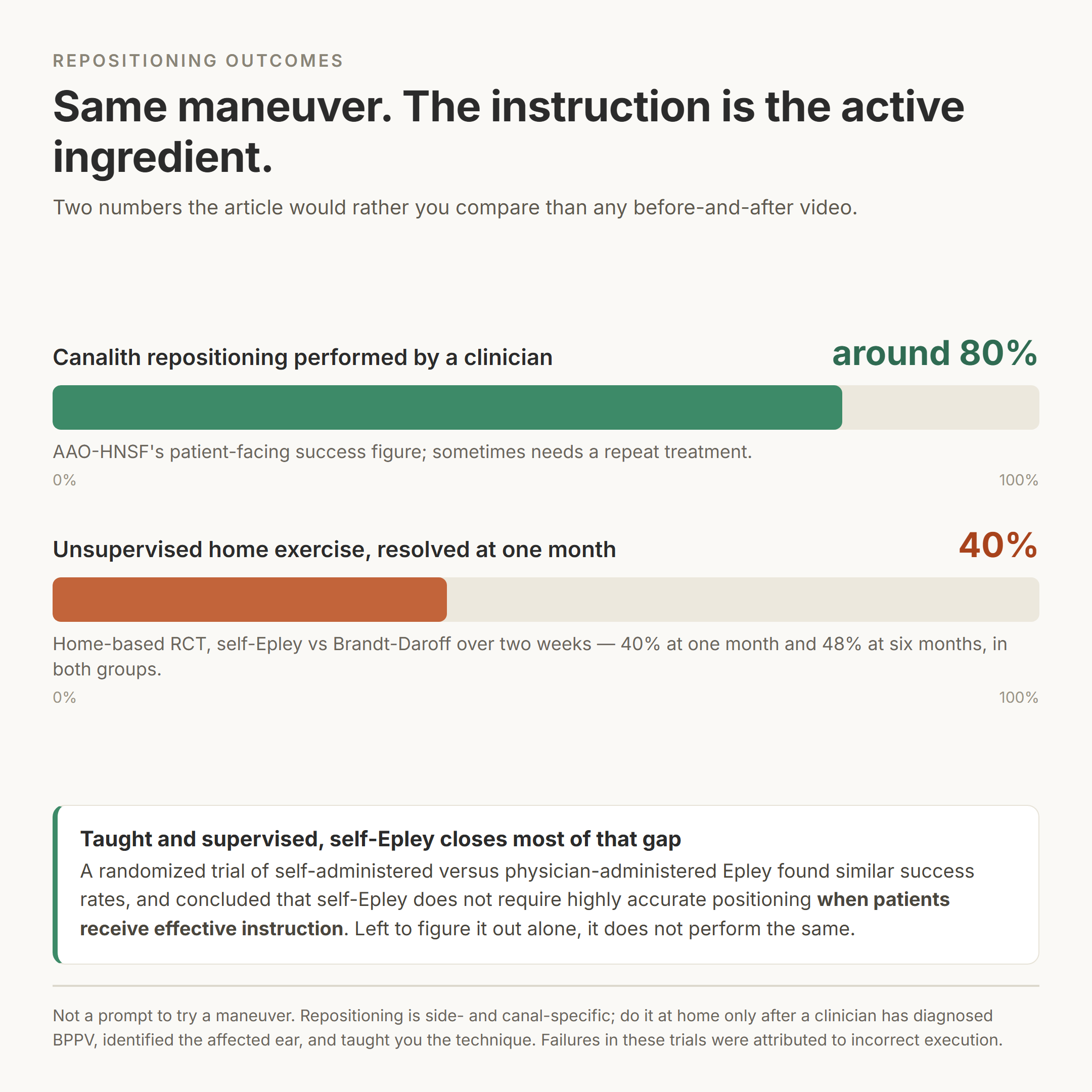
It is genuinely encouraging. A randomized trial comparing self-administered Epley against physician-administered Epley in posterior-canal BPPV found similar success rates, concluding that self-Epley does not require highly accurate positioning to get good results when patients receive effective instruction. A home-based RCT of 155 patients reported resolution in 89.7% at one day for a modified self-Epley versus 75.3% for the standard version, converging to roughly 96% and 92% at one week. The failures were attributed to incorrect execution of the maneuver.
Now the reality check, which is the number I think readers deserve most.
In a home-based RCT comparing self-Epley against Brandt-Daroff exercises over two weeks, only 40% had resolved at one month — and 48% at six months — in both groups. Compare that with the roughly 80% success AAO-HNSF quotes for repositioning performed by a clinician, sometimes needing a repeat treatment.
So: taught properly, self-Epley approaches office results. Left to figure it out alone, it does not. The instruction is the active ingredient.
On Brandt-Daroff specifically: a network meta-analysis of repositioning maneuvers for posterior-canal BPPV ranked Epley highest, significantly better than Sémont, Brandt-Daroff, and control. Head-to-head resolution figures vary enormously between trials, so I won’t quote one — but the direction is consistent across all of them. Brandt-Daroff is a lower-yield fallback, generally used when Epley can’t be done or has already failed.
Do not attempt a home maneuver if any of these apply
- Severe cervical spine disease — stenosis, significant instability, rheumatoid involvement, recent neck surgery or injury, severe neck stiffness or pain
- Suspected vertebrobasilar disease
- Unstable cardiovascular disease
- High-grade carotid stenosis
- Undiagnosed vertigo — meaning no clinician has ever confirmed BPPV and identified which ear and which canal. That is itself a listed contraindication.
- Downbeat, direction-changing, or otherwise atypical nystagmus noted by a clinician, or any Tier 1 red flag
AAO-HNSF adds its own “go to a professional instead” triggers: severe disabling symptoms; being a senior with a history of falls or a fear of falling; or difficulty moving around — joint stiffness, especially neck and back, or weakness.
And the risks, stated plainly
- Immediate falling sensation, nausea, vomiting, faintness, and postural instability that can last up to 24 hours. In one home-treatment trial, 21 to 27% reported nausea, vomiting, or muscle soreness.
- Canal conversion — the crystals migrating into a different canal during the maneuver. Reported at 1.6% to 7.8% across series. In practice this means a home maneuver can change the character of your symptoms rather than resolve them.
- Wrong-side or wrong-canal treatment. The maneuver is side-specific. Guess wrong and you get no benefit, or a worsening.
- Fall injury during the maneuver, especially for an older adult living alone.
Where to actually go, in the United States
“See an ENT” is the instruction I would have given, and it is not how this works here.
The guideline is deliberately specialty-agnostic. KAS 4a reads: clinicians should treat, or refer to a clinician who can treat, posterior-canal BPPV with a canalith repositioning procedure. It was endorsed across physical therapy, audiology, neurology, and emergency medicine. AAO-HNSF’s patient materials name the treating professional as “a health professional — medical provider, audiologist or therapist.”
The realistic pathway:
- Red flags present — 911 or the ER. Not urgent care. Not wait-and-see.
- No red flags, brief triggered spells — primary care or urgent care. Ask for Dix-Hallpike. Many providers will perform the Epley in the same visit; AAO-HNSF notes the maneuvers can be done at the same time as the bedside testing for diagnosis.
- If the clinic doesn’t do positional testing, or symptoms persist — vestibular physical therapy or audiology. Vestibular PT often resolves BPPV in one to three sessions. Many states allow direct access to PT without a physician referral, but this varies by state and by insurer, so check your own rather than assuming.
- ENT (otolaryngology) or neurology for persistent symptoms after repositioning, frequent recurrence, atypical nystagmus, hearing loss, or any suspicion of a central cause. That is KAS 7b — a real and appropriate role. Just not the mandatory first stop.
- Follow-up within one month either way. That is KAS 7a, and it applies whether you were treated or you watched and waited.

Photo: Vitaly Gariev / Pexels
There is a documented gap here worth knowing about. Ambulatory physicians treating BPPV rarely refer to physical therapy, and in one survey a large majority of physicians were unaware of the physiotherapist’s role in vestibular rehabilitation. ENT remains the most preferred specialist referral in survey data — but a preferred referral is not the same thing as a necessary first stop. If your spells persist, asking about vestibular PT by name is a reasonable thing to do.
Recovery, recurrence, and the one-month check
Set your expectations from the real numbers, not from the miracle videos.
| What | The number |
|---|---|
| Repositioning success (patient-facing figure) | around 80%, sometimes needing repeat treatments |
| Clinical series outcome, n=1,271 | 77.9% asymptomatic or improved; 3.2% no improvement |
| Untreated posterior-canal BPPV, natural course | remits in a mean of about 39 days (horizontal canal, about 16 days) |
| Residual dizziness after a successful maneuver | 31 to 61%, usually within the first month, lasting days to weeks |
| Recurrence within one year | roughly 15 to 22% — about 1 in 5 |
| Recurrence, long term | up to 36% over 48 months; around 18% at 10 years |
So the Epley does not permanently cure BPPV, and nobody credible claims that it does. Most people improve quickly, and it can come back. Recurrence risk factors reported in the literature include Ménière’s disease, head trauma, diabetes, migraine, female sex, older age, osteoporosis, and vitamin D deficiency. For context on that fourth item, BPPV runs about 2.2 women for every 1 man, with peak onset in the fifth through seventh decades of life.
On vitamin D, one thing is worth asking about rather than acting on alone. A randomized trial across eight hospitals (n=1,050) found that in patients whose serum vitamin D was below 20 ng/mL, supplementation after successful repositioning reduced the annual recurrence rate — 0.83 versus 1.10 recurrences per person-year. That was a deficient population, studied after treatment. It is not evidence that everyone with vertigo should start a supplement. If BPPV keeps coming back for you, the reasonable move is to ask your clinician whether checking your vitamin D level makes sense.
And the follow-up is not optional garnish. The guideline asks clinicians to reassess within one month to document that it resolved or didn’t, and if symptoms persist, to evaluate for unresolved BPPV or an underlying peripheral or central disorder. Failure to respond to a correctly performed repositioning maneuver is itself a reason to look harder — which is the same thread this article started on.
It is also worth knowing why this gets treated seriously at all. 86% of people with BPPV report interrupted daily activities or lost workdays, 68% reduce their workload, 4% change jobs, and 6% quit because of it. This is not a trivial complaint that people should be quietly enduring.
If I could hand one thing back to the version of me who thought he understood this, it would be the order of operations.
Not “what’s the maneuver.” First: is this the brief, triggered, position-dependent kind, or the constant kind? Because the brief triggered kind is usually an ear problem with a good ending, and the constant kind — with or without anything else to point at — is a different question that belongs to an emergency department.
After that, the rest is almost anticlimactic. Get it confirmed at the bedside. Let someone who knows which ear it is show you the maneuver. Move carefully so you don’t fall, then move normally as soon as you safely can. Check back in a month.
The advice I used to give — stay still, wait it out, book an ENT — was not just slightly off. It was the one combination that keeps a person horizontal, medicated, and undiagnosed for longer than they need to be.
The ceiling stops spinning either way. It is what you do in the first ten minutes that decides which story this turns out to be.
Medical disclaimer. This article is general health information for education, not medical advice, and it cannot diagnose your dizziness. Vertigo has both harmless and life-threatening causes that can feel very similar. If you have any Tier 1 symptom listed above, call 911 immediately — do not use this page to decide whether your symptoms are serious enough. Repositioning maneuvers are side- and canal-specific and should be attempted at home only after a clinician has diagnosed BPPV, identified the affected ear, and taught you the maneuver. Do not start, stop, or change any medication or supplement — including motion-sickness medicines and vitamin D — without your own clinician.
References
- AAO-HNSF — Clinical Practice Guideline: Benign Paroxysmal Positional Vertigo (Update), Bhattacharyya N, et al., Otolaryngol Head Neck Surg 2017;156(3_suppl):S1–S47
- Academy of Neurologic Physical Therapy (ANPT/APTA), Vestibular SIG — Summary of Updated BPPV Clinical Practice Guideline (key action statements)
- AAO-HNSF Patient Information — Frequently Asked Questions: Benign Paroxysmal Positional Vertigo; AAO-HNSF press and fact sheet for the updated guideline (US burden and cost figures)
- CDC — Stroke Signs and Symptoms (B.E. F.A.S.T.; call 911; 3-hour recognition guidance)
- NIDCD / NIH — Balance Disorders (mechanism; prevalence figure from 2008 data)
- StatPearls / NCBI Bookshelf — Benign Paroxysmal Positional Vertigo
- Diagnostic Errors in the Acutely Dizzy Patient — Lessons Learned (PMC11764146)
- Kattah JC, et al. — HINTS to Diagnose Stroke in the Acute Vestibular Syndrome, Stroke 2009
- Ohle R, et al. — Can Emergency Physicians Accurately Rule Out a Central Cause of Vertigo Using the HINTS Examination?, Acad Emerg Med 2020
- Usage of the HINTS exam and neuroimaging in the assessment of peripheral vertigo in the emergency department (PMC6131950)
- The use and misuse of the Dix-Hallpike test in the emergency department (PubMed 33677822)
- Hilton MP, Pinder DK — The Epley (canalith repositioning) manoeuvre for benign paroxysmal positional vertigo, Cochrane Database Syst Rev 2014
- Imai T, et al. — Natural course of the remission of vertigo in patients with benign paroxysmal positional vertigo, Neurology 2005
- Jeong S-H, et al. — Prevention of benign paroxysmal positional vertigo with vitamin D supplementation: a randomized trial, Neurology 2020
- Clinical features of benign paroxysmal positional vertigo (PMC9446050, n=1,271)
- Self-Treatment of Posterior Canal BPPV (PMC8116577, n=155 RCT)
- Comparative efficacy and safety of repositioning maneuvers for posterior canal BPPV: a network meta-analysis (PMC12907698)
- Home-based modified Epley maneuver versus Brandt-Daroff exercise, Korean J Fam Med 2025 (PMC13033425)
- Recovery of Regular Daily Physical Activities Prevents Residual Dizziness after Canalith Repositioning Procedures (PMC8744883)
- We should be screening for BPPV in all older adults at risk of falling — Age and Ageing 2023 commentary on the World Falls Guidelines