Warm Compress for Dry Eye: When Tears Don’t Stop the Grit
Eyes still gritty, like sand in them, no matter how many drops you put in — what’s going on, and what a warm compress can and can’t do
For about a year, I kept a bottle of artificial tears in every bag I owned.
Desk drawer. Coat pocket. Car door.
By late afternoon my eyes felt like someone had brushed fine sand under the lids, and my answer was always the same — another drop. Then another.
It would feel better for a few minutes.
Then the grit came back.
Eventually I ran into the advice that is going around in various forms: “Squeeze out the oil and get your eyes moist again.” The idea is that the tiny oil glands in your eyelids are clogged, that drops can’t fix that, and that heat plus pressure will clear them for good.
Part of that is right. A surprising amount of it is not.
So here is the short version, up front.
When artificial tears don’t help, a common reason is that the oil glands along your eyelid margins aren’t working well — a condition called meibomian gland dysfunction (MGD). A warm compress for dry eye can genuinely help with that, but only if it actually stays warm, and only if you follow it with gentle massage — not squeezing. It is ongoing care, not a cure. And MGD is not the only reason eyes feel gritty, which is why an eye exam matters more than any routine you find online, including this one.
I am not an eye doctor. What follows is what I found when I went through the guidelines and studies properly.
This article is general health information, not medical advice, and does not diagnose any condition. Dry, gritty eyes can come from several different problems — oil-gland dysfunction, too little tear production, autoimmune disease such as Sjögren’s, medications, contact lenses, or eye infection. If your symptoms are persistent, worsening, or come with pain or vision changes, see an eye doctor (optometrist or ophthalmologist) rather than treating at home.
Why artificial tears may not fix gritty dry eye
That sandy, gritty feeling is a textbook dry eye symptom.
The American Academy of Ophthalmology’s 2023 dry eye guideline lists it by name: “burning, gritty, or sandy sensation.”
So the feeling is real. The question is what’s behind it.
Your tear film isn’t just water.
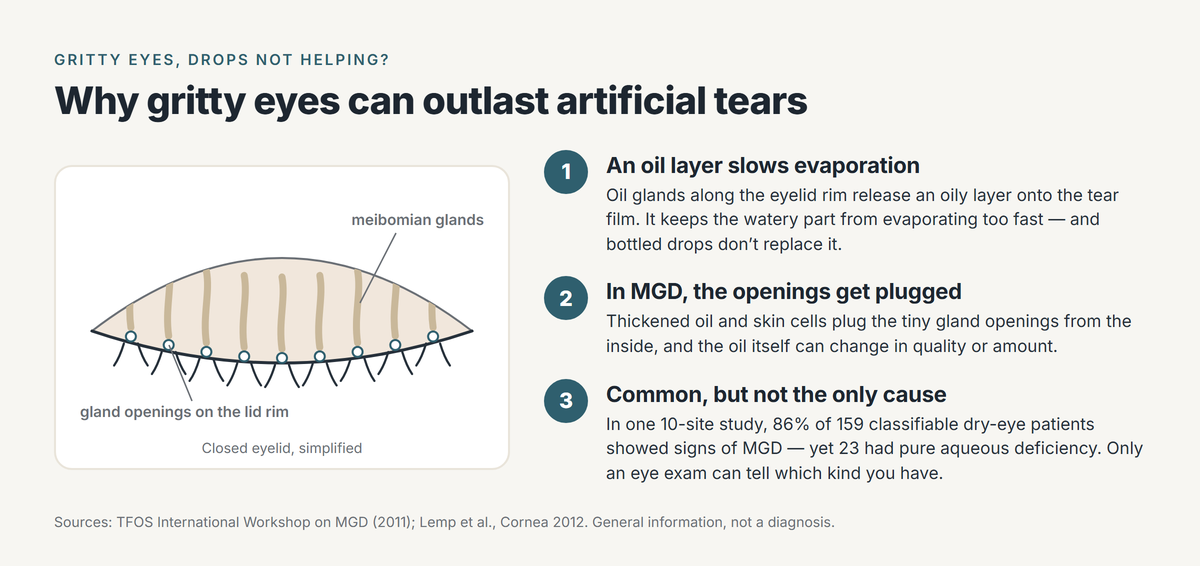
Along the rim of your upper and lower eyelids sit the meibomian glands, which release an oily secretion onto the tear film. That oil slows evaporation. When the glands don’t work well, the watery part of your tears evaporates faster — and adding more water from a bottle doesn’t replace the missing oil.
That is the part of the hook that holds up.
MGD is described by the international TFOS workshop as possibly “the leading cause of dry eye disease throughout the world,” and the 2025 TFOS DEWS III report calls it “a primary contributor.” In one clinic study across 10 sites in Europe and the US, 86% of the 159 dry-eye patients who could be classified showed signs of MGD — 79 with MGD alone and 57 with a mix of MGD and low tear production.
But notice the fine print in that same study.
23 of those 159 patients had pure aqueous deficiency — their eyes simply weren’t making enough tears. No oil-gland problem at all.
MGD is common. It is not the whole story.
Dry eye is multifactorial. Guidelines treat “not enough tears” and “tears evaporating too fast” as two ends of a continuum, and plenty of people have both.
Other causes worth knowing:
- Low tear production, including Sjögren’s disease — about 10% of patients with clinically significant aqueous-deficient dry eye have primary Sjögren’s, according to AAO.
- Medications — diuretics, antihistamines, anticholinergics, antidepressants and isotretinoin can make dry eye worse; antianxiety drugs and oral corticosteroids come up in the research too.
- Preserved eye drops, contact lenses, and eye surgery such as LASIK or cataract surgery.
And one more that surprised me: AAO notes that “some patients with these symptoms may prove to not have dry eye,” and that symptoms and exam findings line up inconsistently.
So “tears don’t work, therefore it’s my oil glands” is a reasonable suspicion.
It is not a diagnosis.
Thickened oil, not “debris”
The popular version says the oil hardens together with debris.
That’s not quite how it’s described clinically.
In MGD, the gland openings get blocked from the inside — by thickened oil and skin cells plugging the tiny gland openings — and the secretion itself can change in quality or amount. It isn’t grime from outside.
Symptoms vary a lot, too. Grittiness, burning or stinging, soreness, light sensitivity, and blurry vision that clears with blinking all show up. Some people get several at once. Others have gland changes on exam and barely notice anything.
For context on how common this is: 6.8% of US adults — about 16.4 million people — have diagnosed dry eye, based on a 2013 survey of 75,000 adults. That rises from 2.7% at ages 18–34 to 18.6% at 75 and older, and it’s higher in women (8.8%) than men (4.5%). Those are diagnosed cases only; symptom-based estimates run higher.
Is putting in more drops part of the problem?
It can be. This is the part of “no matter how many tears you pour in” that deserves a second look.
Most multi-dose artificial tears contain a preservative, often benzalkonium chloride (BAK). TFOS DEWS II notes that preservatives like BAK “may further aggravate” dry eye.
AAO’s 2023 guideline says that when tear substitutes are used frequently and chronically — more than four times a day — preservative-free drops are generally recommended.
AAO’s own consumer page uses a looser line: more than six times a day.
Two sources, two numbers. I’d use the stricter one as a nudge.
If you’re reaching for drops more than about four times a day, that’s a reason to ask about preservative-free — and a reason to get your eyes examined, because needing that many drops is itself a signal.
Photo: Nataliya Vaitkevich / Pexels
Drops also need to be clean
This one isn’t hypothetical.
In the 2023 outbreak linked to EzriCare and Delsam artificial tears, CDC-reported data counted 81 patients in 18 states as of May 15, 2023 — 14 with vision loss, 4 who had an eye removed, and 4 deaths within 30 days of a positive culture. Later that year, in October 2023, FDA warned consumers about 26 over-the-counter eye drop products over insanitary manufacturing conditions; FDA said it had no reports of related eye infections at that time.
FDA’s basic advice is simple:
- Wash your hands before using drops.
- Don’t let the bottle tip touch your eye or any surface.
- Check FDA’s recall list before you buy.
- Stop using drops that cause pain, discharge, discomfort, or a change in vision.
If you also have old bottles hanging around, I went through what “expires after opening” really means for eye drops in medicine expiration after opening.
Does a warm compress for dry eye actually work?
Yes — with conditions attached.
The best-known evidence is small but clear. In a 2003 study of 20 people with MGD, a moist compress held at about 40 °C (104 °F) for 5 minutes raised the thickness of the tear film’s oil layer by more than 80%. The other eye, given a room-temperature compress, didn’t change.
So heat does something real.
It softens thickened oil so it can flow.
I’d avoid the word “melt,” though. You’ll see specific melting-point numbers online. I couldn’t trace one to a solid primary source, so I’m not repeating any. What the research does consistently use is a target: getting the eyelid itself to around 40 °C.
That target is where the popular advice runs into trouble.
The “warm towel for 10 minutes” problem
Here is the finding that changed how I do this.
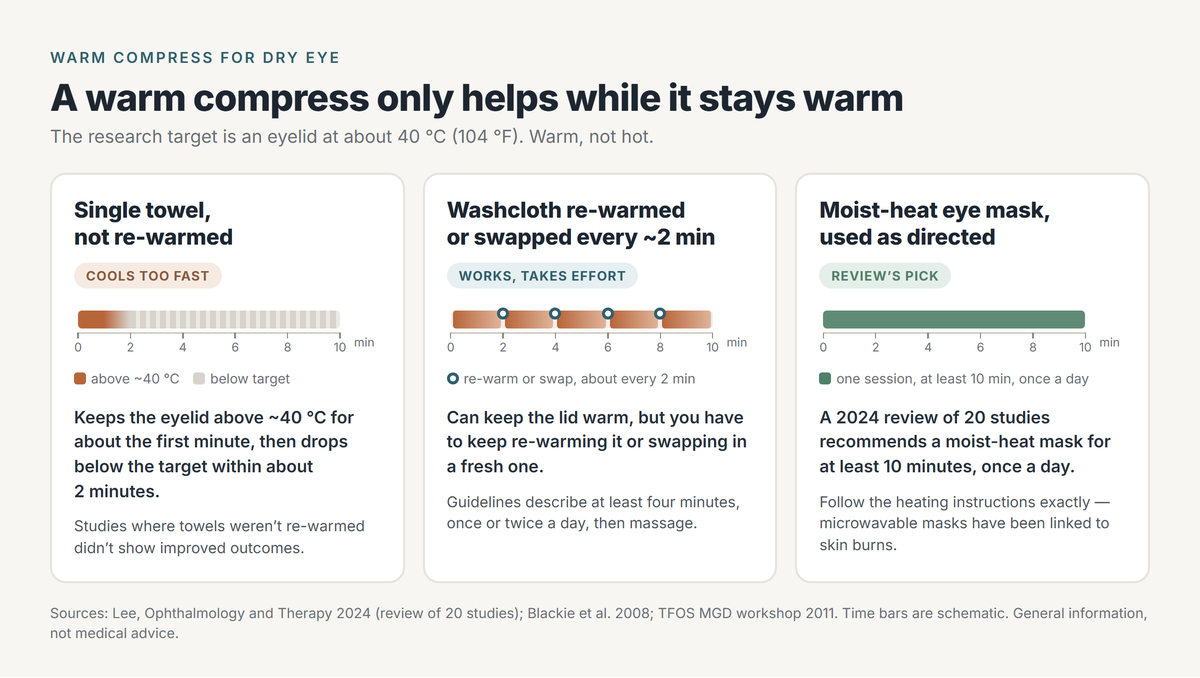
A 2024 review of 20 studies on warm compress therapy found that a hot towel keeps the eyelid above 40 °C for only about the first minute, then drops below the target within about 2 minutes. To work, towels “must be reheated every 2 min.” The review also noted that studies in which towels weren’t reheated didn’t show improved outcomes.
An earlier study makes the same point in numbers. A compress heated to 45 °C (113 °F) and simply left in place, without reheating, never got the inner eyelid past 38.8 °C in the 10 people tested.
So where does “10 minutes” come from?
It comes from that same 2024 review’s recommendation — but for a moist-heat eye mask (microwavable or self-heating), used for at least 10 minutes, once a day. It was never about one towel left to cool on your face.
Guideline durations are actually shorter:
- The TFOS MGD workshop describes warming for a minimum of four minutes, once or twice daily, followed by massage.
- AAO describes “several minutes,” and says once- or twice-daily warm compresses and massage is generally adequate.
No single official number exists. What does exist is a clear principle: the heat has to last.
Warm, not hot
This matters as much as the timing.
Microwaved compresses have caused eyelid burns — there are published case reports, including a second-degree eyelid burn. The 2024 review also notes microwavable masks “have been associated with skin burns.” AAO’s guidance is plain: avoid compresses “so hot that they burn the skin.”
So:
- Follow the mask’s heating instructions exactly. Don’t add extra time.
- Test the temperature before it goes near your eyelids.
- Stop if the skin reddens, stings, or feels too hot.
One more honest note. Heat reaches deeper than the eyelid skin — in one small study of 12 people using compresses swapped every 2 minutes, the cornea itself reached 39.4 °C at the 8-minute mark. A brief blur right after a warm compress is possible. It should clear within minutes.

Photo: Castorly Stock / Pexels
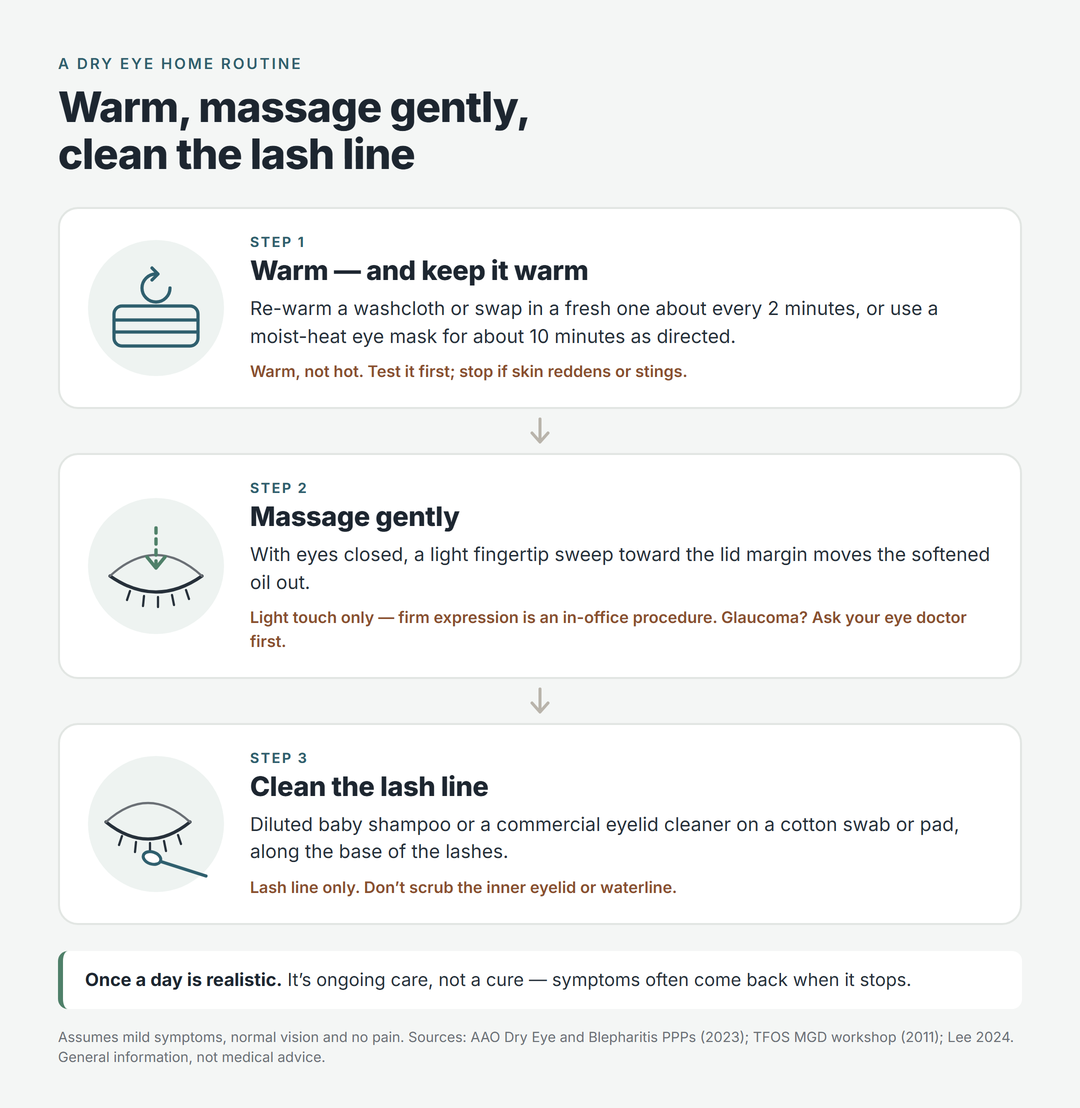
A dry eye home routine: warm, massage gently, clean the lash line
Before the how-to: this is general information, not medical advice. It assumes mild symptoms with normal vision and no pain. If you’re unsure what’s causing your symptoms — or you have glaucoma, recent eye surgery, or an eye infection — check with an eye doctor first.
Step 1 — Warm (and keep it warm)
Pick one:
- A washcloth in warm water, re-warmed or swapped for a fresh one every couple of minutes, for several minutes in total.
- A moist-heat eye mask, used exactly as the instructions say, for about 10 minutes.
Once a day is realistic. In one 4-week study cited in the 2024 review, adherence fell from 91% to 81.6% as sessions per day went up. A routine you actually keep beats a perfect one you drop.
Step 2 — Massage gently. Don’t squeeze.
This is where the hook — “squeeze out the oil” — goes wrong.
Every guideline pairs heat with massage. That’s the step that moves the softened oil out, and it’s missing from a lot of online advice. AAO’s guideline describes vertical eyelid massage to express the secretions: with eyes closed, a light fingertip sweep toward the lid margin.
But “gentle” is doing a lot of work in that sentence.
Firm expression of the glands is an in-office procedure. The TFOS workshop notes that pain rises sharply once force goes above about 15 g/mm² (roughly 5 PSI), and at much higher forces it can be “excruciating.” AAO says expression “must be performed with care,” and that frequent handling of the eyelid can itself cause irritation.
Two groups need extra caution:
- Advanced glaucoma, with or without glaucoma surgery — AAO says these patients should not press on the lids aggressively. If you have glaucoma, ask your eye doctor before starting any lid massage. (If you’re not sure how glaucoma differs from cataract, I covered that in glaucoma vs cataract.)
- Habitual eye-rubbers — heat plus rubbing may contribute to temporary distortion of the cornea.
AAO also notes that lid cleaning or massage can be risky for anyone who lacks the manual dexterity to do it carefully. If that’s an aging parent, it’s worth having an eye doctor show them first.
Step 3 — Clean the lash line
AAO’s guideline describes gently rubbing the base of the eyelashes with diluted baby shampoo or a commercial eyelid cleaner, on a pad, cotton ball, cotton swab, or clean fingertip.
A few honest caveats:
- You don’t need a special cleanser. Diluted baby shampoo is listed as an equal option, and AAO says there isn’t enough evidence that any one option beats the others.
- The evidence for lid cleansers is modest. A 2012 Cochrane review of 34 studies with 2,169 participants found lid hygiene “may provide symptomatic relief,” but “no strong evidence for any of the treatments in terms of curing chronic blepharitis.”
- Stay on the lash line. Don’t scrub the inner surface of the eyelid or the waterline.
- Tea tree products for eyelash mites (Demodex) are something to use only under an eye doctor’s guidance. Evidence is uncertain, and concentrated tea tree oil has injured the cornea.
A couple of other practical notes:
- If you wear contact lenses, ask your eye doctor how to fit this routine around them.
- If you take a medication that might be drying your eyes, don’t stop it on your own — ask the prescriber.
Why “moist again” is the wrong promise
I wanted this to be a fix. It isn’t, and it helps to know that going in.
AAO’s blepharitis guideline puts it plainly: “a cure is usually not possible, but continual daily treatment can significantly improve symptoms,” and “symptoms often recur when treatment is discontinued.” The 2024 review calls warm compresses “palliative rather than curative.”
That isn’t a reason to skip them.
It’s a reason to think of them like brushing your teeth — daily maintenance, not a one-time repair.
What an eye doctor can add when home care isn’t enough
If a consistent routine isn’t helping, that’s useful information, not failure. AAO lists “lack of response to the therapy” as a reason to be seen.
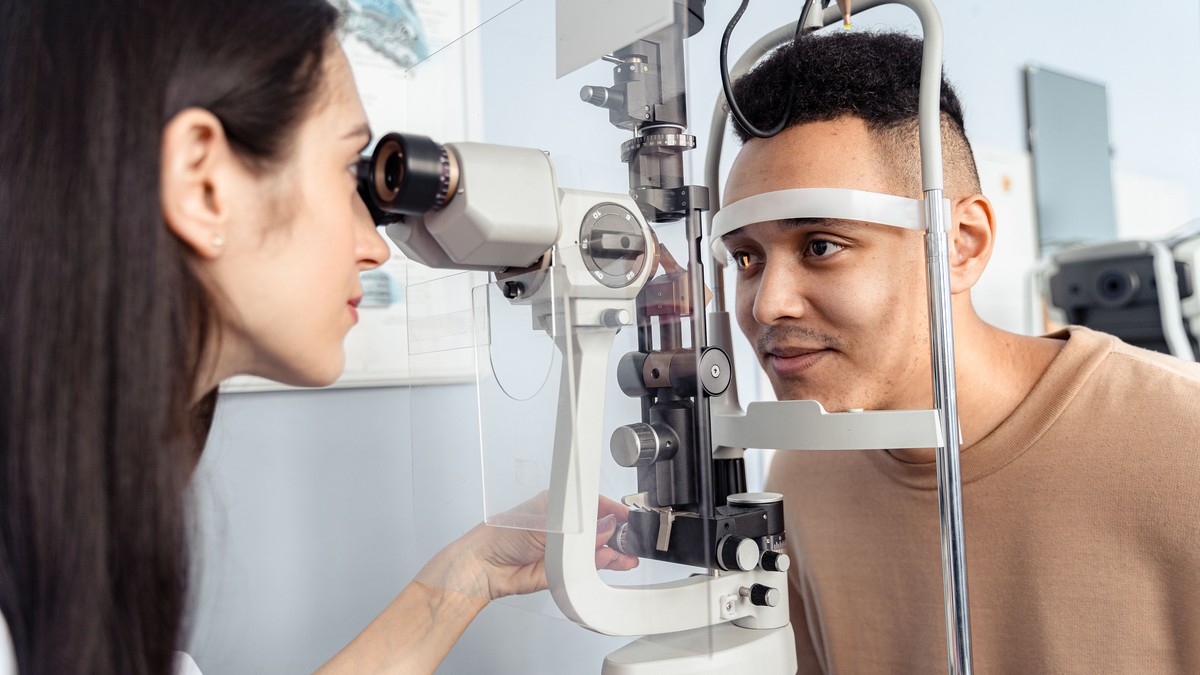
Photo: Antoni Shkraba / Pexels
Options an eye doctor may discuss include:
- Preservative-free drops, overnight ointments, or punctal plugs.
- Prescription anti-inflammatory drops, such as cyclosporine or lifitegrast, or other prescription options.
- In-office heating and gland expression, including thermal pulsation devices, which heat the inner eyelid while protecting the eye. AAO notes that the supporting studies are largely industry-sponsored and that independent head-to-head trials haven’t yet been done.
- Intense pulsed light (IPL) — AAO notes it isn’t covered by insurance, is relatively costly, has to be repeated, and needs caution in darker skin tones.
- Lotilaner 0.25%, a prescription drop for Demodex blepharitis. In a phase 3 trial of 412 patients treated for 6 weeks, 56.0% had their lash collarettes cleared, versus 12.5% on the inactive vehicle drop.
And if you have dry eyes plus a dry mouth, joint pain, or fatigue, mention it. AAO advises a high index of suspicion for Sjögren’s in that combination.
When to see an eye doctor about dry, gritty eyes
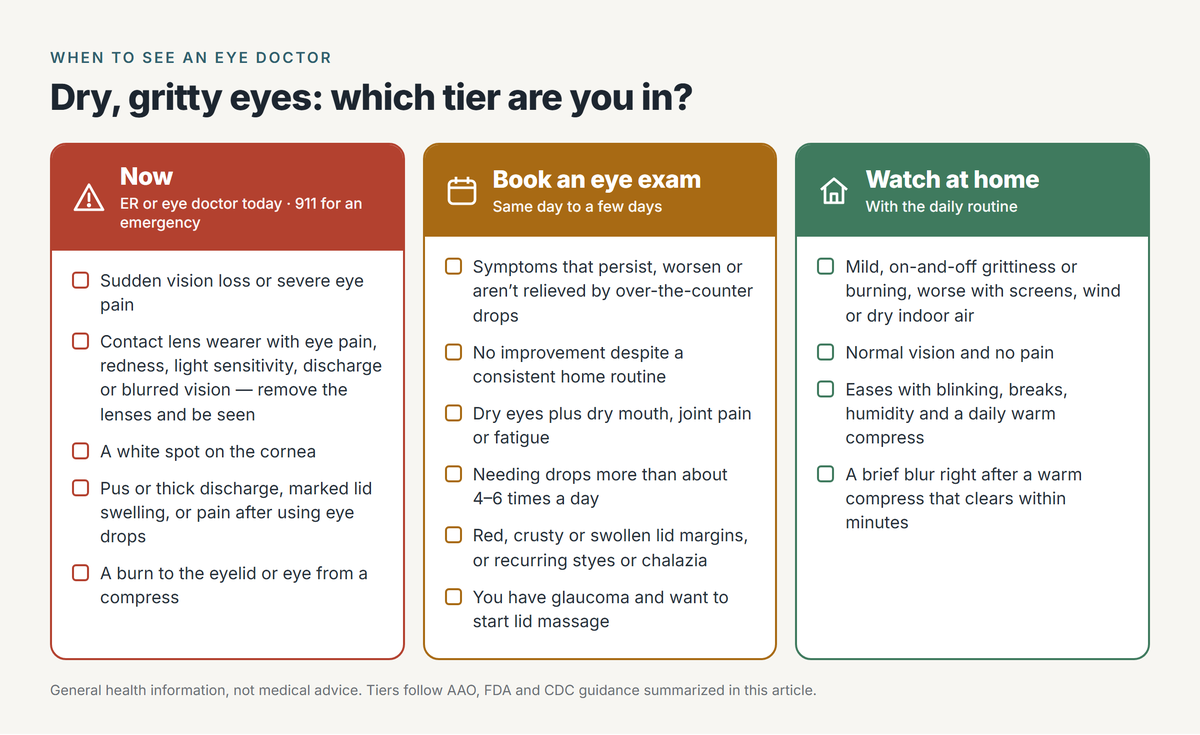
Tier 1 — Go now (ER or an eye doctor the same day; call 911 for an emergency)
- Sudden vision loss or severe eye pain.
- You wear contact lenses and have eye pain, redness, light sensitivity, discharge, or blurred vision. Remove the lenses and be seen right away — this can be a corneal ulcer, which AAO warns can permanently damage vision. A white spot on the cornea is a warning sign.
- Pus or thick discharge, marked eyelid swelling, or pain after using eye drops — especially a recalled product.
- A burn to the eyelid or eye from a compress — blistering, severe pain, or any heat injury to the eye surface.
Tier 2 — Book an eye exam (same day to a few days)
- Symptoms that are persistent, getting worse, affecting daily life, or not relieved by over-the-counter drops.
- No improvement despite a consistent home routine.
- Dry eyes plus dry mouth, joint pain, or fatigue.
- Needing drops more than about 4–6 times a day.
- Red, crusty, or swollen lid margins, flaking at the lashes, or recurring styes or chalazia.
- You started a medication known to dry the eyes, such as antihistamines, antidepressants, isotretinoin, or diuretics.
- You have glaucoma and want to start lid massage.
Tier 3 — Watch at home, with the routine above
- Mild, on-and-off grittiness or burning that’s worse with screens, wind, air conditioning or heating, or long stretches of reading or driving — when you tend to blink less — with normal vision and no pain, and that eases with blinking, breaks, humidity, and a daily warm compress and lid care.
- A brief blur right after a warm compress that clears within minutes.
If you add a humidifier for the “humidity” part, keep it clean — here’s how to clean and disinfect an ultrasonic humidifier. [내부링크: 관련 글 – screen time eye strain and blinking breaks at work]
The one line I’d keep
I still keep artificial tears in my bag. Just one bottle now, preservative-free.
What changed is the order. Warmth that actually stays warm, a light touch instead of a squeeze, a clean lash line — and an eye exam, which is the only thing that can tell you which kind of dry eye you actually have.
If I had to boil it down to one sentence, it would be this:
Warm, gentle, daily — and if it hurts, your vision drops, or you wear contacts and your eye turns red and painful, that’s an eye-doctor problem today, not a compress problem.
The sand doesn’t always go away for good.
But knowing what you’re actually treating makes it a lot easier to live with.
References
- American Academy of Ophthalmology — Dry Eye Syndrome Preferred Practice Pattern, Sept 2023
- American Academy of Ophthalmology — Blepharitis Preferred Practice Pattern, Sept 2023
- AAO EyeSmart — Dry Eye Treatment and Corneal Ulcer (Keratitis)
- TFOS International Workshop on Meibomian Gland Dysfunction — Executive Summary and Management and Treatment report, IOVS 2011
- TFOS DEWS II — Definition and Classification and Iatrogenic reports, 2017; TFOS DEWS III Management and Therapy, 2025
- National Eye Institute — Dry Eye
- Lee G. — Evidence-Based Strategies for Warm Compress Therapy in Meibomian Gland Dysfunction, Ophthalmology and Therapy, 2024
- Olson et al., Eye Contact Lens, 2003; Blackie et al., Optometry and Vision Science, 2008
- Lemp et al., Cornea, 2012; Farrand et al., American Journal of Ophthalmology, 2017
- Cochrane — Interventions for chronic blepharitis, 2012
- Gaddie et al. (Saturn-2 trial), 2023
- FDA — What You Should Know About Eye Drops; EzriCare warning; warning on 26 eye drop products
- Velcani et al. (CDC), Ophthalmology, 2023
- Eyelid burn case reports: Eiseman, 2000; Jones, 2010